Contubernium
Contubernium
A contubernium was a small group of Roman soldiers sharing a campaign tent or barrack accommodation. A common model for the Principate describes eight military personnel. Its association with a decanus is especially explicit in the late antique writer Vegetius, who nevertheless describes ten men under one tent.
A contubernium should not simply be equated with a modern tactical squad. Its members lived and performed domestic tasks together while answering to the century’s command in battle. Barrack archaeology and written accounts belong to different periods and do not always produce the same figures.
Place in the century
In a common model of a Principate legion, ten tent groups of eight men make a century. This describes an organisation, not a guarantee that eighty soldiers were present every day. The centurion, optio, tesserarius, standard-bearer and other personnel helped administer it; specialists should not automatically be counted as additions above the assumed establishment.
Vegetius, II.8 and II.13, calls the tent-group leader a decanus and describes ten men. His late antique account does not prove that eight soldiers of the first and second centuries necessarily had exactly two servants, or that their leader was chosen by a universal procedure. The layout, date and garrison type matter when considering a particular fort.
The contubernium formed a community of daily service but did not replace the cohort and century as levels of command and manoeuvre.
Tent, barrack and shared equipment
The word contubernium could mean both the group of men and the place where they lived. On campaign this was a tent with poles, guy ropes, pegs, repair materials and space for personal belongings; in a permanent fort it was a barrack unit. This double meaning shows how Roman organisation tied space, equipment and group together.
The contubernium was an economic unit. Men of one tent shared part of their equipment: tent, cooking gear, tools, sometimes a pack animal and spare items. Each soldier carried personal gear, but part of the load was distributed within the small group. If the tent, cooking pot, hand mill, pegs or tools were lost, everyone suffered.
In a permanent fort the same principle was reflected in barrack planning. In many forts a barrack block is divided into repeated units: the front part could serve for storage, work, cooking or entry, while the rear room was used for sleeping. The centurion usually had larger rooms at the end of the block, showing the status difference inside one century.
British forts such as Arbeia and Vindolanda are especially useful for understanding this daily life: they show not only wall lines, but also traces of hearths, floors, storage zones, personal objects and repaired equipment. The contubernium was a crowded everyday environment: eight men with weapons, clothing, vessels, supplies and wet tent leather occupied very limited space.
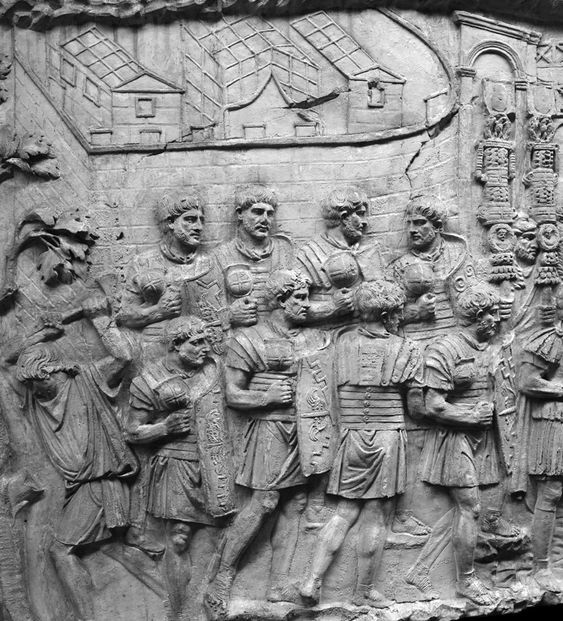 Tents on Trajan’s Column, Rome; early second century CE. Relief evidence for the general outline, not a scaled construction plan.
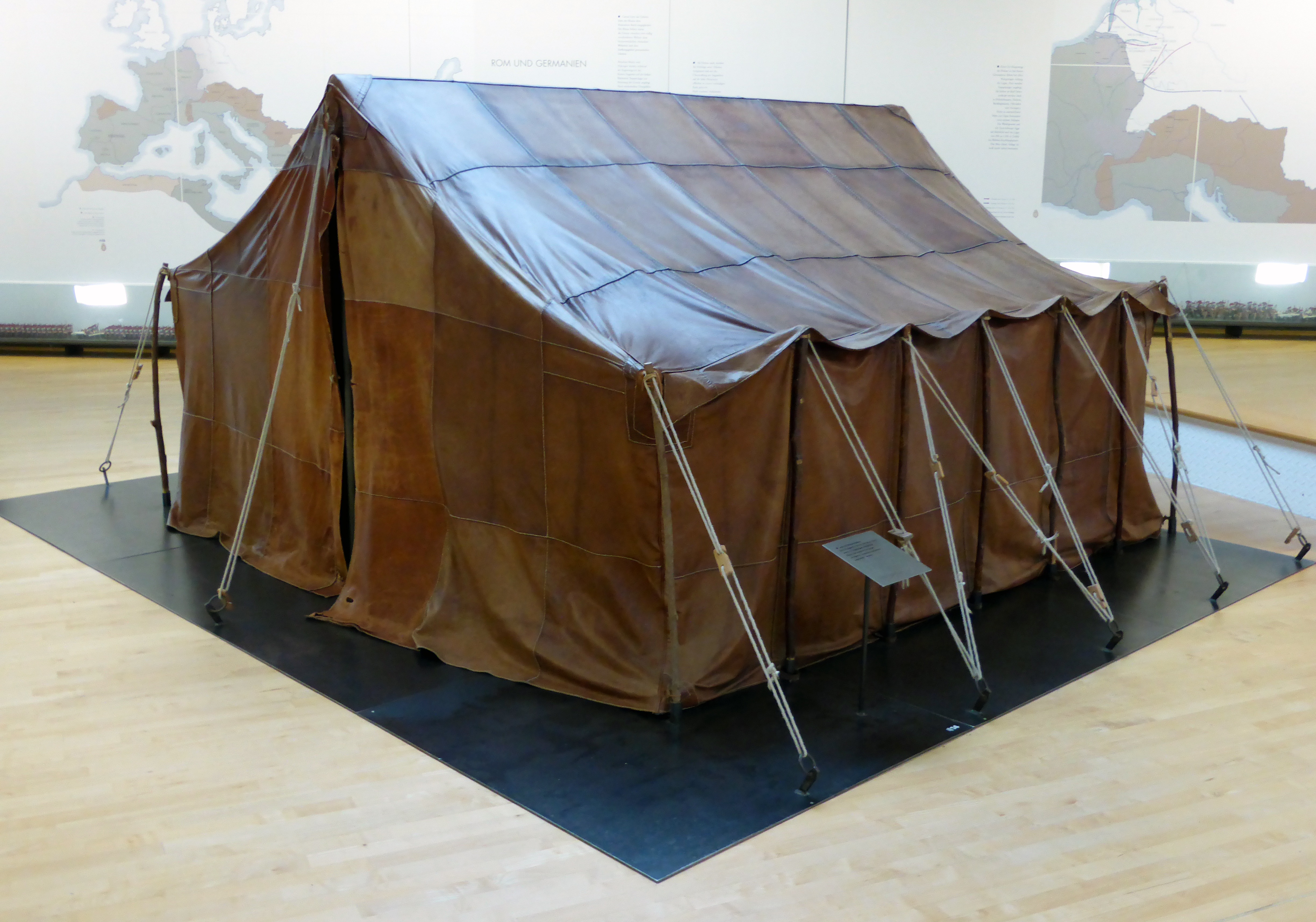 Modern reconstruction of a leather soldiers’ tent. Roman Museum, Haltern.
Daily service and discipline
Daily military life began with simple tasks: receiving grain, grinding it, preparing food, cleaning weapons, drying clothes, pitching or striking the tent, repairing a strap or shoe. Such work was easier to organize by small group than by the whole century at once. The contubernium can therefore be understood as a small household inside the legion.
Within the tent group duties were distributed: who handled fire and water, who watched grain and cooking pot, who carried poles and pegs, who repaired straps, who checked equipment before the march. Shared property bound the men more strongly than an abstract order: it was easier for a commander to call a specific tent group to account, where each man knew his share of the work.
Watches and passwords also connect the contubernium with discipline. The tesserarius transmitted the password, and junior leaders made sure that men knew their turns and did not fail their duty. Inside the tent discipline was not only punishment from above: tent-mates depended on one another, because one man's negligence could cost the others sleep, food, dry shelter or safety.
 Tent pegs attributed to 80–100 CE. Trimontium Museum.
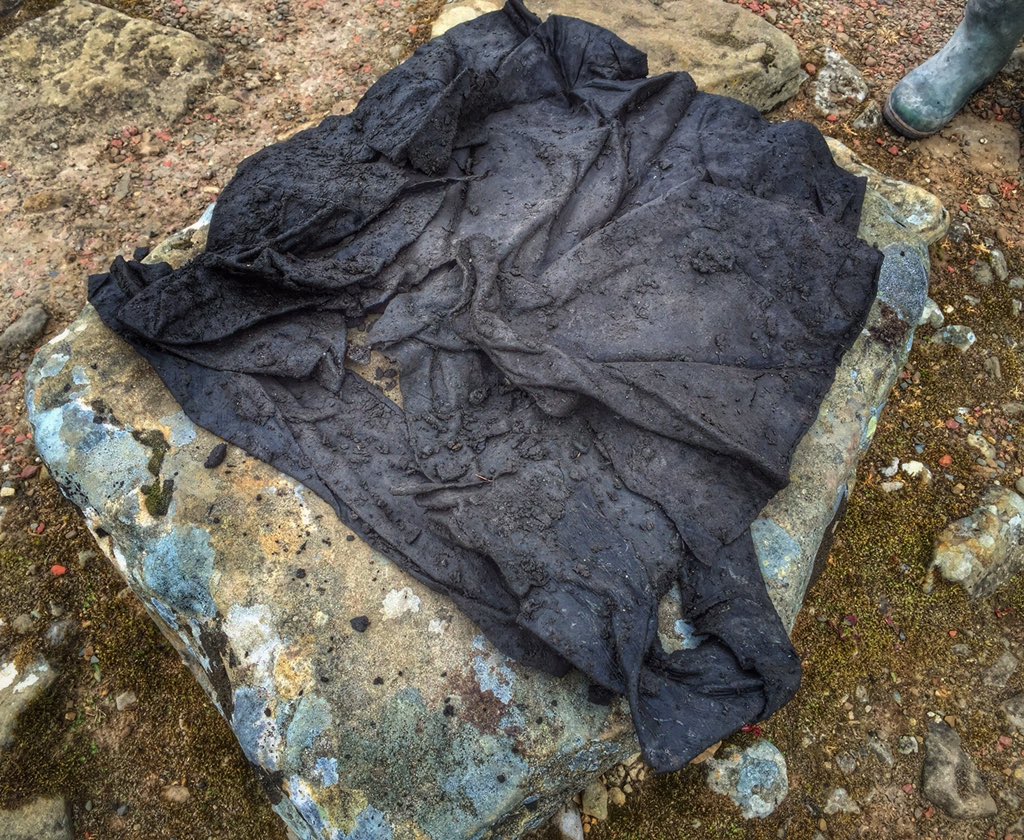 Roman leather tent fragment from Vindolanda; first–second century CE. Vindolanda Museum.
Related topics
Legion, Century, Cohort, Decanus, Roman tent, Tesserarius
Literature and sources
- Polybius. Histories, book VI.
- Adrian Goldsworthy. The Complete Roman Army.
- M. C. Bishop. Handbook to Roman Legionary Fortresses.
- Pseudo-Hyginus. De munitionibus castrorum.
- Vegetius. Epitoma rei militaris.
- Anne Johnson. Roman Forts of the 1st and 2nd Centuries AD in Britain and the German Provinces.
- Jonathan P. Roth. The Logistics of the Roman Army at War.
- Arbeia: reconstruction of the third-century barrack.
- Vegetius, II.8 and II.13: decanus and tent group.
Interested in Ancient Rome beyond reading? Join Legio X Fretensis or explore our reenactment directions.


