Discriminale
A hairpin is a pointed shaft used to hold strands and secure a hairstyle. Roman collections contain plain bone and metal examples as well as pins with decorated heads. Ancient terms for hair accessories, including the Latin discriminale, do not always correspond precisely to modern museum classifications.
A hairpin should be distinguished from a dress pin and a fibula. Similar appearance does not establish an identical function; shape, length, wear and archaeological context help with identification.
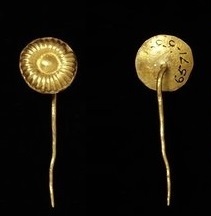 Roman gold pin or hair ornament with a flower-shaped head. Victoria and Albert Museum, London; inv. 571-1855. First–fourth century CE.
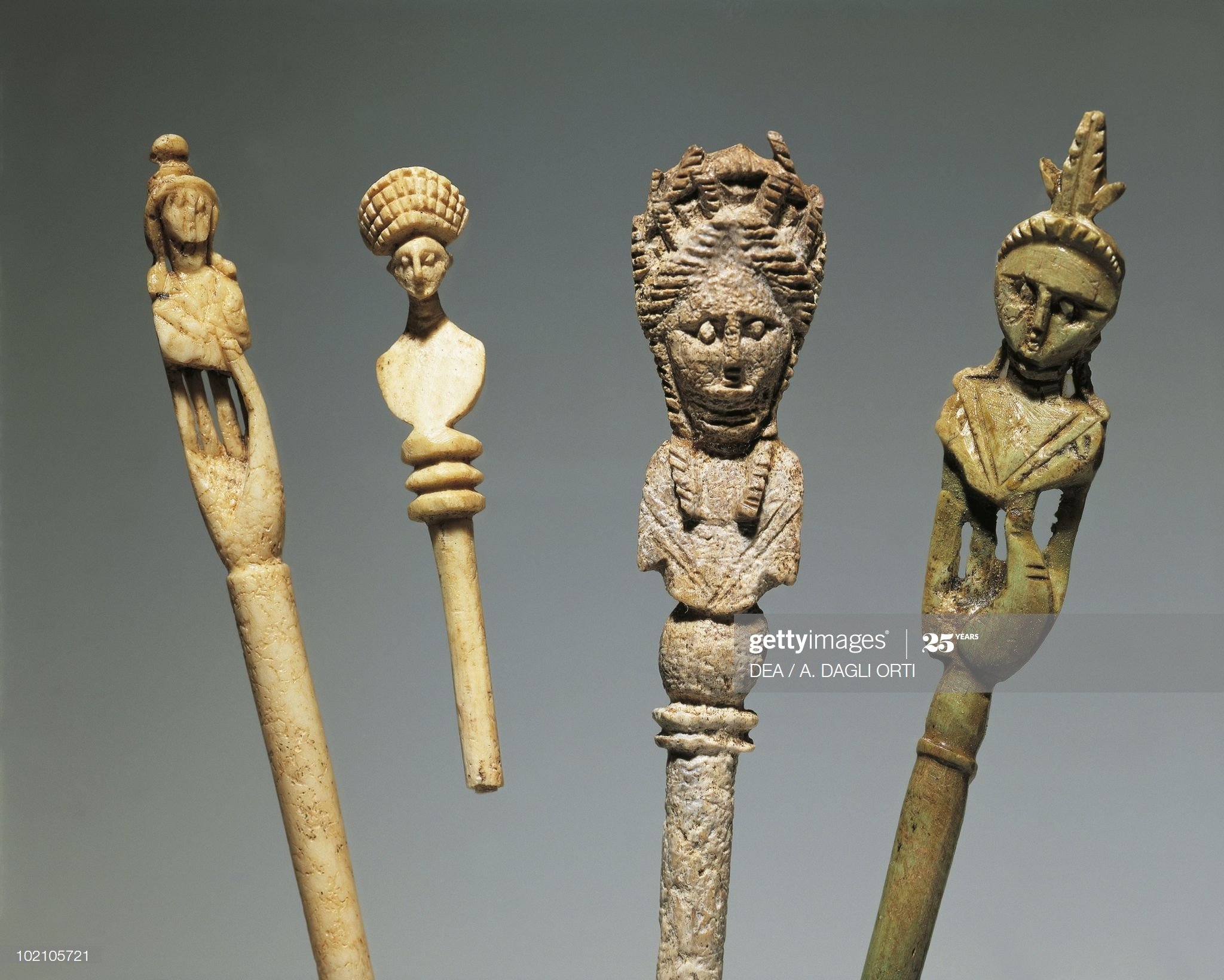 Hairpins, first century CE; Zadar, Croatia.
Form and Use
Heads could be rounded, carved or figural. British Museum OA.245, a bone hairpin dated to the late first century CE, has a female bust with an elaborate hairstyle as its head. It demonstrates that a bone object could receive careful decoration.
Material and ornament alone do not determine the owner's social position; find context and associated objects are also needed. A hairstyle carved on the head does not necessarily reproduce that of the woman who used the pin.
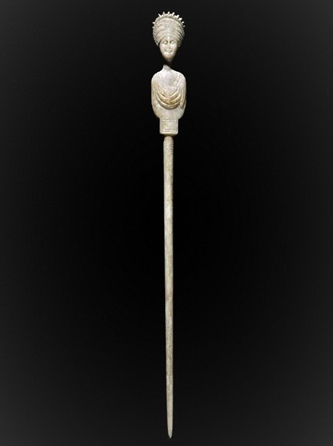 Roman bone hairpin, Flavian period, first century CE; London.
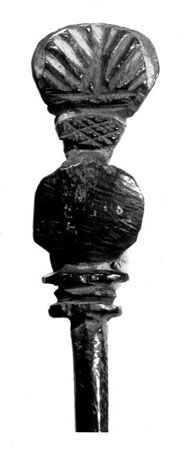 Roman hairpin, Flavian period, first century CE; Trimontium.
Materials and Reconstruction
A replica needs attention to shaft length, thickness and surface as well as decoration. It should stay in the chosen hairstyle without snagging hair or exposing sharp burrs. Modern practical testing does not itself prove an ancient styling method.
Compare the replica with a specific museum find and a dated depiction of a hairstyle. If the original object's function is disputed, that uncertainty should also appear in the reconstruction's description.
Related topics
Literature and sources
- L. Allason-Jones. Women in Roman Britain.
- A. T. Croom. Roman Clothing and Fashion.
- Bone hairpin OA.245: British Museum.
Interested in Ancient Rome beyond reading? Join Legio X Fretensis or explore our reenactment directions.


