Dolabra
The dolabra was an iron tool for cutting and digging. In Roman military contexts the name commonly refers to a combined head with a cutting blade and an opposed pick-like end, mounted on a wooden handle. It belongs primarily to camp construction and obstacle clearance, rather than standard combat armament.
 Iron dolabra head labelled as a find from Austria, first–second century CE. The recorded surviving length is 515 mm, not the overall length with a handle.
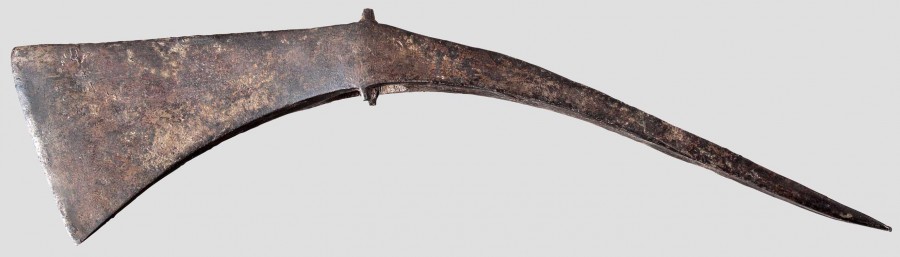 Iron dolabra head labelled as a find from Austria, first–second century CE; another view. Surviving length: 515 mm.
At a glance
The cutting side suited timber and roots, while the pick-like end loosened hard ground. Its capabilities depended on the head’s shape and weight. A dolabra complemented saws, shovels, baskets and other tools; it did not replace an entire engineering toolkit.
Shape and construction
The Latin name covered related cutting and digging tools. Archaeological heads are described through blade arrangement, shaft socket and working wear, rather than assigned to one supposed army model. Wooden handles survive less often than iron parts, so their length and mounting frequently require reconstruction.
Dolabra in camp work
Camp building involved clearing ground, digging a ditch, raising a rampart and preparing timber. The dolabra helped with some of these tasks, but the scale of the defences and division of labour depended on circumstances. Collective construction was an important part of a legionary’s service alongside combat training.
Carrying and the soldier's kit
Josephus, in The Jewish War (III.5.5), lists tools and provisions among Roman infantry marching equipment. This is a literary account of a first-century CE army, not a universal issue list for all Roman periods. It does not establish the number of dolabrae in each contubernium or one method of transporting every tool.
Sheaths and safety
Metal fittings identified as dolabra sheaths illustrate ways to cover a cutting edge during transport. Shape, perforations and compatibility with the proposed blade matter for each example. Leather linings and straps may not survive; their reconstruction must be distinguished from the surviving metal. Elaborate decoration alone does not establish a ceremonial function.
 Bronze fitting identified as a dolabra sheath, reported from Macedonia; first–third century CE. 9.9 × 5.6 cm, approximately 2 mm thick.
 Bronze fitting identified as a dolabra sheath, reported from Macedonia; first–third century CE. Another view.
 Decorated bronze fitting identified as a dolabra sheath. LVR-LandesMuseum Bonn; first–third century CE.
Siege, roads and demolition
Working tools were needed for roads, sieges and obstacle removal. A pick-like end could loosen ground and help break barriers, while the cutting side worked timber. Specific uses require literary or archaeological evidence; a list of possible tasks is not proof that one object performed all of them.
Emergency weapon
Tacitus (Annals III.46) reports the use of axes and dolabrae against heavily armoured crupellarii during the revolt of 21 CE. This is evidence of tools used in a combat emergency, not of a distinct troop type normally armed with battle dolabrae.
Iconography and finds
Iron heads and protective fittings allow comparisons between finds. Construction scenes on Trajan’s Column provide additional context, but reliefs do not give exact dimensions or always permit a secure identification of each tool. A modern replica cannot substitute for evidence about an ancient original.
Scale and working wear
Comparisons take account of head weight, blade preservation, deformation and repairs. The length of surviving iron is not the overall length of a hafted tool. Reconstruction should follow a specific example and identify restored components explicitly.
Related topics
Legionary, Legion, Castrum, Contubernium, Ancient military campaigns, Situla, Pilum, Crupellarius
Literature and sources
- Josephus. The Jewish War, III.5.
- Tacitus. Annals, III.46.
- M. C. Bishop, J. C. N. Coulston. Roman Military Equipment. 2nd ed., 2006.
- Jonathan P. Roth. The Logistics of the Roman Army at War. 1999.


 Construction work on Trajan’s Column, Rome; early second century CE. Identifying each small tool from the relief requires caution.
Interested in Ancient Rome beyond reading? Join Legio X Fretensis or explore our reenactment directions.


