Tropaeum Traiani
The Tropaeum Traiani (Latin Tropaeum Trajani) is a monument built in 109 AD to commemorate the victory of the Roman Emperor Trajan over the Dacians in 102 AD at the Battle of Adamklisi. It was located in the Roman province of Moesia (now Adamklisi,Romania). The monument was erected on the site where the XXI Swift Legion was defeated in 92. Before its construction,there was an altar on the walls of which were written the names of 3,000 legionaries and auxiliaries who died "in the battle for the Republic."
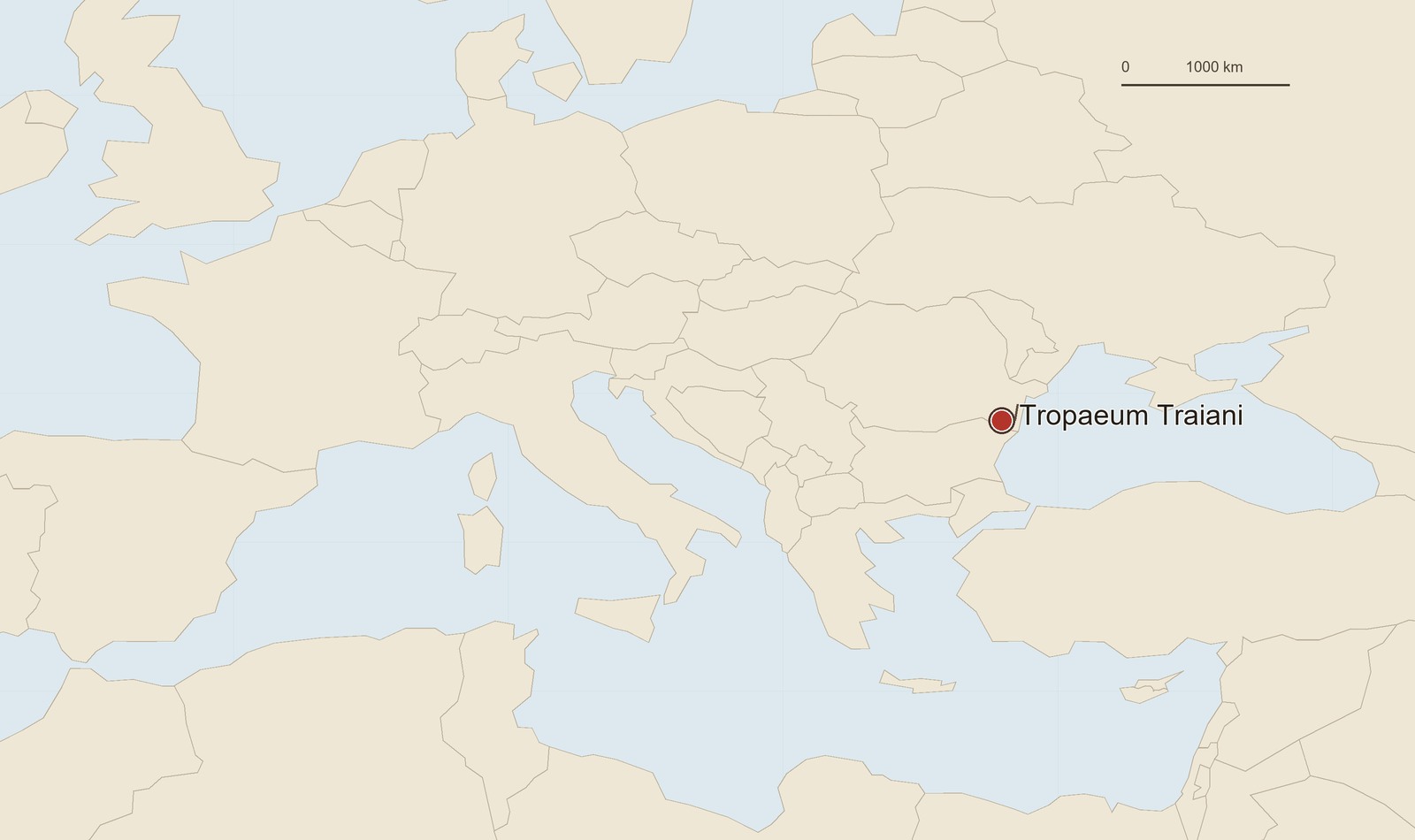 Location map: Tropaeum Traiani. The marker shows the ancient site or main archaeological complex.
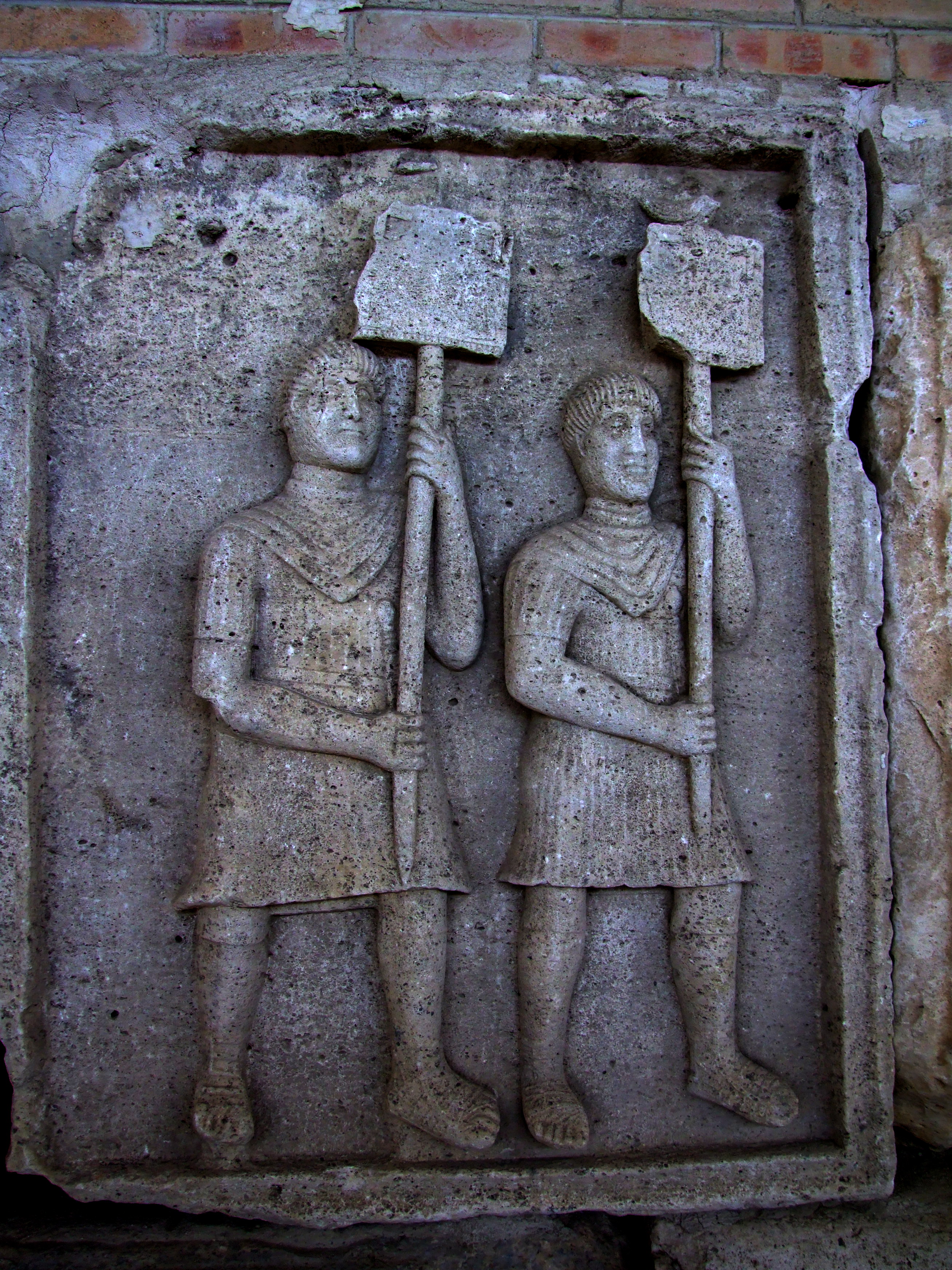
Trajan's monument was inspired by the Mausoleum of Augustus and dedicated to Mars. Its 54 metopes depicted Roman legions fighting their enemies. Most of these reliefs (48 of the 54) are now in the nearby museum, while one is in Istanbul. The monument was intended as a warning to peoples living near the recently conquered province. The structure seen today is a reconstruction completed in 1977; the metopes displayed in the museum are originals.
 The trophy of Trajan. Reconstruction
 The trophy of Trajan. Diagram of the original remains and reconstruction
 The trophy of Trajan. Reconstruction
The monument was built far from the main routes of European travelers,so it was rediscovered only in the nineteenth century. Over the past centuries,the monument has been heavily destroyed,in particular,farmers from nearby villages used parts of the monument to build houses. At the end of the 19th century,the Bucharest archaeologist Grigori Tocilescu (1850-1909),together with two Austrian scientists,published the first work on the monument. It dealt with a number of stylistic and historical issues,such as the dating and chronological order of events related to the construction of the monument. The monument itself has the following inscription: MARTI ULTOR[I] IM[P(erator)CAES]AR DIVI NERVA[E] F(ILIUS) N[E]RVA TRA]IANUS [AUG(USTUS) GERM(ANICUS)] DAC]I[CU]S PONT(IFEX) MAX(IMUS) TRIB(UNICIA) POTEST(ATE) XIII IMP(ERATOR) VI CO(N)S(UL) V P(ater) P(atriae)?VICTO EXERC]ITU D[ACORUM]?---- ET SARMATA]RUM ----]E. Translation: To Mars Ultor,Caesar the Emperor,son of the divine Nerva,Nerva Trajan Augustus,Germanicus, Dacicus, chief pontiff, holding tribunician power for the 13th time,[proclaimed] By the Emperor [army] for the sixth time,Consul for the fifth time,Father of the Fatherland,Victor of the Dacian and Sarmatian armies...
Archaeological context
The metopes of Tropaeum Traiani are useful for studying images of warriors and prisoners, but they require comparison with Lower Danube archaeology, Roman forts and imperial visual monuments. See Archaeology and museums.
Related topics
Marcus Ulpius Nerva Trajan,Trajan's Column
Literature and sources
- The Tropaeum Traiani // Topsel-Uzh. - M.: Sovetskaya entsiklopediya,1956. - p. 298. - (Bolshaya sovetskaya entsiklopediya: [in 51 volumes] / ch. ed. by B. A. Vvedensky; 1949-1958,vol. 43). - Florea Bobu Florescu,Das Siegesdenkmal von Adamklissi. Tropaeum Traiani. Akademieverlag,Bukarest 1965. - Wilhelm Jänecke,Die ursprüngliche Gestalt des Tropaion von Adamklissi. Winter,Heidelberg 1919. - Adrian V. Rădulescu,Das Siegesdenkmal von Adamklissi. Konstanza 1972 und öfter. - Ian A. Richmond: Adamklissi,en Papers of the British School at Rome 35,1967,p. 29-39. Lino Rossi,A Synoptic Outlook of Adamklissi Metopes and Trajan’s Column Frieze. Factual and Fanciful Topics Revisited,en Athenaeum 85,1997,p. 471—486. - Das Tropaion von Adamklissi und provinzialrömische Kunst. Von Adolf Furtwängler (München,Verlag der K. Akademie,1903),by Adolf Furtwängler Das - Tropaion von Adamklissi und provinzialromische Kunst: Furtwängler,Adolf,1853-1907 - Florea Bobu Florescu,Das Siegesdenkmal von Adamklissi. Tropaeum Traiani. Akademieverlag,Bukarest 1965. - Wilhelm Jänecke,Die ursprüngliche Gestalt des Tropaion von Adamklissi. Winter,Heidelberg 1919. - Adrian V. Rădulescu,Das Siegesdenkmal von Adamklissi. Konstanza 1972 und öfter.
Trajan's Metopes
 1
 2
 3
 4
 5
 6
 7
 8
 9
 10
 11
 12
 13
 14
 15
 16
 17
 18
 19
 20
 21
 22
 23
 24
 25
 26
 27
 28
 30
 31
 32
 33
 34
 35
 35
 36
 37
 38
 39
 40
 41
 42
 43
 44
 46
Prisoners of war


Interested in Ancient Rome beyond reading? Join Legio X Fretensis or explore our reenactment directions.


