Popina
Popina (Latin popina) was an ancient Roman drinking establishment where wine and simple food were served: olives, bread, hot dishes and snacks. Unlike the caupona, a popina was not an inn and did not provide lodging, so in written tradition it often had a less respectable reputation.
Clients of such places could include craftsmen, traders, labourers, slaves, freedmen, travellers and inhabitants of crowded insulae. Wealthy households could prepare food at home, but in a dense urban setting small drinking and eating establishments were part of ordinary daily life.
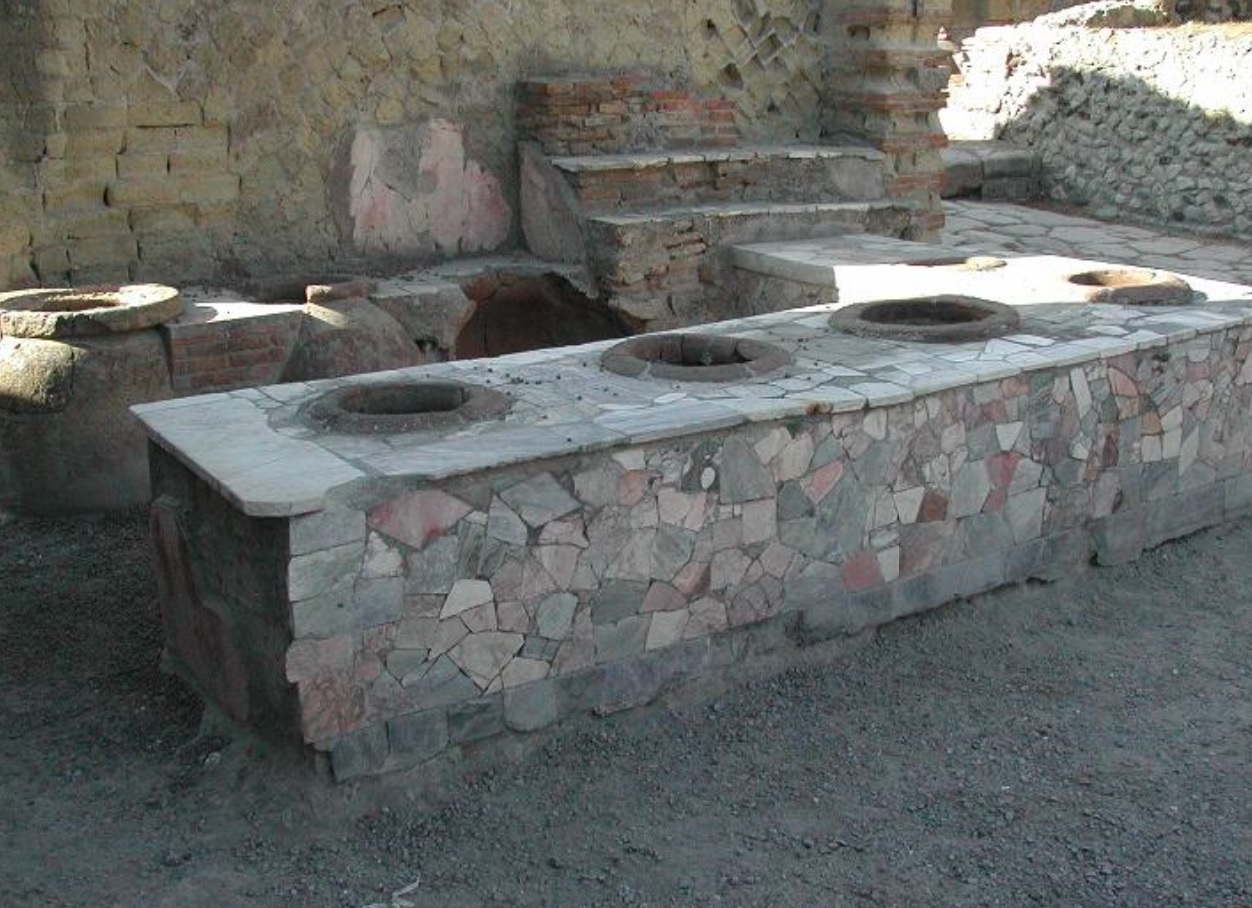 Drinking establishment in Pompeii
Popina and urban life
The popina was part of urban infrastructure alongside shops, workshops, street trade and housing. A person could drink, eat quickly, meet acquaintances, hear news and spend time away from home there. For people without a spacious kitchen or private dining room, such an establishment was a practical element of city life.
The popina shows Rome not as the ceremonial capital of senators, but as a city of craftsmen, tenants, slaves, freedmen and passers-by. Food, drink, work and social contact in such places belonged to the rhythm of the street: a front entrance, neighbourhood noise, quick service and constant mixing of social groups.
Food, wine and reputation
The social reputation of the popina was ambiguous. Roman authors often associated such places with noise, wine, songs, fights, low status and questionable entertainment. Such judgements reflect not only real features of the establishments, but also elite attitudes toward the urban habits of lower-status groups.
Women could work in popinae as barmaids, servants or proprietors. Inscriptions from Pompeii and literary testimony show that such roles sometimes overlapped with prostitution. The popina was therefore not only a place for food and wine, but also a space of social contact, risk and moral accusation.
Popina, thermopolium and caupona
The popina is easily confused with the thermopolium because both kinds of establishment are linked with food and drink. A thermopolium is more often described through a counter, dolia and the sale of prepared food, while a popina is more strongly associated with drinking, socializing and a less prestigious urban setting. The caupona, by contrast, was closer to an inn and could provide lodging.
The boundaries between the terms are not always strict. In cities such as Pompeii and Ostia one room could combine food sale, wine, trade and service to people from the street. The important clues are therefore not only names, but features: counter, vessels, hearth, street entrance, neighbouring rooms and connection with a residential block.
Archaeological context
Such establishments are best known from Pompeii, Herculaneum and Ostia, where counters, rooms, traces of food preparation and urban layout survive. An archaeological space is not always easy to name with one word: shop, thermopolium, caupona and popina could overlap in function, and later classification depends on the set of features.
Material traces show how the establishment worked within the city fabric. A street entrance connects it with passers-by and neighbouring shops; counter and vessels point to the sale of food or drink; hearths and working areas show food preparation; adjoining rooms may indicate storage, residence or a mixed function.
Related topics
Literature and sources
- Ray Laurence. Roman Pompeii: Space and Society.
- Steven J. R. Ellis. The Roman Retail Revolution: The Socio-Economic World of the Taberna.
- Andrew Wallace-Hadrill. Houses and Society in Pompeii and Herculaneum.
- Allison E. Cooley, M. G. L. Cooley. Pompeii and Herculaneum: A Sourcebook.
Interested in Ancient Rome beyond reading? Join Legio X Fretensis or explore our reenactment directions.


