Strophium
Strophium is a term used for a female breast band in descriptions of ancient dress. Its function can be compared with supportive underwear, but it did not have the cups and elastic components of a modern bra.
Women wearing breast bands appear in athletic and other scenes. Such images do not establish that the garment belonged exclusively to unmarried girls or was worn by every female gladiator. Ancient terminology also includes mamillare and other words for bands; these cannot be divided into fixed types solely by how tightly they compressed the breasts. Martial mentions a mamillare in Epigram 14.66.
Visual and reconstruction guide
An image can show the position and visible width of a breast band, but not always its material or knot. A familiar example is the mosaic of women exercising at the villa near Piazza Armerina. The represented outfit should not automatically be treated as everyday clothing for all Roman women.
| Feature | How to read the image | Practical choice |
|---|---|---|
|
Width |
In images it usually reads as a relatively narrow band, not as a modern bra. |
Do not add modern cups, fasteners or elastic details. |
|
Material |
Exact fabrics are rarely visible; soft woven materials are plausible. |
Linen or wool is more convincing than modern synthetics. |
|
Tying |
Images often show the front of the body, so the knot is often a reconstruction hypothesis. |
Label what comes from the source and what is a practical wearing solution. |
Choosing the dimensions
- A simple woven band is a reconstruction option, not a surviving universal pattern.
- Choose width and length for the wearer and the number of wraps.
- Check freedom of movement and stability without excessive compression.
- Modern additions needed for a performance should not be presented as ancient details.
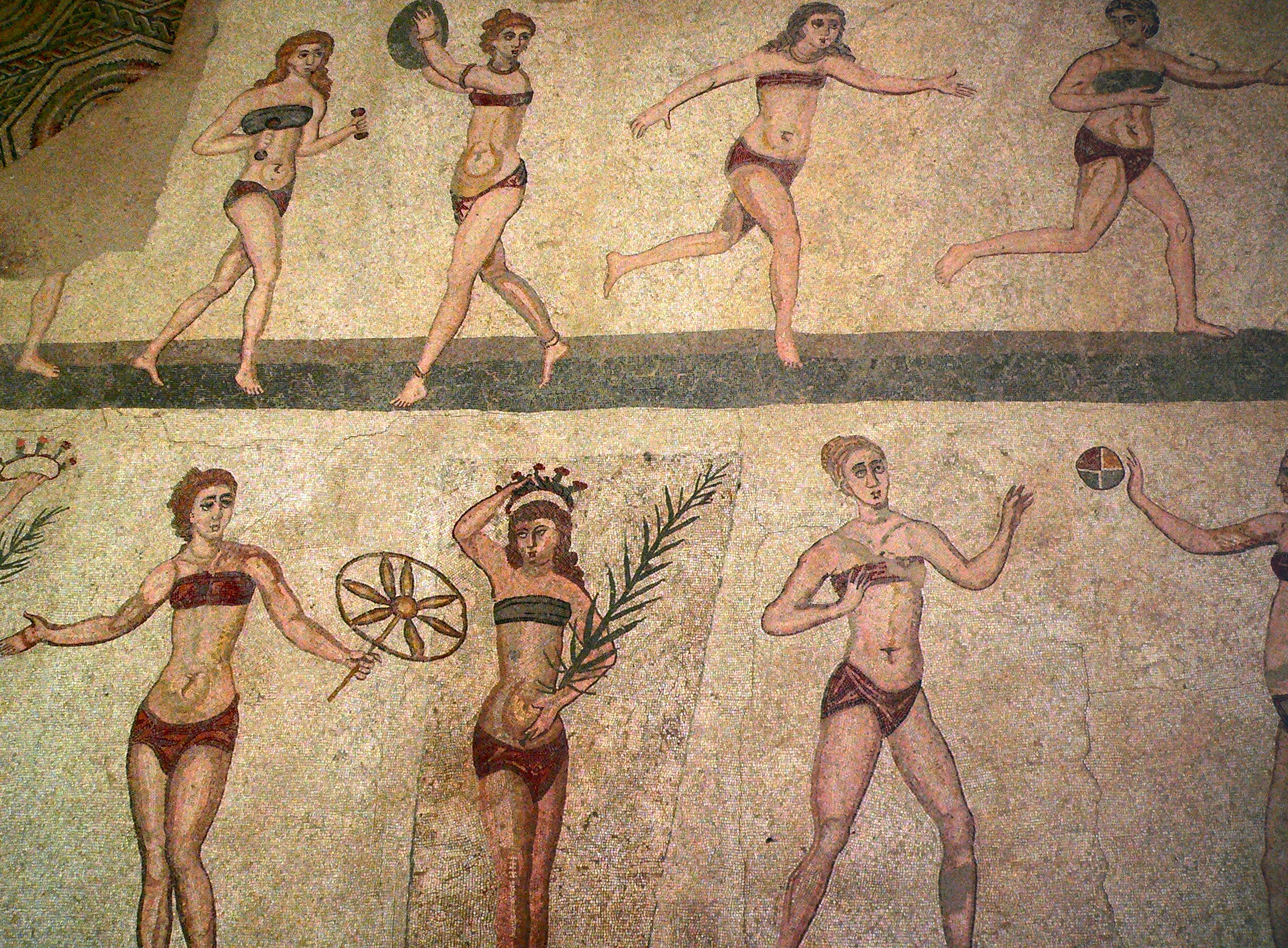 Mosaic showing women exercising in breast bands and brief garments. Villa Romana del Casale near Piazza Armerina, Sicily; fourth century CE.
Reconstruction
Soft cloth with finished edges suits a trial model. A linen or fine wool band can be a practical choice; distinguish its fibre and fastening from details actually visible in the source. Dimensions around 3 m by 20–30 cm are a possible modern starting point, not an ancient standard.
Test the band while moving the arms and torso. The knot must not chafe or interfere with outer clothing. A leather version needs its own justification: Martial’s mention of leather does not establish its use in every athletic image.
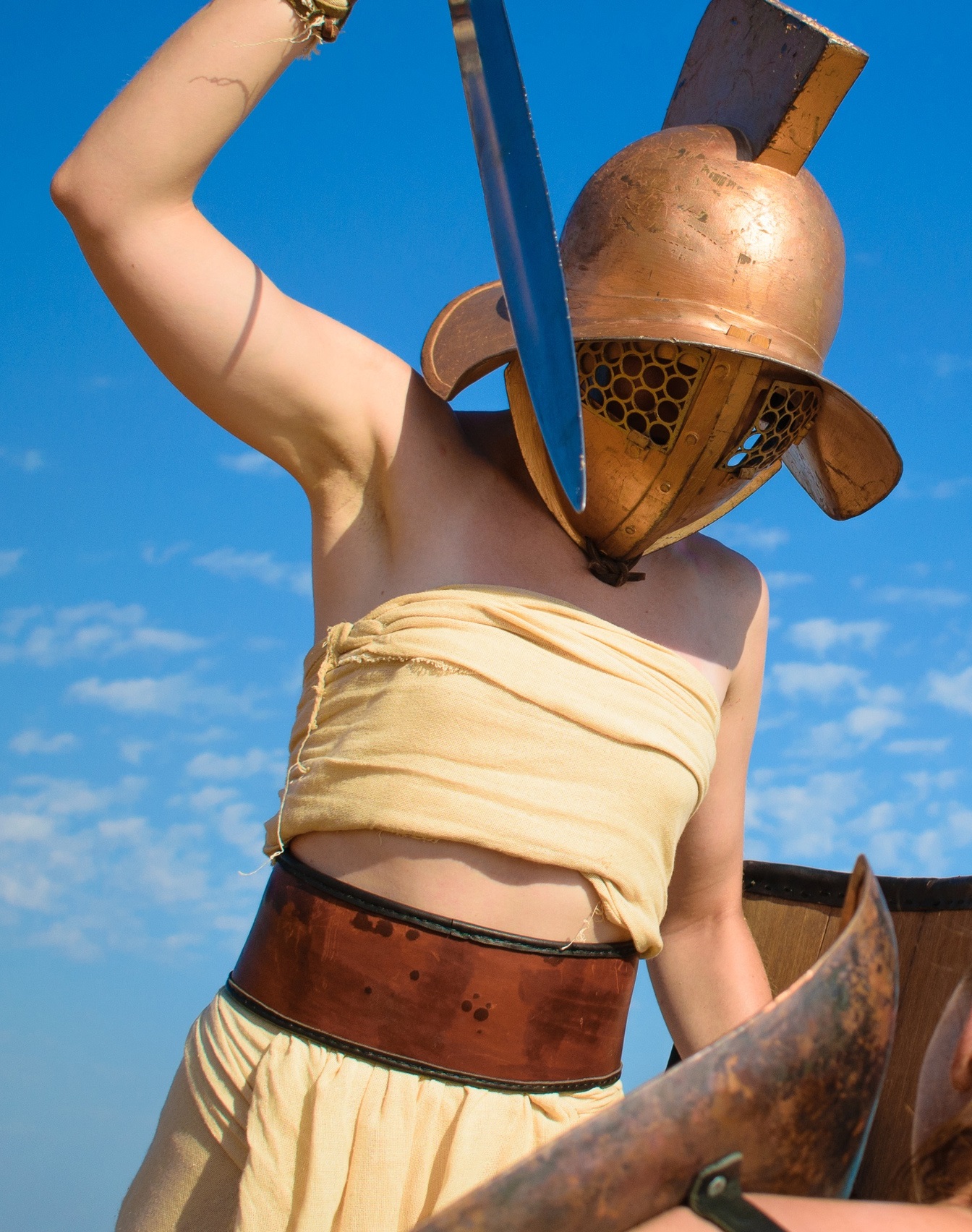 Modern reconstruction of a female gladiator wearing a breast band; its use in this setting is interpretative.
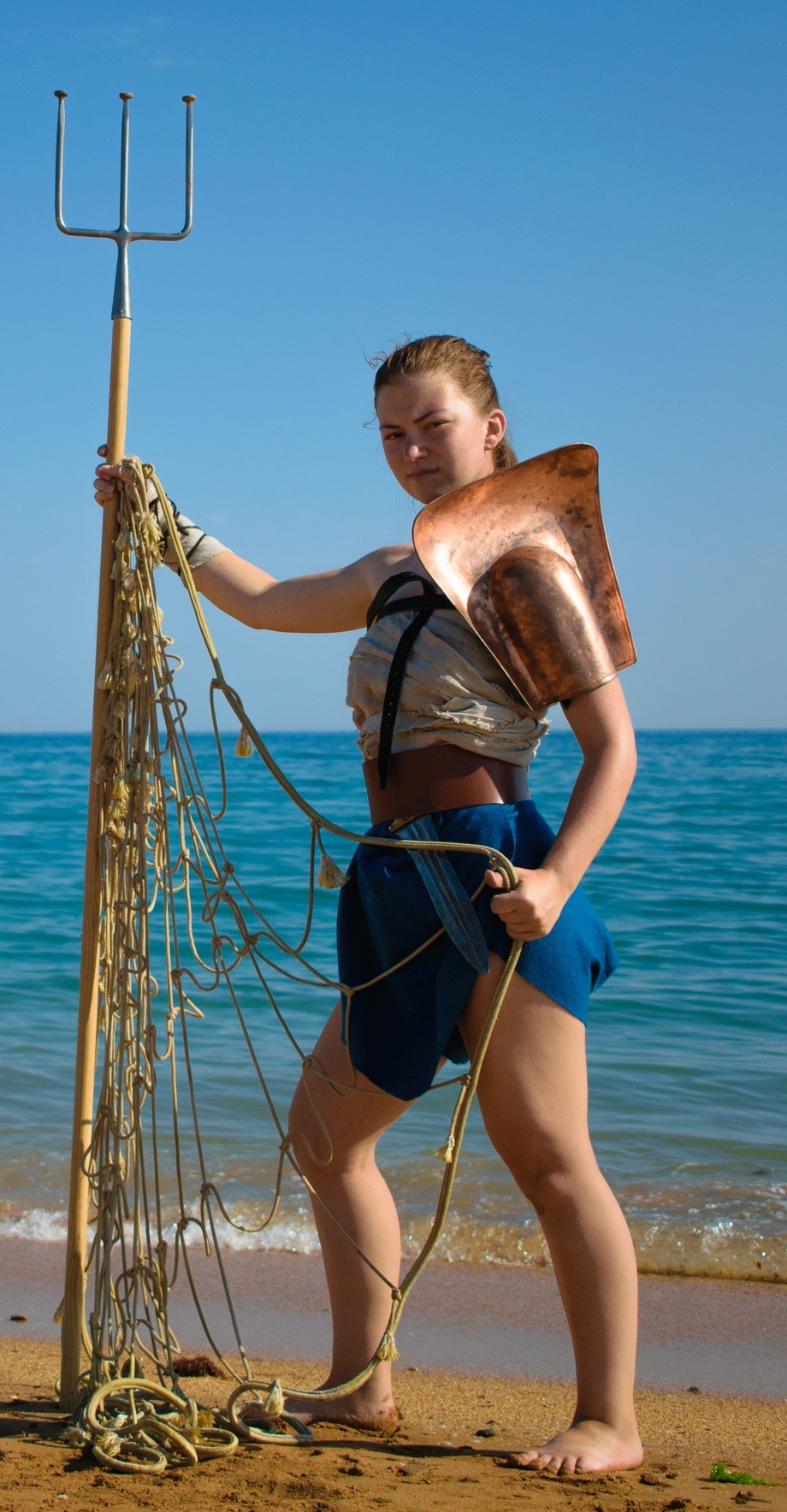 Modern reconstruction of a female gladiator wearing a breast band; its use in this setting is interpretative.
 Modern reconstruction of a breast band with a proposed tying method.
Related topics
Women in ancient Rome · Subligaculum · Female gladiators · Roman clothing
Literature and sources
- Martial. Epigrams, 14.66 (mamillare) and 14.134 (breast band).
- Kelly Olson. Dress and the Roman Woman. Routledge, 2008.
Interested in Ancient Rome beyond reading? Join Legio X Fretensis or explore our reenactment directions.


