Tesserarius
A tesserarius (from Latin tessera, a tablet or token) was a principalis of the Roman army associated with transmitting the watchword and guard duty. In a normal century he is considered among the centurion’s assistants. The appointment is commonly placed in the pay-and-a-half category, but this should not be treated as an unchanging rule for every period.
Polybius, VI.34, describes a man from the tenth maniple who receives a wooden watchword tablet and passes it along a prescribed route. He does not call the man a tesserarius or say that his appointment lasted only one night. This is evidence for a Republican procedure, not a complete account of an imperial establishment.
The imperial appointment is directly attested: the Ilkley tombstone of Pudens (RIB 638) identifies a tesserarius of the Second Legion Augusta. The tessera explains the name, but a tablet in a soldier’s image does not by itself prove this rank. Personal arms, including the gladius, depended on unit and date.
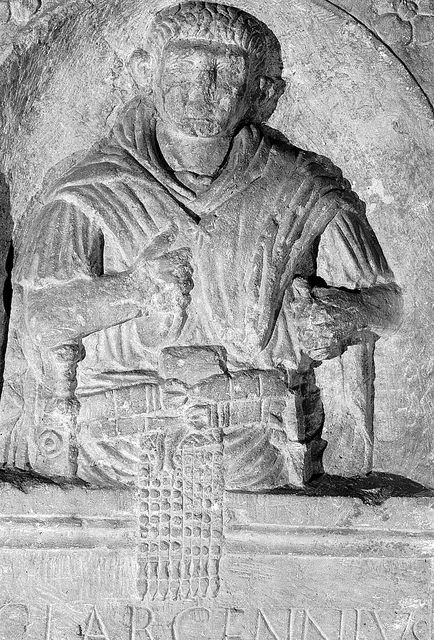 Tombstone of Gaius Largennius, soldier of the Second Legion, first half of the first century CE. Strasbourg Archaeological Museum, MAS 2431; limestone. The depicted equipment does not establish the appointment of tesserarius.
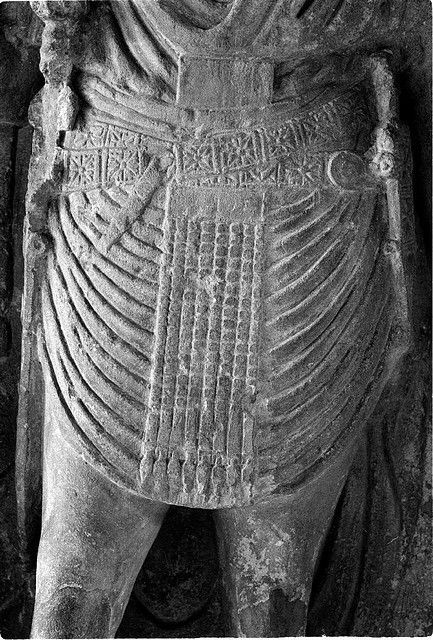 Detail of the tombstone of Annaius Daverzus, soldier of cohors IIII Delmatarum. Bingerbrück; Römerhalle, Bad Kreuznach, first century CE. The inscription does not establish the appointment of tesserarius.
Duties of the tesserarius
The tesserarius was responsible for the password, guard duties and part of the unit's internal service. His title is linked with the tessera, a tablet or token on which a password could be transmitted. In camp and on the march this function mattered for security: sentries had to know whom to admit, how to respond to alarm and whose authority governed the watch change.
The role of the tesserarius shows how much the Roman army depended on daily organization. Victory rested not only on formation and weapons, but also on guard schedules, transmission of orders, accounting for men and discipline in camp. He is therefore a useful example of a junior officer whose work is almost invisible in battle narratives but essential to service.
Rank and command position
The tesserarius belonged to the principales, the group of junior commanders and specialists standing above ordinary soldiers. He was not a centurion, but held a responsible position and performed tasks requiring literacy, reliability and knowledge of routine. Within the century he belongs beside optiones and other assistants of the commander.
The sources give almost no external marks for the tesserarius. His position is clearer through function: tablet or password sign, connection with guard duty, transmission of orders and place in camp service. The tesserarius is therefore important not as a separate equipment type, but as one of the men who made the century an administratively controlled military unit.
Password and security
In Polybius, VI.34, the wooden watchword tablet passes between units and returns to the tribune before nightfall. Its marks help locate a failure in transmission. The procedure checks compliance with the route as well as knowledge of the password.
This describes the army of the second century BCE. It cannot be transferred wholesale to an imperial century or used to assign every camp report to a tesserarius. For later periods, inscriptions naming the appointment and documents from particular units are essential.
Related topics
Literature and sources
- Alfred von Domaszewski. Die Rangordnung des römischen Heeres. 3rd ed. Böhlau Verlag, Bonn, 1981.
- Michael A. Speidel. Sold und Wirtschaftslage der römischen Soldaten // Kaiser, Heer und Gesellschaft in der römischen Kaiserzeit. Steiner Verlag, Stuttgart, 2000.
- Gabriele Wesch-Klein. Soziale Aspekte des römischen Heerwesens in der Kaiserzeit. Steiner Verlag, Stuttgart, 1998.
- Polybius. Histories, VI.34–37: watchwords and guards.
- RIB 638: tombstone of Pudens, tesserarius of II Augusta.
Interested in Ancient Rome beyond reading? Join Legio X Fretensis or explore our reenactment directions.


