Furca
Furca, Latin for a fork, is the conventional name for a wooden device used to carry marching baggage. Roman reliefs show soldiers with poles and suspended belongings. Modern replicas often have a crosspiece or fork, but the images do not establish uniform dimensions or joints.
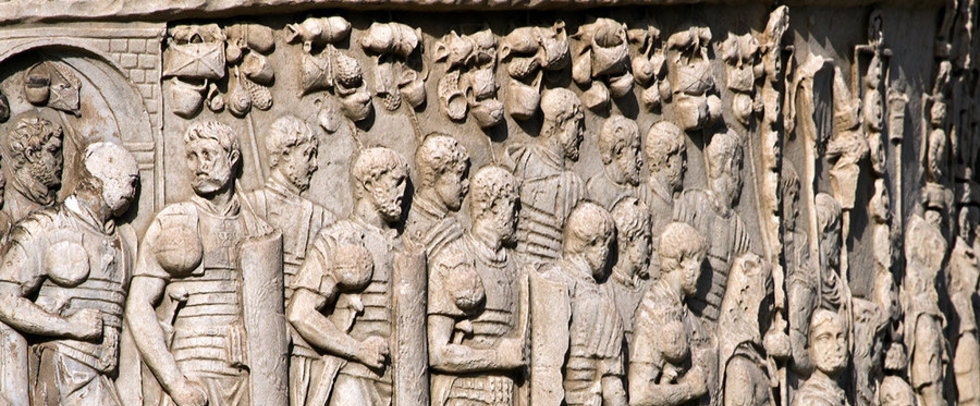 Soldiers carrying baggage on poles. Trajan’s Column, Rome; early second century CE.
Bags and bundles could be suspended from the pole. Identification as a loculus, cassidile or another container depends on the image and interpretation. Attaching a pilum to a furca should not be treated as obligatory for every soldier.
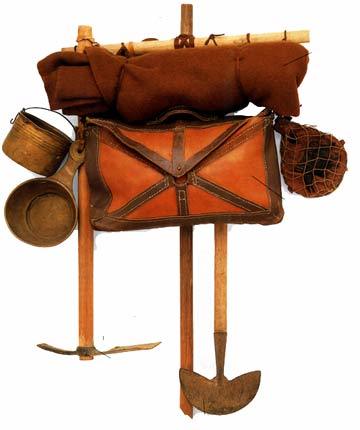 Modern reconstruction of a loaded furca.
Function
Marching baggage included belongings and provisions carried by the soldier himself. In his Life of Marius (13), Plutarch associates “Marius’s mules” with carrying baggage and preparing food. The account is evidence for soldiers’ workload, not an exact specification for a carrying pole.
Practical Use
Test a replica for load balance, secure knots and freedom from sharp projections. Bags should not slip, strike nearby participants or prevent quick removal of the load. Increase weight gradually; modern experiments do not establish identical loads for all Roman soldiers.
Related topics
Legionary, Loculus, Cassidile, Flask, Ancient military campaigns
Literature and sources
- M. C. Bishop, J. C. N. Coulston, Roman Military Equipment from the Punic Wars to the Fall of Rome.
- Graham Sumner, Roman Military Dress.
- Peter Connolly, Greece and Rome at War.
- Plutarch. Life of Marius, 13.
Yann Le Bohec. The Roman Army of the Early Empire. Russian translation. Moscow: ROSSPEN, 2001.
Interested in Ancient Rome beyond reading? Join Legio X Fretensis or explore our reenactment directions.


