Trident
A trident, Latin tridens, has a three-pronged head on a long shaft. Related implements were used in fishing; in the arena the trident became a characteristic weapon of the retiarius.
Archaeological and visual evidence does not establish a single linear evolution of all fishing implements into weapons. The shape and dimensions of the prongs depended on their purpose. An object with a different number of prongs is more precisely described as a multi-pronged fork, not literally a trident.
In Greco-Roman culture, the trident was also an attribute of Poseidon / Neptune and a symbol of power over the sea.
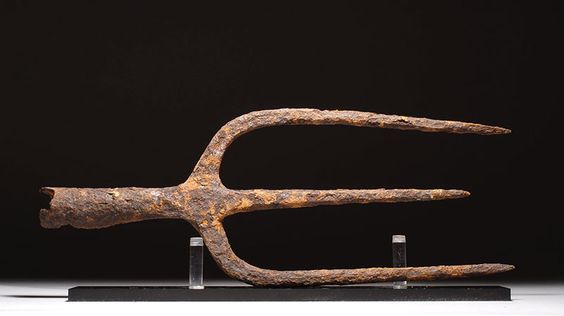 Roman trident. Iron. Private collection. Mid-2nd century AD
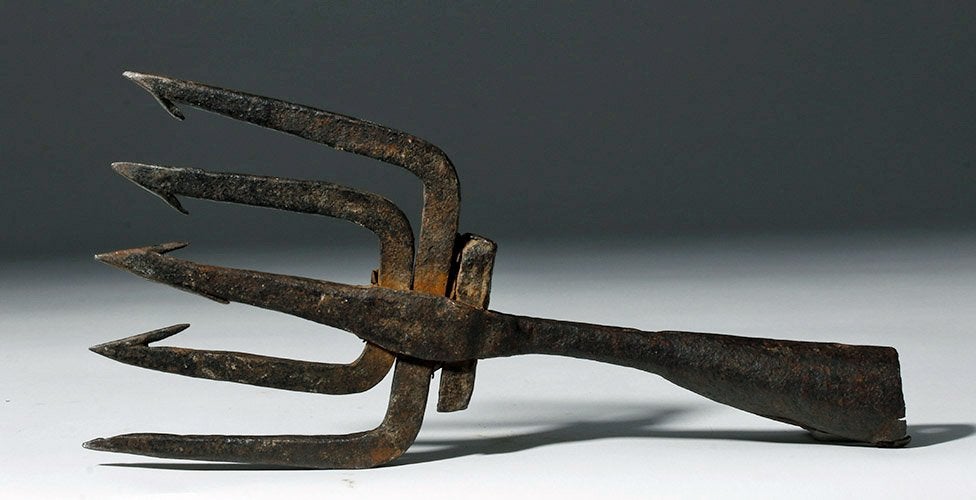 Roman trident. Iron. Private collection. 14 cm*30.5 cm 1-3 century AD
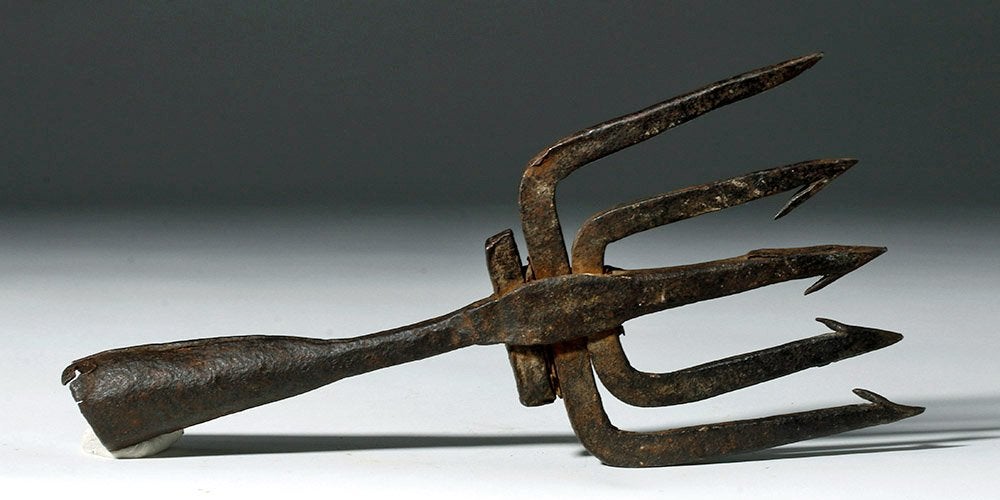 Roman trident. Iron. Private collection. 14 cm*30.5 cm 1-3 century AD
Trident in the arena
In the Roman amphitheatre the trident is most strongly connected with the retiarius. Paired with a net, it allowed the fighter to keep distance, threaten thrusts and use shaft length against a heavier opponent. This did not make the retiarius safe: if the opponent closed the distance, the long weapon became less convenient and the gladiator had to shift to dagger or movement.
The trident was both a weapon and a strong visual sign. It immediately marked the gladiator type, recalled maritime imagery and created contrast with the closed helmet and shield of the secutor. The retiarius-secutor pair opposed a light fighter with net and pole weapon to a heavy pursuer with a large shield.
Construction and reconstruction
The ancient tridens should not be copied automatically from fishing forks or decorative tridents. For arena use, the key issues are the weight of the head, the length of the shaft, the strength of the socket and safe control of the weapon. A head that is too heavy makes the weapon slow, a shaft that is too short removes the retiarius' distance advantage, and a weak joint is dangerous even in training work.
The Legio X Fretensis club reconstruction shows why the trident should not be considered apart from the whole retiarius kit. The long shaft keeps the opponent outside close distance, the net blocks a direct entry under the weapon, and the galerus and manica protect the most exposed side of the body. The dagger remains a reserve weapon if the opponent passes the shaft and the fight moves to close range.
The separate head matters as much as the full image. A working club replica needs a strong socket, a straight fit on the shaft and three prongs that read as a thrusting weapon rather than a decorative emblem. In a training version, edges and points are controlled: the object keeps the silhouette of an ancient weapon without adding unnecessary risk.
By purpose one can distinguish a museum replica, a training model and stage equipment. A museum replica stands closer to the archaeological object, a training version needs predictable balance and safe finishing, and stage equipment must read clearly from a distance together with net, belt, arm protection and the movement style of the retiarius.
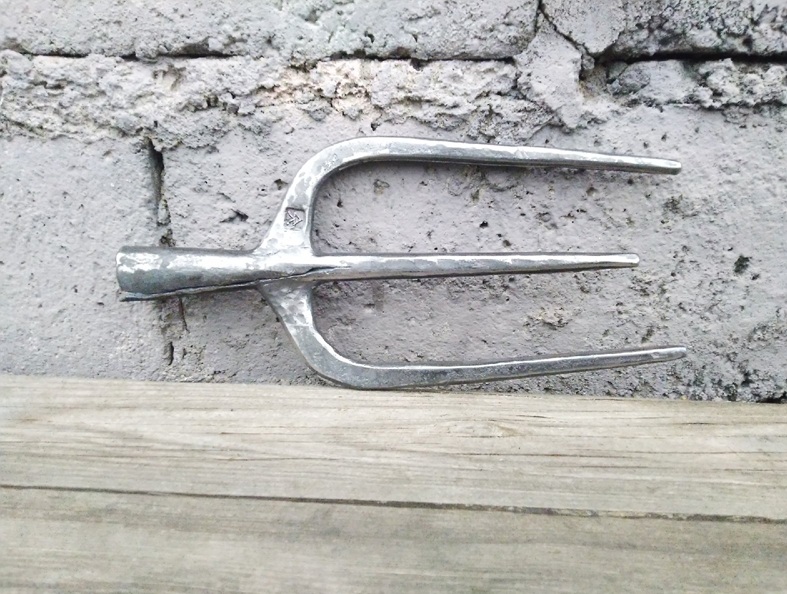 Reconstructed trident head: forged socket, three working prongs and a fitting for the wooden shaft. Legio X Fretensis.
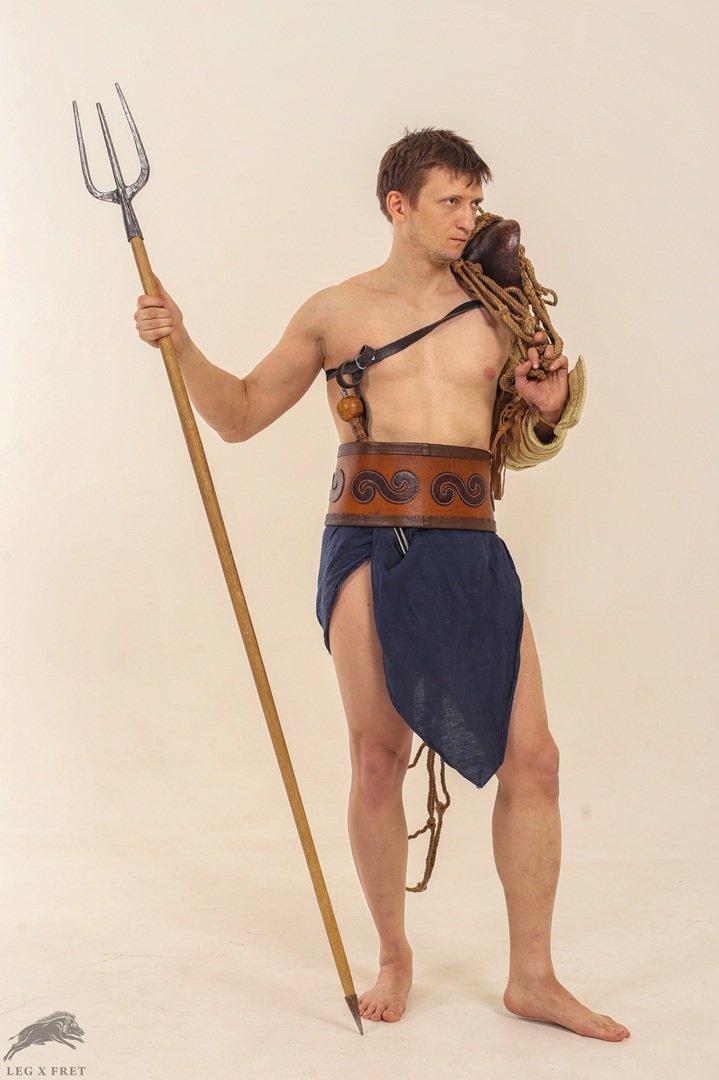 Legio X Fretensis reconstruction of a retiarius: trident, net, galerus, manica and short dagger.
Technique against a shield
The trident allowed the retiarius to work not only by thrusting, but by controlling distance. The long shaft made it difficult for an opponent to enter close combat freely, while the three prongs threatened different lines of attack. Against a heavy shield this was especially important: the aim was not to smash through protection by force, but to make the opponent open up.
Together with the net, the trident created pressure. The net could disrupt rhythm or restrict movement, after which the pole weapon kept a safer distance. But if the net throw failed, the retiarius was vulnerable: he had to move, preserve distance and prevent the secutor from imposing close combat.
Weapon symbolism
The trident carried a strong maritime association. It recalled Neptune, fishing and the world of water, making the retiarius visually distinct from land-based heavy gladiators. This symbolism formed part of the arena language: helmet, shield, net, trident and movement style set up the contrast of the pair before contact.
The tridens is therefore not merely a weapon. It connects fighting technique with the image of the retiarius: distance, net, lack of heavy helmet, protection of one arm and maritime theme work together. Without this system the trident becomes a striking object, but loses its gladiatorial meaning.
Length and control balance
The trident has an obvious advantage, distance, but a shaft that is too long can become a problem. In the confined arena a fighter had not only to keep the opponent away, but also change direction quickly, avoid having the weapon seized and keep balance. Length matters only together with controllability.
In the retiarius kit the trident works together with net and dagger. The net disrupts movement, the trident holds distance, and the dagger remains the last resource at close range. This combination explains why the pole weapon of a light gladiator was not a solitary attribute, but part of a deliberate fighting system.
Related topics


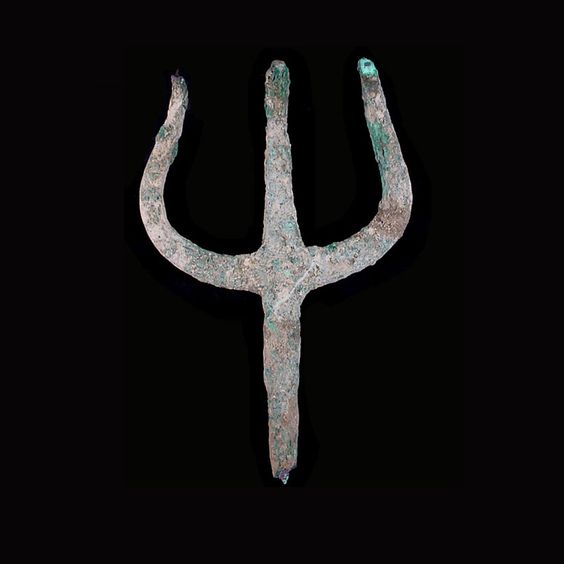 Gladiator's trident. Bronze. 1st century BC-2nd century AD
Interested in Ancient Rome beyond reading? Join Legio X Fretensis or explore our reenactment directions.


