Vitis
The vitis was a centurion’s staff, traditionally made from vine wood. It signified his office and disciplinary authority and could also be used to punish legionaries.
Tacitus describes the centurion Lucilius, nicknamed Cedo alteram, “Give me another”: when he broke one staff while punishing soldiers, he called for the next. Soldiers killed him during the Pannonian mutiny of AD 14 (Annals I.23).
On tombstones a vitis can help identify a centurion, together with inscriptions and other insignia. It was not necessarily shown in every depiction, and not every represented staff can securely be identified as a vitis.
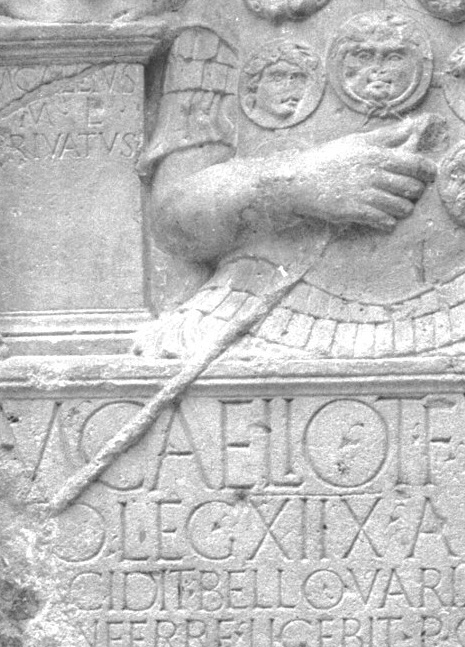 Fragment of a bas-relief of a centurion with vitis. It is kept in the Rheinisches Landesmuseum in Bonn. 1st century AD
 Tombstone of Centurion Marcus Favonius Facilis of the XX (Valeria Victrix) Valerian Victorious Legion. Colchester. Colchester and Essex Museum. 1st century AD (43-50 AD)
 Primipil with vitius,reconstruction
Badge of Rank
The vitis (Latin vitis) is the centurion's staff, traditionally associated with vine wood. In the Roman army it was not merely a stick but a visible sign of a junior officer's authority over his unit. With it a centurion could indicate direction, maintain order, and display disciplinary power.
Reconstruction
When making a vitis, moderate length, comfortable grip, and recognizable material or texture matter. The object should not become a heavy club: in the sources it functions as an officer's sign and practical command tool. In public demonstrations the vitis helps viewers distinguish a centurion from an ordinary legionary at once.
Literature and sources
- Graham Webster, The Roman Imperial Army.
- M. C. Bishop, J. C. N. Coulston, Roman Military Equipment from the Punic Wars to the Fall of Rome.
- Graham Sumner, Roman Military Dress.
Related topics
Centurion, Roman Army helmets, Phalerae
Interested in Ancient Rome beyond reading? Join Legio X Fretensis or explore our reenactment directions.


