Celtic skirts
Separate skirts are known from northern European Iron Age finds. They were not a uniquely Celtic invention. A well-known example is associated with the woman from Huldremose, Denmark, whose clothing included a wool skirt, scarf and skin capes. This find cannot be identified as the costume of a woman from Gaul without further evidence.
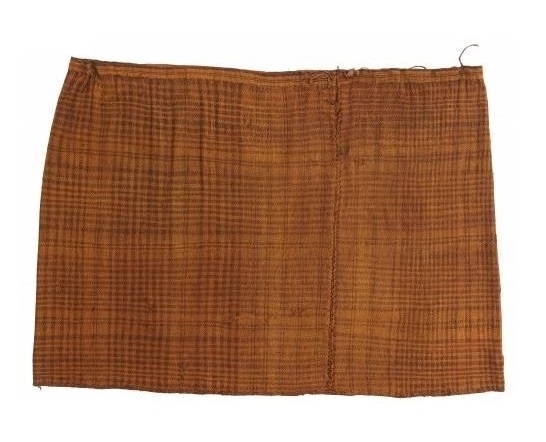 Wool textile from Huldremose, Denmark, Iron Age; National Museum of Denmark. A northern European find, not securely a Celtic skirt.
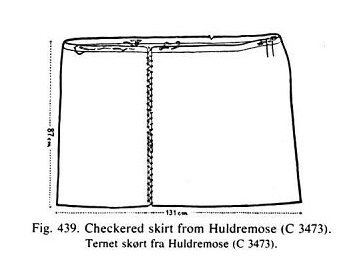 Diagram of the checked skirt from Huldremose, Denmark, Iron Age; National Museum of Denmark, object C 3473.
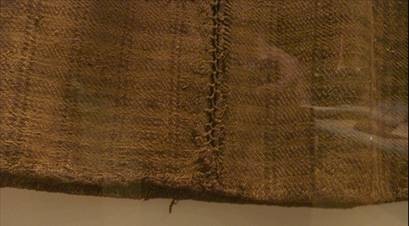 Seam detail of the wool skirt from Huldremose, Denmark, Iron Age; National Museum of Denmark.
A Textile Find
Textiles reveal weave, seams and fastening. A bog textile’s present brown colour need not be its original colour. Comparisons must distinguish the Huldremose woman’s skirt from a separate tubular garment also found in that area.
Wearing and Combination
Reconstruction should follow a particular assemblage rather than combine finds from different periods. Length, width, woven edges, ties and associated garments must match the chosen evidence. A skirt and peplos differ principally in construction and wearing arrangement, not an assumed ethnic identity.
Related topics
The Celts,Celtic Belt,Peplos,Celtic shirts
Literature and sources
- Margarita Gleba. Textile Production in Pre-Roman Italy.
- Karina Grömer. The Art of Prehistoric Textile Making.
- Lise Bender Jørgensen. North European Textiles until AD 1000.
- National Museum of Denmark: Huldremose clothing.
Interested in Ancient Rome beyond reading? Join Legio X Fretensis or explore our reenactment directions.


