Emperors of Rome
Octavian Augustus is usually regarded as the first Roman emperor in the modern sense. In January 27 BCE the Senate granted him the name Augustus; his position developed through a series of settlements rather than a single coronation. Julius Caesar had been dictator, not the first ruler of the Principate.
The list below follows the emperors from Augustus to Severus Alexander, with separate notes on rival claimants and selected later rulers. It is not a complete catalogue of the third-century or late Roman emperors. Overlapping dates indicate joint rule or competing claims, not necessarily an error in the chronology. All dates are CE unless marked BCE.
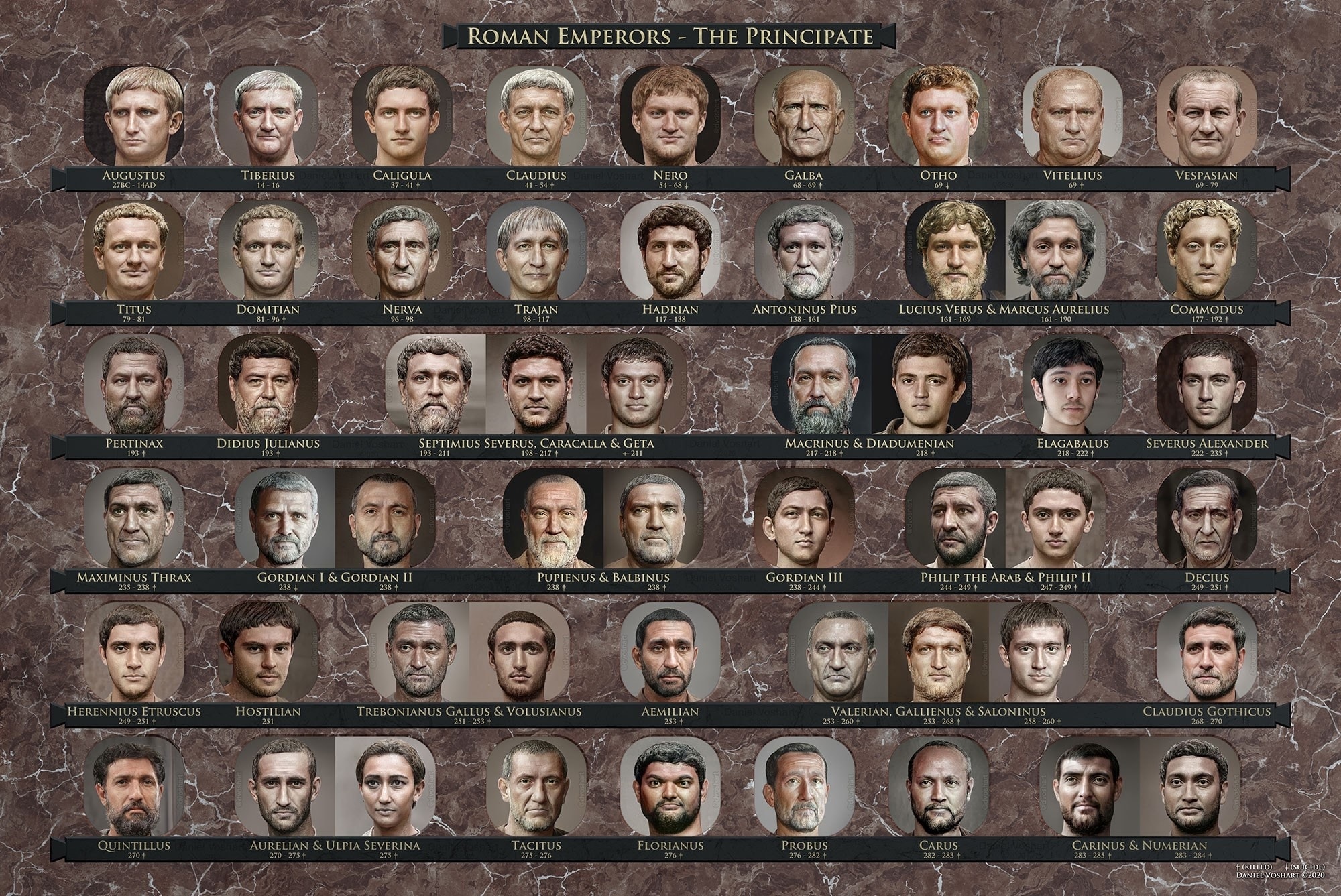
List of Roman emperors
Julio-Claudian dynasty
- Augustus (27 BCE–14 CE): established the Principate after the civil wars. His authority combined military command, political influence and powers granted within republican institutions.
- Tiberius (14–37): Augustus's adopted son and successor; he spent the later part of his reign on Capri.
- Caligula (37–41): son of Germanicus; assassinated in a palace conspiracy.
- Claudius (41–54): Caligula's uncle; his reign saw the invasion of Britain in 43. Ancient accounts allege that he was poisoned, but the circumstances of his death remain uncertain.
- Nero (54–68): Claudius's adopted son; his fall brought the Julio-Claudian dynasty to an end.
Rebels and impostors, not a succession of recognised emperors
- Clemens (executed in 16): a former slave who impersonated Agrippa Postumus. He was not an emperor.
- Lucius Arruntius Camillus Scribonianus (42): governor of Dalmatia who briefly rebelled against Claudius.
- Lucius Clodius Macer (68): commander in Africa who rebelled against Nero and was killed under Galba; his position should not be confused with an accepted imperial reign.
The Year of the Four Emperors and the Flavians
- Galba (68–69): became emperor after Nero's fall and was murdered in January 69.
- Otho (January–April 69): seized power from Galba; died by suicide after defeat by Vitellius's forces.
- Vitellius (April–December 69): supported by the Rhine armies; defeated by the supporters of Vespasian.
- Vespasian (69–79): founder of the Flavian dynasty; his victory ended the civil war of 69.
- Titus (79–81): Vespasian's son and successor. Vesuvius erupted in 79, during his reign.
- Domitian (81–96): Titus's brother; assassinated in 96.
Julius Sabinus, a leader in the revolt of 69–70, claimed descent from Caesar and adopted the name Caesar. Terentius Maximus, active around 79–80, presented himself as Nero. Neither belongs in the regular succession of Flavian emperors.
Nerva and the Antonine emperors
- Nerva (96–98): chosen after Domitian's assassination; adopted Trajan as his successor.
- Trajan (98–117): conquered Dacia and campaigned against Parthia.
- Hadrian (117–138): abandoned some of Trajan's eastern conquests and consolidated imperial frontiers.
- Antoninus Pius (138–161): succeeded Hadrian; his reign preceded the joint rule of Marcus Aurelius and Lucius Verus.
- Marcus Aurelius (161–180): ruled jointly with Lucius Verus until 169 and with Commodus from 177. Much of his later reign was occupied by wars on the Danube.
- Lucius Verus (161–169): co-emperor with Marcus Aurelius; the eastern war against Parthia was fought during their joint reign.
- Commodus (177–192; sole emperor from 180): Marcus Aurelius's son. His assassination was followed by renewed struggles for power.
The expression "Five Good Emperors" is a later judgement, conventionally applied to Nerva, Trajan, Hadrian, Antoninus Pius and Marcus Aurelius. It is not an ancient constitutional title.
The struggle for power in 193–197
- Pertinax (January–March 193): succeeded Commodus but was killed by members of the Praetorian Guard.
- Didius Julianus (March–June 193): obtained the guard's support after Pertinax's death; lost power as Septimius Severus approached Rome.
- Pescennius Niger (193–194): proclaimed emperor by eastern supporters; defeated by Severus.
- Clodius Albinus: accepted the subordinate title Caesar under Severus in 193, then claimed the rank of Augustus in 195 or 196. He was defeated near Lugdunum in 197.
Septimius Severus also claimed power in 193. These competing claims explain the conventional name "Year of the Five Emperors"; the men did not simply reign one after another.
The Severan dynasty and the reign of Macrinus
- Septimius Severus (193–211): founded the dynasty after defeating his rivals. He died at Eboracum, modern York, during the British campaigns.
- Caracalla (198–217): became Augustus while his father was still ruling; after Geta's murder in 211 he ruled alone. His citizenship grant of 212 is discussed under Roman citizenship.
- Geta (209–211): co-emperor with his father and brother, then with Caracalla; killed on Caracalla's orders.
- Macrinus (217–218): a praetorian prefect who succeeded Caracalla. He was not a member of the Severan family.
- Diadumenian (Augustus in May–June 218): Macrinus's son, previously Caesar from 217. His earlier junior title should not be mistaken for a year-long reign as co-emperor.
- Elagabalus (218–222): brought to power by a movement associated with the Severan family; killed in 222.
- Severus Alexander (222–235): succeeded Elagabalus; his murder by soldiers ended the Severan dynasty.
"Caesar" and "Augustus" could denote different ranks within an imperial household. A date of appointment as Caesar is therefore not automatically the beginning of a reign as Augustus.
The third-century crisis and selected later emperors
After Severus Alexander's death, the empire entered the period usually called the third-century crisis. Rapid changes of ruler, civil wars, invasions and regional breakaway regimes make a single unqualified sequence misleading.
- Diocletian (284–305): developed the Tetrarchy, in which two Augusti and two Caesars shared imperial responsibilities. He abdicated in 305.
- Constantine I (306–337): proclaimed by his father's soldiers in 306; defeated successive rivals and became sole emperor in 324. Constantinople was dedicated in 330.
For the changing institutions and the subsequent history of the empire, see the Dominate, the late Roman Empire and the fall of the Western Roman Empire. The deposition of Romulus Augustulus in 476 did not end Roman imperial government in the East.
Chronology and sources
- De Imperatoribus Romanis: an online encyclopedia of Roman rulers.
- Suetonius, Lives of the Caesars: an ancient biographical source whose anecdotes require comparison with other evidence.
- Diadumenian: title and short reign.
Related topics
Interested in Ancient Rome beyond reading? Join Legio X Fretensis or explore our reenactment directions.


