Roman Legion - Legio I Parthica
Legio I Parthica, the First Parthian Legion, was raised by Septimius Severus in 197 CE for operations in the East. It became a long-serving garrison unit in Roman Mesopotamia.
- Formation: 197 CE; still attested in the early fifth century.
- Principal early base: Singara, near modern Sinjar in Iraq.
- Emblem: a centaur.
- Parthica refers to the legion's association with the Parthian wars, not to an army belonging to Parthia.
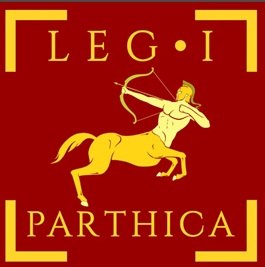 Modern reconstruction of a vexillum attributed to Legio I Parthica.
Campaigns and garrison service
Foundation and Singara
Septimius Severus raised three Parthian legions, I, II and III Parthica. His campaign of 197–198 reached Ctesiphon, while the organisation of Roman Mesopotamia created new garrison responsibilities. I Parthica was stationed at Singara and III Parthica at Rhesaena; II Parthica eventually became based near Rome.
Unlike a legion commanded by a senatorial legate, I Parthica served under an equestrian prefect. This reflects the administrative arrangements of Mesopotamia. "Equestrian" here means the Roman social order, not that the commander necessarily led cavalry.
An expanded name, Severiana Antoniniana, has been proposed in connection with Severus's dynastic claims to the Antonine family. Such a reconstruction of titulature should be distinguished from the securely attested short designation I Parthica.
The third-century eastern frontier
The legion's position placed it in the wars against the Parthians and subsequently the Sasanian Persian Empire. It is associated with the eastern campaigns of Caracalla in 216–217, Severus Alexander in 231–233 and Gordian III in 242–244. The surviving evidence does not allow every operation or detachment to be followed in detail.
Under Philip the Arab, the legion received the honorific Philippiana. Inscriptions also attest detachments away from its main base, including in Lycia and Cyrenaica. A vexillation was a detachment deployed separately from its parent legion.
Singara's fall and later evidence
Singara fell to Shapur II in 360. The garrison suffered severe losses and captivity, and the legion's later history must be read against Rome's loss of territory in the region. Nisibis itself was ceded to Persia in 363, so it should not be presented as an unchanged Roman legionary base throughout the fifth century.
The Notitia Dignitatum places the First Parthian legion, with the epithet Nisibena, at Constantina under the dux of Mesopotamia. The epithet and the recorded station are different pieces of information. This early fifth-century administrative evidence is not a complete narrative of the unit's intervening movements.
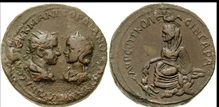 Bronze coin from Singara with portraits of Gordian III and Tranquillina; the reverse shows a centaur, emblem of Legio I Parthica. Third century AD.
Related topics
Literature and sources
- Catherine Wolff. "Legio I Parthica", in Yann Le Bohec, ed., Les légions de Rome sous le Haut-Empire. Lyon, 2000, pp. 247–249.
- Oliver Stoll. Römisches Heer und Gesellschaft. Stuttgart: Steiner, 2001.
- Notitia Dignitatum, eastern section, command of the dux Mesopotamiae.
- Ammianus Marcellinus, Res Gestae, Book 20, for the fall of Singara.
Interested in Ancient Rome beyond reading? Join Legio X Fretensis or explore our reenactment directions.


