Parma
Parma (Latin parma, diminutive parmula) was a small round or nearly round shield in the Roman tradition. In ancient texts the word does not always describe one rigidly standardised object, but a family of lighter shields distinct from the large scutum and the heavier clipeus.
Three contexts matter most for military history: the parma of Republican velites, shields used by cavalry and auxiliary troops, and the gladiatorial parmula. In all of them the basic idea is the same: the shield provided protection without removing mobility. It was therefore useful where a fighter had to throw javelins, change distance quickly, fight on horseback or operate outside a dense heavy line.
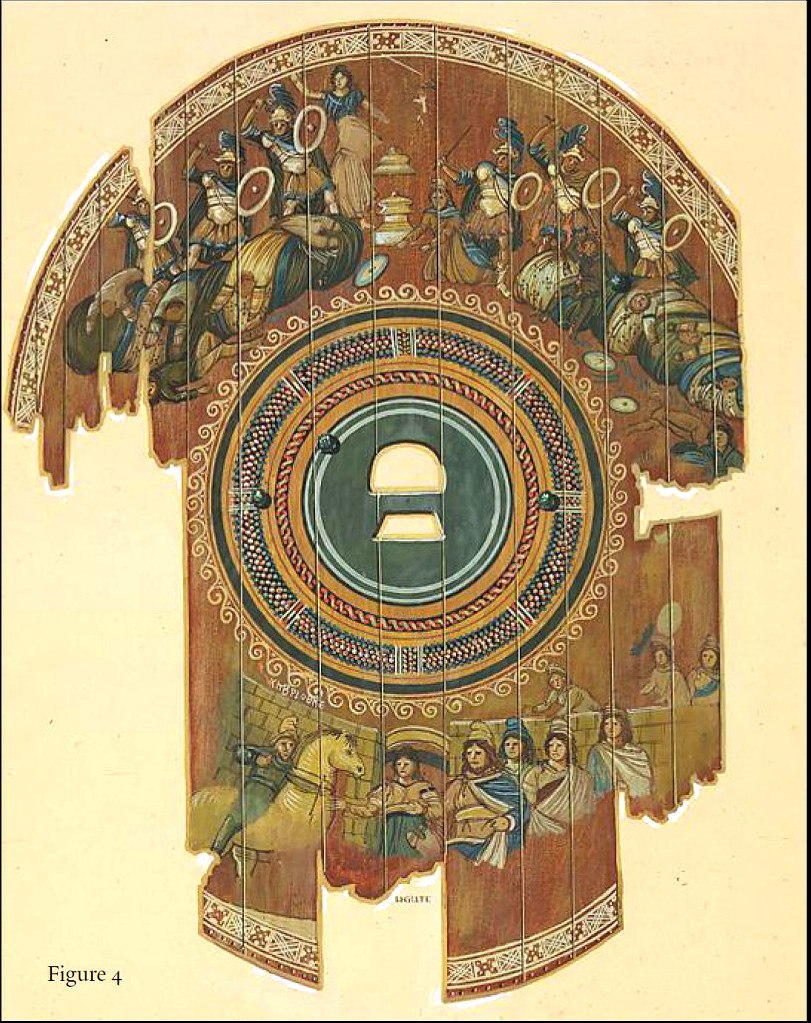
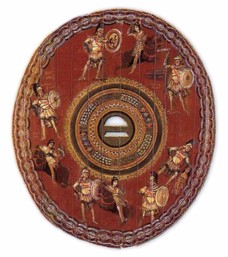 Painted round shield from Dura-Europos. Mythological and military scenes on the shield show that protective equipment could be brightly decorated.
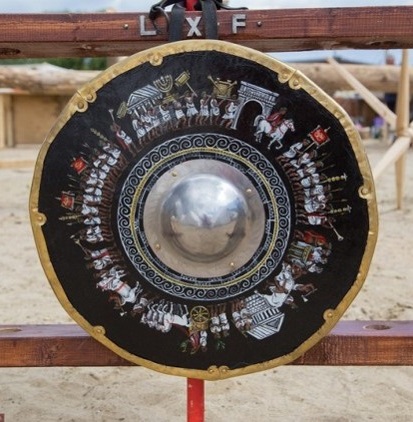 Parma,reconstruction
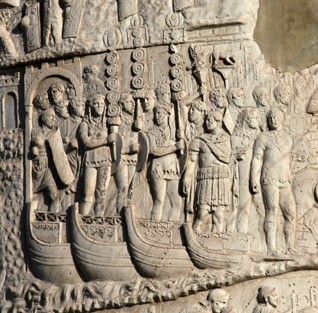 Flag bearers with parmas. Trajan's column. Early 2nd century AD
At a glance
The parma is best understood not as a miniature scutum, but as a mobile shield. In Polybius, the velites carried a sword, javelins and a circular parma about three Roman feet across. Smith's Dictionary of Greek and Roman Antiquities likewise describes the parma as a round shield of about three feet, strong enough to give real protection.
The key features are moderate diameter, central grip, boss or reinforced centre, wooden or hide construction, and possible metal edging or reinforcement. Exact size, curvature, edge shape and decoration depended on period, troop type and purpose. Parma/parmula was not every Roman-period round shield, but a light shield whose identification depends on size, context, grip, boss, date and user.
Size and construction
The figure most often given for the parma is about 90 cm across, roughly the three Roman feet described by Polybius. This size protects the body better than a small hand buckler, but remains much lighter and more convenient than the large shield of heavy infantry. In combat it was a compromise: less complete cover, but more visibility, speed and freedom for a javelin throw or spear work.
In construction a parma could include a wooden core, hide, glue, textile, metal edging and a reinforced centre. The boss protected the hand and helped turn blows away from the shield's centre. Yet archaeology rarely preserves complete combat parmae, so one museum example should not be projected onto every Roman period. Decorative, votive and parade shields are useful for shape and symbolism, but they do not always reveal battlefield weight and strength.
Parma in the manipular legion
The clearest ancient description is connected with the velites of the early and middle Republic. Polybius says that the youngest and poorest soldiers, the velites, carried a sword, javelins and a parma. Their task was not to hold a shoulder-to-shoulder heavy line, but to open the action, harass the enemy with missiles, screen the deployment of heavy infantry and withdraw behind the hastati, principes and triarii.
For that role a large scutum would have been awkward. A veles needed to see the field, move quickly, throw several javelins and retreat when necessary. The parma protected him from opposing missiles and accidental close contact, but it did not turn him into a heavy infantryman.
The parma's smaller size does not make it a weak shield. Polybius explicitly stresses that the velites' shield was large and strong enough to protect them. Its task was different: not to cover the whole body in a dense line, but to help a fighter survive the exchange of javelins, a brief clash and withdrawal. In this sense the parma was a tool for a different kind of fighting, not a worse copy of the scutum.
Cavalry and auxilia
Ancient tradition also connects the parma with horsemen. A light round shield is practical on horseback: it is easier to hold, turn and carry together with a spear or javelins. Yet not every round shield carried by a Roman rider is automatically the same parma described for the velites: the sources use different words, and the material record shows different shield forms.
In the imperial period auxiliary troops and cavalry used round, oval and other shields. Shape depended on provincial traditions, unit role, date and supply. Parma/parmula remains one of the terms and images through which Romans described a light shield, especially for fighters who needed mobility.
The gladiatorial parmula
In the amphitheatre the diminutive parmula became part of the vocabulary of gladiatorial arms. Small shields were carried by fighters whom later tradition could contrast with scutarii, gladiators with large shields. In this context the important types are the Thraex, hoplomachus and eques.
The Thraex is often described with a small rectangular or almost square parma/parmula, together with the sica and high greaves. The hoplomachus, by contrast, is associated with a round shield and spear, an arena version of the Greek hoplite image. The eques fought as a mounted gladiator with a round or medium shield, beginning on horseback and possibly continuing on foot. These arena kits should be separated from army equipment: the gladiatorial parmula worked inside the rules of spectacle, paired types and visual recognition.
Iconography and finds
The parma is known not only from texts, but also from images, reliefs, mosaics, gladiatorial scenes and preserved shield fittings. The Dura-Europos images are especially useful: they show that Roman and near-Roman shields could be brightly painted with mythological and military scenes. Such material helps with appearance and decorative culture, but it does not always answer directly what every combat parma looked like.
A separate category is made up of votive and ceremonial round shields. The British Museum describes early bronze shields as thin objects probably intended for dedication or ritual rather than practical combat. This is a useful warning: round form, boss and rich decoration are important visual parallels, but a battlefield shield must be judged by thickness, grip, edge, repair traces and find context.
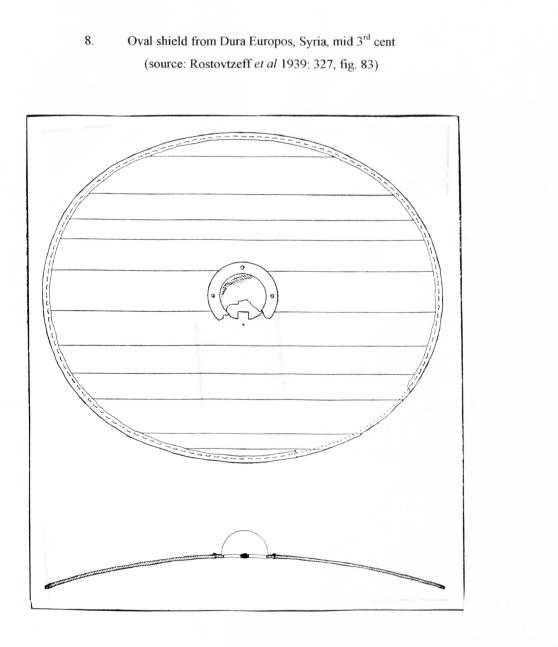 Drawing of the oval shield from Dura-Europos after the excavation publication. The drawing shows curvature, boards and boss placement better than the colour photograph.
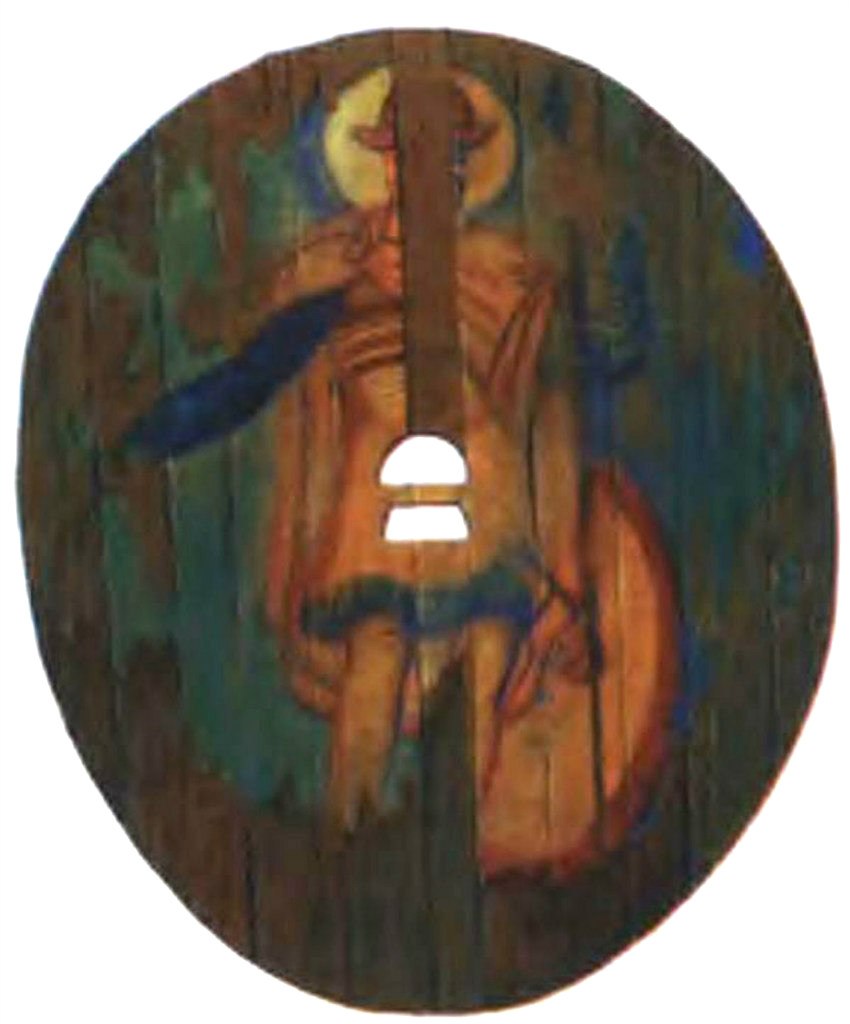 Painted oval shield from Dura-Europos, general view. The image helps show the shape, curvature and placement of decoration on a wooden base.
 Parma from Dura Europos (Syria). 3rd century AD
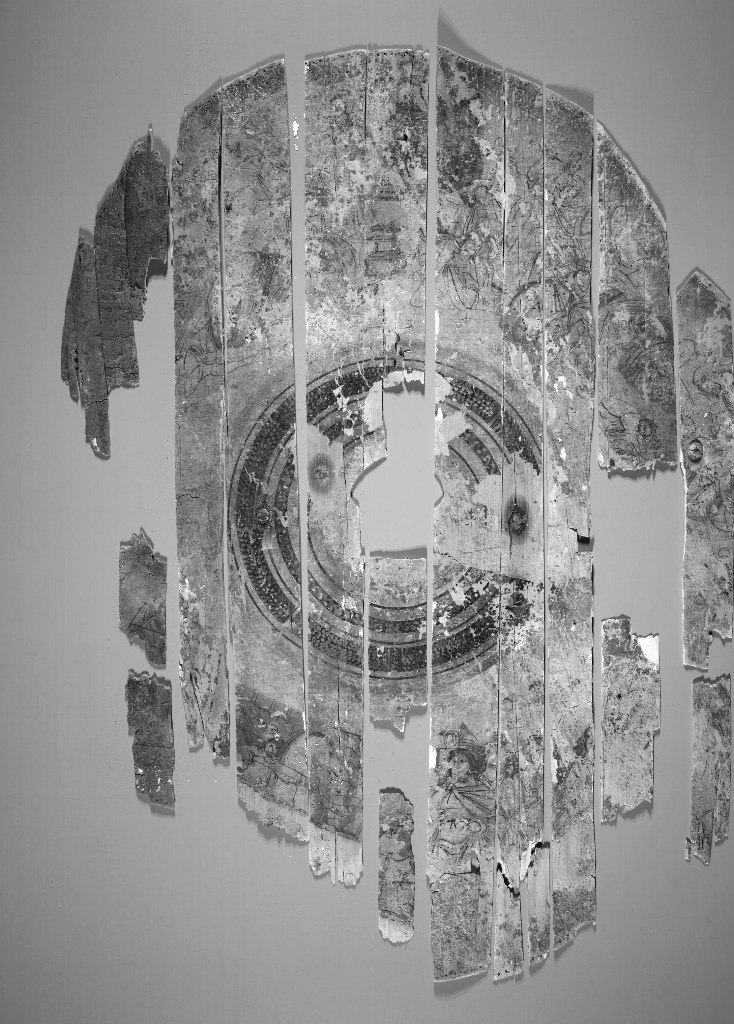 Parma from Dura Europos (Syria). 3rd century AD
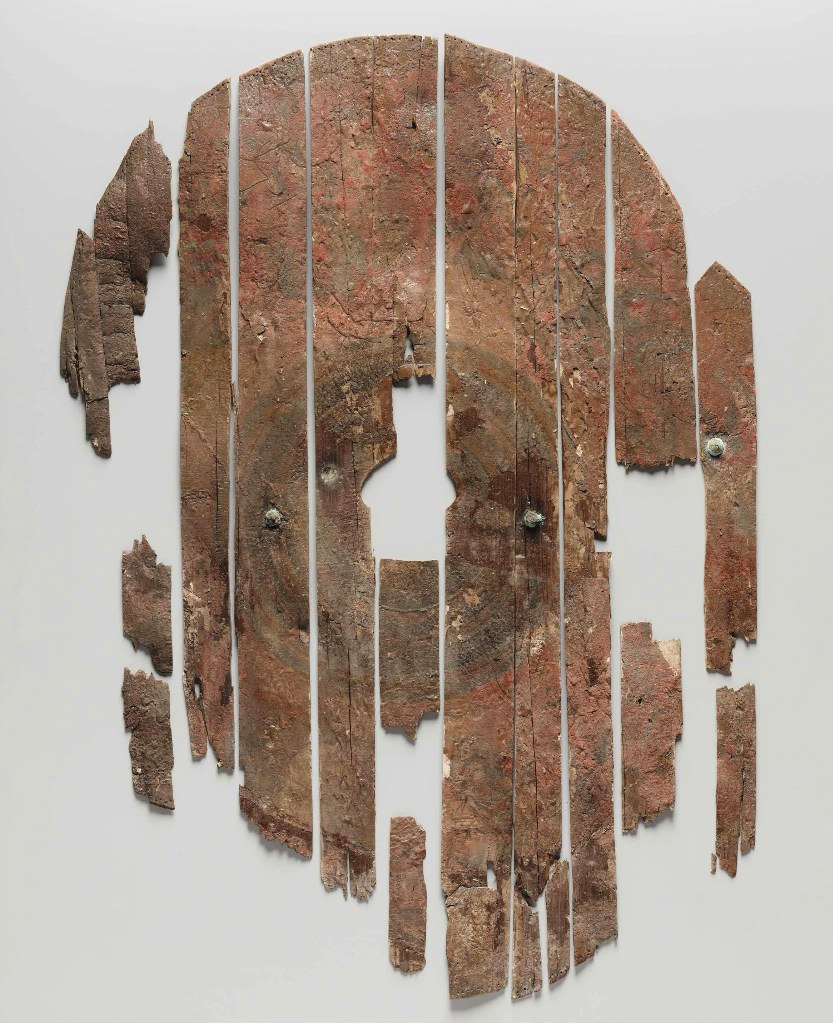 Parma from Dura Europos (Syria). 3rd century AD
Difference from other shields
The parma differs from the scutum above all in scale and role. The scutum is heavier, covers more of the body and is linked with the dense work of heavy infantry. The parma is lighter and more useful for a fighter who has to move, throw, change distance or operate on horseback.
It differs from the clipeus by smaller size and a lighter context of use. The clipeus in early tradition is associated with a larger round shield and Greco-Italic heavy equipment. The distinction from the cetra is harder: ancient authors sometimes bring these words close together because both can describe small round shields. Roman terminology was flexible, so modern classification has to consider context, not only shield geometry.
Parma as a working shield
The parma is best understood through function, not through a single decorative pattern. A veles' shield had to allow javelin throwing, quick withdrawal and low arm fatigue. The gladiatorial parmula, by contrast, depended on the specific fighter type: thraex, hoplomachus and eques had different silhouettes, opponents and rules of arena imagery.
For the Republican military context the key points are moderate diameter, central grip, boss, reliable edge, leather or cloth over the core and weight compatible with mobility. A parma that is too heavy becomes a poor scutum, while one that is too light becomes a decorative object without protective meaning. In every case size and construction have to be tied to the bearer: veles, horseman, auxiliary soldier or gladiator.
Related topics
Literature and sources
- Polybius. Histories. Book VI, 22.
- William Smith. A Dictionary of Greek and Roman Antiquities. Parma.
- M. C. Bishop, J. C. N. Coulston. Roman Military Equipment.
- M. C. Bishop. Roman Shields.
- Marcus Junkelmann. Das Spiel mit dem Tod: So kämpften Roms Gladiatoren.
- The Excavations at Dura-Europos. Final reports on arms, armour and painted shields.
- Royal Armouries. The World of the Gladiators.
Interested in Ancient Rome beyond reading? Join Legio X Fretensis or explore our reenactment directions.


