Barbarian kingdoms
Barbarian kingdoms were states that emerged in the fifth and sixth centuries on or near the territory of the Western Roman Empire. They were created by military elites of Goths, Vandals, Franks, Burgundians, Suebi, Lombards and other groups drawn into the Roman political orbit during the Great Migration of Peoples.
The word 'barbarian' reflects the Roman language for describing outsiders, but these kingdoms were not a simple negation of Rome. They inherited taxation, cities, law, Latin literacy, the Christian church and the idea that legitimate rule continued imperial order.
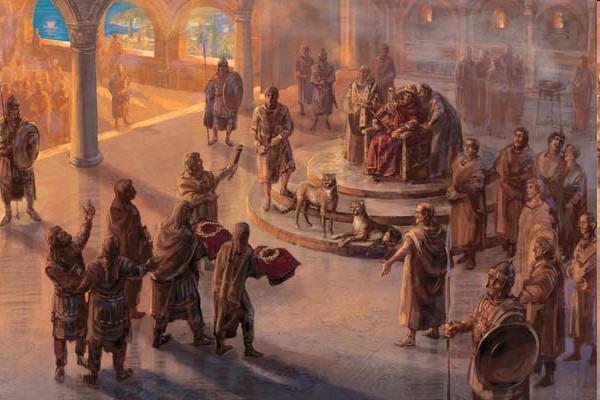 Odoacer's ambassadors hand over symbols of the Western Emperor's power to the Byzantine Emperor Zeno
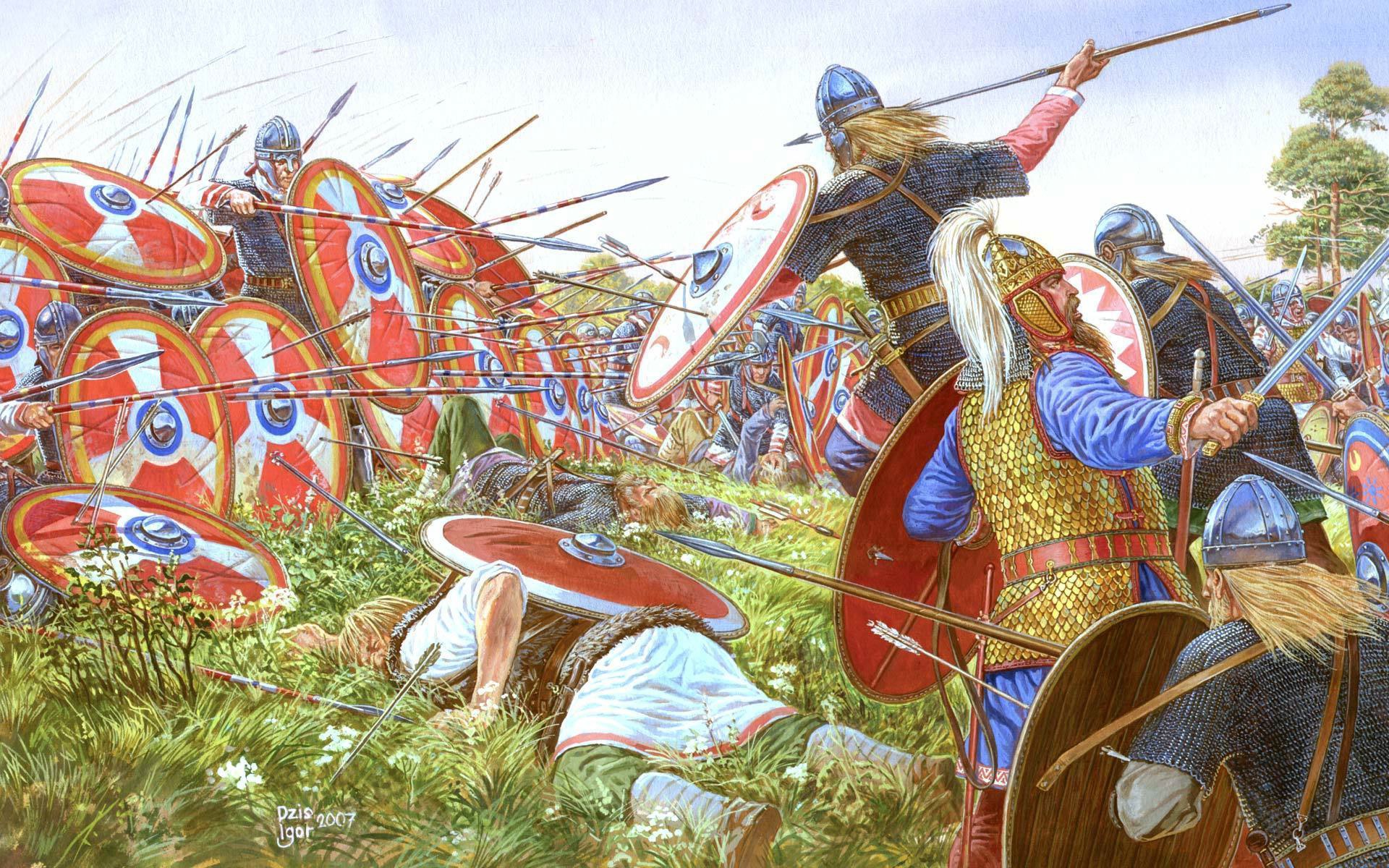 Romans take on Goths
Main kingdoms
The most important kingdoms include the Visigothic kingdom in Gaul and Spain, the Ostrogothic kingdom in Italy, the Vandal kingdom in North Africa, the Frankish kingdom in northern Gaul, the Burgundian kingdom, the Suevic kingdom in Spain and, later, the Lombard kingdom in Italy.
Their borders were unstable. Kingdoms emerged from treaties with the Empire, military conquest, settlement of federates and competition among war leaders. Some disappeared quickly, while others, especially the Franks, became foundations of the medieval political map of Europe.
Roman legacy
New kings often preserved Roman administration. Roman landowners remained important advisers, bishops became mediators between population and rulers, and Latin continued to be used in law and documents. In Italy Theoderic the Ostrogoth stressed that he governed Romans by Roman law and Goths by their military tradition.
This legacy did not exclude violence and rupture. The tax base shrank, cities changed, armies became more personal, and royal power depended on war bands and land distribution. Yet the combination of Roman and barbarian military elements made these states viable.
Religion and law
Religion was one of the main fields of tension. Many Gothic and Vandal elites followed Arian Christianity, while most of the Roman population belonged to the Nicene church. In some kingdoms this caused conflict; in others it led to compromise and gradual integration.
Law codes of the barbarian kingdoms reveal a mixed world. They recorded norms for different population groups, used Latin and Roman legal forms, but also strengthened royal power and the special position of military elites.
Related topics
Literature and sources
- Gregory of Tours. History of the Franks.
- Jordanes. Getica.
- Heather P. The Goths.
- Wolfram H. History of the Goths.
- Wickham C. The Inheritance of Rome.
Interested in Ancient Rome beyond reading? Join Legio X Fretensis or explore our reenactment directions.


