Cyclopes
The Cyclopes of Greek mythology are not one people with a single biography, but several connected images of one-eyed beings. In one layer of myth they are ancient craftsmen who help Zeus obtain thunder, lightning and the thunderbolt. In another they are wild shepherds at the edge of the human world. The most famous Cyclops, Polyphemus, appears in the Odyssey as Odysseus' opponent and as an example of strength overcome by cunning.
This doubleness matters. A Cyclops may be a maker of divine weapons, a threat to hospitality, or a lonely giant in love in later poetry. The image was useful to ancient people because it joined several boundaries: human and non-human, technology and wildness, strength and lack of measure, solitude and dangerous self-sufficiency.
 Proto-Attic amphora with Odysseus and his companions blinding Polyphemus, ca. 650 BC, Archaeological Museum of Eleusis.
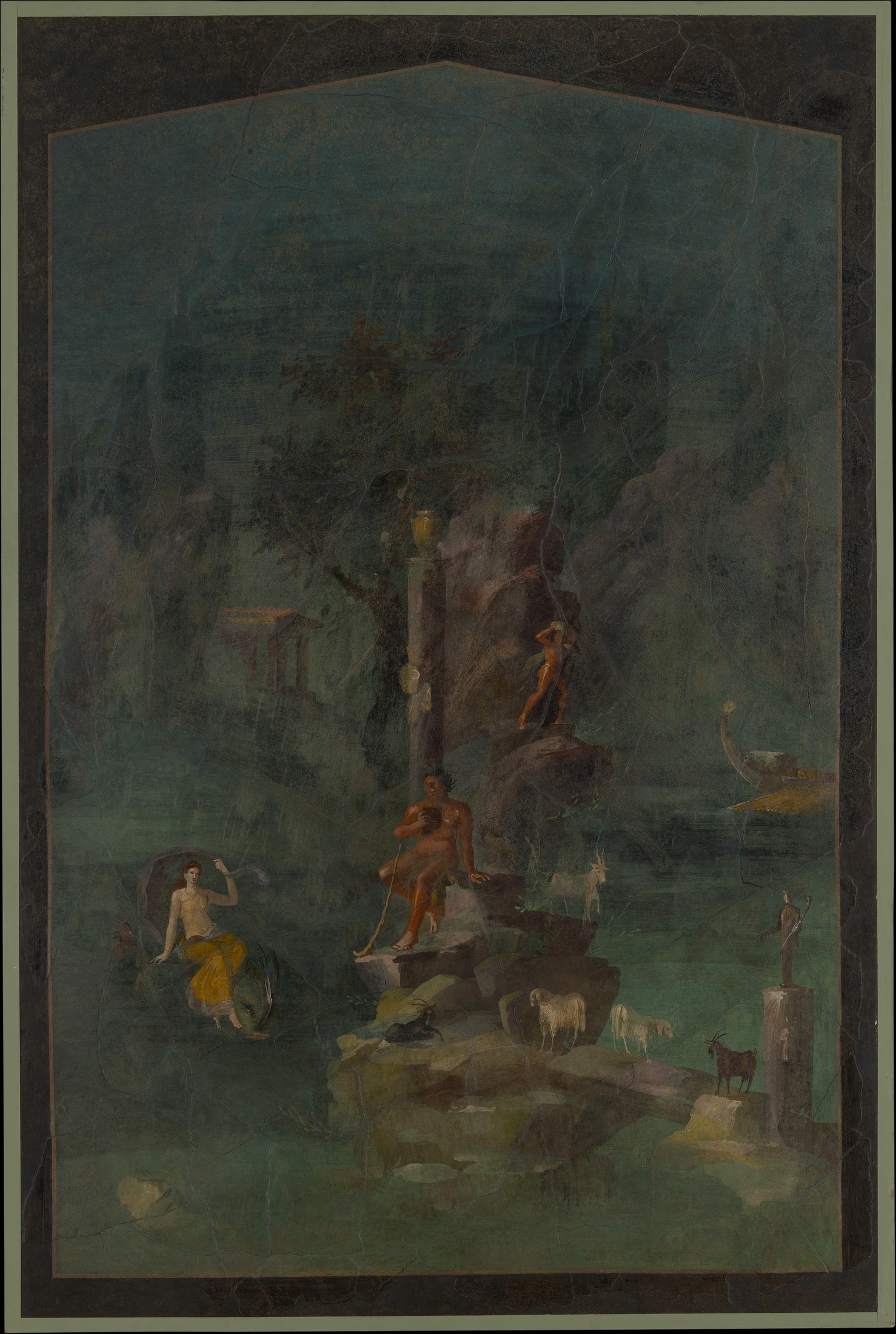 Roman fresco with Polyphemus and Galatea from the imperial villa at Boscotrecase, last decade of the first century BC. Metropolitan Museum of Art, 20.192.17.
Hesiodic Cyclopes and Divine Weapons
In Hesiod's Theogony the Cyclopes Brontes, Steropes and Arges belong to the early generations of the world. They are not like Polyphemus in the Odyssey. Their role is cosmic: they give Zeus thunder and lightning, with which he defeats the Titans and establishes the new order of the gods. One-eyedness here is not merely deformity, but a sign of unusual, pre-human nature.
This layer of myth connects the Cyclopes with craft. In later tradition they become assistants of Hephaestus and smiths of subterranean fire. The development is understandable: thunder, volcano, metal and divine weaponry are easily joined in one imagination. The Cyclopes are terrifying but necessary beings: their power is dangerous, yet without it Olympian order would lack its weapon.
Cyclopes therefore cannot be reduced to foolish giants. In one version they stand at the beginning of Zeus' power and divine technology. They do not live in a polis or obey human law, but they participate in the creation of cosmic order.
Polyphemus and the Violation of Hospitality
In the Odyssey Polyphemus lives in a cave, tends sheep and knows no law of hospitality. When Odysseus and his companions enter, they expect a host's gift and a guest's protection. Instead the Cyclops closes the entrance with a stone and begins to eat the men. The scene is built on sharp contrasts: guest and host, bread and raw violence, speech and brute force.
Odysseus' victory is not a fair duel. The hero calls himself "Nobody," gives Polyphemus wine, blinds him with a heated stake and leads his men out of the cave under the bellies of rams. For Greeks the story showed the power of metis, intelligent cunning, the ability to defeat a stronger opponent by plan rather than muscle. But victory has a price: Odysseus' taunt reveals his name, and Polyphemus calls on Poseidon to punish him.
Polyphemus' fate in myth does not end with blindness. He remains alive, and his curse becomes part of Odysseus' long return. In Hellenistic and Roman poetry the same Cyclops can be a giant in love with Galatea. One image thus moves from wild man-eater to unhappy lover, while keeping bodily enormity and solitude.
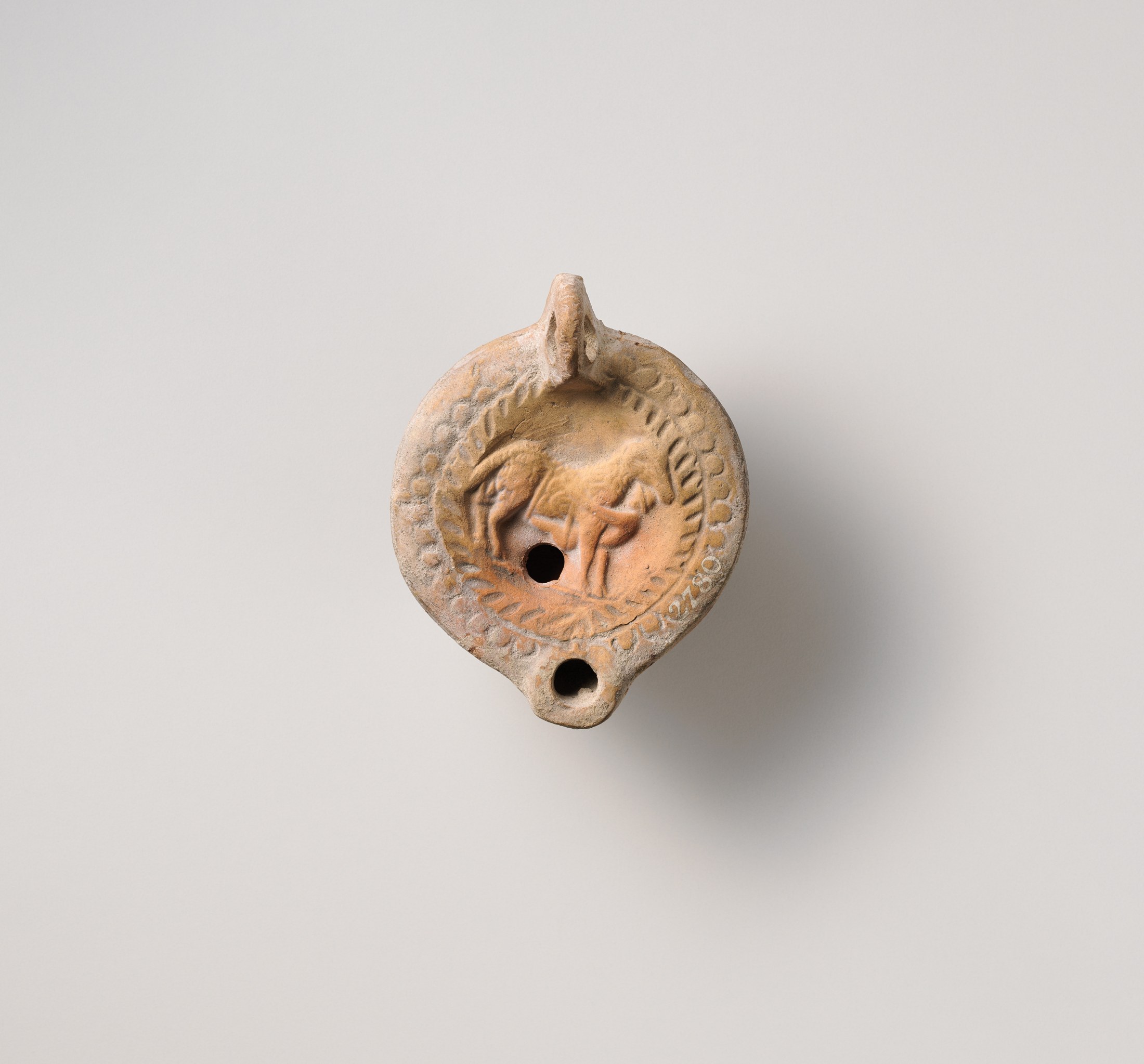 Roman Cypriot terracotta lamp with a Cyclops subject, ca. AD 150-250. Metropolitan Museum of Art, 74.51.2498.
Symbolism and Meaning
Cyclopes helped express the boundary of culture. Polyphemus is strong, rich in flocks and able to survive, but he does not plough, gather in community, respect guest-protecting gods or know gift exchange. His cave is like an inverted house: there is food and hearth, but no human law. Odysseus' victory therefore becomes not only the victory of a man over a monster, but of social order over solitary wildness.
The Hesiodic Cyclopes carry a different symbolism. They show that divine order needs the dark, deep power of craft. Zeus' lightning does not simply fall from the sky; someone has to make it. In this sense the Cyclopes stand near smiths, volcanoes and dangerous knowledge that serves power but never becomes wholly safe.
For ancient art the Cyclops is useful as a figure of scale. He can be shown by huge body, single eye, stone, flock, cave or the scene of blinding. Even if an object preserves only one moment, the viewer could recognize a whole story about cunning, punishment and the danger of the world outside human rules.
The Image After Epic
After Homeric epic the Cyclopes do not disappear. Polyphemus becomes a figure of pastoral and love poetry: a huge, rough and lonely giant sings to Galatea and suffers rejection. This Polyphemus is no longer only a man-eater. He is comic, frightening and pitiable at once, because his strength cannot win love.
In Roman painting and small objects this later Polyphemus could be an attractive subject for a villa or house. The fresco from Boscotrecase shows not Odysseus' cave but a landscape in which the giant belongs to a world of mythological nature. For the owner of such an image the Cyclops was part of educated culture, a sign of knowing Greek poetry.
The Cyclopic image thus passed through several stages: ancient smith of the gods, epic wild man, deceived opponent of Odysseus, giant in love and decorative motif. This changeability explains why the Cyclopes occupied more space in ancient culture than one episode of blinding.
Monuments and Images
Images of Cyclopes survive in different genres. The Proto-Attic amphora with the blinding of Polyphemus gives a very early vase-painting version of the epic episode. The Roman fresco from Boscotrecase shows a different Polyphemus world: landscape, love for Galatea and Hellenistic poetic treatment of the monster. A small lamp reminds us that the myth could also exist on an everyday object.
The difference between these monuments matters. The vase is closer to Odysseus' epic conflict, the fresco to later literary tradition, the lamp to daily use of a recognizable subject. One Cyclops therefore does not replace another: each object shows a separate way in which antiquity understood the one-eyed giant.
Related Topics
- Medusa Gorgon
- Minotaur
- Centaurs
- Sirens
- Scylla and Charybdis
- Cerberus
- Lernaean Hydra
- Greco-Roman Mythology
Literature and sources
- Homer, Odyssey / Iliad
- Perseus Digital Library.
- Hesiod, Theogony
- Perseus Digital Library.
- Pseudo-Apollodorus, Library
- Perseus Digital Library.
- Ovid, Metamorphoses
- Perseus Digital Library.
- Blinding of Polyphemus: amphora from Eleusis
- Metropolitan Museum of Art: object 250946
- Metropolitan Museum of Art: object 241503
Interested in Ancient Rome beyond reading? Join Legio X Fretensis or explore our reenactment directions.


