Odyssey
The Odyssey is an ancient Greek epic poem associated with Homer. It tells of Odysseus' return from the Trojan War to Ithaca and of the restoration of his house after twenty years of absence. If the Iliad is built around Achilles' anger inside a military camp, the Odyssey is built around journey, memory, recognition, hospitality and return to legitimate order.
The hero wins not through one decisive blow, but through endurance, speech, disguise and the ability to wait. The poem gives importance to sea, islands, foreign houses, dangerous hosts, female fidelity, relations between father and son, authority over servants and the question of who has the right to rule a household. The Odyssey is therefore both an adventure narrative and a poem about the boundaries of human society.
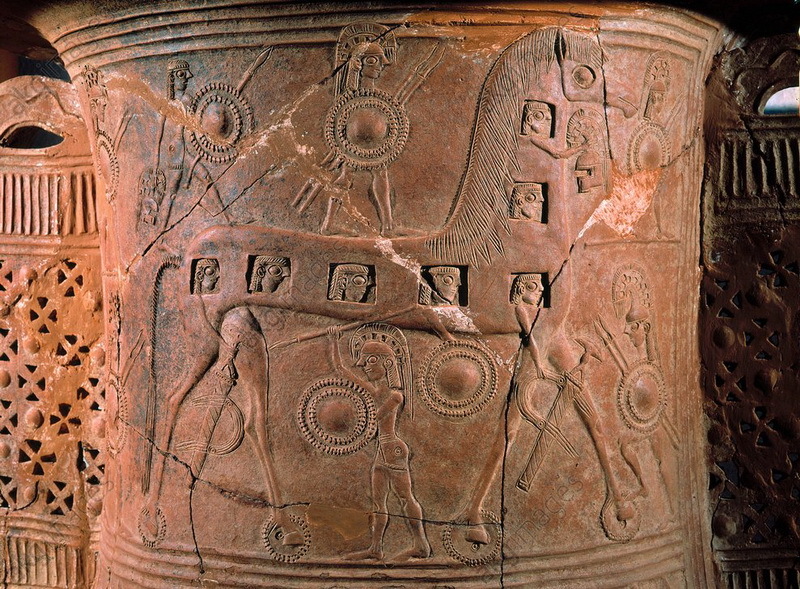 The siege of Troy on the relief amphora from Mykonos, around 670-640 BC; one of the early Greek images of the Trojan myth.
Structure of the Poem
The Odyssey consists of 24 books, but its narrative does not move simply from the start of the journey to the end. The first part is often called the Telemachy: Athena urges Telemachus to seek news of his father, while in Ithaca Penelope's suitors consume Odysseus' house. The action then moves to Odysseus himself, held by Calypso. After shipwreck he reaches the Phaeacians, and there he tells of his earlier wanderings.
This composition matters for the poem's meaning. The reader first sees a house without its master, a son without full authority and a wife forced to resist the pressure of suitors. Only then does Odysseus appear as the man everyone awaits but almost no one recognises. The second half of the poem moves to Ithaca: the hero returns disguised as a beggar, tests the house, recognises loyal and disloyal people, then reveals himself to his son, Penelope and his father Laertes.
Odysseus' Journey
After leaving Troy, Odysseus and his companions meet the Cicones, Lotus-eaters, Cyclopes, Aeolus, Laestrygonians, Circe, shades of the dead, Sirens, Scylla and Charybdis, the cattle of Helios, Calypso and the Phaeacians. These episodes are not a random chain of wonders. Each island tests a different side of human conduct: memory of home, respect for prohibition, treatment of the guest, ability to hear advice and mastery of desire.
Among the Lotus-eaters the danger lies not in violence but in forgetting. With Polyphemus hospitality is broken: the master of the cave does not receive men as guests, but eats them. With Aeolus the mistake arises from the crew's mistrust of Odysseus. Among the Laestrygonians the world again becomes cannibal and anti-social. With Circe men lose human form, yet can be restored to it. Odysseus' journey thus becomes a movement between human order and its destruction.
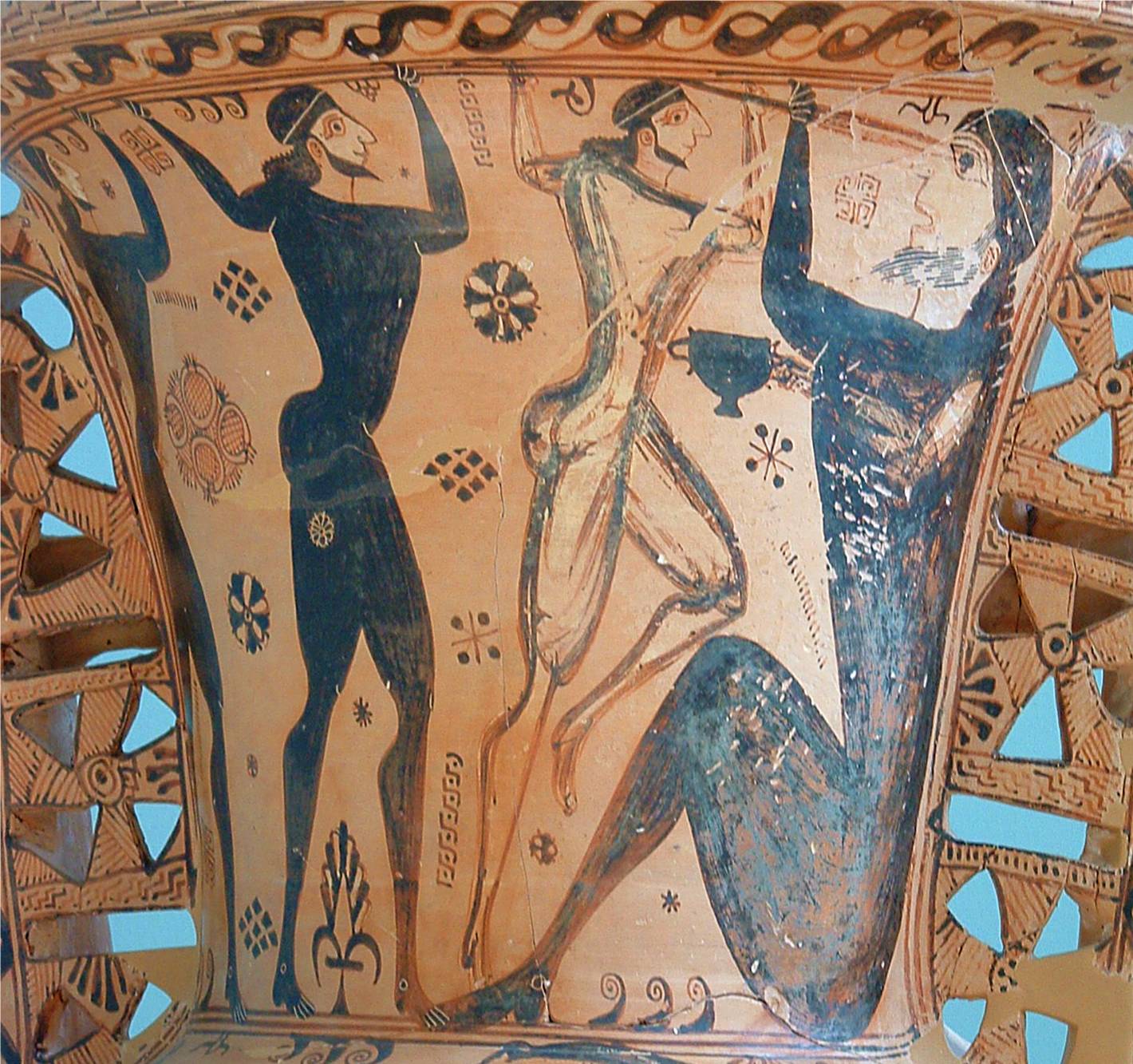 Odysseus and his companions blind Polyphemus. Proto-Attic amphora from Eleusis, around 670 BC; Archaeological Museum of Eleusis.
Odysseus as a Hero of Cunning
Odysseus differs from Achilles by another kind of heroism. His central quality is metis: practical intelligence, flexibility and the ability to find a way out where direct force is insufficient. He calls himself Nobody before Polyphemus, hides his tears among the Phaeacians, enters his own house as a beggar, endures insults and chooses the moment for action. This cunning does not make him a weak hero; rather it shows the military and political strength of a man who knows how to survive.
Yet the poem does not idealise cunning without limits. Odysseus is often saved by speech, but sometimes worsens danger himself: after escaping the cave he reveals his name to Polyphemus, and the Cyclops' curse leads to Poseidon's anger. His false tales on Ithaca help him remain hidden, but also show that truth does not return immediately. Odysseus must prove his identity not by words alone, but by knowledge of the bow, scar, marriage bed and people of his own house.
Gods and Fate
Among the gods Athena and Poseidon are especially important. Athena protects Odysseus because she sees in him a mind akin to her own: the capacity for planning, endurance and hidden action. She helps Telemachus grow, guides Odysseus to the Phaeacians and participates in restoring order on Ithaca. Poseidon, by contrast, pursues the hero for blinding Polyphemus, his son. The conflict of gods makes return not a straight road, but a trial in which the anger of the sea must be endured.
Zeus in the Odyssey more often appears as guardian of a larger moral balance. He reminds us that humans cannot place every disaster on the gods if they themselves act recklessly. Helios demands punishment for the killing of his sacred cattle. Hermes carries the will of the gods to Calypso and helps Odysseus with Circe. The gods act constantly in the poem, yet humans remain responsible for memory, measure and fidelity to prohibition.
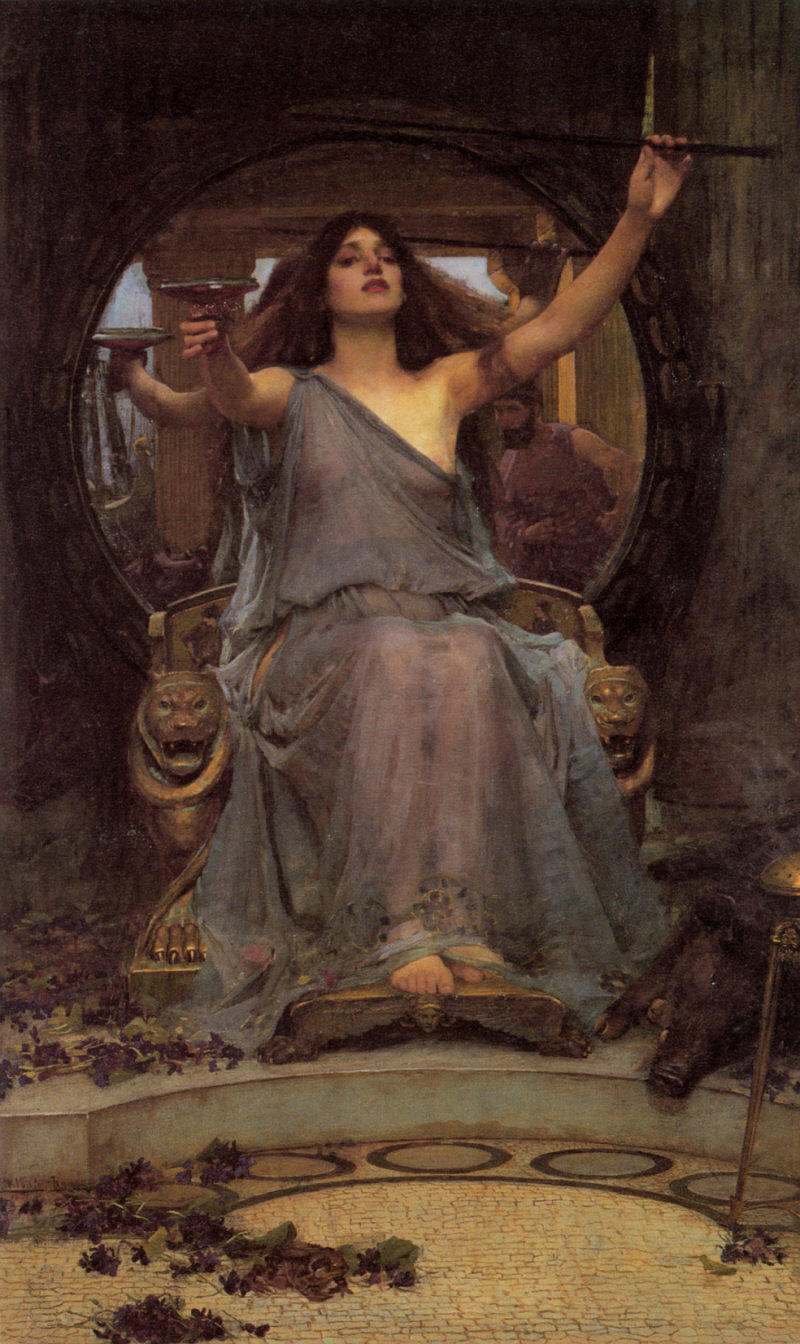 Circe offers a cup to Odysseus. Attic red-figure vessel, 5th century BC; ancient iconography of the trial on the sorceress' island.
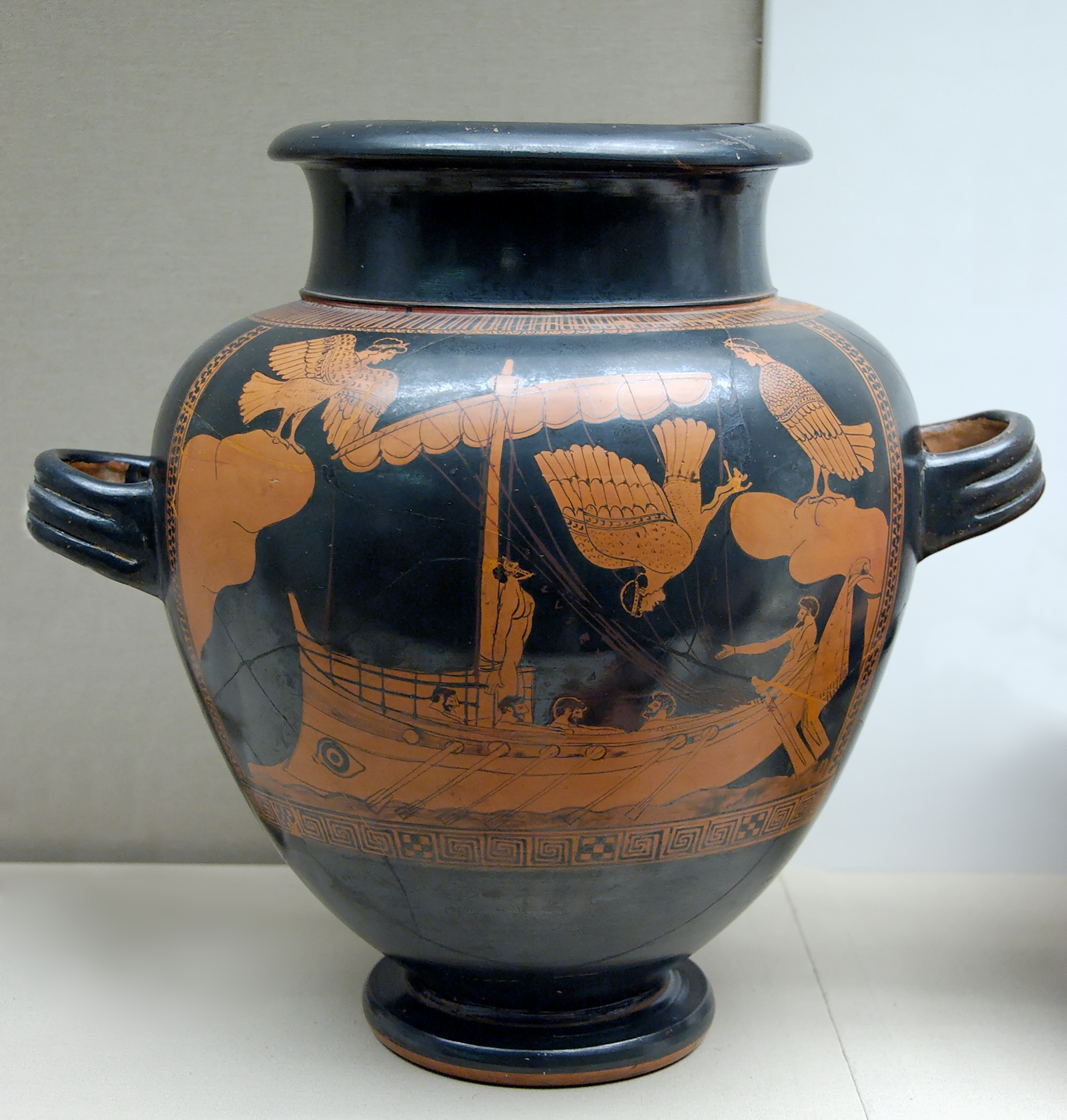 Odysseus and the Sirens. Attic red-figure stamnos, around 480-470 BC; British Museum.
Hospitality and Foreign Houses
The Odyssey constantly tests the rule of xenia, hospitality between host and stranger. A good host first receives the guest, feeds him and gives rest, and only then asks his name and story. Nestor, Menelaus, the Phaeacians and Eumaeus show different forms of proper reception. Polyphemus, the Laestrygonians and Penelope's suitors are the opposite of this order: they consume another's flesh or another's property and turn the house into a place of violence.
This is why the punishment of the suitors at the end is not only a husband's jealousy. They violate the basic order of the house: they consume food, pressure Penelope, plot Telemachus' death, insult the beggar-guest and behave as if the master no longer existed. Odysseus' return restores not only marriage, but the boundary between guest, host, servant and enemy.
Penelope, Telemachus and Ithaca
Penelope is not a passive reward for the hero. She preserves the house through her own cunning: she promises to choose a husband after finishing the burial shroud for Laertes and unweaves it at night. Her caution in the recognition scene is necessary: after years of Odysseus' absence any man could call himself king of Ithaca. The test of the marriage bed shows that true recognition rests on shared past inaccessible to outsiders.
Telemachus at the beginning of the poem does not yet fully possess voice and authority. His journey to Nestor and Menelaus teaches him to speak among elders, learn his father's history and see different models of royal household. Odysseus' return does not cancel the son's growth: in the killing of the suitors father and son act together. Ithaca is therefore not merely the endpoint of a route, but the place where father, son, wife, old father, loyal servants and ancestral land must be joined again.
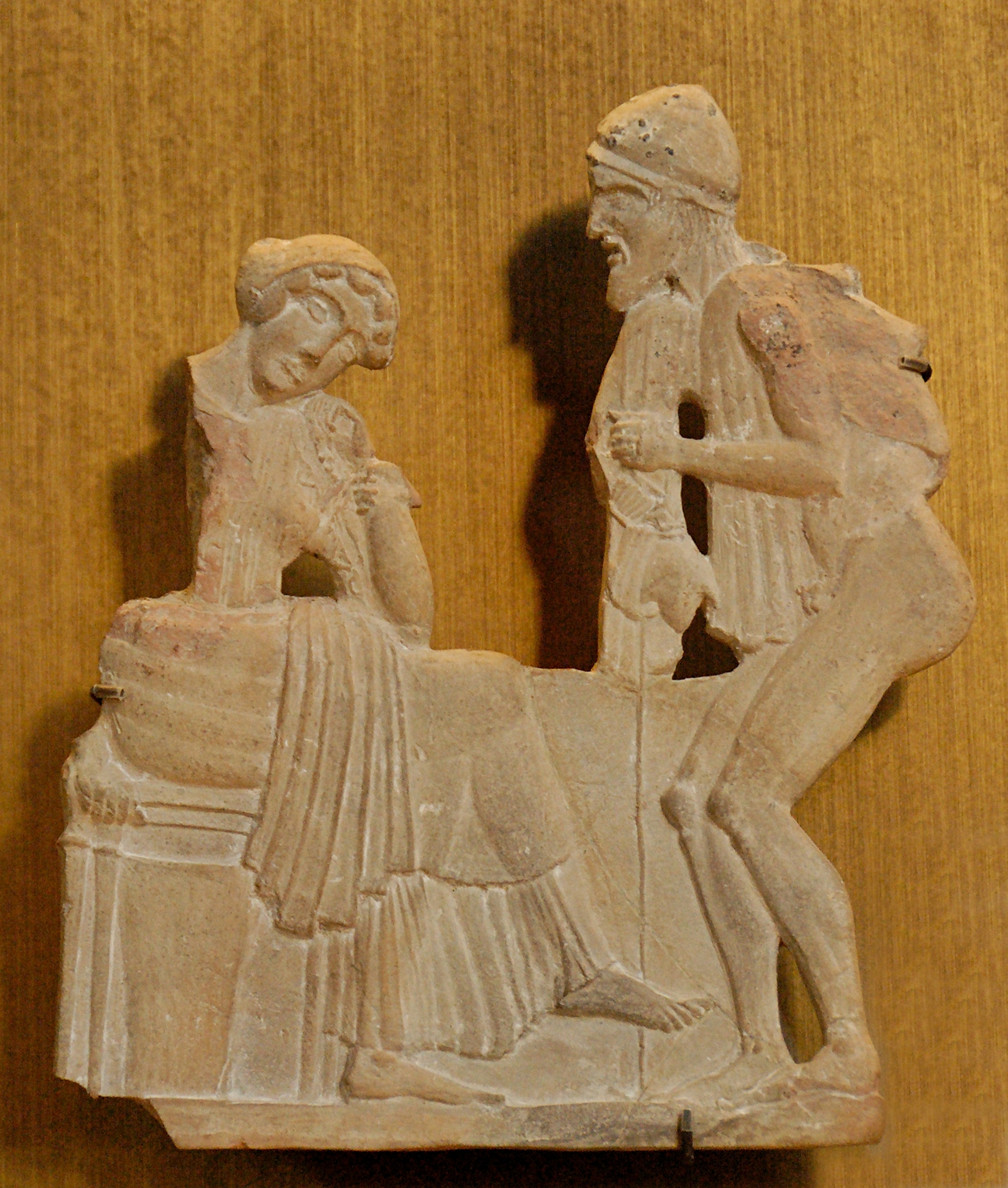 Odysseus and Penelope. Terracotta relief from Melos, around 450 BC; Louvre, CA 860.
Monsters and the Boundaries of the World
The monsters of the Odyssey show that the hero moves along the edges of the human world. Polyphemus lives without assemblies, laws or agricultural order. The Sirens possess knowledge and song, but their knowledge is deadly: it stops the journey and turns the listener into prey. Scylla and Charybdis offer no victory; here one must choose the lesser loss and acknowledge the limit of human power. These scenes made the poem a central source for many images of Greek mythology.
The monsters are not all the same. Against the Cyclops Odysseus wins through planning and collective action. With Circe rescue comes through Hermes' help and an agreement. With the Sirens Odysseus admits his own weakness in advance and orders himself bound. With Scylla and Charybdis he cannot save everyone. Each trial therefore shows not only a danger, but a distinct form of human response.
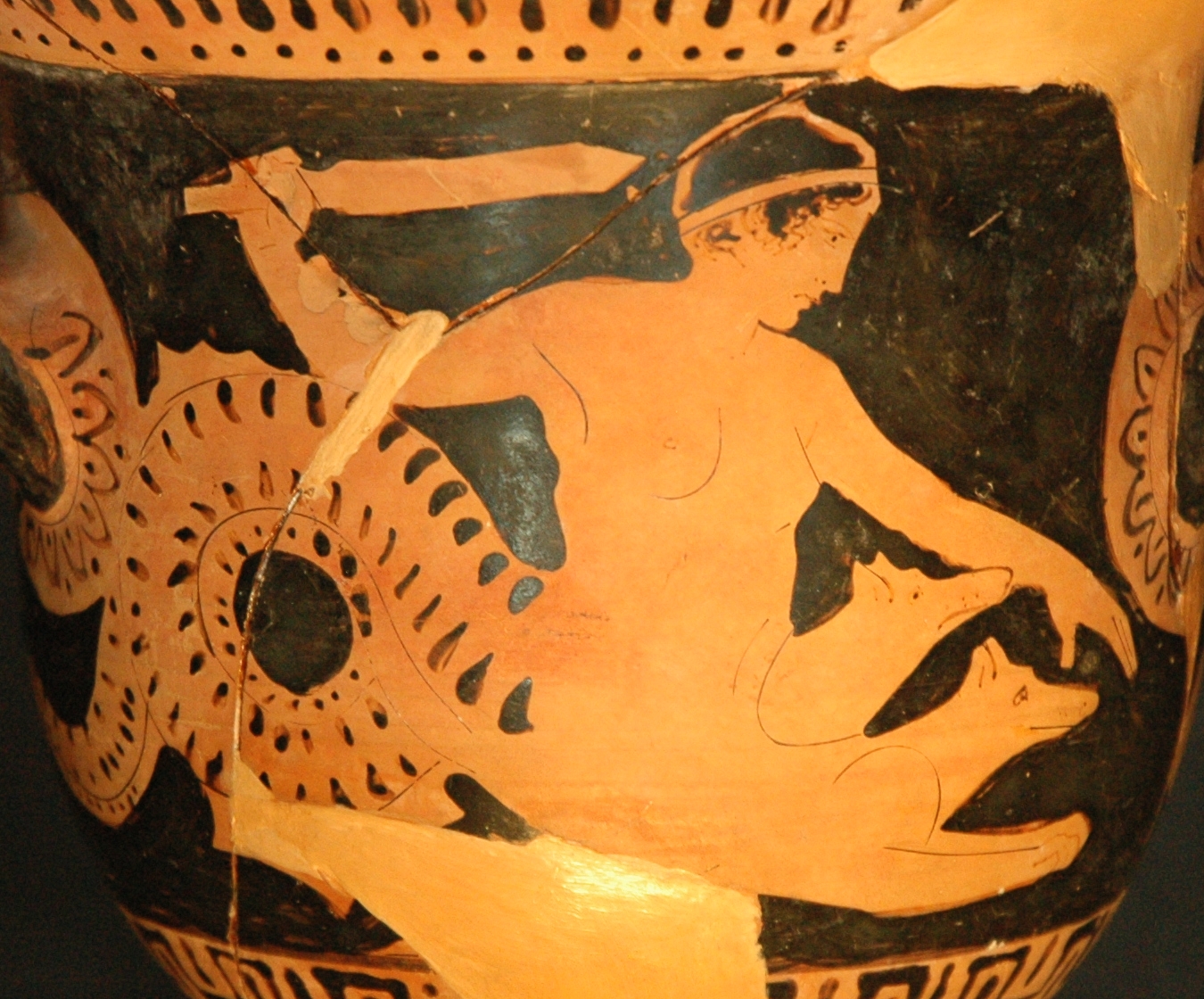 Scylla, detail from side A of a red-figure bell-krater, 450-425 BC. Louvre, CA 1341;.
Language, Memory and Oral Tradition
The Odyssey, like the Iliad, is composed in dactylic hexameter and preserves features of oral epic tradition. Fixed epithets, repeated scenes and formulas of hospitality, sleep, departure, sacrifice and lament create a recognisable order of narration. Yet the Odyssey is especially fond of story within story: Odysseus becomes the singer of his own fate among the Phaeacians, choosing how to present the past to his listeners.
Speech in the poem is therefore an action. Odysseus' false tales protect him, the songs of Demodocus make him weep, Penelope tests her husband with words about the bed, and the stories of Nestor and Menelaus give Telemachus a place in the memory of Troy. To return home one must not only cross the sea, but restore the correct story of who one is, who one's allies are and to whom the house belongs.
Historical and Archaeological Context
The Odyssey is not a travel diary of a real voyage. It joins memory of the Mycenaean world of the Late Bronze Age, experience of seafaring, colonising imagination of Archaic Greeks and poetic geography of the edge of the world. Ithaca, Pylos, Sparta and Troy have real geographical anchors, but many islands of wandering are shaped as testing spaces where human order is examined.
Archaeology helps us understand the material background of the poem: palace centres, megarons, ships, weapons, feasts, elite gifts, burials and images of myths on vases. It does not confirm every stop of Odysseus, but it shows why epic spoke to ancient listeners in a recognisable language of things. Vase painting is especially important: scenes with Polyphemus, Circe, the Sirens and Penelope show how Archaic and Classical Greece imagined episodes of the poem visually.
Influence and Reception
In antiquity the Odyssey was one of the central texts of education. It taught not only words and myths, but models of conduct: how to speak with strangers, how to listen to elders, how to preserve a house, how to recognise falsehood and how to restore authority without an open army. Odysseus could be seen both as a model of wisdom and as a dangerous master of deception. This doubleness made him one of the most vivid heroes of ancient literature.
Later Greek tragedy, Roman literature, philosophy and art constantly returned to Odysseus. For Stoics he could be an example of endurance, for critics a figure of cunning, for Romans part of the world from which Trojan and then Roman destiny emerged. In the European tradition the poem's name came to mean a long journey through trials, whose main aim is not simply to see new lands, but to regain home and name.
Short Chronology
- 13th-12th centuries BC
- the Late Bronze Age Aegean world forms the historical background of Achaean palaces and Trojan traditions.
- 12th-9th centuries BC
- oral songs about the returns of heroes after Troy preserve and rework memory of the war.
- 8th-7th centuries BC
- probable shaping of the Odyssey as a large epic poem in the Homeric tradition.
- 6th-5th centuries BC
- episodes of the Odyssey are actively shown in vase painting; the poem enters education and public performance.
- 3rd-2nd centuries BC
- Alexandrian philologists study the text, the division into books and variants of the manuscript tradition.
- Roman period
- Odysseus becomes a lasting hero of Greco-Roman literature and art.
Related Topics
Literature and sources
- Homer. Odyssey / translated by A. T. Murray. Loeb Classical Library. Harvard University Press.
- Homer. The Odyssey / translated by Richmond Lattimore. Harper & Row, 1965.
- Heubeck A., West S., Hainsworth J. B. A Commentary on Homer's Odyssey. Vol. 1. Oxford University Press, 1988.
- Heubeck A., Hoekstra A. A Commentary on Homer's Odyssey. Vol. 2. Oxford University Press, 1989.
- Russo J., Fernandez-Galiano M., Heubeck A. A Commentary on Homer's Odyssey. Vol. 3. Oxford University Press, 1992.
- Clay J. S. The Wrath of Athena: Gods and Men in the Odyssey. Princeton University Press, 1983.
- Malkin I. The Returns of Odysseus: Colonization and Ethnicity. University of California Press, 1998.


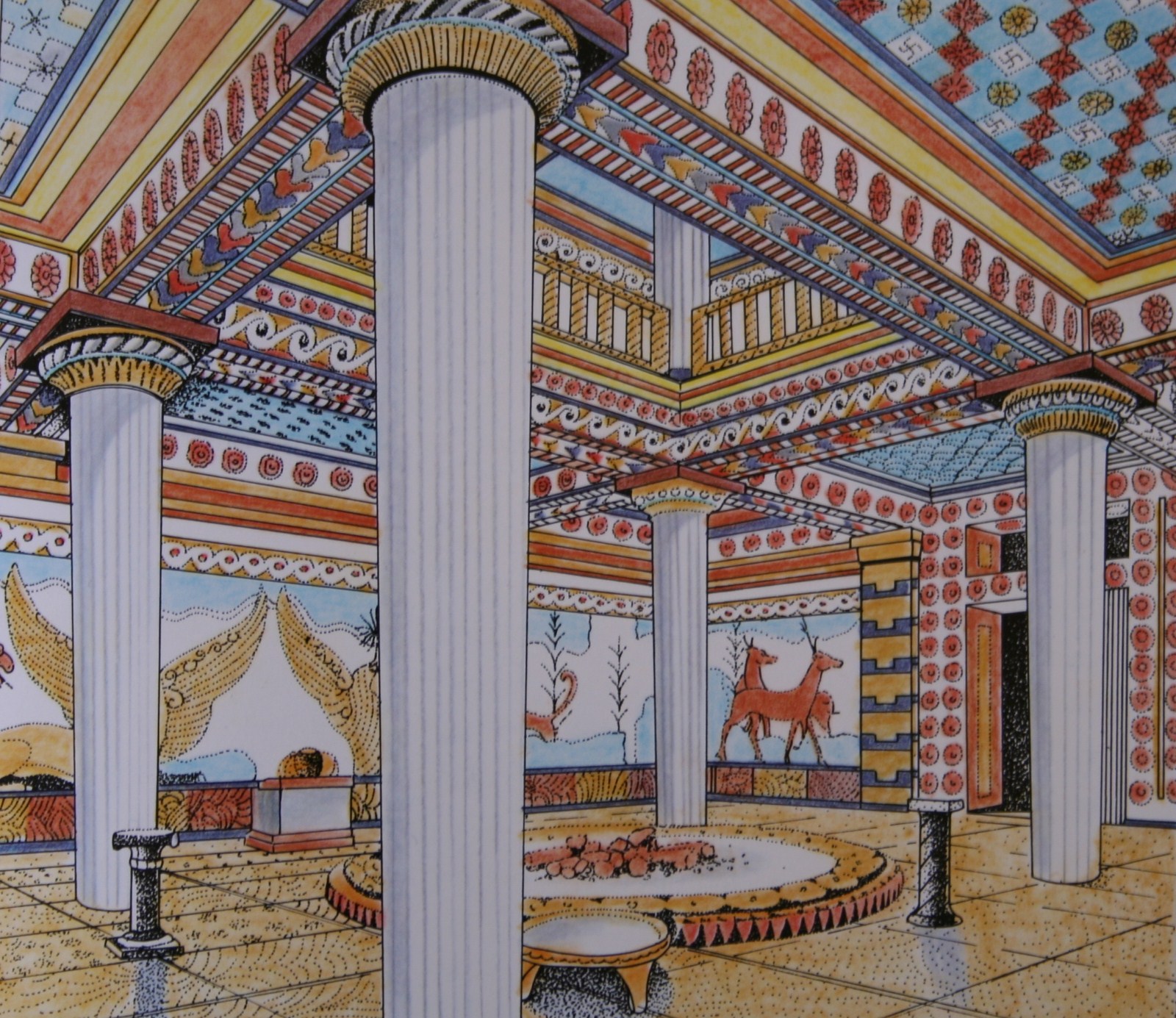 Reconstruction of a Mycenaean megaron; the palace world of the Late Bronze Age helps frame the world reworked by epic.
Interested in Ancient Rome beyond reading? Join Legio X Fretensis or explore our reenactment directions.


