Scylla and Charybdis
Scylla and Charybdis are a pair of sea dangers in Greek mythology. In the Odyssey they stand on opposite sides of a narrow passage: Scylla snatches men from the ship, while Charybdis swallows and vomits water. Together they create a situation of choosing between two disasters. The phrase "between Scylla and Charybdis" became fixed precisely because the myth shows not victory over a monster, but the need to pass through unavoidable loss.
Scylla usually has the more developed image in art: a female upper body, dog heads or animal protomes at the waist, fish tail, oar or marine attributes. Charybdis is harder to depict because she is not so much a body as a whirlpool and a collapse of water. Visual tradition therefore often concentrates on Scylla, while literary memory holds the pair together.
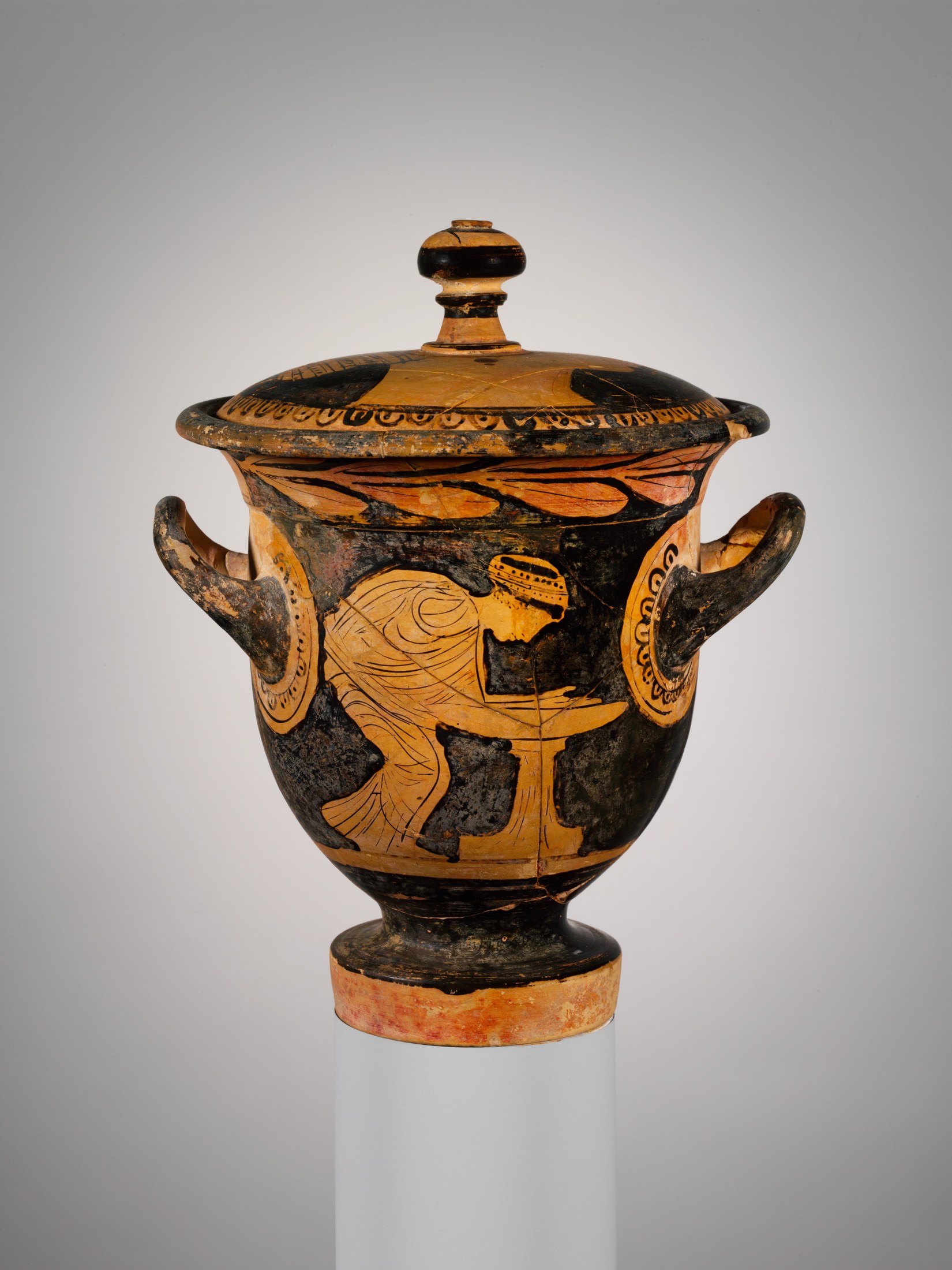 Boeotian bell-krater with lid and an image of Scylla, late fifth century BC. Metropolitan Museum of Art, 06.1021.197.
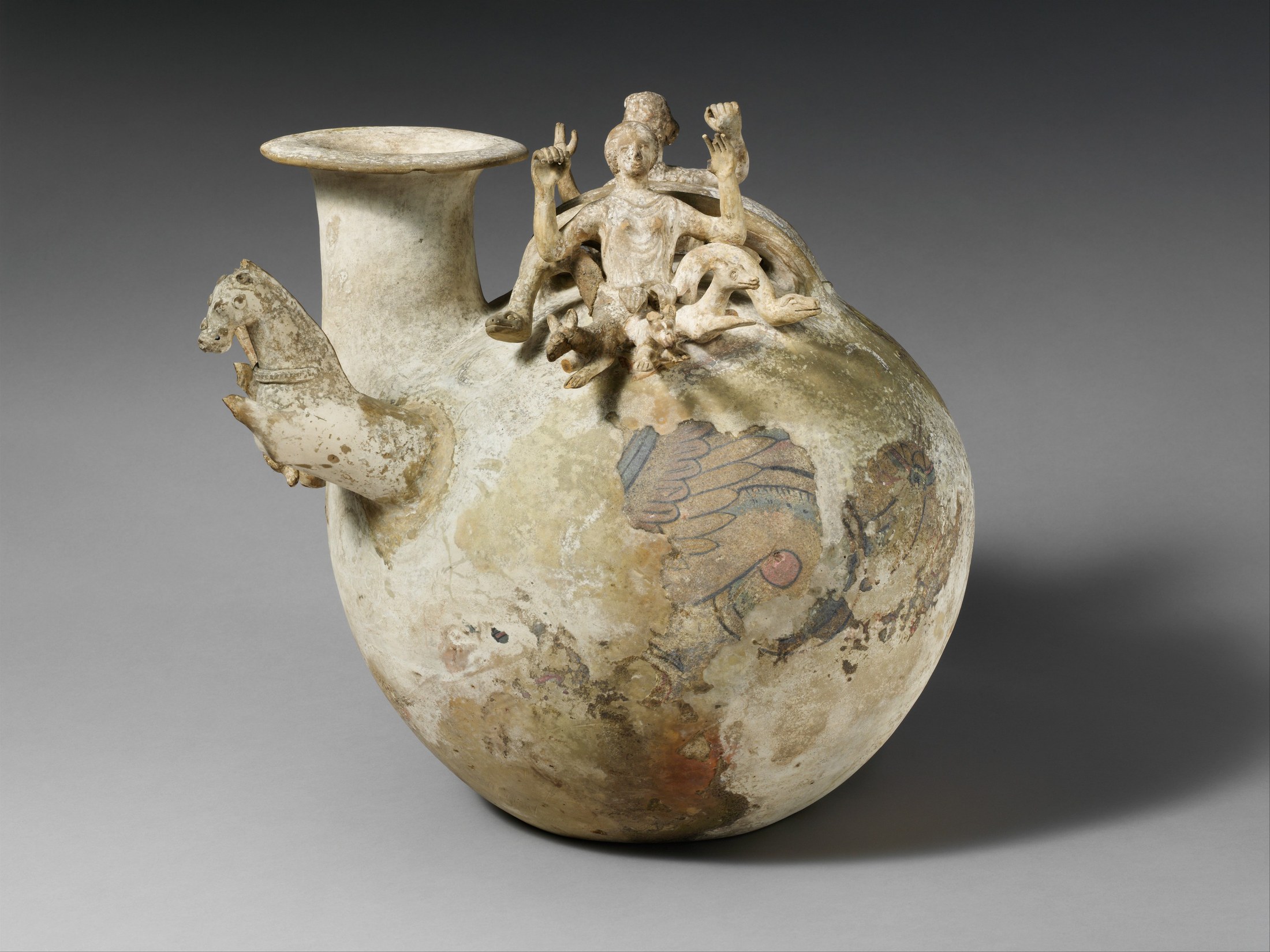 South Italian Canosan askos with the figure of Scylla, third century BC. Metropolitan Museum of Art, 06.1021.219.
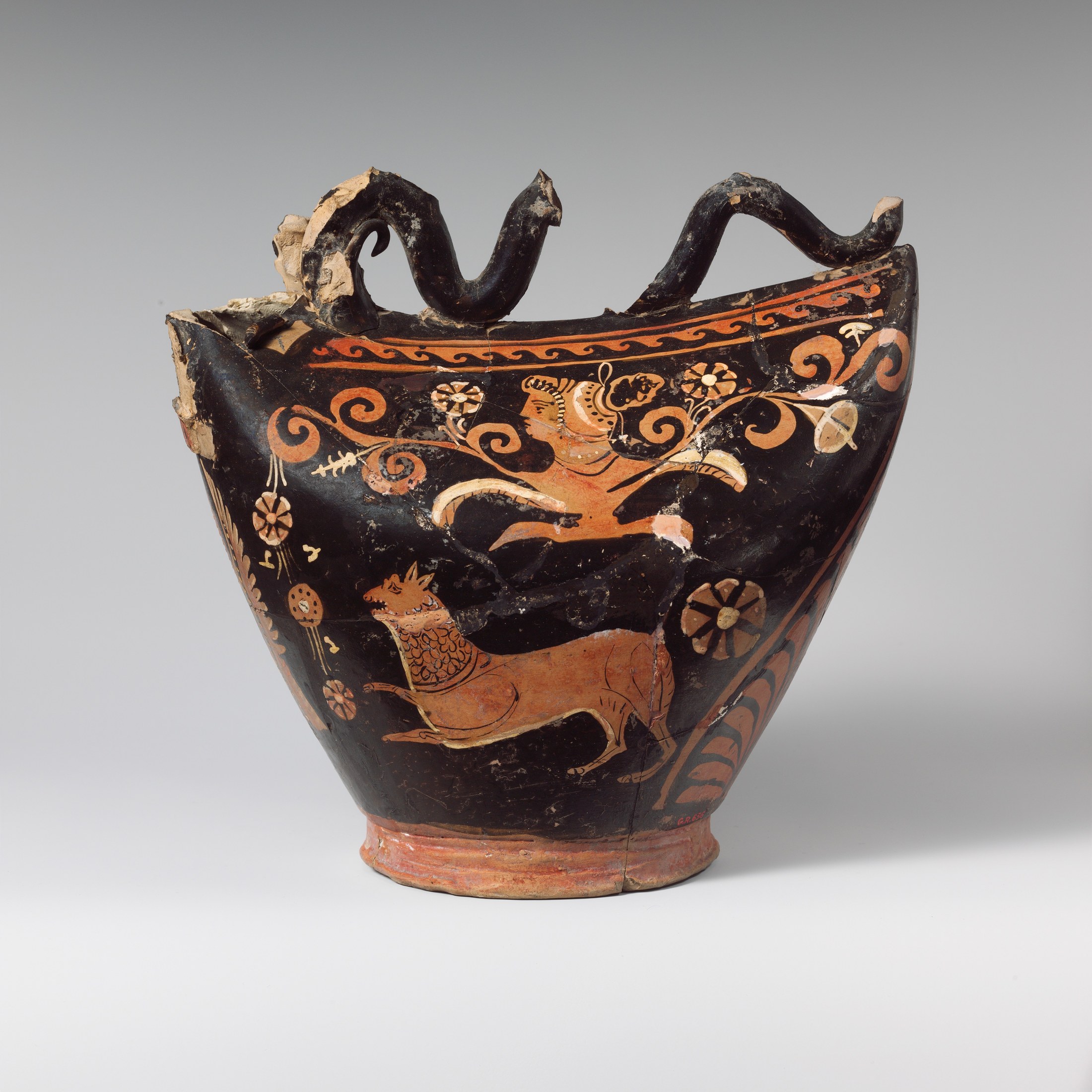 South Italian Apulian askos with Scylla, ca. 300 BC. Metropolitan Museum of Art, 06.1021.202.
Odysseus and the Choice of Lesser Loss
Circe warns Odysseus: on one side is Scylla's rock, on the other Charybdis. The hero has no completely safe passage. If he approaches Charybdis, the whole ship may perish; if he approaches Scylla, he will lose some men. Odysseus chooses the path past Scylla, hiding the full danger from the crew because panic could destroy everyone.
The episode is cruel because it gives the hero no clean victory. Odysseus is usually strong in intelligence, but here his intelligence is needed to choose damage. Scylla seizes six companions and the ship passes on. The myth shows the limit of heroic power: sometimes wisdom does not save everyone, but only prevents the journey from total ruin.
Charybdis returns later in the story when Odysseus alone clings to wreckage after the ship's destruction. She swallows the raft and then throws it out. The pair of dangers thus works not only as a geographic point, but as a rhythm of maritime disaster: narrow passage, loss of men, return of danger and survival at the edge.
The Form of Scylla and the Myth of Transformation
In different versions Scylla was a nymph or girl transformed into a monster. The transformation motif makes her not only an external threat but spoiled beauty. In later poetry the cause may be jealousy, Circe's magic or the desire of a sea deity. As a result Scylla's body becomes composite: woman, fish, dogs, sea mouth and cry.
The dog heads around her body explain why Scylla snatches men from the ship. She is not one animal, but many mouths acting at once. Her image is useful for artists: it can show movement, sea power and bodily horror without representing the entire Odyssey scene.
Charybdis, by contrast, almost lacks an individual body. She may be a daughter of gods or a punished being, but in epic she acts as a water force. In the pair Scylla gives fear a form, while Charybdis gives it bottomlessness. They cannot be fully separated: one is visible, the other almost ungraspable, and together they form the maritime boundary of choice.
Symbolism of the Passage
Scylla and Charybdis mattered for ancient thought because they turned a route into a moral problem. The sea in the Odyssey constantly tests the hero: storm, island, sleep of companions, forgetting home, forbidden cattle. The narrow passage between two monsters is the clearest image of a situation with no good solution.
For a sailor such a myth was connected with real experience of straits, currents, rocks and unpredictable water. But the myth is not reducible to a navigational note. It turns natural danger into a language of choice. Odysseus must decide what loss can be endured and accept responsibility for a decision that will still bring death to men.
The pair therefore became a stable metaphor. Scylla and Charybdis do not require the hero to defeat both forces. They require him to pass while preserving the goal. In this sense their meaning is closer to tragic choice than to an ordinary fight with a monster.
Monuments and Images
Scylla is especially visible in South Italian and Boeotian pottery. The krater and askoi show that she could be not only an episode of the Odyssey but an independent decorative and mythological motif. Her composite body allowed artists to join female figure, sea monster and the movement of the vessel.
Charybdis has almost no equally stable iconography, and this itself matters. Archaeological sources confirm the asymmetry of the pair: the ancient text preserves both dangers, while images more often choose the one that can be given a body. An article on Scylla and Charybdis must therefore consider not only what survives in art, but also what was difficult to depict.
Related Topics
Literature and sources
- Homer, Odyssey / Iliad
- Perseus Digital Library.
- Hesiod, Theogony
- Perseus Digital Library.
- Pseudo-Apollodorus, Library
- Perseus Digital Library.
- Ovid, Metamorphoses
- Perseus Digital Library.
- Metropolitan Museum of Art: object 247395
- Metropolitan Museum of Art: object 248471
- Metropolitan Museum of Art: object 246576
Interested in Ancient Rome beyond reading? Join Legio X Fretensis or explore our reenactment directions.


