Sirens
The Sirens are figures of Greek mythology whose song promises knowledge and delight but leads travellers to death. In the Odyssey they sit in a flowering meadow among the bones of dead sailors and call to Odysseus, promising to tell him everything that happened at Troy and everything taking place on earth.
This episode made the Sirens an image of dangerous knowledge and a test of self-control. Odysseus wants to hear their song without dying: he orders his companions to seal their ears with wax, while he has himself tied to the mast and tells them not to release him no matter how urgently he begs. In ancient tradition the Sirens are therefore linked not only with maritime danger, but with the boundary between reason, curiosity and deadly temptation.
Origin and Names
Ancient versions gave the Sirens different origins. They were called daughters of the river god Achelous and one of the Muses, daughters of Phorcys, or beings once connected with Persephone's retinue. These variants show that the figure was not fixed by a single genealogy: the Sirens stood between music, water, death and the underworld.
Their names also varied. Later authors mention Parthenope, Ligeia, Leucosia, Aglaopheme, Thelxiope and other forms. This instability matters: in early tradition the Sirens function above all as a group rather than as characters with separate biographies. Their force lies in voice, knowledge and the dangerous place through which the hero must pass.
Sirens in the Odyssey
The central ancient text on the Sirens is book 12 of the Odyssey. Circe warns Odysseus in advance: anyone who approaches and hears the Sirens' song will never return home, because he will forget his route, family and duty. This warning places the episode beside Odysseus' other maritime trials, including Scylla and Charybdis, the Wandering Rocks and the island of Helios.
The Sirens' song is not described as a simple erotic lure. They promise knowledge: the hero will learn the past, the war and the fates of people. Odysseus therefore does not block his own ears, but creates a technical solution that lets him experience the danger without dying. The mast, ropes and wax become part of the myth just as much as weapons do in scenes of combat with monsters.
Appearance in Ancient Art
In early Greek art the Sirens most often appear as birds with female heads, sometimes with human arms. The later image of a woman with a fish tail belongs to another visual tradition and should not be projected automatically onto Archaic and Classical Greece. For an ancient viewer the Siren was above all a hybrid of voice, wings and threshold space.
On vases and small terracottas Sirens may stand near a hero, sit on a rock, or occupy the vessel as a protective or funerary image. In funerary contexts they are connected with lament, music and the passage of the dead into another world. Archaeological images therefore show not one simple 'illustration of the Odyssey', but a wider field of meanings: maritime danger, memory of death, female voice and the power of song.
Visual and Archaeological Sources
The ancient appearance of the Sirens is known not only from literature but also from objects: painted vessels, terracotta figurines, reliefs and wall paintings. These monuments show that the Greek Siren was usually a bird with a female head or torso, not a woman with a fish tail. Ancient images should therefore be read separately from the medieval and modern mermaid tradition.
Vessels placed Sirens in the world of feasting, song and storytelling; terracotta figures and funerary images connected them with death and memory; Roman and later images could emphasise musical attributes. The same myth changed its meaning according to the object: on a vase it was an episode in Odysseus' wanderings, while in a funerary context it became an image of voice, memory and passage beyond life.
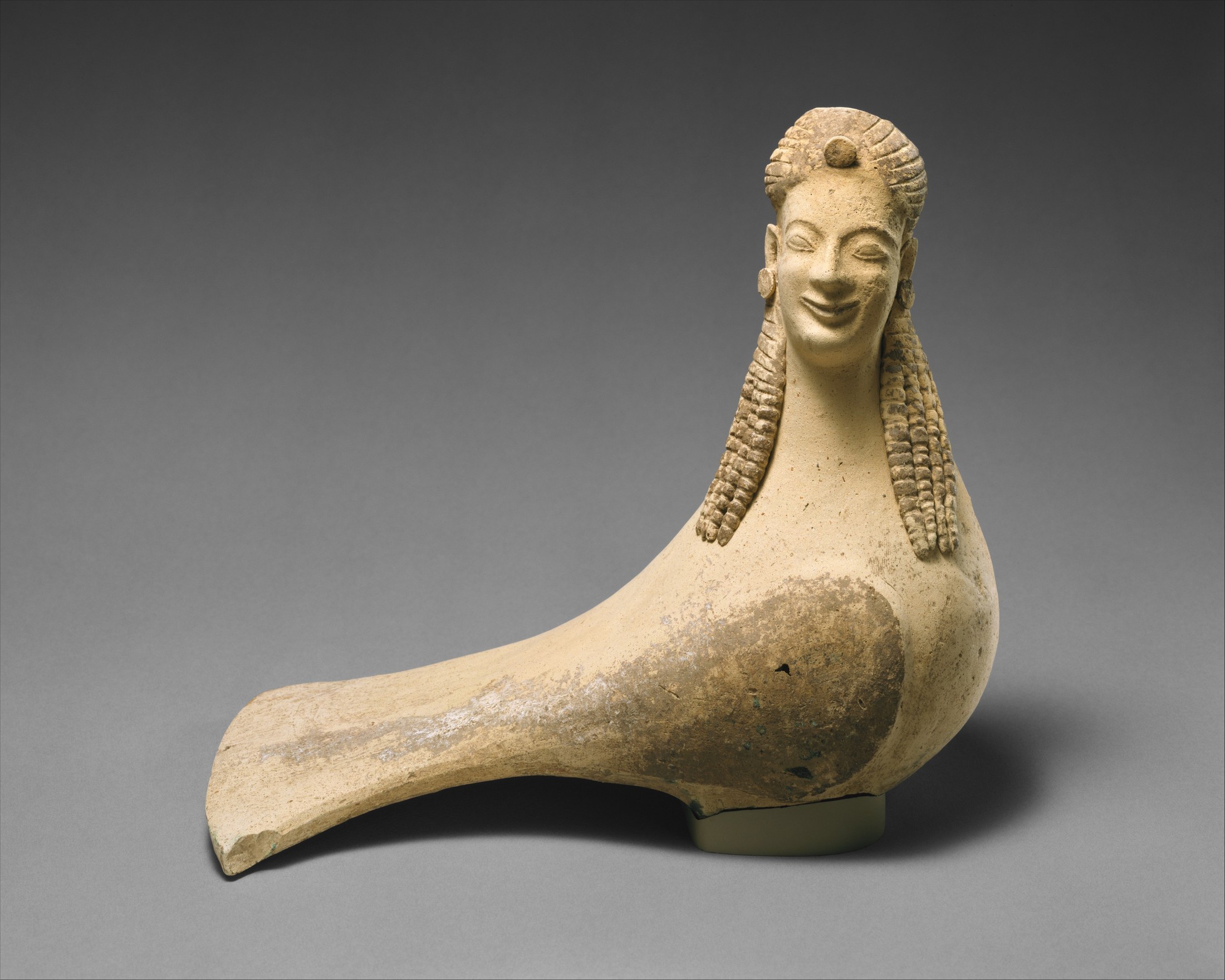 Greek terracotta statuette of a siren, ca. 550-500 BC. The bird body and female head belong to the early form of the Sirens. Metropolitan Museum of Art, 74.51.1611.
 Roman fresco fragment with a siren, first century AD. Metropolitan Museum of Art, 17.190.2070.
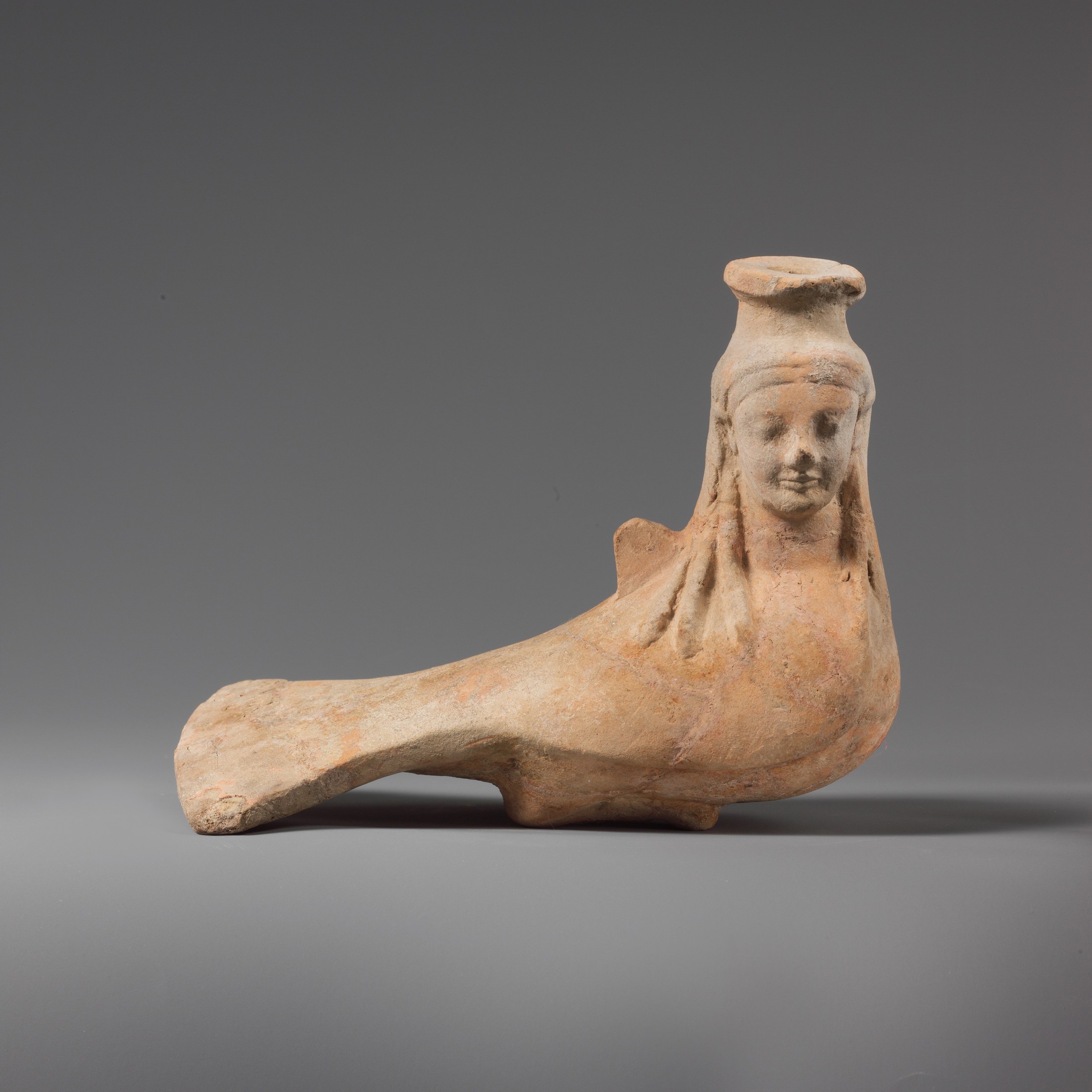 East Greek Rhodian aryballos in the form of a siren, ca. 550-500 BC. Metropolitan Museum of Art, 41.162.159.
Later Tradition
In Hellenistic and Roman culture the Sirens gradually moved beyond the single episode of the Odyssey and became a durable sign of enchanting but dangerous music. They could be shown with instruments, near tombs or within decorative programs where the literal scene with Odysseus mattered less than the idea of a voice at the boundary between life and death.
Later European tradition brought Sirens close to sea-maidens and mermaids. This change was useful for literature and emblems, but it obscures the ancient archaeological material. For an article on the ancient world the early type should remain central: Sirens as bird-like female hybrids connected with song, death, travel and the hero's trial.
Related topics
Literature and sources
Homer. Odyssey, XII.39-54; XII.158-200.
Apollonius Rhodius. Argonautica, IV.891-921.
Apollodorus. Bibliotheca, Epitome 7.18-19.
Pausanias. Description of Greece, IX.34.3.
Lexicon Iconographicum Mythologiae Classicae (LIMC), Seirenes.
Beazley Archive Pottery Database: images of Sirens in Greek vase painting.
Metropolitan Museum of Art: archaeological and museum parallels for Siren images in terracotta, vase painting and Roman wall painting.
Interested in Ancient Rome beyond reading? Join Legio X Fretensis or explore our reenactment directions.


