Iliad
The Iliad is an ancient Greek epic poem associated with Homer. It does not tell the whole Trojan War, but a short and intense episode from its final year: the wrath of Achilles, the crisis of the Achaean army, the death of Patroclus, revenge on Hector and Achilles' reconciliation with Priam. The poem is therefore not a simple military chronicle. Its main subject is the collision of personal honour, authority of the leader, friendship, fate, family duty and the cost of heroic glory.
For Greeks the Iliad was at once a monument of poetry, a school of language, a storehouse of myth and an image of the heroic past. It shaped ideas about war, kingship, gods, burial, male courage and pity for an enemy. In antiquity the poem was read together with the Odyssey, but the two works are structured differently: the Odyssey centres on return home, while the Iliad centres on the destructive force of anger inside a military community.
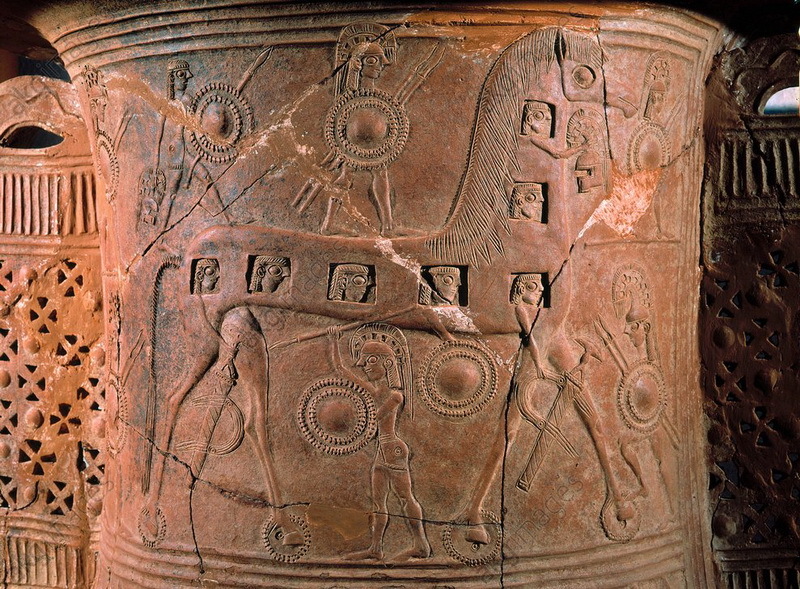 The siege of Troy on the relief amphora from Mykonos, around 670-640 BC; one of the early Greek images of the Trojan myth.
Place in the Trojan Myth
In the mythological chronology the Iliad stands near the end of the war, but it does not describe the abduction of Helen, the gathering of the Achaeans, the beginning of the siege, the wooden horse or the fall of Troy. These stories belonged to the wider Trojan cycle and later retellings. The Homeric poem selects one crisis and through it shows the whole world of war: kings and ordinary warriors, women of the city, old men, gods, burials, booty, ships, walls and battlefield.
This narrowing gives the poem its power. The quarrel between Achilles and Agamemnon in the first book seems like a private conflict between two leaders, but gradually becomes a disaster for the whole army. Achilles' refusal to fight changes the balance of the war, raises Hector's importance, exposes Agamemnon's weak authority and leads to Patroclus' death. The final book does not end the war, but it completes the moral line: Achilles returns Hector's body to Priam and for a moment recognises shared human suffering.
Plot of the Poem
The poem begins with disease in the Achaean camp. Apollo punishes the army for the insult to his priest Chryses, and Agamemnon is forced to return the captive Chryseis. To preserve his prestige he takes Briseis from Achilles. Achilles sees this as public humiliation, refuses to fight and asks his mother Thetis to persuade Zeus to grant temporary success to the Trojans. From the beginning the poem shows that heroic honour is not an abstract feeling, but part of the political order of the army.
In the middle books the war unfolds with growing pressure. Agamemnon tests the army, the Catalogue of Ships is given, Menelaus and Paris fight a duel, Diomedes receives his aristeia, Hector returns to the city and parts from Andromache, and the Trojans break through to the ships. The embassy to Achilles does not bring him back to battle: Agamemnon's gifts are not enough, because the dispute concerns not only objects, but recognition of status.
The turning point comes when Patroclus enters battle in Achilles' armour. He drives the Trojans away from the ships, but goes too far and dies by Hector's hand after Apollo's intervention. Achilles returns to war no longer because of the earlier insult, but because of personal loss. Hephaestus makes him new armour, including the famous shield with images of cosmos, cities, trial, wedding, harvest and war. Achilles' victory over Hector is the climax, but not the end of the poem's meaning: after the killing the question of the proper measure of revenge remains.
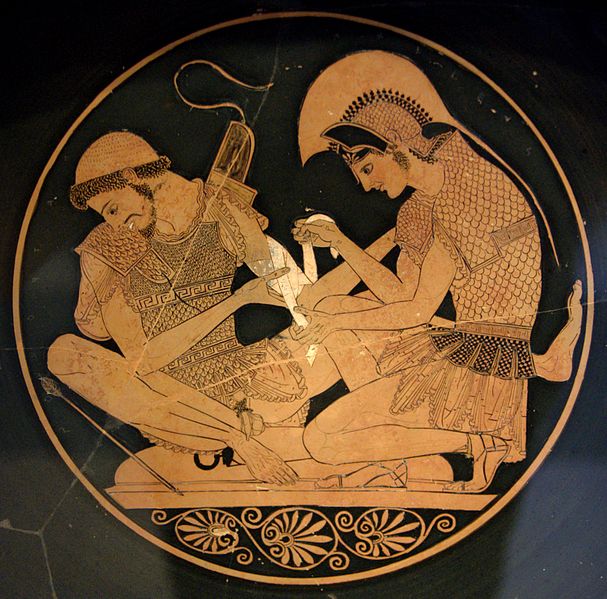 Achilles bandages the wounded Patroclus. Red-figure vase from Vulci, around 500 BC; a scene from the Trojan cycle.
Achilles, Hector and Other Heroes
Achilles is the strongest Achaean warrior, but his greatness is tied to an inner fracture. He knows his short fate and chooses glory over long life. His anger is first directed against Agamemnon, then against Hector, and in the final books against human limitation itself. The scene with Priam matters because Achilles briefly leaves the state of inhuman fury and sees his own father Peleus in the old king.
Hector is the chief defender of Troy. Unlike Achilles, he is shown not only as a warrior, but also as son, husband, father and representative of the city. His meeting with Andromache and little Astyanax makes Troy's fate personal and familial. Hector too seeks glory, but his choice is tied to duty toward walls, parents, wife and people. His death is therefore not merely the fall of an enemy, but a sign of the city's future destruction.
Agamemnon embodies the authority of the supreme leader, but the poem constantly shows the limits of that authority. Odysseus matters as negotiator, counsellor and master of speech. Ajax is the heavy force of defence, especially at the ships. Diomedes in his aristeia almost reaches the level of heroes of an earlier age. Patroclus has a special place: he is gentler than Achilles, capable of pity, and dies because he tries to combine his friend's glory with the rescue of the army.
 Achilles and Troilus. Black-figure Attic vase of the Tyrrhenian group, 575-550 BC; Archaeological Museum, Florence.
Gods, Fate and Responsibility
The gods of the Iliad act directly: Apollo sends disease, Athena restrains Achilles from killing Agamemnon, Hera and Athena support the Achaeans, Aphrodite and Apollo help the Trojans, and Zeus tries to hold the larger course of fate. Divine intervention does not cancel human choice. Heroes decide, argue, err, cross limits and bear consequences even when a god stands nearby.
Fate in the poem is not a simple command. Zeus may weigh lots of death, yet he himself feels pity for Sarpedon and Hector. Achilles knows that early death awaits him, but chooses the road that leads to glory. Hector understands the danger of meeting Achilles, yet cannot abandon the defender's duty. The tragic force of the Iliad is built from this tension between knowledge, desire, honour and necessity.
War, Society and Honour
The Iliad provides rich material for understanding a warrior society, although it cannot be read as a direct report on the Bronze Age. The poem emphasises retinues of leaders, assembly, council of elders, feast, distribution of booty, gift exchange, duels, seizure of armour, ransom of captives and funeral games. Authority rests not only on command, but also on the ability to speak, persuade, give, distribute booty and recognise the status of others.
The key concept is timē (τιμή), recognised honour and a hero's share in the common order. When Agamemnon takes Briseis from Achilles, he takes not only a captive woman, but also a visible sign of status. Kleos, glory, works differently: it outlives the body and makes the hero's short life known to future generations. Between timē and kleos lies Achilles' main dilemma: live long without the highest glory, or die early and become a measure of heroic name.
Women and the City
Women in the Iliad rarely determine the course of battle, but through them the poem shows the cost of war. Helen lives between guilt, shame and beauty for which men continue to fight. Andromache sees Hector not only as a hero, but as the last protection of her house. Hecuba and Priam represent the older generation losing sons and city. Briseis and Chryseis remind us that booty and captivity are part of the military order, but human lives stand behind that order.
Troy in the poem is not a faceless fortress. It contains palace, walls, gates, sanctuaries, towers, families and the memory of future destruction. The Greek camp, by contrast, is arranged around ships: a temporary, military, male space. The contrast between city and camp makes the conflict larger than a single battle. The Achaeans seek victory and booty, while the Trojans defend the place where their parents, wives and children live.
Language and Structure
The Iliad is composed in dactylic hexameter and belongs to the tradition of oral epic poetry. Repeated formulas, fixed epithets and type-scenes of feast, arming, duel, prayer or burial are not poverty of language. They help sustain a long narrative, connect episodes and create a solemn order. "Swift-footed Achilles", "Hector of the shining helm" or "ox-eyed Hera" function as signs of recognition.
The division into 24 books became fixed in ancient book culture and is connected with the work of Hellenistic scholars. Within the poem one can see large blocks: the quarrel and withdrawal of Achilles, Achaean defeats, exploits of individual heroes, crisis at the ships, death of Patroclus, return of Achilles, death of Hector and ransom of the body. This composition sustains tension even when the action temporarily moves away from the main hero.
Archaeological and Historical Context
The Iliad preserves memory of a world that cannot be assigned to one period. It contains traces of the Late Bronze Age, Mycenaean palaces, war chariots, bronze weapons, royal families and distant expeditions. At the same time the poem shows features of the later Homeric Age: social relations, assemblies of warriors, ideas of gift exchange and forms of epic language. The poem is valuable not as a record of events, but as a complex memory in which different layers of the past are joined into an artistic whole.
Excavations of Troy at Hisarlik and study of the Achaean states of the second millennium BC show that the Trojan myth stands behind a real Aegean world of the Late Bronze Age. Archaeology does not prove the events of the Iliad word for word: it shows fortified settlements, destructions, trade links, weapons, palaces and elite burials. Epic transforms this material into a story of honour, anger and fate, not into an annal of one siege.
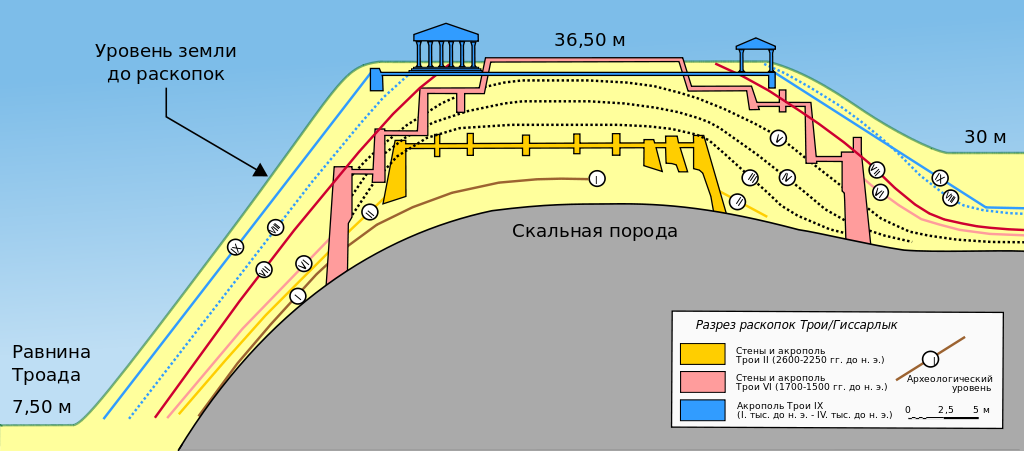 Section of the Troy excavations at Hisarlik; the site's many layers are important for comparing epic and archaeology.
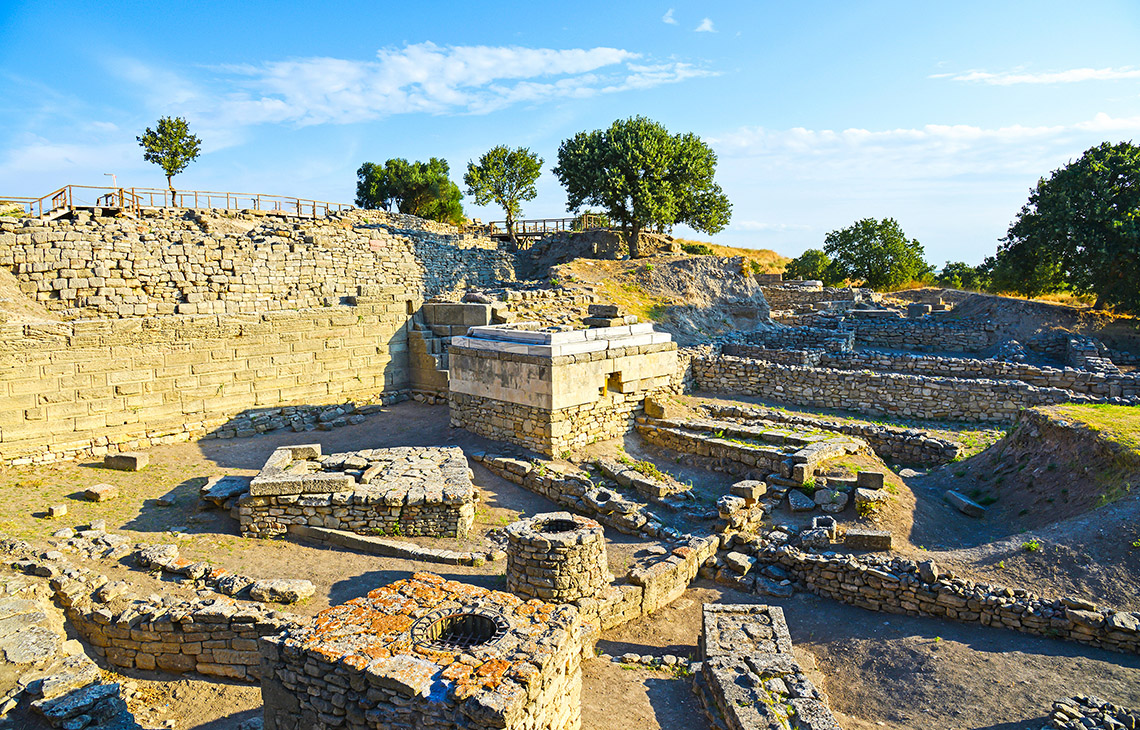 Troy, Hisarlik in modern Turkey; general view of the archaeological site.
Influence and Reception
In ancient Greece the Iliad was part of education and public memory. Rhapsodes performed epic at festivals, teachers used Homer as a model of language, and poets and tragedians argued with his heroes. Athenian tragedy, vase painting, sculpture and later epic cycles constantly returned to Achilles, Hector, Helen, Ajax, Priam and Andromache. Even scenes absent from the Iliad itself were often perceived through Homeric authority.
At Rome the Iliad became one of the main Greek texts through which the elite learned language and mythology. Roman tradition paid special attention to the Trojan side because through Aeneas it connected the fall of Troy with Rome's future. The Aeneas and Aeneid tradition therefore did not merely continue Trojan material, but translated it into a Roman language of fate, authority and origin. In European culture Achilles and Hector remained two different images of heroism: the fury of the solitary warrior and the endurance of the city's defender.
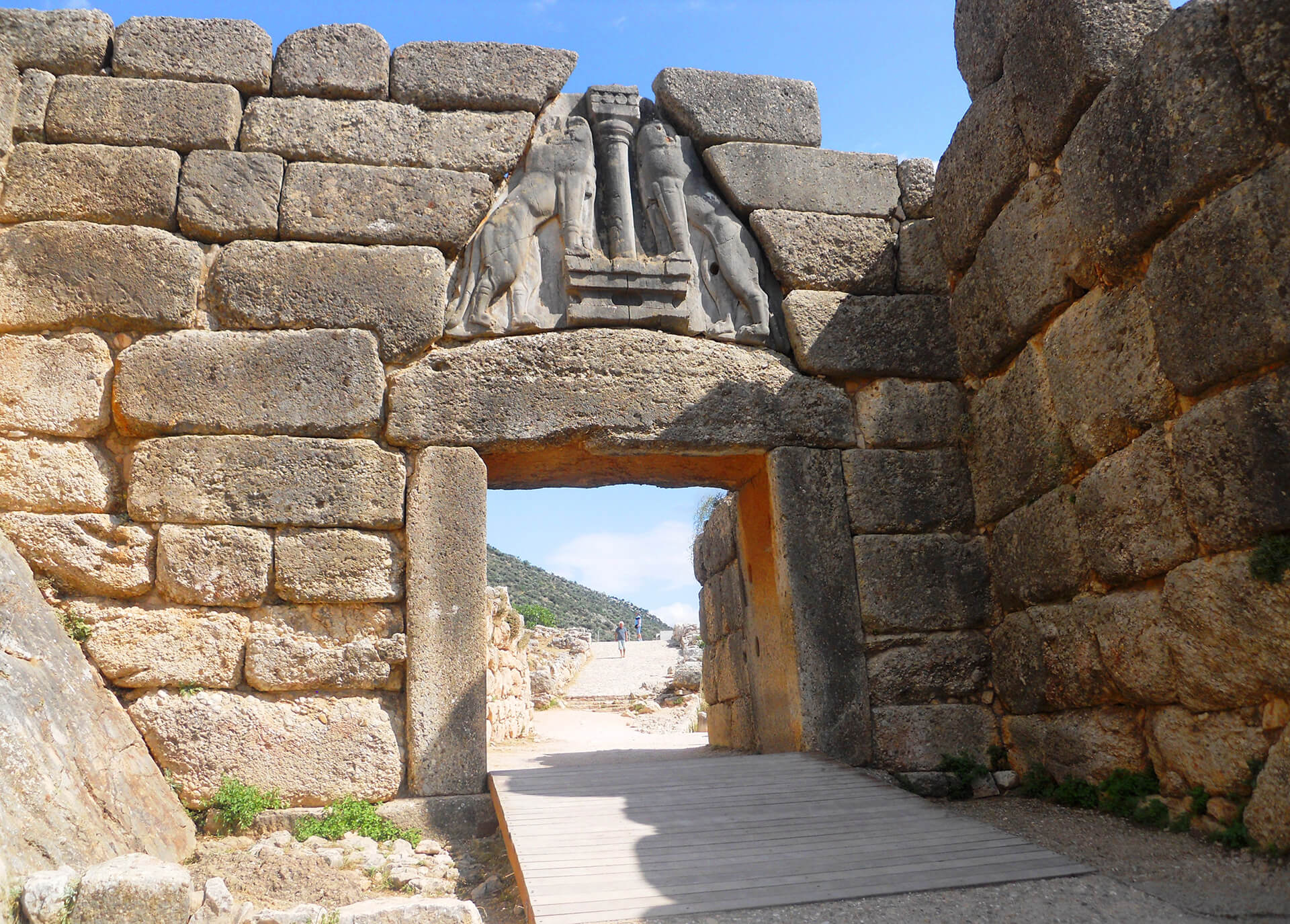 Lion Gate at Mycenae, around 1250 BC; material context of the Achaean elite of the Late Bronze Age.
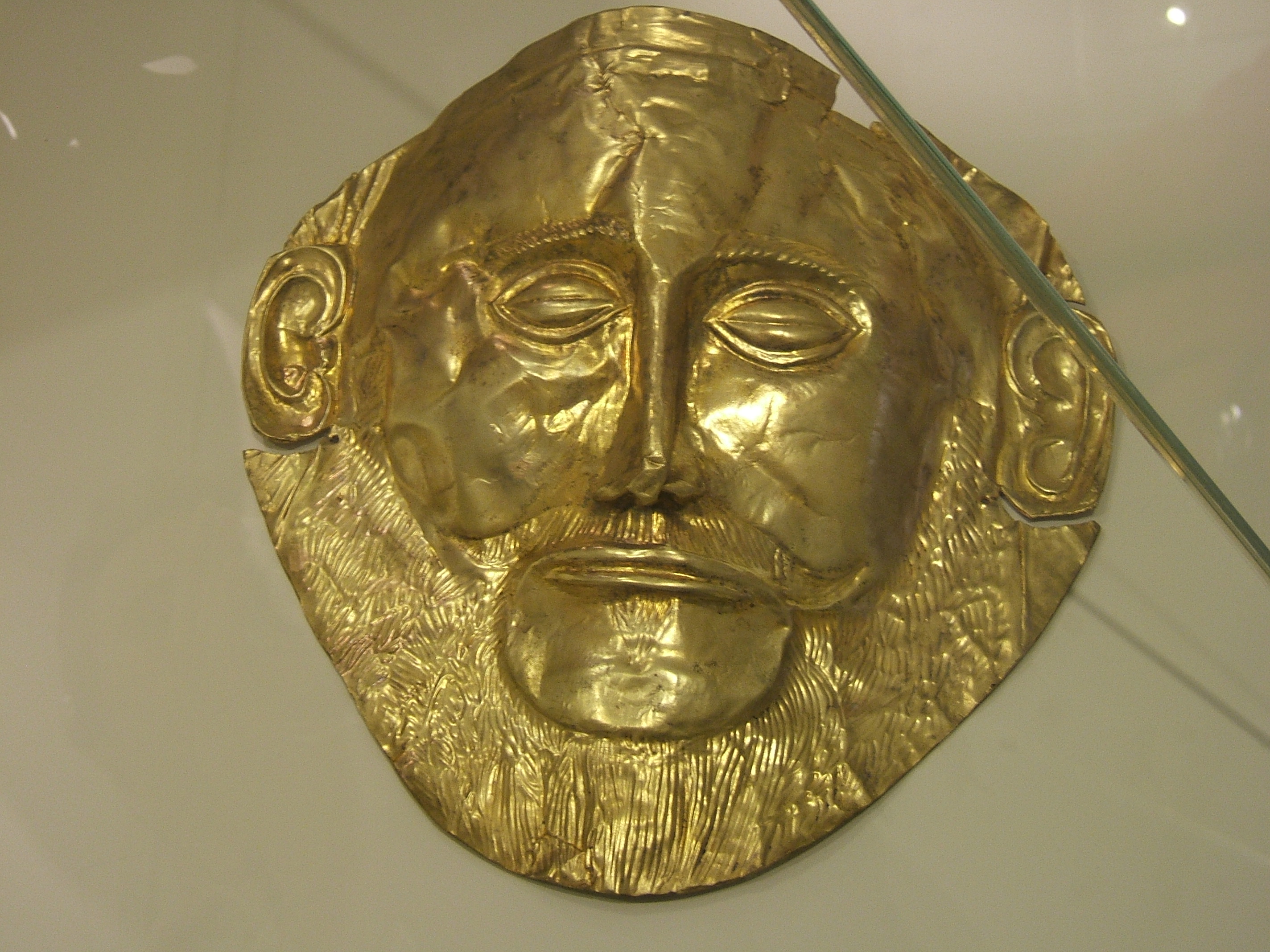 The so-called Mask of Agamemnon from Mycenae, 1550-1500 BC; the name is conventional and does not mean a portrait of the Trojan War hero.
Short Chronology
- 13th-12th centuries BC
- the Late Bronze Age Aegean world; Mycenaean palaces, fortifications, elite burials and destructions form the historical background of Trojan traditions.
- 12th-9th centuries BC
- oral heroic songs preserve and rework memory of the past.
- 8th-7th centuries BC
- probable shaping of the Iliad as a large epic poem in the tradition associated with Homer.
- 6th-5th centuries BC
- the poem becomes an important part of performance, education, vase painting and civic culture of Greek poleis.
- 3rd-2nd centuries BC
- Alexandrian philologists study the text, stabilise the division into books and work with variants of the manuscript tradition.
- Roman period
- the Iliad enters the education of the Greco-Roman elite and influences Latin literature.
Related Topics
- Trojan War
- Odyssey
- Aeneas and Aeneid
- Homer
- Homeric Age
- Achaean States in the Second Millennium BC
- Greek Gods
Literature and sources
- Homer. Iliad / translated by A. T. Murray. Loeb Classical Library. Harvard University Press.
- Homer. The Iliad / translated by Richmond Lattimore. University of Chicago Press.
- Kirk G. S. The Iliad: A Commentary. Vol. 1-6. Cambridge University Press, 1985-1993.
- Latacz J. Troy and Homer: Towards a Solution of an Old Mystery. Oxford University Press, 2004.
- West M. L. The Making of the Iliad: Disquisition and Analytical Commentary. Oxford University Press, 2011.
- Burgess J. S. The Tradition of the Trojan War in Homer and the Epic Cycle. Johns Hopkins University Press, 2001.


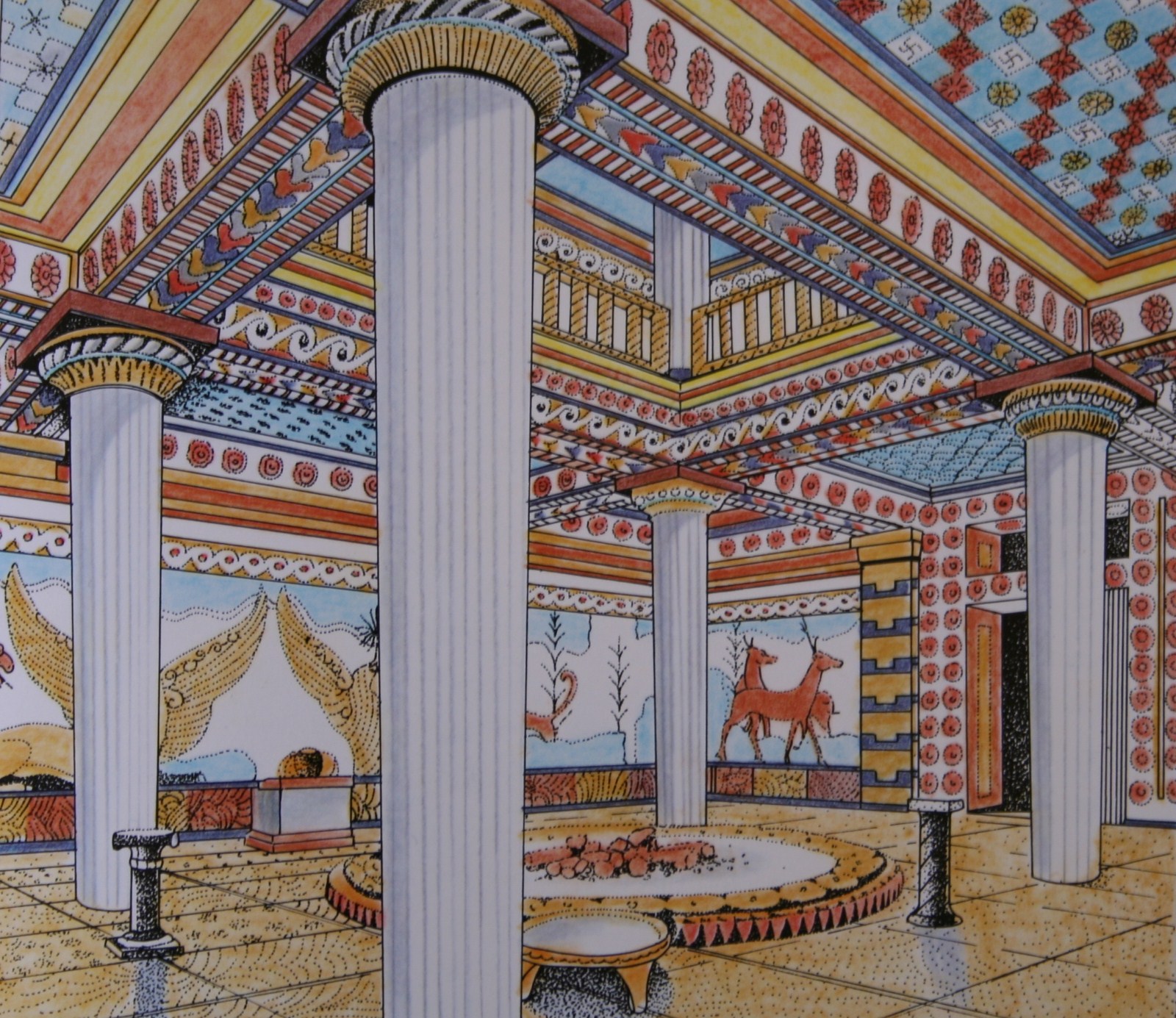 Reconstruction of a Mycenaean megaron; the palace world of the Late Bronze Age helps frame the world reworked by epic.
Interested in Ancient Rome beyond reading? Join Legio X Fretensis or explore our reenactment directions.


