Trojan War
The Trojan War is the central mythical conflict of Greek epic: the campaign of Achaean kings against Troy, connected with Helen, Paris, Menelaus, Agamemnon, Achilles, Hector, Odysseus and the fall of the city. In ancient tradition the war lasted ten years and ended with the capture of Troy through the wooden horse. For Greeks it was not a single story, but a whole world of traditions about families, gods, heroes, returns and the collapse of an old order.
The Iliad describes only a brief episode from the war's final year: Achilles' wrath and Hector's death. Other parts of the Trojan cycle were known from other epic poems, tragedy, lyric poetry, vase painting, later retellings and Roman literature. The Odyssey shows the war's consequences through Odysseus' return, while Aeneas and Aeneid carry Trojan memory into the Roman story of origins.
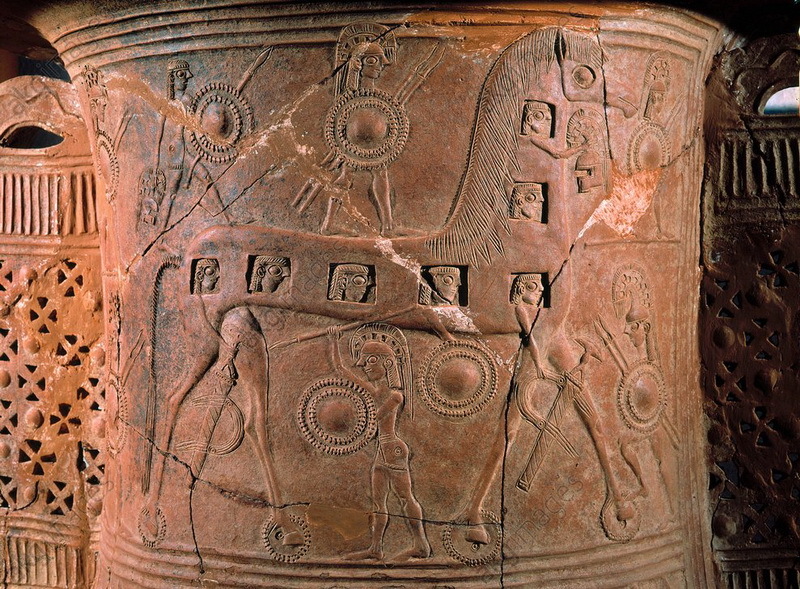 The siege of Troy on the relief amphora from Mykonos, around 670-640 BC; one of the early Greek images of the Trojan myth.
Causes of the War in Myth
The mythical cause of the war begins not at the walls of Troy. At the wedding of Peleus and Thetis, Eris throws the apple "to the fairest". Paris, son of the Trojan king Priam, chooses Aphrodite over Hera and Athena because the goddess promises him the love of Helen. This judgement of Paris explained why the gods took sides in the war: Hera and Athena are hostile to Troy, Aphrodite protects Paris and the Trojans, and Zeus tries to hold the larger course of fate.
Helen was the wife of Menelaus, king of Sparta. In different versions Paris abducts her, takes her with her consent or becomes an instrument of divine design. The Achaean kings gather not only because of Menelaus' personal grievance: tradition spoke of an earlier oath of Helen's suitors to defend her marriage. The campaign against Troy therefore joins family conflict, violation of hospitality, royal honour and divine will.
Achaeans and Trojans
On the Achaean side stand kings and heroes from many regions of the Greek world: Agamemnon of Mycenae as supreme leader, Menelaus of Sparta, Achilles with the Myrmidons, Odysseus of Ithaca, Nestor of Pylos, Diomedes of Argos, the two Ajaxes, Idomeneus of Crete and many others. The Catalogue of Ships in the Iliad makes the war a pan-Achaean expedition, although different historical and poetic layers stand behind this epic list.
Troy is not shown merely as an enemy fortress. Priam and Hecuba have many children, among whom Hector, Paris, Cassandra and Polyxena are especially important. Hector is the chief defender of the city and at the same time son, husband of Andromache and father of Astyanax. Aeneas stands among the Trojans as a hero of another future: Greek epic knows him as a participant in the war, while Roman tradition makes him the bearer of Trojan memory after the city's fall.
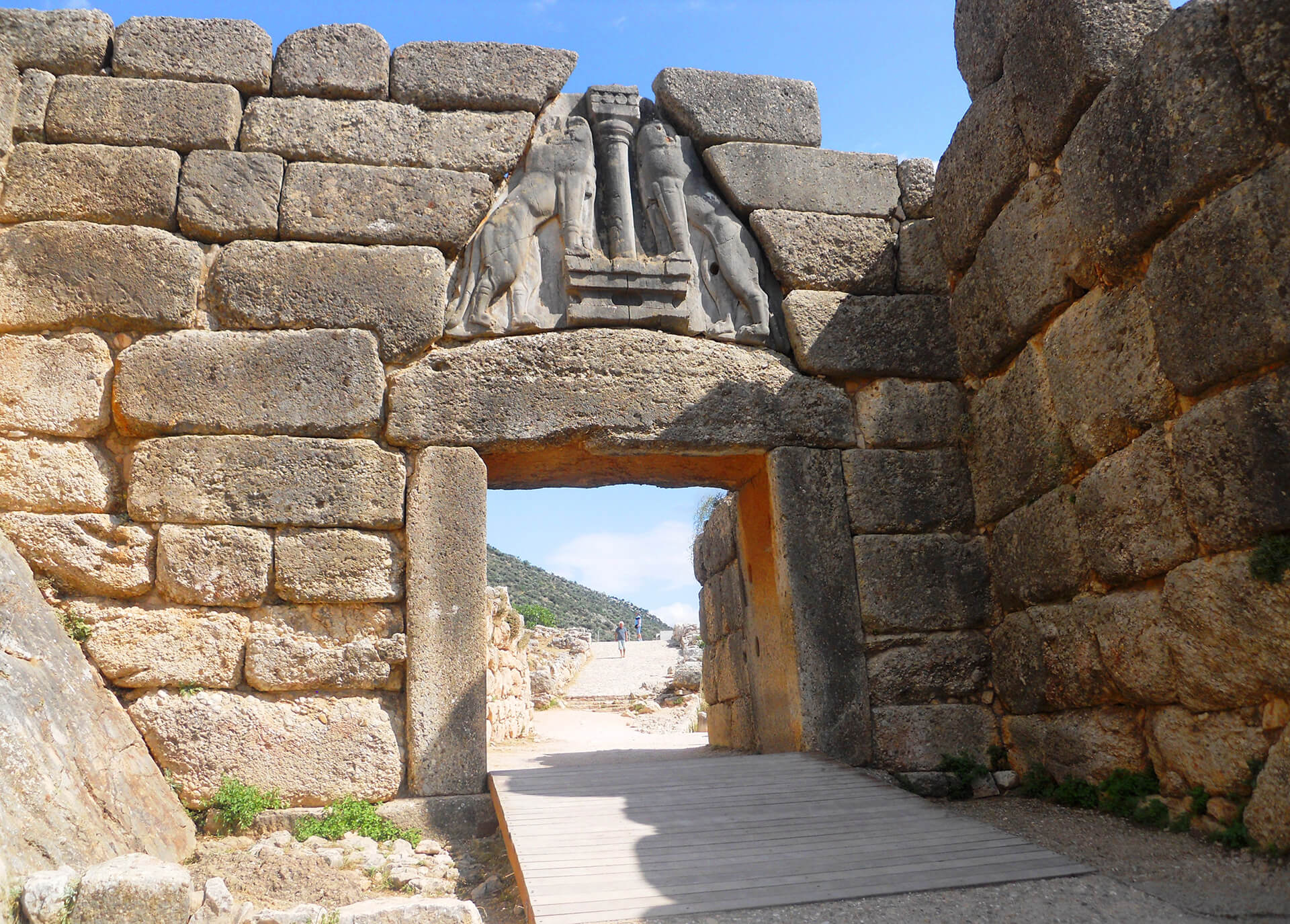 Lion Gate at Mycenae, around 1250 BC; material context of the Achaean elite of the Late Bronze Age.
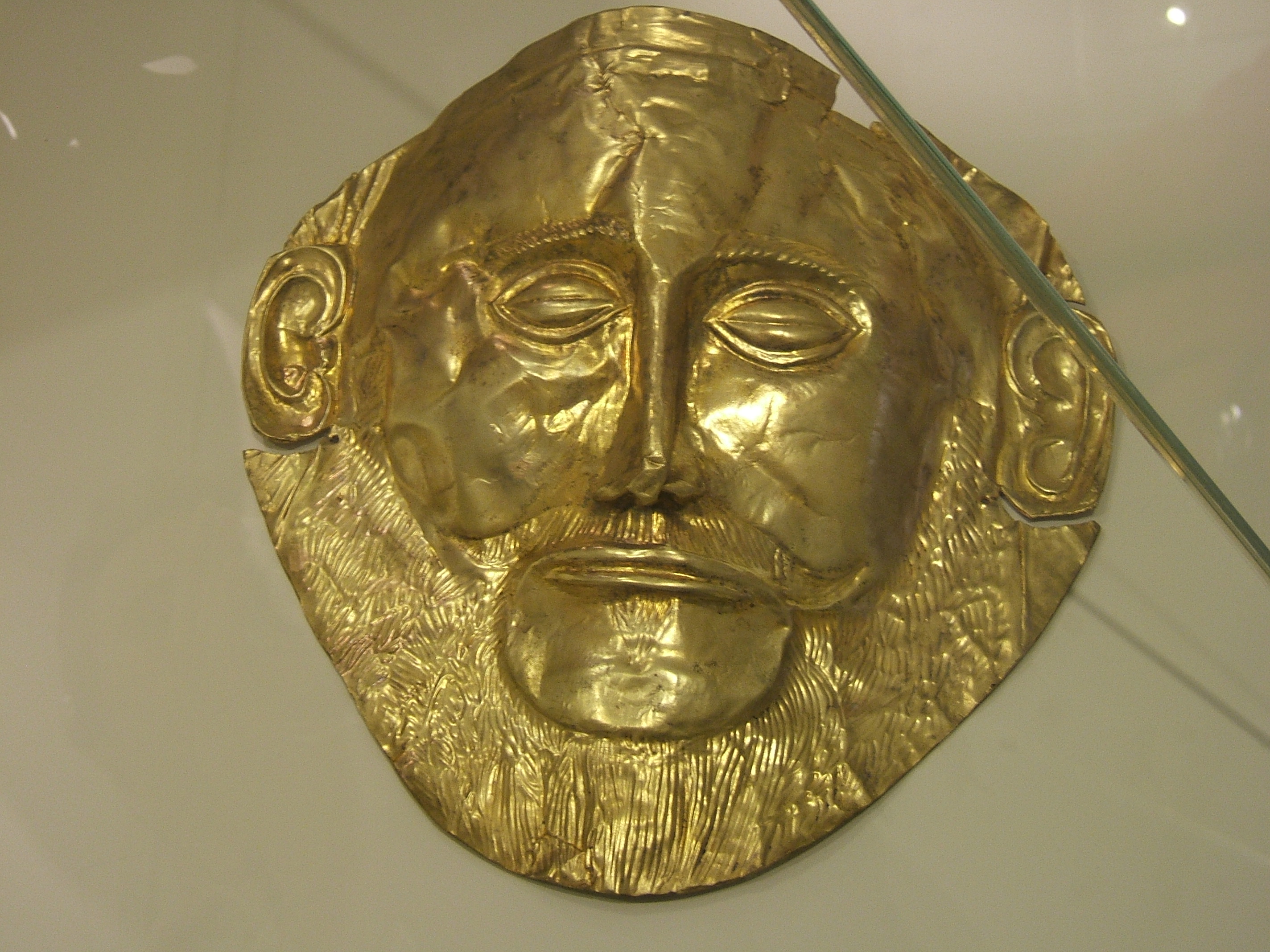 The so-called Mask of Agamemnon from Mycenae, 1550-1500 BC; the name is conventional and does not mean a portrait of the Trojan War hero.
The War before the Iliad
Before sailing the Achaeans gather at Aulis. In later tradition the episode of Iphigenia occurs there: Artemis holds back the wind, and Agamemnon must sacrifice his daughter or witness her miraculous rescue, depending on the version. This story already shows the cost of the expedition: the war begins with a breach of family order inside the Achaean camp itself.
The first years of the war in epic are filled with landings, raids, distribution of booty, negotiations and duels. Achilles sacks towns around the Troad, takes captives and spoils; the Greeks hold the camp by the ships; the Trojans defend the city and seek allies. The ten-year length matters for the myth: by the time of the Iliad exhaustion, resentment and desire for glory have accumulated, and war has become a familiar but destructive order.
The Final Year and the Iliad
The Iliad begins with conflict inside the Achaean camp: Agamemnon takes Briseis from Achilles, and the best warrior refuses to fight. The whole army experiences the consequences of this decision. Hector is able to drive the Achaeans toward the ships, and the embassy to Achilles does not bring him back to battle. The death of Patroclus in Achilles' armour becomes the turning point: personal insult gives way to the desire for revenge.
Achilles kills Hector, but the poem does not end in triumph. Priam comes to the Achaean camp and asks for his son's body. This scene temporarily joins enemies through memory of fathers, children and future death. The Iliad therefore shows not the fall of Troy, but the moral peak of the Trojan myth: a hero capable of terrible fury finally recognises a human being in his enemy.
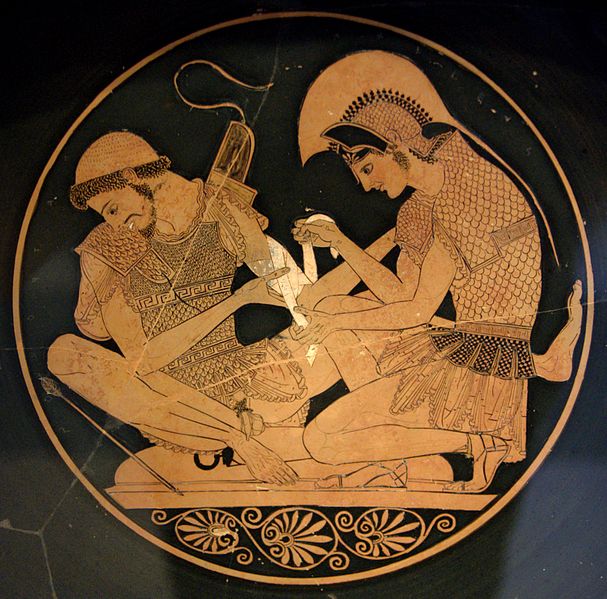 Achilles bandages the wounded Patroclus. Red-figure vase from Vulci, around 500 BC; a scene from the Trojan cycle.
 Achilles and Troilus. Black-figure Attic vase of the Tyrrhenian group, 575-550 BC; Archaeological Museum, Florence.
Events after the Iliad
The war does not end after Hector's death. The later Epic Cycle told of the arrival of the Amazon Penthesilea, the Ethiopian king Memnon, Achilles' death by Paris' arrow, the dispute over Achilles' armour and Ajax's death. To take Troy the Achaeans need new conditions: Philoctetes with Heracles' bow, Neoptolemus son of Achilles, and the theft of the Palladium. These stories show that victory requires not only force, but fulfilment of prophecies.
The most famous final episode became the Trojan horse. On Odysseus' advice the Achaeans leave a wooden horse with warriors inside, pretend to sail away and make the Trojans accept a dangerous gift. Cassandra and Laocoon warn the city, but they are not believed. At night the Achaeans emerge from the horse, open the gates and Troy falls. This ending joins cunning, the blindness of the city's victors and the inevitability of fate.
Fall of the City and Returns
The fall of Troy in myth is accompanied by brutality: Priam, Polyxena, Astyanax and many Trojans die; women become captives; sanctuaries are violated. The Achaean victory does not look like a simple happy ending. Many heroes later pay for the violence of the sack in their own returns. The nostoi, traditions about returns, showed that war does not end at the moment a fortress is taken.
Agamemnon returns to Mycenae and dies at the hands of Clytemnestra and Aegisthus. Menelaus wanders for a long time before returning to Sparta. Odysseus spends ten years reaching Ithaca. Aeneas leaves the destroyed city and in Roman tradition becomes ancestor of future Romans. The Trojan cycle thus breaks into several paths: revenge, return home, foundation of a new people and memory of a lost city.
Women of the Trojan Cycle
Female figures make the Trojan myth more than a story about a campaign of kings. Helen stands at the centre of the war's cause, but ancient tradition explained her role in different ways: as a victim of abduction, a woman overcome by Aphrodite or the cause of disaster. Andromache shows the war from Hector's household: for her the death of her husband means not the loss of military strength, but the end of house, protection of her son and Troy's future. Hecuba represents the older generation that sees children die and a queen become a captive.
Cassandra, Polyxena, Briseis, Chryseis and the Trojan captives show the cost of victory for those who did not decide to begin the war. Cassandra knows the truth but is doomed not to be heard; Polyxena in later versions becomes a sacrifice at Achilles' tomb; Briseis and Chryseis in the Iliad become objects of dispute between men, although destroyed families and captured cities stand behind them. Tragedians therefore returned especially often to Trojan women: through them it was easiest to show that heroic glory is built on another's loss.
Gods, Honour and Guilt
The gods in the Trojan myth are not distant observers. Athena, Hera, Aphrodite, Apollo, Poseidon, Ares, Hephaestus and Zeus intervene in battles, save favourites, deceive one another and support different sides. Their involvement explains the scale of the war: a conflict of mortals is tied to the heavenly hierarchy, old divine resentments and the fate of heroes.
The war is built on honour, glory and guilt. For Menelaus and Agamemnon the honour of the house of Atreus matters; for Achilles, recognition of his status; for Hector, duty toward the city; for Helen, memory of her own role in disaster; for Priam, preservation of human dignity before destruction. The Trojan myth outlived antiquity because it is not reducible to winners and losers, but repeatedly asks about the cost of glory.
Sources of the Myth and Images
The main written evidence for the war survives unevenly. The Iliad is preserved complete, the Odyssey tells of consequences, while many poems of the Epic Cycle are known only through summaries and fragments. Fifth-century BC tragedians developed individual episodes: Iphigenia, Ajax, Trojan women, Hecuba, Helen, Philoctetes and Orestes. Roman literature reworked Trojan inheritance through Aeneas.
Visual evidence is no less important than texts. Already in the 7th-6th centuries BC vase painters showed the siege of Troy, Achilles, Troilus, Patroclus, Menelaus and Helen, Priam's death and scenes with the Trojan horse. Such images do not always illustrate the surviving text of the Iliad. They often reflect other versions of the myth, local traditions or popular episodes that viewers understood without written explanation.
Archaeology of Troy and the Mycenaean Context
Archaeological Troy lies at Hisarlik in north-western Asia Minor. Excavations showed that it is a multi-layered site where one city was built over another. For comparison with the myth, the Late Bronze Age layers are especially discussed, above all Troy VI and Troy VIIa. They show a fortified settlement, destructions and links with the Aegean world, but they do not prove every scene of epic in a simple way.
On the Achaean side the archaeological background is provided by Mycenae, Tiryns, Pylos and other palace centres of the Late Bronze Age. Their walls, megarons, tombs, weapons, seals and Linear B tablets show a real elite world that could become one layer of epic memory. Yet Homeric epic took shape later and mixed the Bronze Age, experience of the Dark Ages, Archaic ideas and poetic tradition.
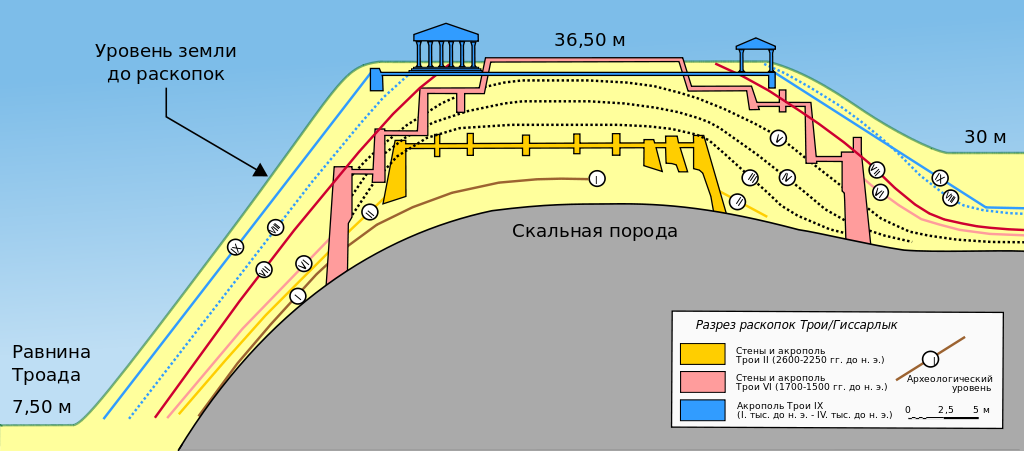 Section of the Troy excavations at Hisarlik; the site's many layers are important for comparing epic and archaeology.
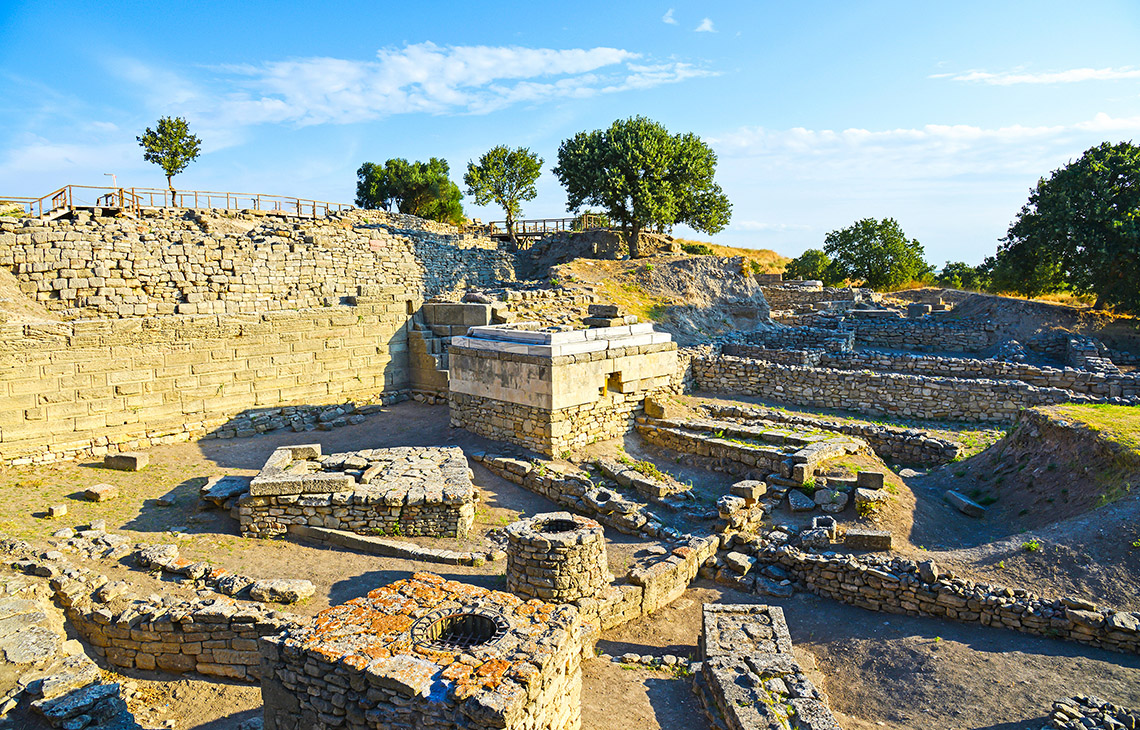 Troy, Hisarlik in modern Turkey; general view of the archaeological site.
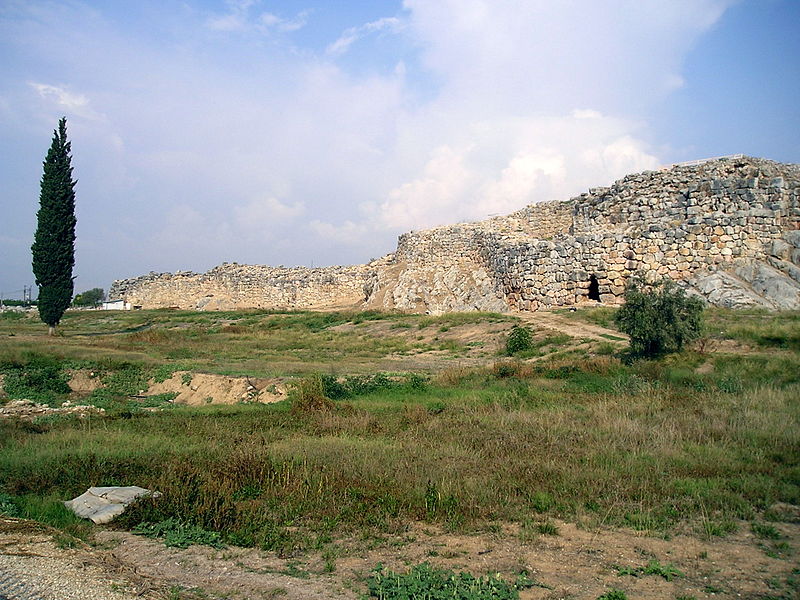 Tiryns, a Mycenaean fortress in the Argolid; material context of Achaean palace centres of the Late Bronze Age.
Place in Greek and Roman Memory
For Greeks the Trojan War was a shared past through which genealogies, rights of cities, heroic cults and ideals of martial courage could be explained. Poleis could connect themselves with participants in the expedition, and aristocratic families traced descent from heroes. At the same time the myth warned about the destructive side of glory: almost every victor suffers loss, and almost every household is damaged by war.
For Romans the Trojan line of Aeneas became especially important. Through it Rome could present its origin not as a simple continuation of Greek victory, but as the destiny of surviving Trojans. Virgil made the fall of Troy the beginning of a long road toward Italy, Lavinium, Alba Longa and future Rome. The same myth thus became for Greeks a memory of heroic expedition, and for Romans a story of survival, migration and new foundation.
Short Chronology of the Myth
- Wedding of Peleus and Thetis
- quarrel of the goddesses and judgement of Paris.
- Abduction or departure of Helen
- violation of Menelaus' marriage and cause for the campaign.
- Gathering of the Achaeans
- oath of the suitors, Aulis, Iphigenia and sailing to Troy.
- First years of the war
- landing, raids, allies, distribution of booty and duels.
- Final year
- Achilles' wrath, Patroclus' death, Hector's death and ransom of the body.
- After the Iliad
- Penthesilea, Memnon, Achilles' death, dispute over the armour, Philoctetes, Neoptolemus.
- Fall of Troy
- wooden horse, destruction of the city, captivity of Trojan women.
- Returns and continuations
- nostoi of the Achaeans, wanderings of Odysseus, flight of Aeneas.
Related Topics
- Iliad
- Odyssey
- Aeneas and Aeneid
- Homer
- Homeric Age
- Achaean States in the Second Millennium BC
- Greek Gods
Literature and sources
- Homer. Iliad / translated by A. T. Murray. Loeb Classical Library. Harvard University Press.
- Homer. Odyssey / translated by A. T. Murray. Loeb Classical Library. Harvard University Press.
- Proclus. Chrestomathy: summaries of the Epic Cycle.
- Burgess J. S. The Tradition of the Trojan War in Homer and the Epic Cycle. Johns Hopkins University Press, 2001.
- Latacz J. Troy and Homer: Towards a Solution of an Old Mystery. Oxford University Press, 2004.
- Korfmann M. Troia and the Troad: Archaeology of a Region. Various studies.
- West M. L. The Epic Cycle: A Commentary on the Lost Troy Epics. Oxford University Press, 2013.


 The so-called Priam's Treasure from Troy, around 2400-2300 BC; the name is conventional and does not refer to King Priam of epic.
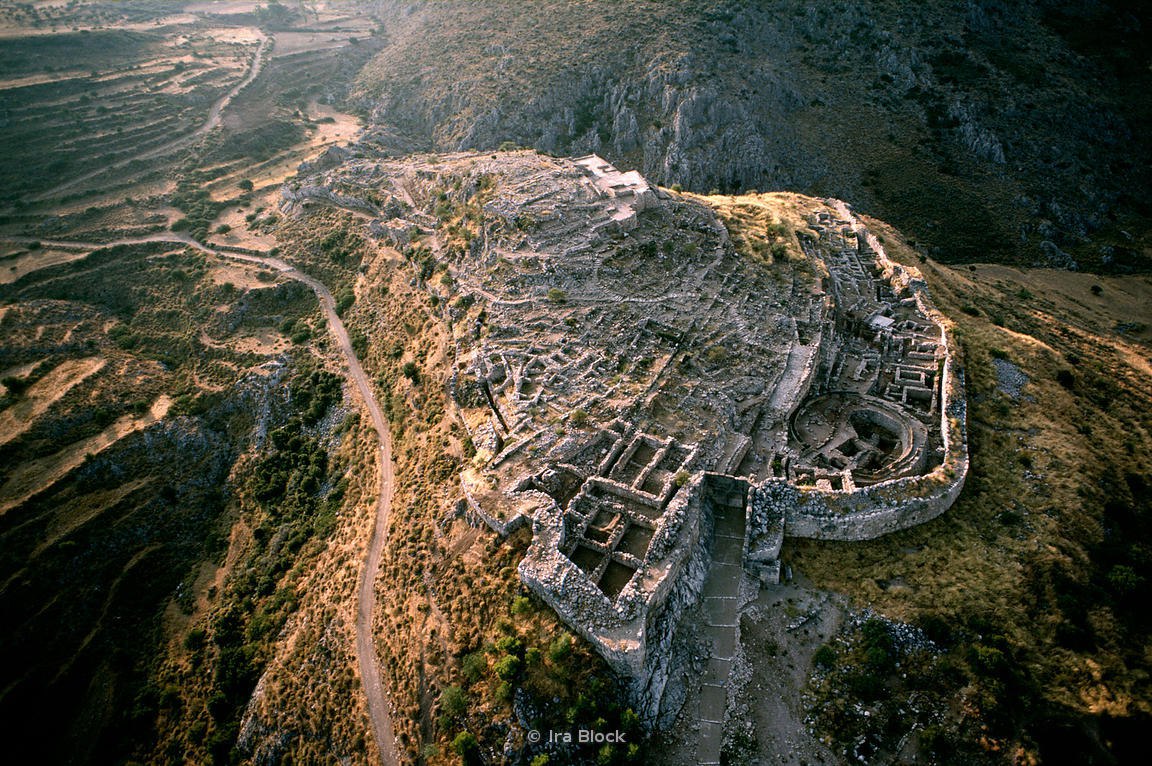 Mycenae, modern view of the archaeological site; in epic tradition Agamemnon ruled here.
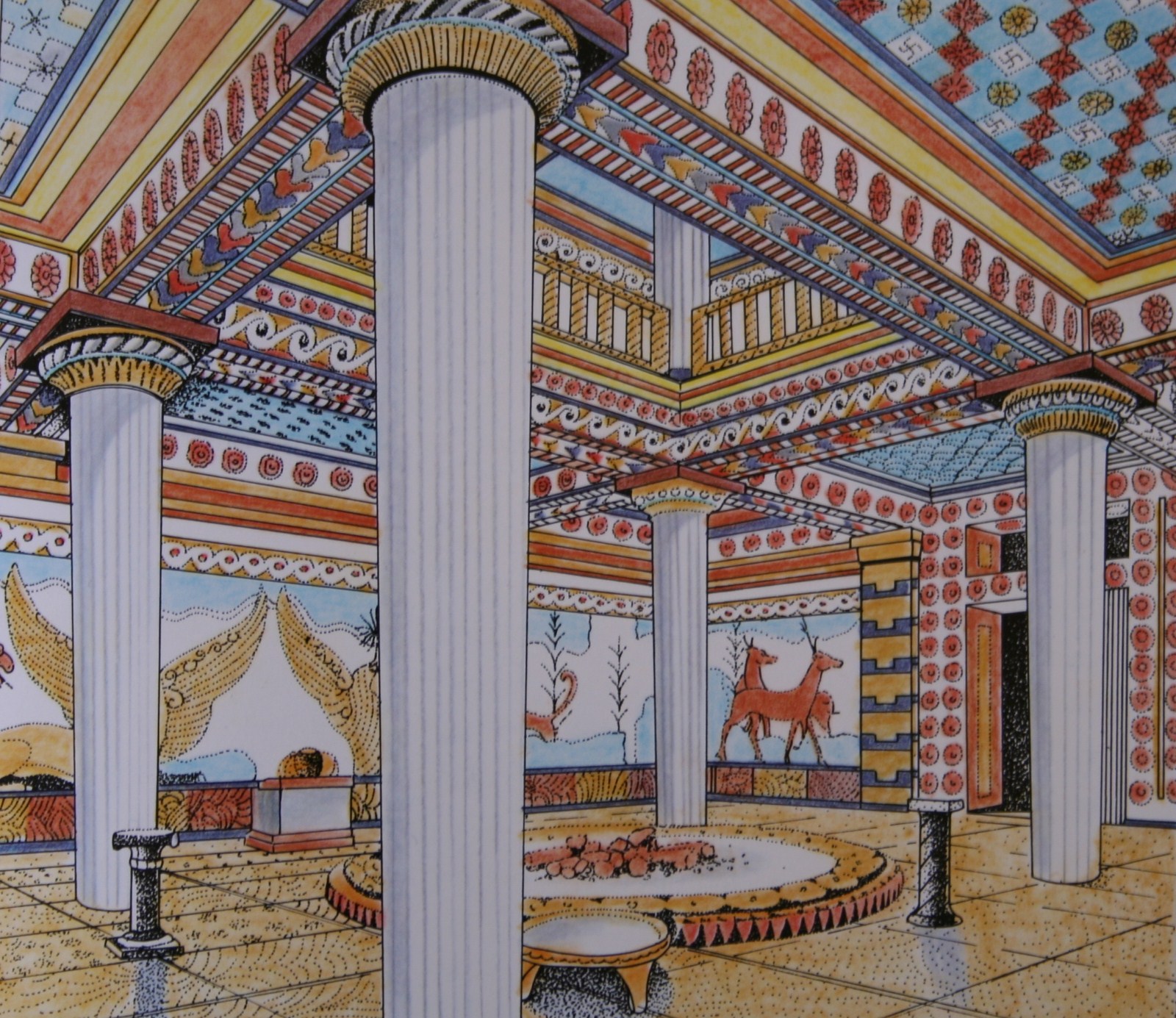 Reconstruction of a Mycenaean megaron; the palace world of the Late Bronze Age helps frame the world reworked by epic.
Interested in Ancient Rome beyond reading? Join Legio X Fretensis or explore our reenactment directions.


