Aeneas and the Aeneid
Aeneas is a Trojan hero and the central figure of Virgil's Aeneid. In Roman tradition he became not simply a participant in the Trojan War but an ancestor of the future Romans: his son Ascanius, or Iulus, was connected with Alba Longa and the Julian line, and through that line with the political language of the age of Octavian Augustus. The poem turns the Greek myth of Troy's fall into a Roman story about the origins of power, the city and religious duty.
The Aeneid was composed in the last decades of the 1st century BC, after the civil wars and the establishment of the principate. It therefore works on three levels at once: an ancient heroic plot, the memory of Roman wars and a meditation on the cost of founding a state. Aeneas must leave the past behind, renounce private happiness and lead the Trojans to Italy, yet victory is almost always accompanied by loss.
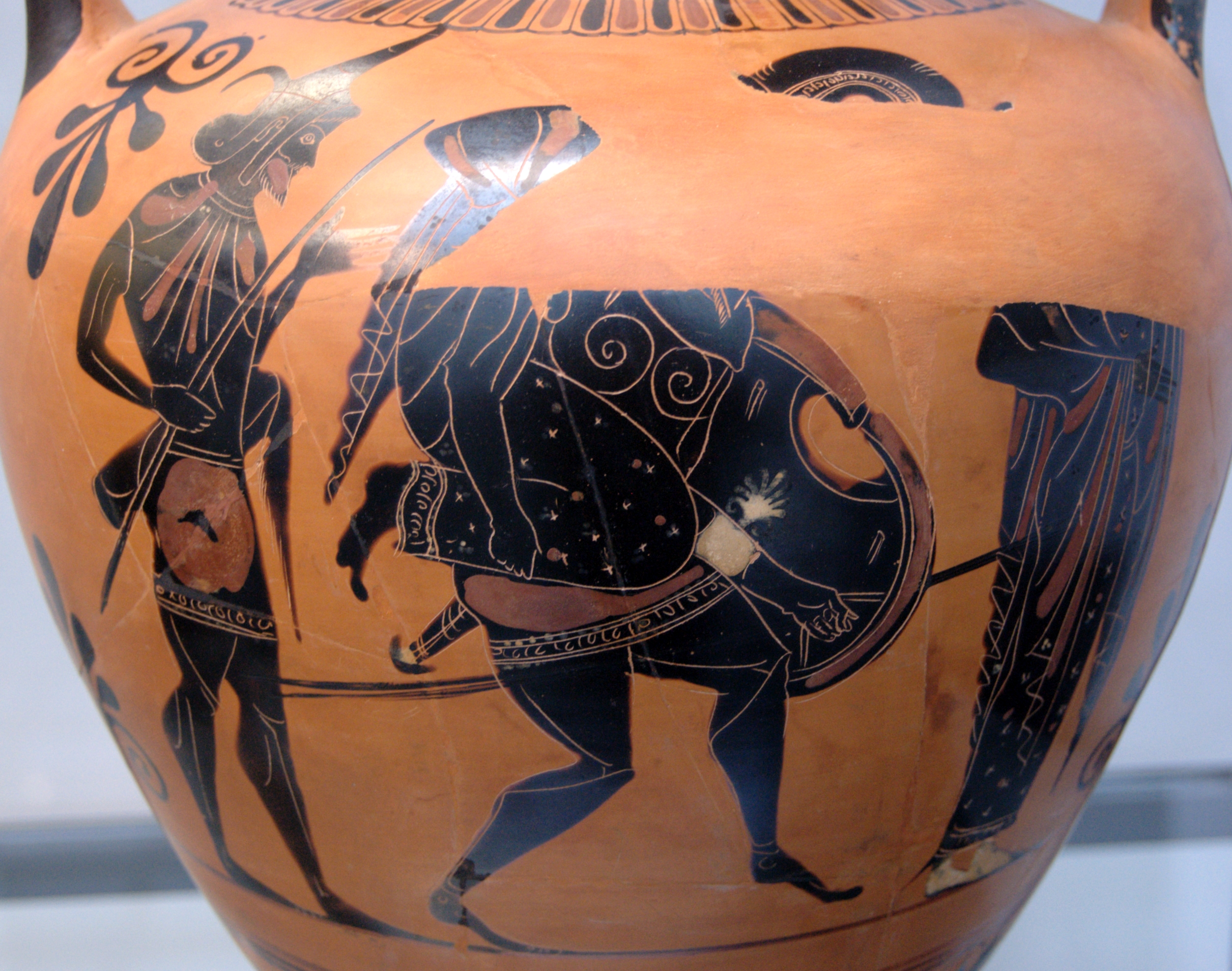 Flight from Troy: Aeneas carries Anchises. Attic black-figure amphora, around 510 BC; Staatliche Antikensammlungen, Munich.
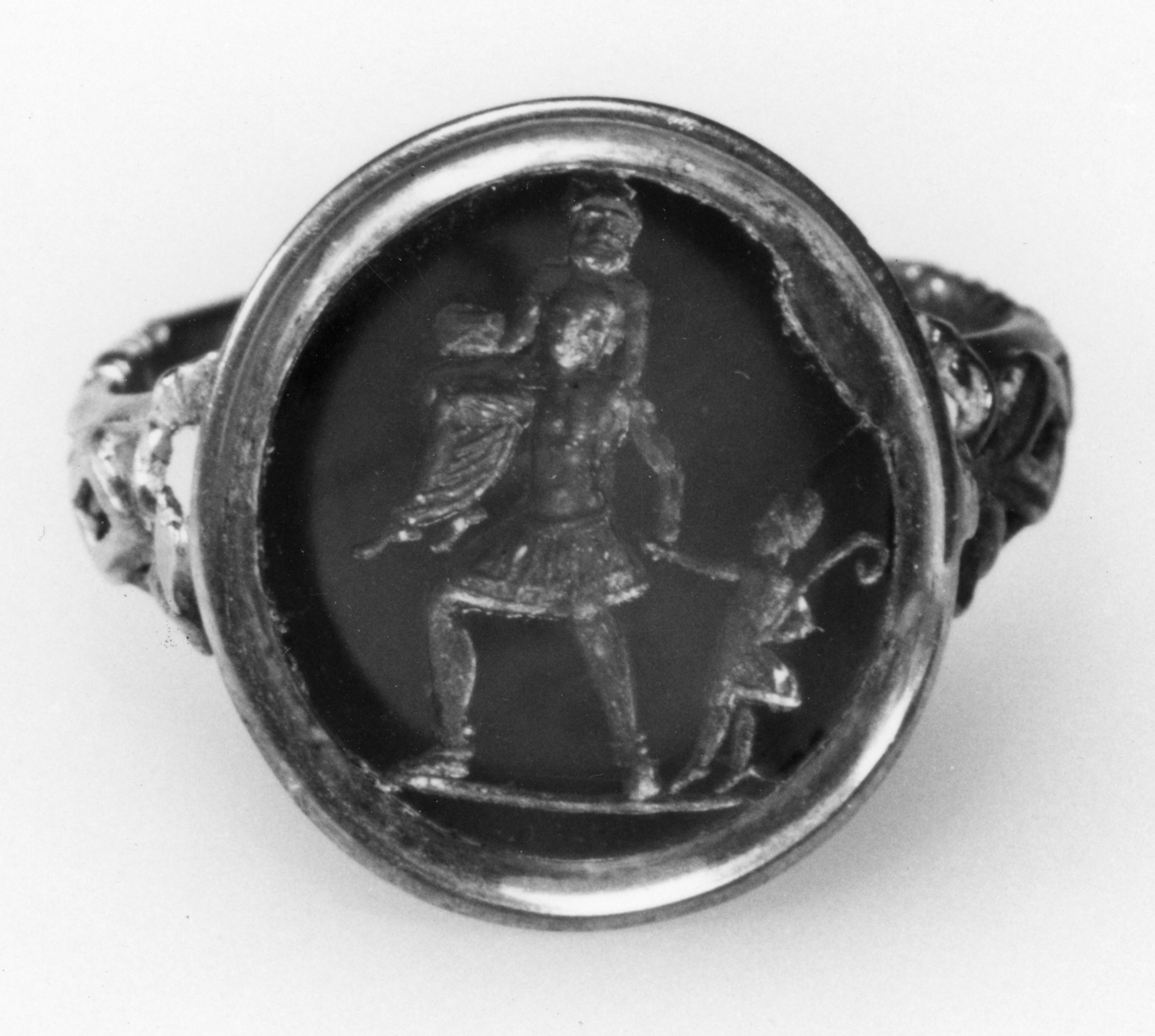 Aeneas with Anchises and Ascanius on a Roman intaglio; a compact image of dynastic continuity central to the Roman reading of the myth. Walters Art Museum.
Aeneas Before Virgil
Aeneas was not a late invention of Roman writers. Greek epic tradition knew him as the son of Anchises and Aphrodite, a kinsman of Priam's royal house and one of the Trojan leaders. In the Iliad he fights beside Hector, confronts Diomedes and Achilles, and is repeatedly saved by the gods. Even in Homer Aeneas is more than a passing warrior: he carries a lineage that is destined to continue after Troy's destruction.
In Archaic and Classical Greek vase painting the flight from Troy had already acquired a stable form: Aeneas carries the aged Anchises, the child Ascanius walks nearby, and the burning city lies behind them. For Romans the image was especially useful: it showed not only the rescue of a family but the transfer of household gods, memory and legitimate inheritance. The myth of flight became a myth of continuation.
Design and Structure of the Poem
The Aeneid consists of twelve books. The first six resemble a Roman answer to the Odyssey: after Troy's fall Aeneas wanders by sea, loses companions, hears prophecies, survives a storm, reaches Carthage and descends to the underworld. The last six books stand closer to the Iliad: the action moves to Italy, where the Trojans enter a war with local peoples, and the poem ends with the duel between Aeneas and Turnus.
This structure is essential for understanding Aeneas. He is neither only a wanderer nor only a warrior. In the first half of the poem he learns to follow destiny even when he cannot yet grasp its meaning. In the second half he must turn prophecy into political reality: secure allies, endure Juno's hostility, accept war as a forced stage and found a new community in Latium.
Main Figures
Aeneas is surrounded by a chain of figures, each revealing a different side of foundation. Anchises embodies family memory and old Troy; Ascanius-Iulus represents the future for which the hero must move on; Creusa marks the lost family and the impossibility of a simple return to the past. Dido shows the strength of another city and the danger of personal attachment when it conflicts with a historical mission.
In the Italian half Latinus, Lavinia, Turnus, Evander, Pallas, Mezentius, Camilla and Amata are crucial. Latinus tries to accept prophecy and avoid war, but his authority is limited by internal resistance. Lavinia speaks very little, yet her marriage is meant to join Trojans and Latins. Turnus defends his right and the honour of an older alliance, so he is not a casual villain. Pallas, Aeneas' young ally, turns war from political necessity into personal tragedy.
The Flight from Troy
In Book II Aeneas himself tells Dido about Troy's last night. The Greeks bring the wooden horse into the city, Laocoon dies, Cassandra is not believed, and Priam's palace becomes a place of slaughter. Aeneas first wishes to die in battle, but the vision of Venus and the shade of Hector force him to understand that his task is not heroic death. He must carry out of the fire his father Anchises, his son Ascanius and the Penates, the household gods through which Trojan memory will move to a new land.
The loss of Creusa, Aeneas' wife, gives the episode its harshest note. She does not merely vanish in the chaos of the city: her shade declares Aeneas' future journey and his future marriage in Italy. Thus the origin of Roman history begins not with triumph but with a broken family. Virgil does not soften that pain, because the founding of a new history requires the loss of the life the hero wanted to preserve.
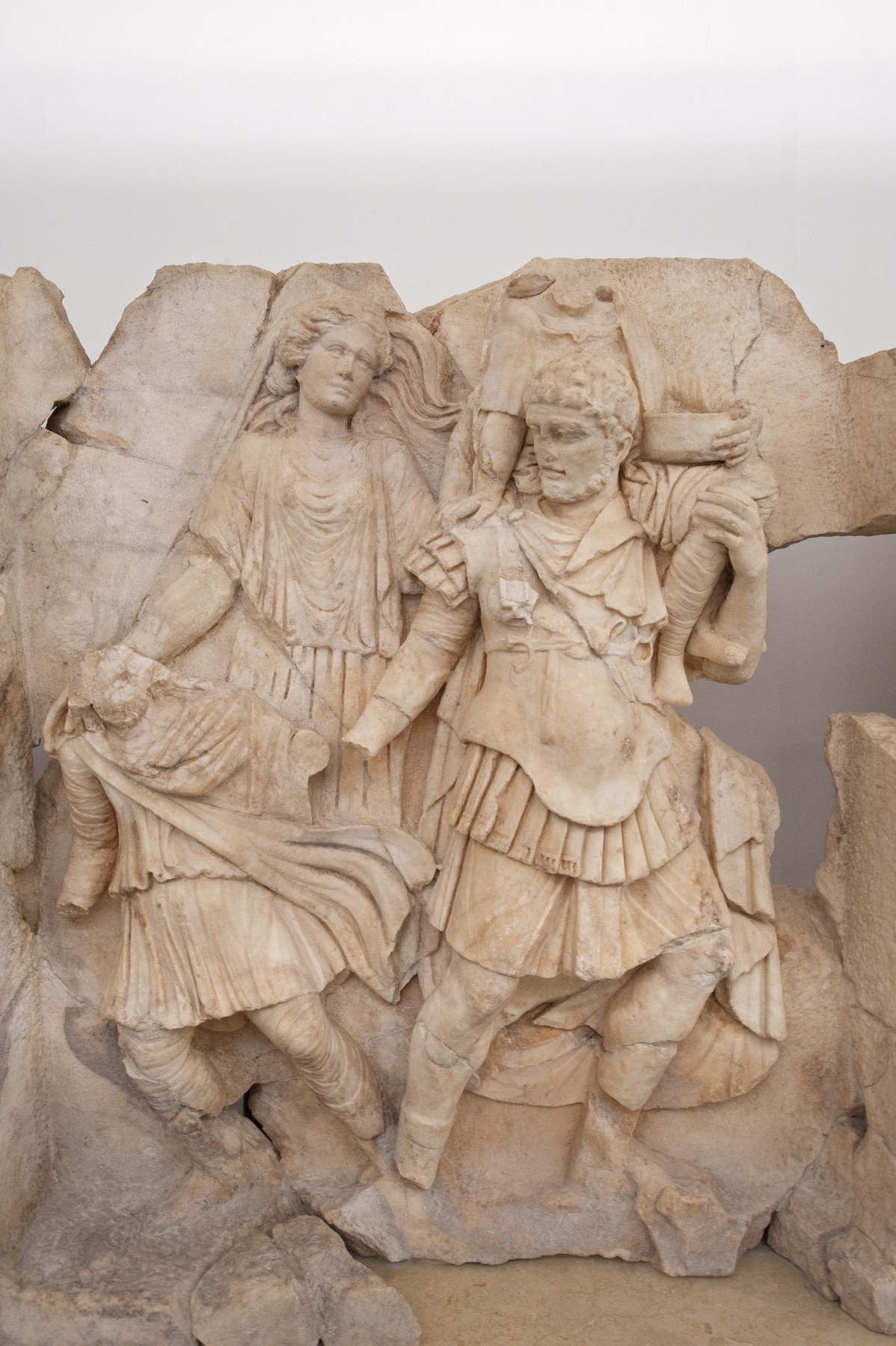 Aeneas fleeing Troy on a relief from the Sebasteion at Aphrodisias, 1st century AD; the Trojan ancestor myth is absorbed into imperial imagery.
Wanderings and Carthage
After the flight the Trojans search for the land appointed by fate. They pass through Thrace, Delos, Crete, Epirus and Sicily, hear conflicting prophecies and gradually understand that their final goal lies not in the east but in Italy. Aeneas' route echoes Greek epic, but its meaning is different: the hero is not returning home like Odysseus; he is seeking a place that does not yet exist for him.
The Carthaginian section stands at the centre of the poem. Dido, queen of a new city, is herself an exile: she fled Tyre after the murder of her husband Sychaeus and is building power in a foreign land. Her meeting with Aeneas could have become an alliance of two migrant histories, but divine intrigue turns hospitality and sympathy into love. When Jupiter, through Mercury, reminds Aeneas of his mission, the hero leaves Carthage and Dido curses his descendants.
For a Roman reader this episode inevitably cast a shadow forward to the Punic Wars. Virgil does not turn Dido into a simple enemy of Rome: she is dignified, generous and politically capable. The tragedy arises because two future cities cannot be founded by the same alliance. Aeneas' personal guilt and the command of fate remain in tension, making the Carthaginian story one of the poem's most ambiguous passages.
The women of the Aeneid are not ornaments to the plot. Creusa sets the price of rescue, Dido reveals the destructive side of duty, Lavinia becomes the centre of dynastic alliance, Amata drives Latium's internal conflict toward madness, and Camilla brings onto the battlefield a warrior woman who does not fit the usual roles of marriage and household. Through them the poem shows that the founding of male political power affects families, marriages, civic communities and the memory of the dead.
Gods, Fate and Pietas
The divine plan of the Aeneid is built around the conflict of Juno, Venus and Jupiter. Juno hates the Trojans because of the Judgment of Paris and Rome's future glory; Venus protects her son and his descendants; Jupiter preserves the larger course of fate. These gods belong to the world of Roman religion while retaining the features of Greek epic, so the poem clearly reveals the double nature of Greek and Roman gods.
Aeneas' central virtue is pietas. It is not merely piety in the modern sense, but loyalty to father, son, gods, community and destiny. Aeneas often suffers precisely because pietas requires choices he might not desire as a private man. He carries Anchises, performs funeral rites, obeys prophecies and repeatedly chooses between personal feeling and obligation.
The Underworld and Roman Memory
In Book VI Aeneas reaches Cumae and descends to the underworld under the guidance of the Sibyl. The episode joins religious rite, heroic ordeal and political prophecy. Aeneas meets Dido's shade, sees the punished and the blessed, and then finds Anchises, who shows him the future Romans: the kings of Alba Longa, Romulus, the heroes of the Republic, Julius Caesar and Augustus.
The parade of Roman heroes is not simple praise. Among the images of glory appears the young Marcellus, Augustus' nephew, who died in 23 BC. His shade reminds the reader that even Augustan peace does not abolish early death, dynastic fragility and grief. The underworld in the Aeneid therefore promises Rome greatness while showing that history will be paid for by human losses.
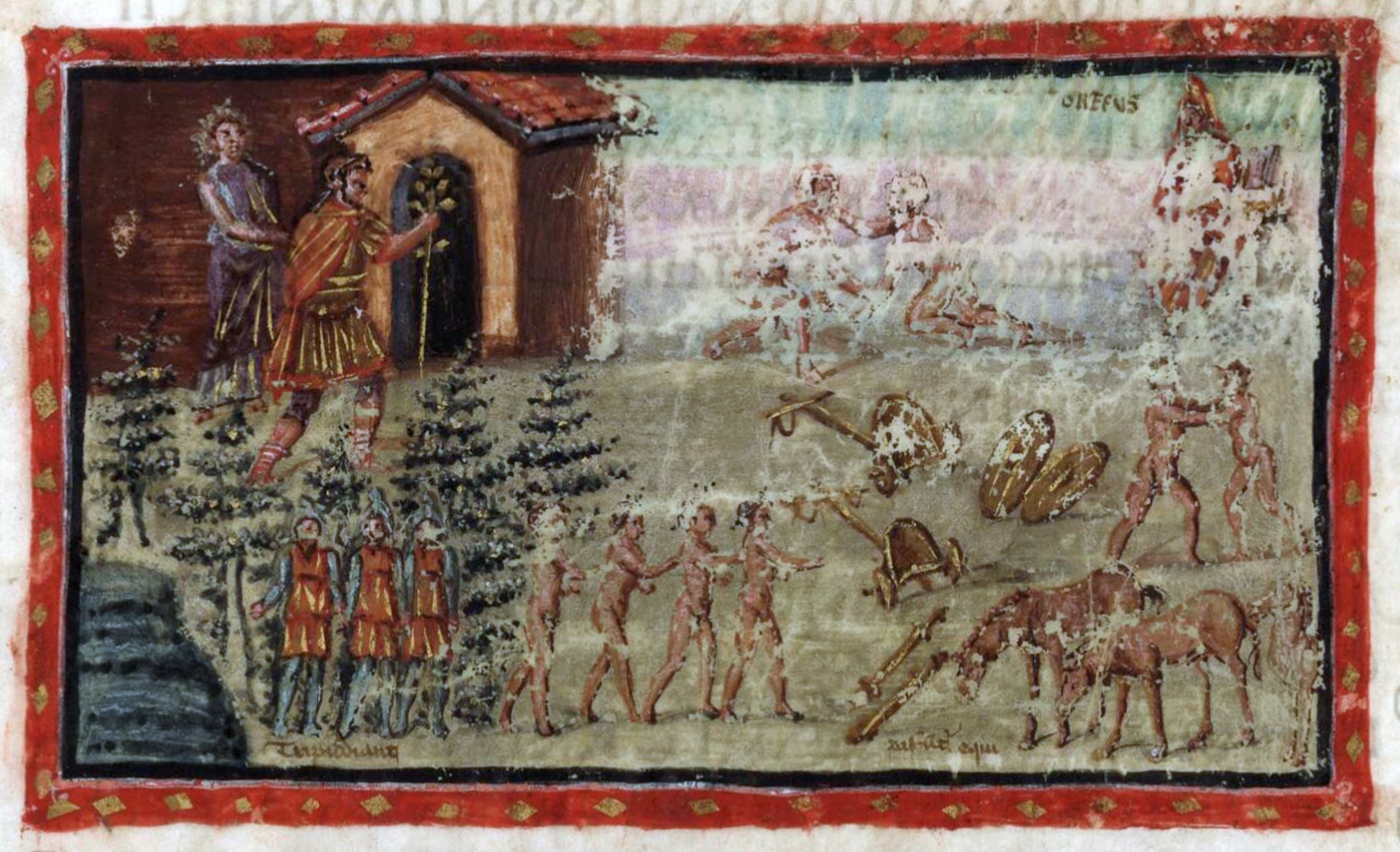 Aeneas with the golden bough and the Cumaean Sibyl at the entrance to Elysium. Vatican Vergil, around AD 400.
Italy, Lavinium and the War with Turnus
Arrival in Latium does not end Aeneas' journey but opens a new conflict. King Latinus receives the Trojans and prepares an alliance through Aeneas' marriage to Lavinia, but Juno stirs resistance. Turnus, leader of the Rutulians and Lavinia's former suitor, becomes Aeneas' main opponent. The war draws in local peoples, Trojans and allies, among whom the Arcadian Evander and his son Pallas are especially important.
Pallas' death at Turnus' hands changes the tone of the final books. Aeneas begins to act not only as the bearer of fate but also as a man seized by anger and the duty of revenge. The final duel with Turnus ends when Aeneas notices Pallas' belt on his enemy. He could spare the defeated man, but kills him. The poem's closing line leaves the reader not with a triumphant image of foundation but with a troubling question about the violence through which that foundation occurred.
Augustan Rome and the Julian Line
The link between Aeneas and Augustus runs through Ascanius-Iulus. Romans traced the Julian line to Iulus, Aeneas' son, and Aeneas himself to Venus. That genealogical language joined Trojan antiquity, divine ancestry and contemporary power. In the age of Augustus it mattered especially after decades of civil war: the new order could be presented not as the accidental victory of one politician but as the restoration of a destined course of history.
Yet the Aeneid cannot be reduced to an official slogan. Virgil shows the greatness of future Rome, but constantly returns the reader to the price of that greatness: Troy falls, Creusa dies, Dido is destroyed, Palinurus is lost, Pallas is killed, and victory over Turnus does not look like pure liberation. The poem therefore remains powerful not as direct praise of power but as a complex text about memory, duty and violence within Roman history.
The Shield of Aeneas and the Image of the Future
In Book VIII Venus brings Aeneas weapons made by Vulcan. The central object is the shield, on which future Roman history is displayed: the she-wolf and the twins, the seizure of the Sabine women, heroes of the Republic, wars with the Gauls, civil disturbances and Augustus' victory at Actium. Aeneas does not yet know these events, but he carries them as a visual sign of destiny.
The shield links myth to Roman historical imagination more strongly than any genealogy. Troy's past, the expedition's present and Rome's future are gathered into one object. The episode makes especially clear that the Aeneid was written after the civil wars: Augustus appears as the end point of a chain of disasters, but the chain itself does not disappear from memory. Roman greatness is shown through victory, ritual, image and uneasy knowledge of violence.
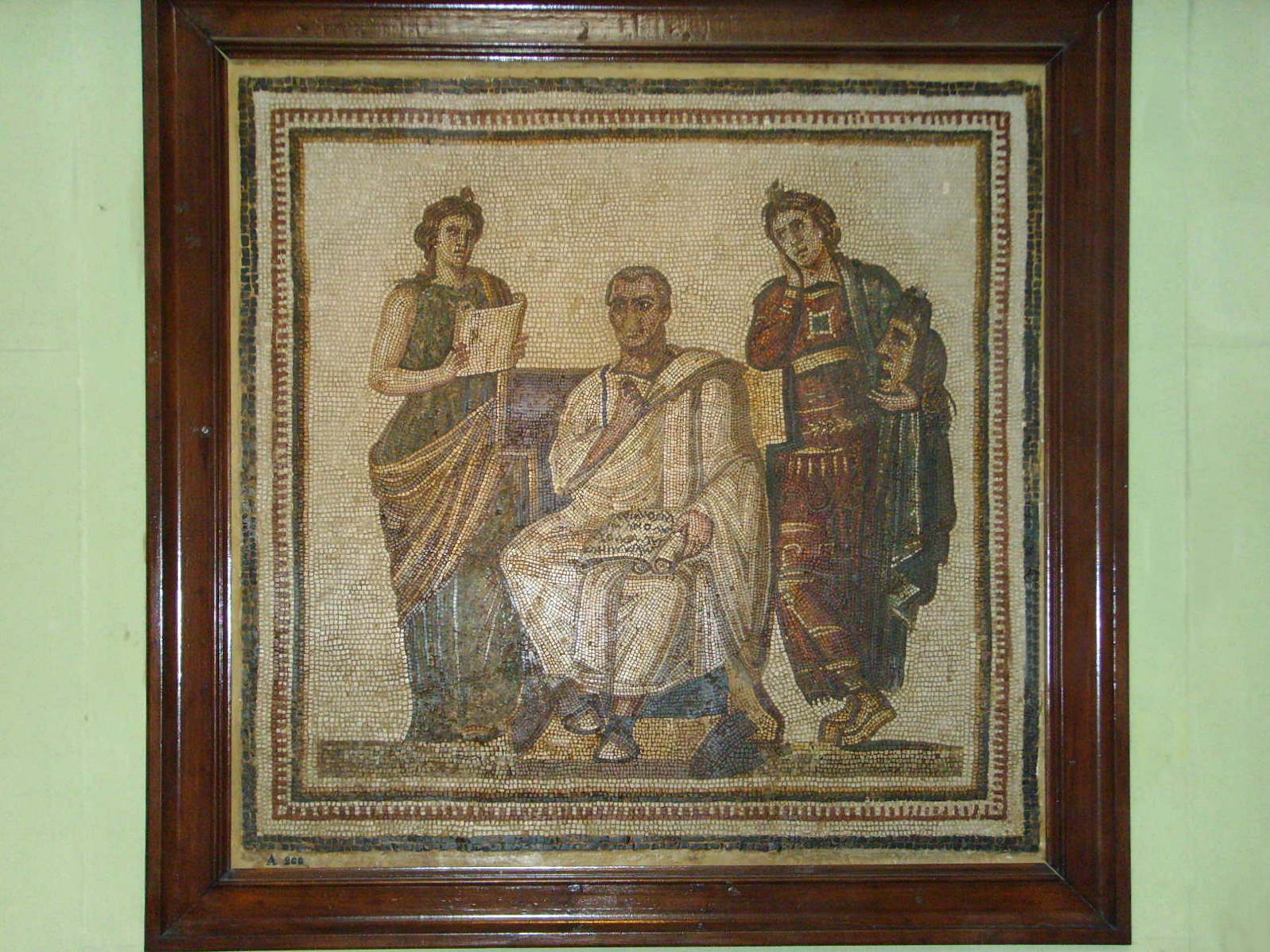 Virgil with a manuscript of the Aeneid between the muses Clio and Melpomene. Roman mosaic from Hadrumetum, 3rd century AD; Bardo National Museum.
Visual and Manuscript Evidence
Aeneas' story can be traced through several kinds of evidence. Greek vase painting shows that the flight from Troy was known long before Virgil. Roman gems, reliefs and coins connected Aeneas with lineage, power and the image of pietas. Late antique manuscripts, above all the Vatican Vergil, show how the text of the Aeneid was read and illustrated in a Roman Empire already moving toward Christianity.
These images do not prove Aeneas' historicity. Their value lies elsewhere: they record which episodes were recognizable, how the hero's political meaning changed and which objects linked the literary plot with civic, family and imperial memory. For the Aeneid, date, findspot and object type matter especially: an Archaic amphora, a Roman intaglio, an imperial relief and a late antique miniature speak to different stages in the life of one myth.
Later Significance
The Aeneid became for Latin literature what the Homeric poems were for Greek education: a school text for grammar, rhetoric and historical memory. In the Roman Empire it was quoted, copied, illustrated and used as a model of elevated style. In the Middle Ages Virgil was perceived not only as a poet but as a sage, and Aeneas' journey continued to live in manuscripts, commentaries and school tradition.
For the history of Rome the poem matters also because it shows how the elite of the early empire explained its own past. Rome appears not only as a city of laws, armies and magistracies, but as the heir of another people's catastrophe. Such memory allowed Romans to speak of victory without forgetting exile, of order without forgetting violence, and of divine ancestry without erasing human pain.
Brief Chronology
- End of the Bronze Age: the historical horizon of destructions and movements in the Aegean and Asia Minor with which later tradition associated the memory of Troy.
- 8th-7th centuries BC: formation of Homeric epic; Aeneas is known as a Trojan hero whose lineage is destined to continue.
- 6th-5th centuries BC: Greek artists depict Aeneas' flight with Anchises and Ascanius.
- 3rd-1st centuries BC: Roman tradition strongly connects Aeneas, Lavinium, Alba Longa and the origin of the Romans.
- 29-19 BC: Virgil works on the Aeneid; the poem remains not fully revised at his death in 19 BC.
- 1st century AD: the image of Aeneas enters imperial visual programs, including the reliefs of Aphrodisias.
- Around AD 400: the Vatican Vergil is produced, one of the most important late antique illustrated witnesses to the text.
Related topics
- Trojan War
- Iliad
- Odyssey
- Roman Gods
- Greek and Roman Gods
- Roman Religion
- Ancient Rome
- Roman Kingdom
- Octavian Augustus
- Punic Wars
Literature and sources
- Virgil. Aeneid / translated by H. Rushton Fairclough, revised by G. P. Goold. Loeb Classical Library. Harvard University Press.
- Virgil. The Aeneid / translated by Robert Fagles. Viking, 2006.
- Horsfall N. A Companion to the Study of Virgil. Brill, 1995.
- Hardie P. Virgil's Aeneid: Cosmos and Imperium. Oxford University Press, 1986.
- Galinsky K. Augustan Culture: An Interpretive Introduction. Princeton University Press, 1996.
- Feeney D. The Gods in Epic: Poets and Critics of the Classical Tradition. Oxford University Press, 1991.
- Conte G. B. The Poetry of Pathos: Studies in Virgilian Epic. Oxford University Press, 2007.
- Wright D. H. The Vatican Vergil: A Masterpiece of Late Antique Art. University of California Press, 1993.


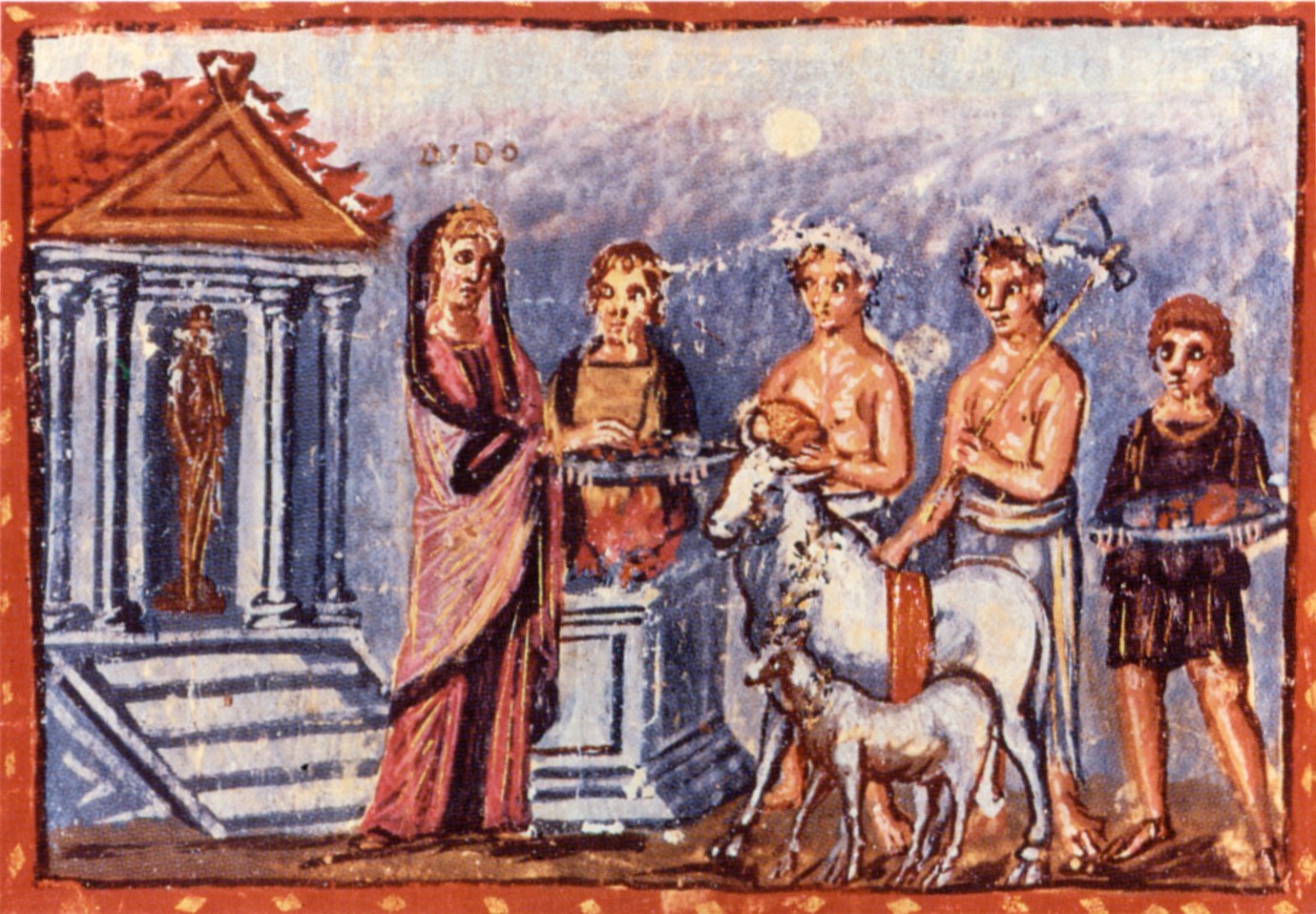 Dido offers sacrifice. Miniature from the Vatican Vergil, around AD 400; a late antique illustrated codex of the Aeneid.
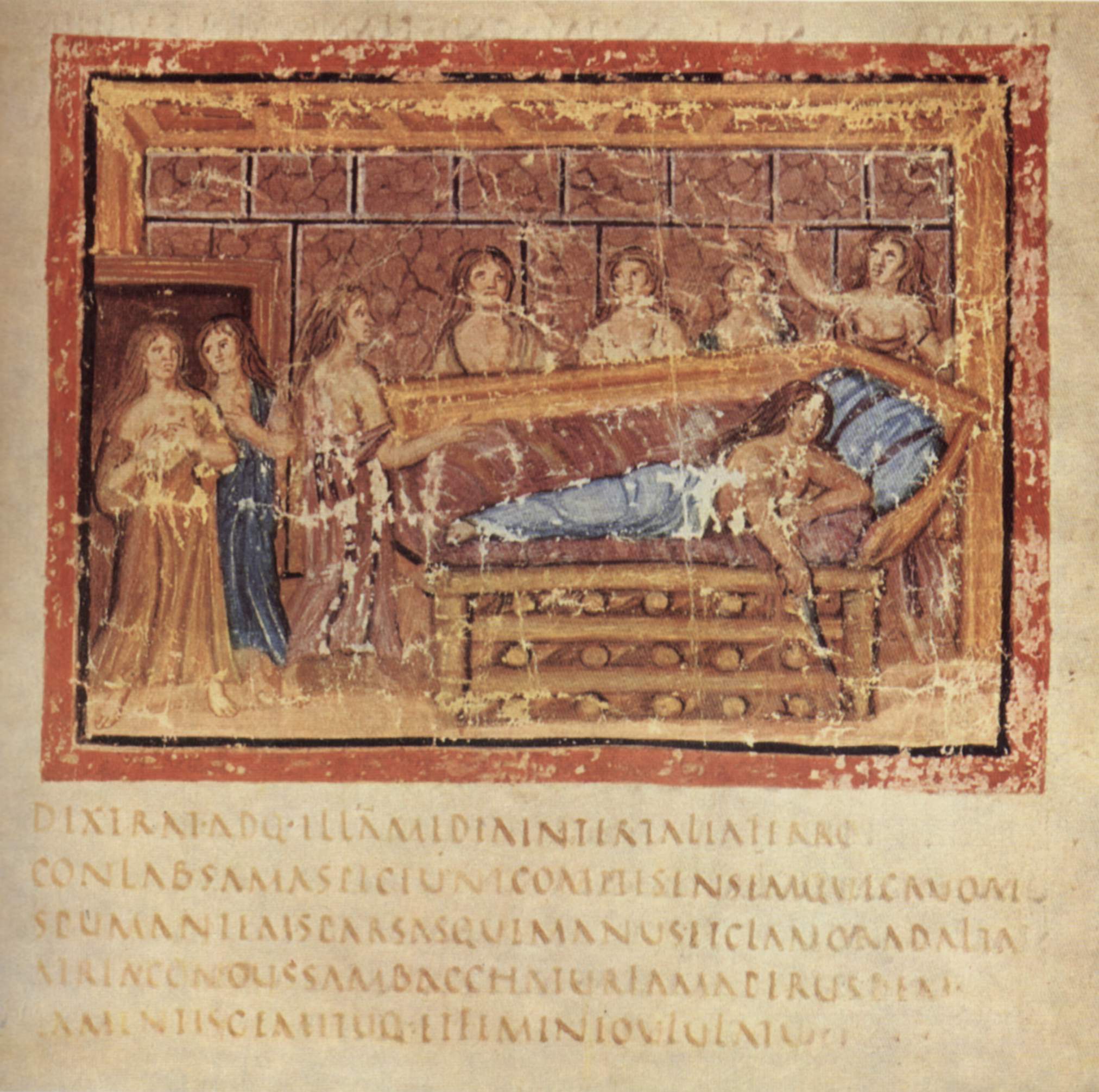 The death of Dido. Miniature from the Vatican Vergil, around AD 400; Aeneid Book IV.
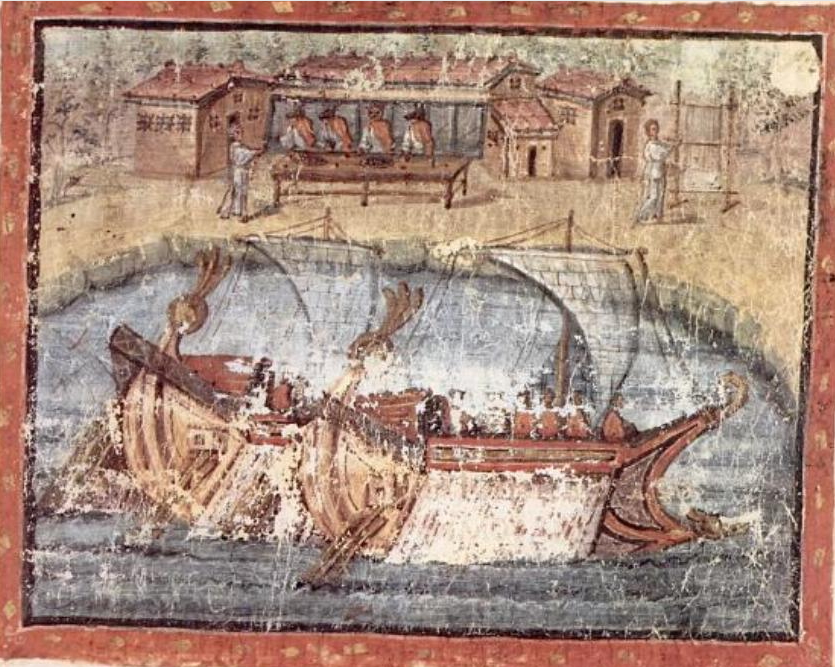 Trojan ships pass the island of Circe. Miniature from the Vatican Vergil, around AD 400; Aeneas' wanderings in Book VII.
Interested in Ancient Rome beyond reading? Join Legio X Fretensis or explore our reenactment directions.


