Roman Gods
Roman gods belonged to a religious system in which the central issue was not narrated doctrine, but the proper relationship between humans, the city and divine powers. Romans spoke of pax deorum, concord with the gods, maintained through sacrifices, vows, calendar, divination, temples, family rites and decisions of magistrates. The Roman pantheon therefore cannot be understood merely as a Latin translation of the Greek one: behind the names stood distinct divine offices, legally framed ritual and the memory of the Roman community.
Roman tradition willingly accepted Greek images, Etruscan forms of divination, Italic cults and provincial deities, but incorporated them into its own order. A deity could protect the state, family, road, door, boundary, army, craft, treaty or a specific action. This is what distinguished Roman religion from a more literary view of mythology: not only stories about gods mattered, but also who addressed them, where, with which words and by what right.
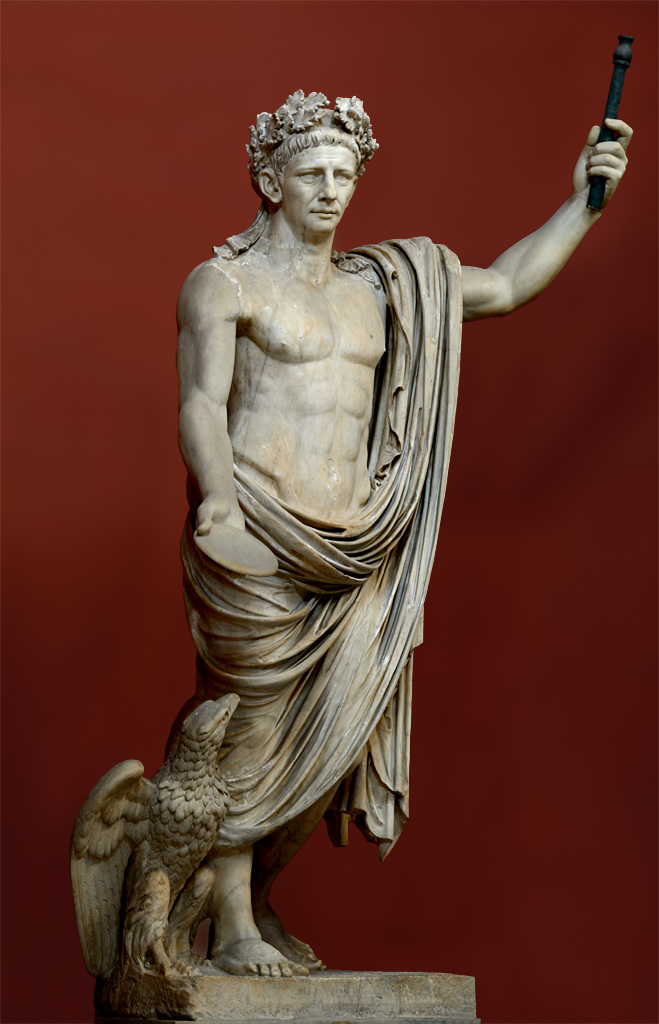 Emperor Claudius represented as Jupiter. Marble, 1st century AD; Vatican Museums.
 Roman gold cameo ring with a bust of Minerva in a Corinthian helmet, 1st century AD; Los Angeles County Museum of Art.
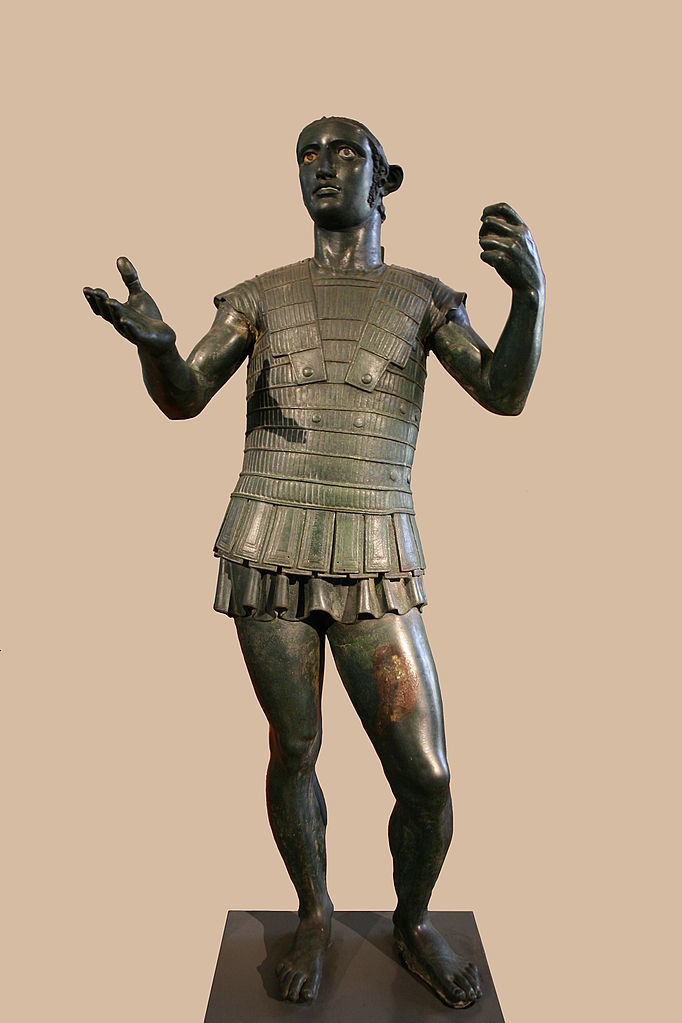 Mars of Todi, bronze statue in the Etruscan-Roman tradition, late 5th to early 4th century BC; Vatican Museums.
Roman gods: a short answer
The gods of Ancient Rome did not form one unchanging list, but a layered pantheon. Jupiter stood at the head of state cult beside Juno and Minerva in the Capitoline Triad. Mars governed war and the military community, Venus love, fertility and Roman ancestry, Vesta the sacred fire, and Janus beginnings and transitions. Households worshipped Lares, Penates, the family genius and the Manes of the ancestors.
The twelve dii consentes were usually Jupiter, Juno, Minerva, Vesta, Ceres, Diana, Venus, Mars, Mercury, Neptune, Vulcan and Apollo. This is a useful list of the principal Roman gods, but it does not exhaust Roman religion, which also included ancient Italic deities, imported cults, deified emperors and hundreds of local numina.
List of the principal Roman gods
The table gives a quick guide to the spheres and attributes of Roman gods. The Greek name is only a reference point, because functions and cults did not always coincide. A fuller comparison belongs to Greek and Roman Gods.
| Deity | Main spheres | Attributes | Greek counterpart |
|---|---|---|---|
|
Jupiter |
sovereignty, sky, oaths, victory |
thunderbolt, eagle, sceptre |
Zeus |
|
Juno |
marriage, matrons, community and state |
veil, peacock, sceptre |
Hera |
|
Minerva |
craft, knowledge, skill, strategic war |
helmet, spear, aegis, owl |
Athena |
|
Mars |
war, military community, purification of fields |
spear, shield, armour |
Ares |
|
Venus |
love, fertility, Roman ancestry |
dove, myrtle, apple, Cupid |
Aphrodite |
|
Vesta |
hearth, sacred fire, continuity of the community |
flame, round temple |
Hestia |
|
Janus |
beginnings, doors, transitions, war and peace |
two faces, key, staff |
no direct counterpart |
|
Saturn |
sowing, ancient order, abundance |
sickle, veiled head |
Cronus |
|
Ceres |
grain, agriculture, fertility |
ears of grain, torch, basket |
Demeter |
|
Diana |
hunting, woodland, women, Moon |
bow, deer, crescent |
Artemis |
|
Mercury |
trade, profit, roads, messages |
caduceus, winged hat, purse |
Hermes |
|
Neptune |
sea, water, horses |
trident, horse, dolphin |
Poseidon |
|
Vulcan |
fire, smithcraft, destructive heat |
hammer, tongs, smith's cap |
Hephaestus |
|
Apollo |
healing, prophecy, music, Augustan power |
lyre, bow, laurel |
Apollo |
|
Fortuna |
fortune, fate, change of status |
cornucopia, wheel, rudder |
Tyche |
|
Liber / Bacchus |
wine, fertility, liberation |
grapes, thyrsus, panther |
Dionysus |
|
Quirinus |
Roman civic community, deified Romulus |
spear, bearded civic image |
no direct counterpart |
|
Lares and Penates |
home, family, place and provisions |
patera, rhyton, household shrine |
no direct counterpart |
Hierarchy and Groups of Gods
At the centre of the state pantheon stood the Capitoline Triad: Jupiter Optimus Maximus, Juno and Minerva. Their temple on the Capitoline Hill symbolised Roman power, vows, triumph and the bond between city and gods. Jupiter governed supreme authority, thunder, oaths and victory; Juno was linked with marriage, female status, public welfare and the image of the Roman community; Minerva protected crafts, disciplined military force, learning and professional associations.
An older layer is often connected with the archaic triad of Jupiter, Mars and Quirinus. Mars was not simply a god of war: he was linked with the spring military season, fertility, purificatory rites, the fatherhood of Romulus and the armed community. Quirinus, probably connected with the Roman citizen-community and the deified Romulus, shows that early Roman religion understood gods through military, civic and kinship organisation.
Beside these groups stood the dii consentes, the twelve consenting gods whose gilded images stood in the Forum: Jupiter, Juno, Minerva, Vesta, Ceres, Diana, Venus, Mars, Mercury, Neptune, Vulcan and Apollo. This set reflects strong Greek influence, but in the Roman context each figure received a civic and cultic role of its own.
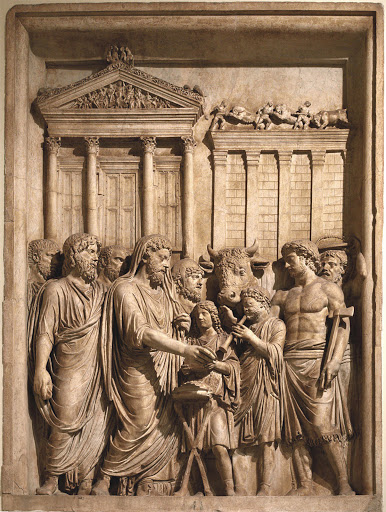 Sacrifice to Jupiter Capitolinus; relief panel from the Arch of Marcus Aurelius, AD 176-180; marble.
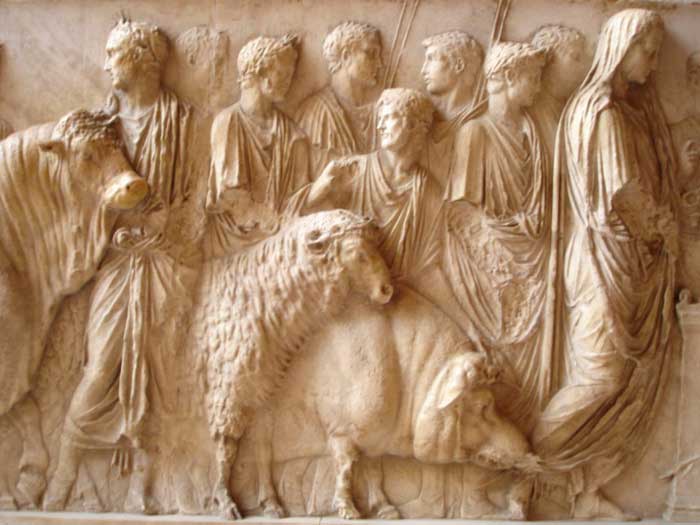 Sacrifice to Mars: suovetaurilia on a marble relief from the Louvre, first half of the 1st century AD.
Jupiter, Juno and Minerva
Jupiter was the supreme god of public authority. His epithet Optimus Maximus stressed his highest position in state cult, and the Capitoline temple was the place to which a commander ascended after a triumph. Jupiter protected oaths, treaties, senatorial decisions, victory and the Roman claim that their actions accorded with heavenly order. Thunderbolt, eagle, sceptre and the seated pose of a ruler became stable signs of his iconography.
Juno was much broader than the later image of a jealous wife. She was connected with marriage, women's lives, childbirth, the protection of matrons, calendar festivals and the fate of Rome itself. Juno Moneta on the Capitoline was linked with warning memory and the mint; Juno Sospita at Lanuvium kept a distinctive Italic image with spear, shield and goatskin. Such local forms show that the Roman goddess did not dissolve into the Greek Hera.
Minerva entered the Capitoline Triad as goddess of craft, skill and intelligent force. Artisans, scribes, physicians, actors, teachers and collegia honoured her; the Quinquatria festival was linked with crafts and learning. In images Minerva often retains Greek traits of Athena - helmet, spear, shield and aegis - but Roman objects such as lamps, cameos, cups and coins show her as an everyday and public patroness of skill.
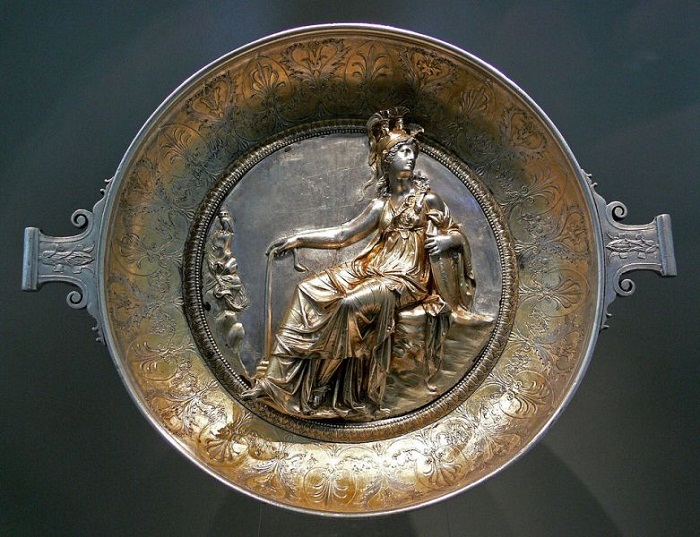 Gilded silver bowl from the Hildesheim treasure. Antikensammlung, Berlin, Misc. 3779, 1. Bowl: first century CE; Athena emblem: second century BCE, according to the museum catalogue.
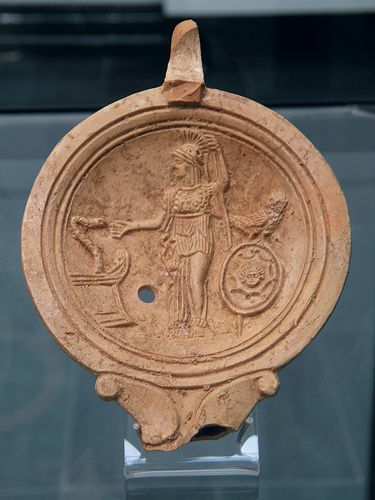 Roman ceramic lamp with Minerva, 1st century AD; Staatliche Antikensammlungen, Munich.
Mars, Venus and Roman Origin Memory
Mars held a special place at Rome. He was father of Romulus and Remus, protector of military power, the spring departure of the army, purificatory processions and male courage. His priest was the flamen Martialis, and the dancing Salii preserved an archaic military ritual with the ancilia shields. Unlike the Greek Ares, often shown as dangerous battle rage, Mars at Rome was one of the pillars of civic and military identity.
Venus was not only a goddess of love and beauty. Through the myth of Aeneas she became ancestress of the Roman people, and for the Julian family she was Venus Genetrix, the ancestral goddess. Politicians of the Late Republic used her image to legitimise power, victory and descent. The link between Venus and Mars in art could speak not only of a love story, but also of Roman power born from the union of war, fertility and mythical genealogy.
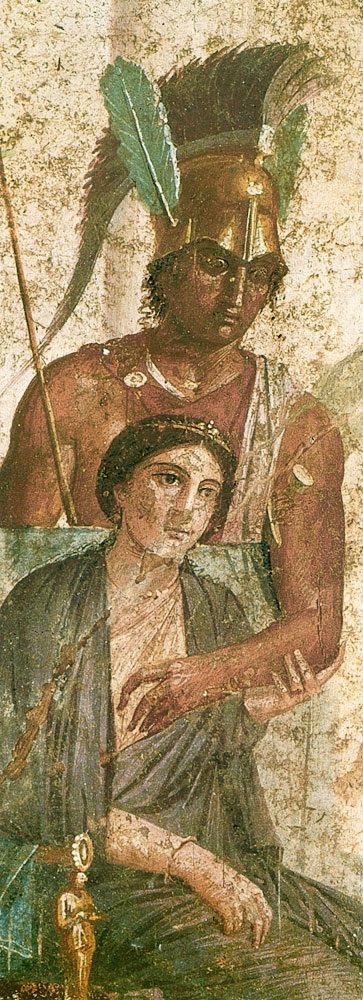 Venus and Mars on a fresco from Pompeii, 1st century AD; an image of love, war and Roman mythological memory.
Vesta, Janus, Saturn and the Rhythm of Time
Vesta guarded the sacred fire, hearth and continuity of the Roman community. Her cult in the Forum was maintained by the Vestal Virgins, whose status was exceptional: they were not ordinary priestesses of a private cult, but guardians of a sign of the state's vitality. An extinguished fire, broken vow or damage to sacred objects was perceived as a religious and political danger.
Janus was the god of doors, gates, beginnings, transitions and time. His two-faced image expresses Roman attention to boundaries: entrance and exit, war and peace, old and new, January and the new year. Saturn was linked with ancient time, sowing, wealth and the Saturnalia, when social order was temporarily inverted. These deities show that Roman spheres of responsibility often concerned not a natural element, but the precise moment of action.
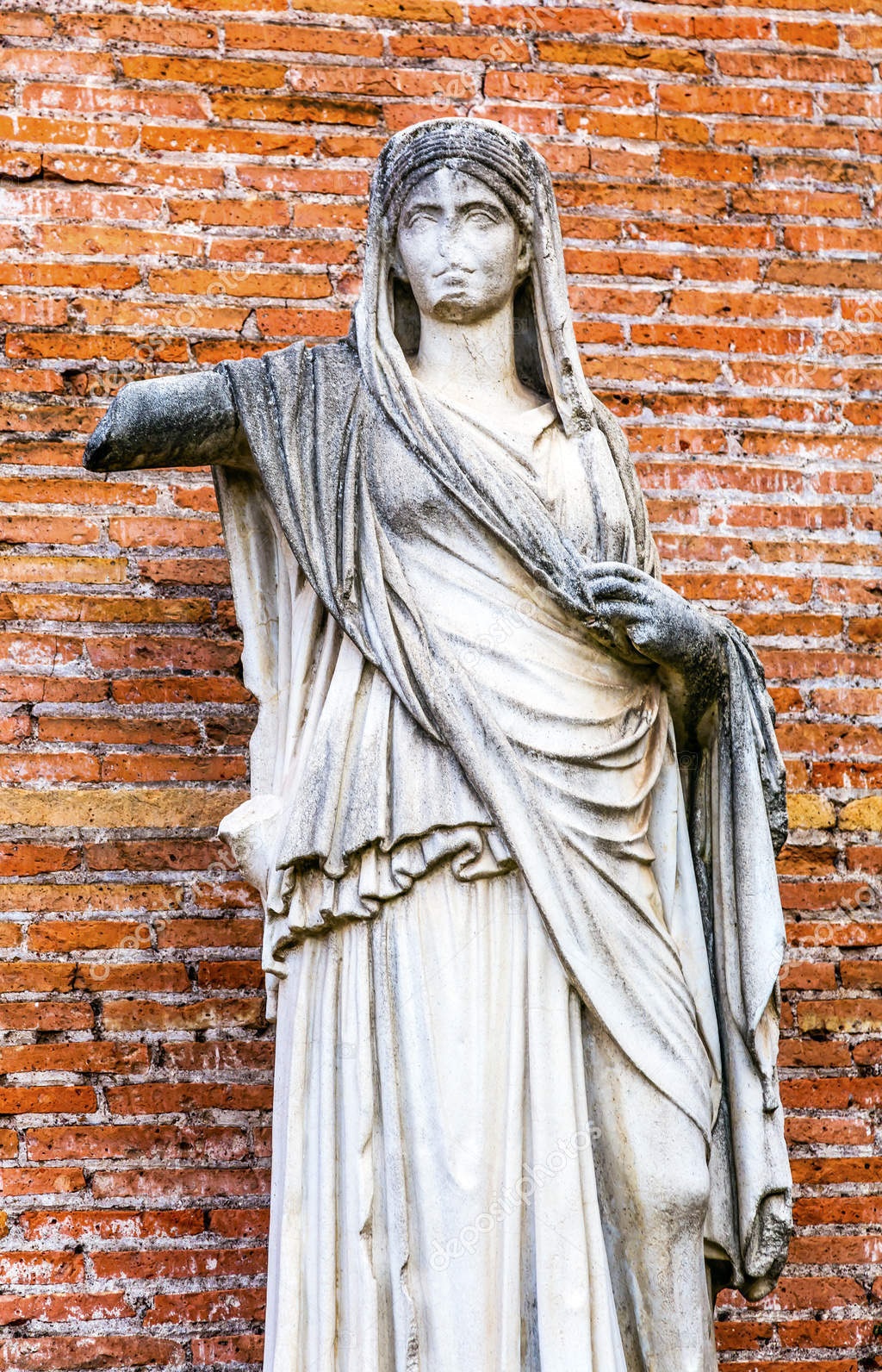 Statue of a Vestal from the Temple of Antoninus and Faustina in Rome, 2nd century AD.
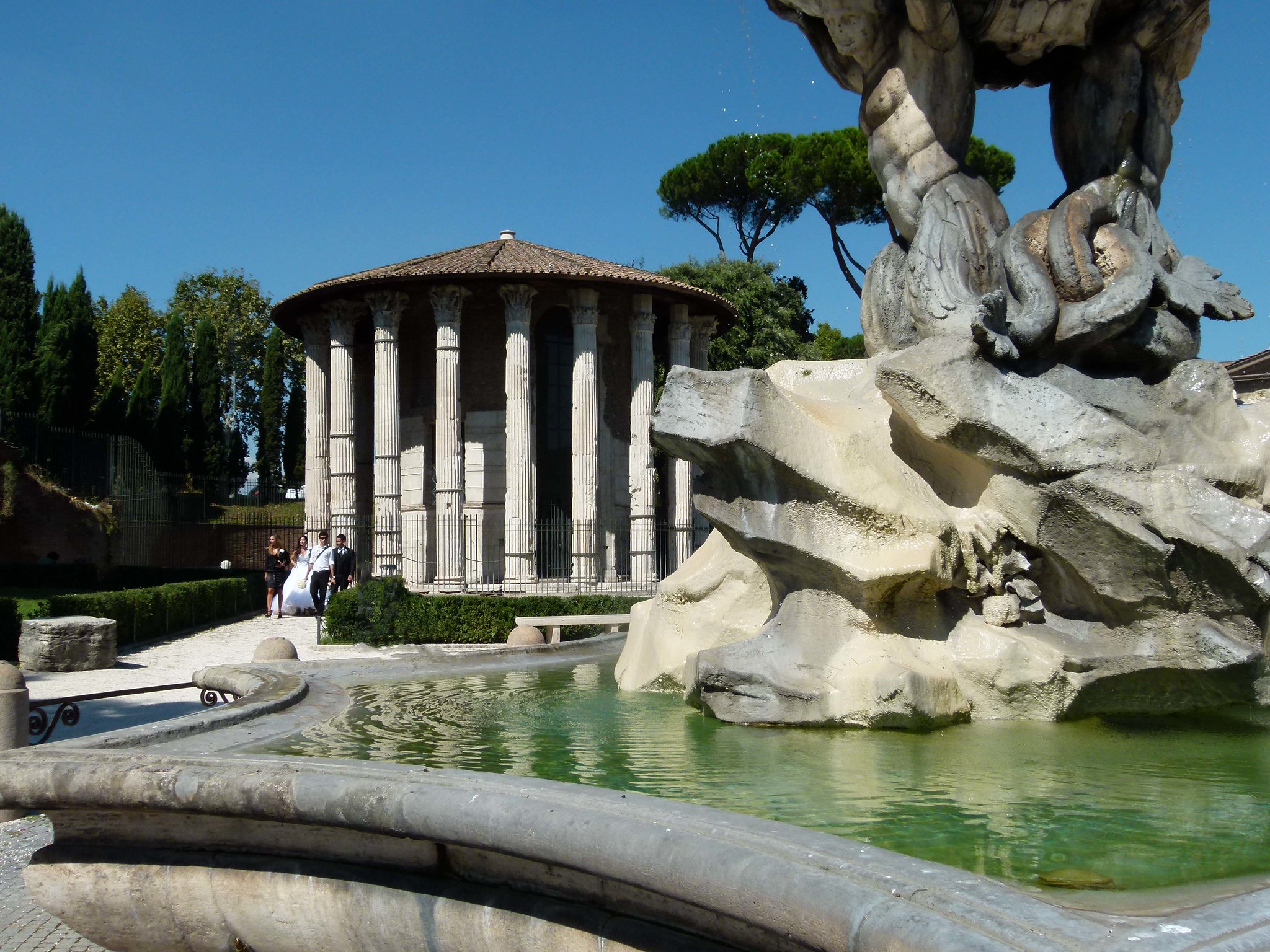 Temple of Vesta in the Roman Forum; the public sacred fire was understood as the hearth of the Roman people.
Household and Ancestral Deities
The Roman pantheon continued inside the house. The Lares protected place, crossroads, family and domestic space; the Penates were tied to storage, food and the stability of the household; the genius of the head of the family expressed the life-force of the lineage; the Manes belonged to the dead ancestors. This layer of religion was not secondary: in the house a person saw the gods daily, offered small gifts and connected the family with ancestral memory.
The lararium of Pompeii and Herculaneum makes this world especially visible. Frescoes show Lares with rhyta, a genius with patera, guardian snakes, sacrificial altar and procession. Unlike a formal temple relief, the lararium records everyday religion: the protection of food, hearth, threshold, trade, enslaved people and free members of the household. This side is treated in more detail in the article on Roman household religion.
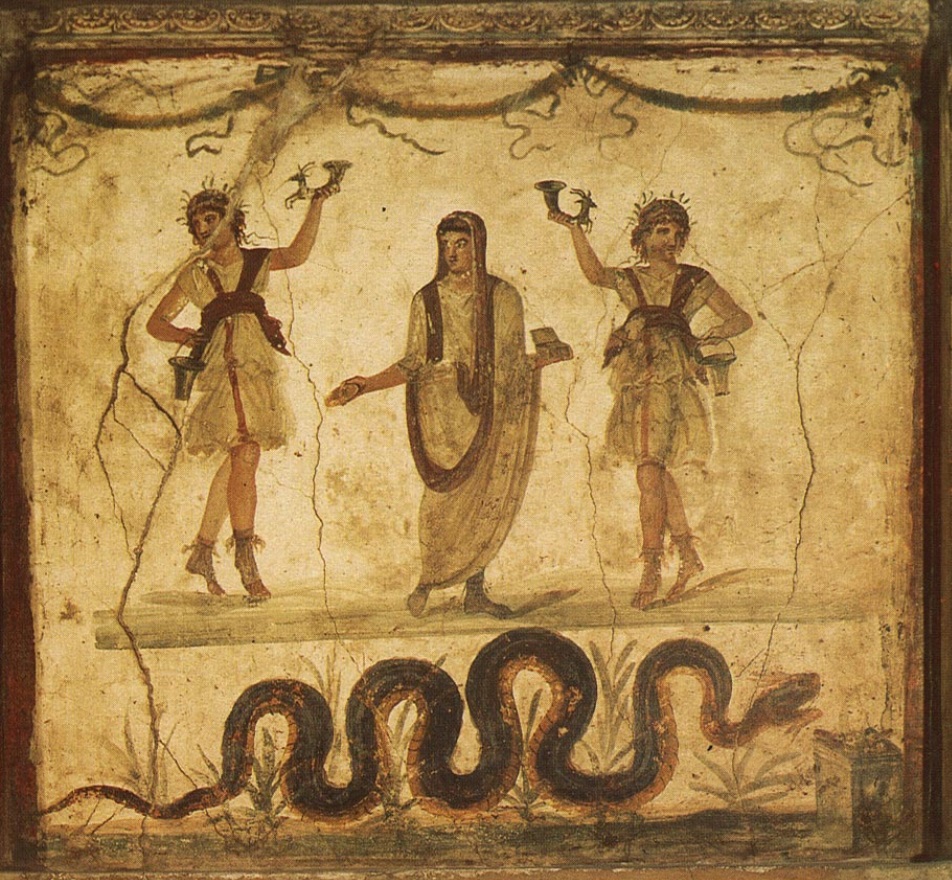 Lararium of the House of the Vettii in Pompeii (VI.15.1), kitchen area: the household genius between Lares, with serpent and altar; AD 60-79.
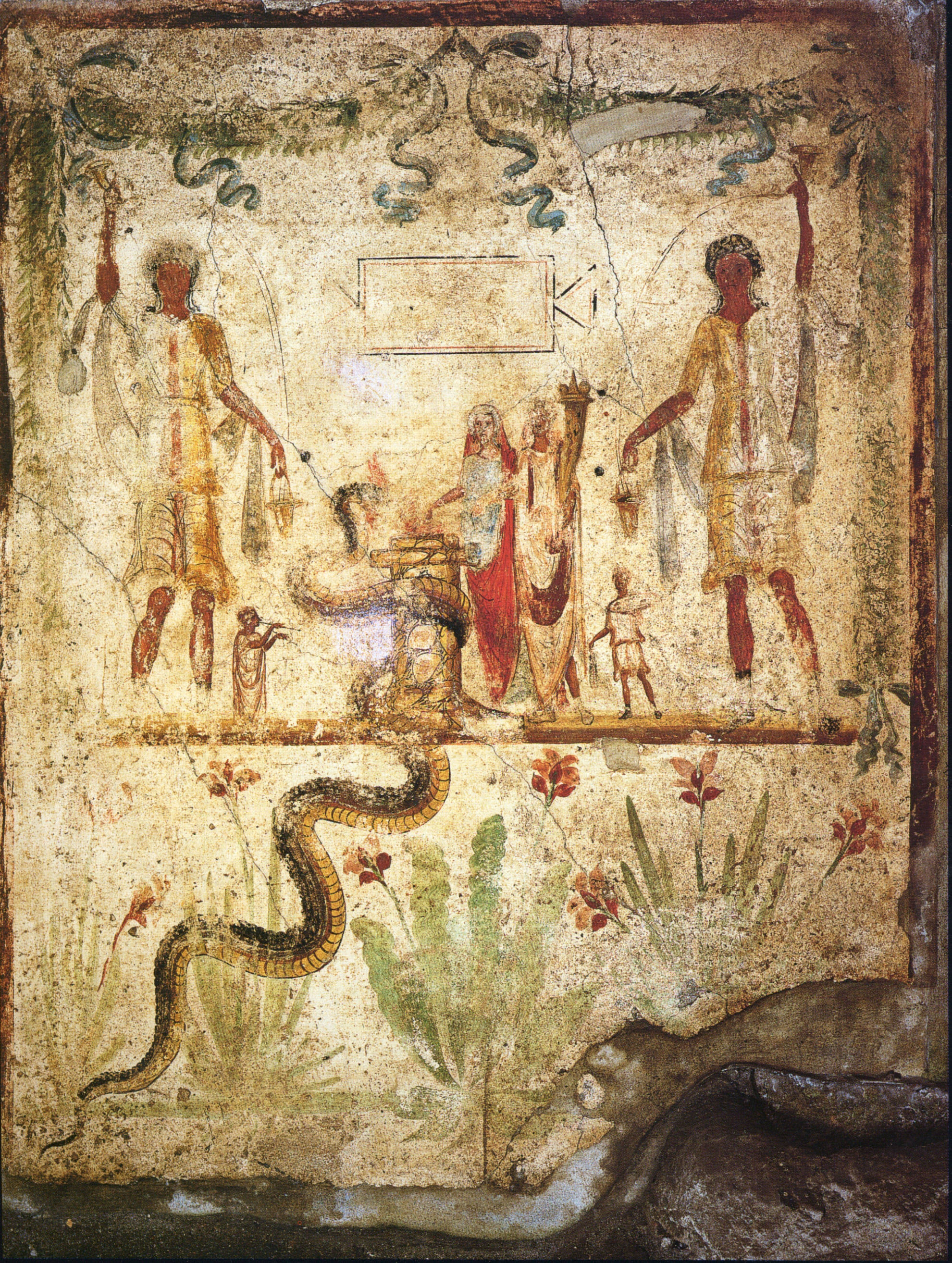 Fresco from the lararium of the House of Julius Polybius in Pompeii, 1st century AD; a household shrine with Lares, genius, serpents and altar.
Gods of Activities, Places and Dangers
Romans addressed not only great gods, but also many specialised powers. Mercury protected trade, profit, movement and roads. Neptune governed the sea and the danger of water, but long remained less central for Rome than Poseidon was for Greek maritime cities. Vulcan was connected with fire, conflagration, forge and destructive heat; his festival, the Volcanalia, fell in the dangerous dry season.
Ceres governed grain, fertility and plebeian political memory; Diana joined hunting, women, enslaved people and the Latin connections of her Aventine sanctuary; Fortuna expressed luck, change of status and the favour of fate; Apollo was received at Rome as a god of healing, prophecy, music and later Augustan power. Silvanus, Terminus, Pales, Faunus and many rural numina show the practical character of Roman appeal to the divine: each part of life had its own protection.
 Temple complex of Jupiter Anxur at Terracina, 1st century BC; modern view of the sanctuary.
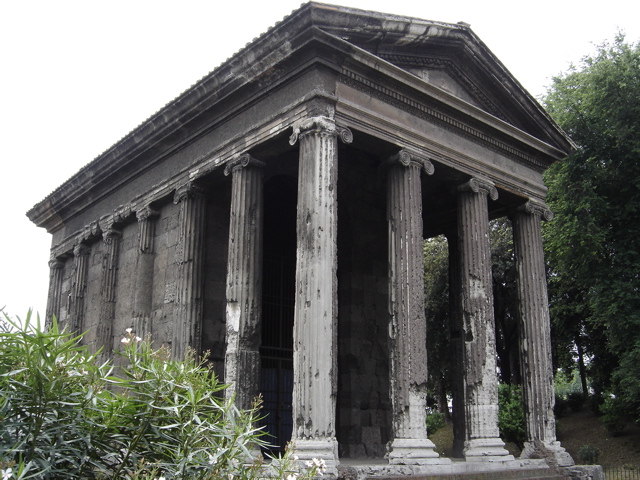 Temple of Portunus in the Forum Boarium at Rome, late 2nd-early 1st century BCE. The building combines a high podium and frontal stair with the Ionic order and a pseudoperipteral plan.
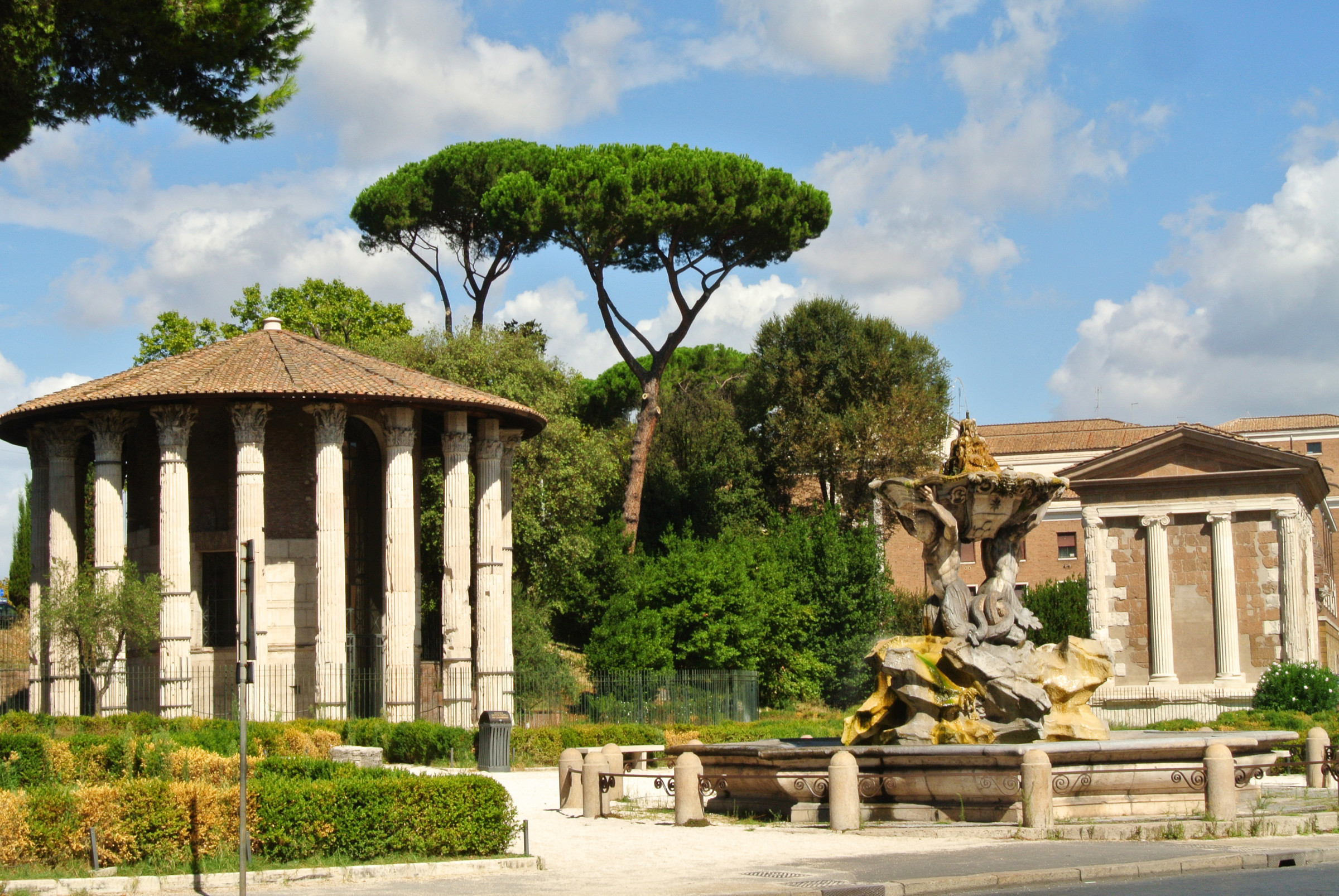 Temple of Portunus and the round Temple of Hercules Victor in Rome’s Forum Boarium. Both buildings date to the Republican period.
Names, epithets and different forms of one god
A divine name rarely stood alone. An epithet specified which power was being invoked and where. Jupiter could be Optimus Maximus, supreme protector of the state; Stator, who stopped flight; or Latiaris, god of the Latin League. Mars Ultor was the Avenger and patron of the Augustan temple, while Mars Gradivus accompanied an army on campaign. Venus Genetrix stressed the ancestry of the Julii, Venus Victrix victory, and Fortuna Redux a safe return.
The same god could therefore have several temples, festivals and groups of worshippers. An epithet was not a casual nickname: it gave a prayer a precise ritual and legal address. A dedication to Iuppiter Optimus Maximus did not address an abstract sky god, but Jupiter in his highest state function. Local forms such as Diana Nemorensis or Juno Sospita of Lanuvium preserved the identity of a particular sanctuary and community.
Festivals and the calendar of Roman gods
The Roman calendar distributed relations with the gods across the year. Festivals of Mars in March accompanied the opening of the traditional campaigning season; the Matronalia on 1 March concerned Juno Lucina and family welfare. April brought the Cerealia for Ceres, the Parilia for Pales and purification of the flocks, and the Vinalia for Jupiter and Venus. The Vestalia marked a special period of service to Vesta in June, the Vulcanalia sought protection from fire in August, and the December Saturnalia honoured Saturn with feasting, gifts and a temporary loosening of ordinary hierarchy.
A festival was not merely the anniversary of a myth, but a public action. Magistrates and priests conducted sacrifice, games, processions and banquets; households performed domestic rites; shops might close; and participants observed prescribed dress and formulas. Date, place and officiant were as important as the name of the deity. The Roman calendar was therefore a religious, political and social timetable for the city.
Imported and provincial cults
The Roman pantheon changed continuously. The Great Mother Cybele officially arrived from Pessinus during the Second Punic War; the cult of Isis spread through Mediterranean ports and cities; Mithras became especially visible among soldiers and imperial officials; and Serapis combined Greek and Egyptian features. In the third century the cult of Sol Invictus, the Unconquered Sun, received imperial support, although solar deities had been worshipped earlier.
In the provinces Roman names merged with local ones. A dedication might address Jupiter Dolichenus, Sulis Minerva or Mars Lenus. In such formulas a Roman god did not simply erase a local deity, but created a new joint interpretation of divine power. Soldiers, merchants, slaves, freedpeople and migrants carried cults between regions. Roman gods therefore belonged not only to the old pantheon of the city of Rome, but to a religious network across the empire.
How Romans addressed the gods
A prayer normally named the deity and the required epithet, recalled earlier gifts or promises, and stated the request. A vow followed the logic do ut des, 'I give so that you may give': a person or community promised a sacrifice, altar, temple, games or another gift if the request was fulfilled. After success, a dedication could record votum solvit libens merito, 'he fulfilled the vow willingly and deservedly'.
The deity depended on the task. A public decision involved Jupiter and the taking of auspices; a campaign called on Mars and gods of victory; trade on Mercury; and a family transition on Juno, Vesta, the Lares and Penates. If the exact identity of a power was uncertain, a formula could remain cautious: sive deus sive dea, 'whether god or goddess'. This precision helps explain the many epithets, priestly offices and ritual rules of Roman religion.
Greek Equivalences and Roman Specificity
Romans compared their gods with Greek ones: Jupiter with Zeus, Juno with Hera, Minerva with Athena, Mars with Ares, Venus with Aphrodite, Mercury with Hermes. Yet such pairs do not mean complete identity. Mars, Venus, Vesta, Janus, Quirinus and the Lares carry Roman meanings that cannot be derived only from Greek myths. Even when a statue looks Greek, its place in a temple, on a coin, in a house or on an altar may be thoroughly Roman.
Greek influence intensified after conquests in southern Italy, Sicily and the eastern Mediterranean. The Roman elite read Greek literature, collected statues, built temples in Hellenistic forms and reinterpreted myths. Yet official cult remained tied to the Roman calendar, priestly colleges, the law of vows and public decisions. The topic of the gods therefore requires both comparison with Greece and attention to the differences between Greek and Roman religion.
Imperial Imagery and Deification
Under the principate the language of the gods became part of the image of power. After Caesar's death and the rise of Octavian Augustus, Romans gained a stable form of honouring divi, deified rulers. A living emperor did not always directly become a god in Italian cult, but his genius, numen, victory, peace and connection with Jupiter, Apollo, Venus or Mars could receive public expression. A statue of an emperor as Jupiter is not merely a portrait, but a political theology of power.
In the provinces the imperial cult often joined local gods and civic elites. Altars, inscriptions, temples of Roma and Augustus, coins and processions show that Roman religion was not a closed system of old Italic names. It included power, army, provincial cities and local traditions, but translated them into the language of Roman order, gratitude and loyalty.
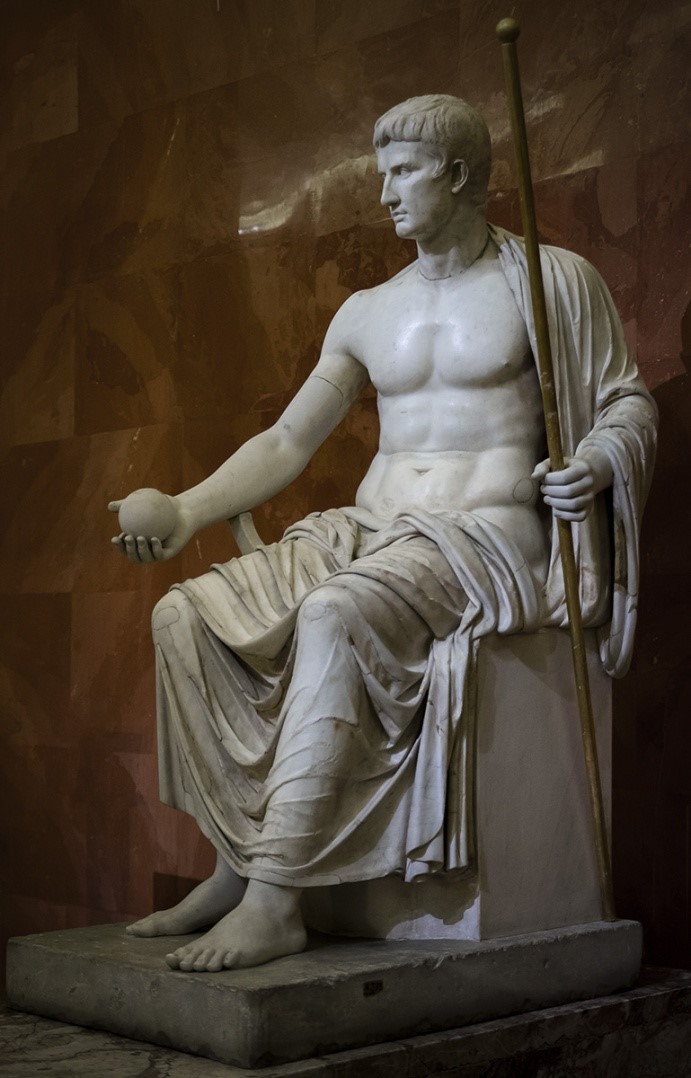 Octavian Augustus represented as Jupiter. Marble, first half of the 1st century AD; Hermitage Museum, St Petersburg.
Ritual, Priests and Law
Roman gods were closely tied to procedure. The pontifices supervised sacred law and the calendar, the augurs interpreted signs before public actions, the flamines served the cults of individual gods, and the Vestals guarded Vesta's fire. These offices show that religion was part of the structure of the state: an error in words, gestures or the right to perform a rite could require the sacrifice to be repeated.
Sacrifice was the central way of communicating with the gods. Roman ritual included processions, the covered head of the sacrificer, music, prayer, inspection of the animal, libation, division of parts and later interpretation of the result. Military reliefs and altars make especially visible how Jupiter, Mars, Apollo and other gods received offerings on behalf of the army, city or emperor.
Iconography and Archaeological Evidence
Roman gods are identified through a combination of name, attribute and context. Jupiter usually receives thunderbolt, eagle, sceptre and throne; Juno a veil, peacock or matronly form; Minerva helmet, spear, shield and aegis; Mars weapons and martial image; Venus a semi-nude figure, Cupid, mirror or apple; Mercury caduceus, purse and winged elements; Vesta the hearth and veiled priestess; Fortuna cornucopia, rudder and the wheel of fate.
Archaeological evidence shows different levels of religion. A temple and forum speak of public cult; an inscribed altar of a specific dedicator and deity; a coin of political programme; a lamp or ring of the everyday carrying of an image; a lararium of domestic ritual; a military relief of the link between gods, army and emperor. For Roman gods it is especially important not to separate an image from the function of the object.
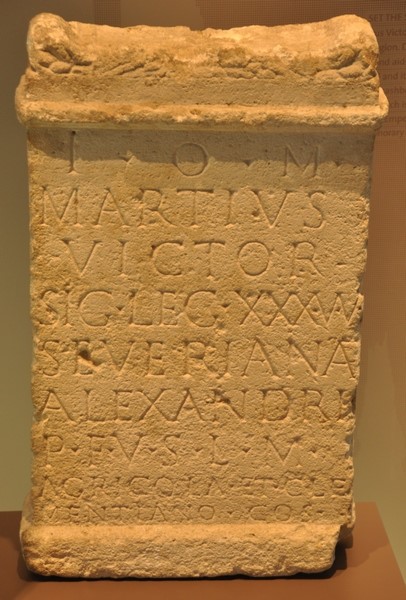 Altar dedicated to Jupiter by Legio XXX Ulpia Victrix. Xanten, AD 230; LVR-RömerMuseum, Xanten Archaeological Park.
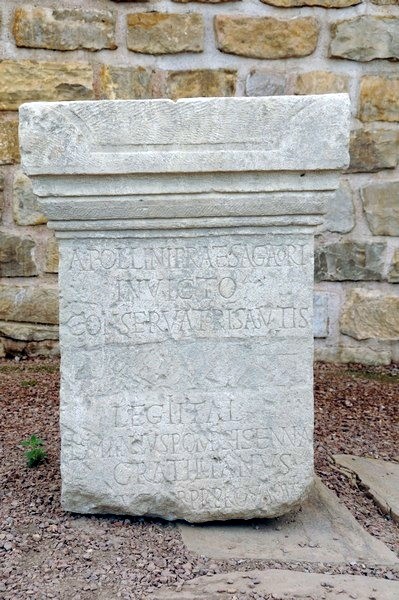 Altar dedicated to Apollo by Legio I Italica; Svishtov City Museum, Bulgaria, 1st century AD.
Short Chronology
- 8th-6th centuries BC - formation of early Roman and Latin cults, archaic priestly offices, calendar and sacred places of the city.
- Late 6th century BC - establishment of the Capitoline temple of Jupiter, Juno and Minerva as the chief symbol of state cult.
- 4th-3rd centuries BC - Rome's expansion intensifies contact with Latin, Samnite, Etruscan and Greek cults.
- 204 BC - during the Second Punic War the cult of the Great Mother is brought to Rome, showing the state's ability to accept new divine powers.
- 1st century BC - the Late Republic connects Venus, Mars, Apollo and Jupiter with political competition, family myths and civil wars.
- 1st-3rd centuries AD - imperial cult, provincial altars, military dedications and household lararia form the multilevel religion of the empire.
- 4th century AD - traditional cults gradually lose their former public status as Christianity grows stronger.
Frequently asked questions about Roman gods
Who was the chief Roman god? Jupiter Optimus Maximus was the supreme protector of the state, oaths and victory. His Capitoline temple stood at the centre of public cult.
Which three gods formed the Capitoline Triad? Jupiter, Juno and Minerva. The older Archaic Triad consisted of Jupiter, Mars and Quirinus.
Who were the twelve principal Roman gods? Jupiter, Juno, Minerva, Vesta, Ceres, Diana, Venus, Mars, Mercury, Neptune, Vulcan and Apollo. They were known as the dii consentes.
Were Roman gods copies of Greek gods? No. Romans equated many deities with Greek figures and adopted images and myths, but preserved their own cults, epithets, festivals and state functions. Janus, Quirinus, the Lares and Penates have no simple Greek equivalent.
Which Roman goddess governed love? Venus governed love, fertility, beauty and Roman ancestry through Aeneas.
Which god did Roman soldiers worship? Above all Mars, but also Jupiter, Victoria, Hercules and local deities of a unit or province. Altars show that military religion was broader than the cult of Mars alone.
Related Topics
- Roman Religion
- Religion of Ancient Greece and Ancient Rome
- Greek and Roman Gods
- Roman Household Religion
- Lares
- Lararium
- Penates
- Roman Temples
- Sacrifices in Ancient Rome
- Pontifex
- Augur
- Flamen
- Vestal Virgin
- Octavian Augustus
Literature
- Beard M., North J., Price S. Religions of Rome. Vol. 1: A History. Cambridge University Press, 1998.
- Beard M., North J., Price S. Religions of Rome. Vol. 2: A Sourcebook. Cambridge University Press, 1998.
- Rüpke J. Religion of the Romans. Polity Press, 2007.
- Scheid J. An Introduction to Roman Religion. Indiana University Press, 2003.
- Wissowa G. Religion und Kultus der Römer. München, 1912.
- Orlin E. Foreign Cults in Rome: Creating a Roman Empire. Oxford University Press, 2010.
- LIMC: Lexicon Iconographicum Mythologiae Classicae.


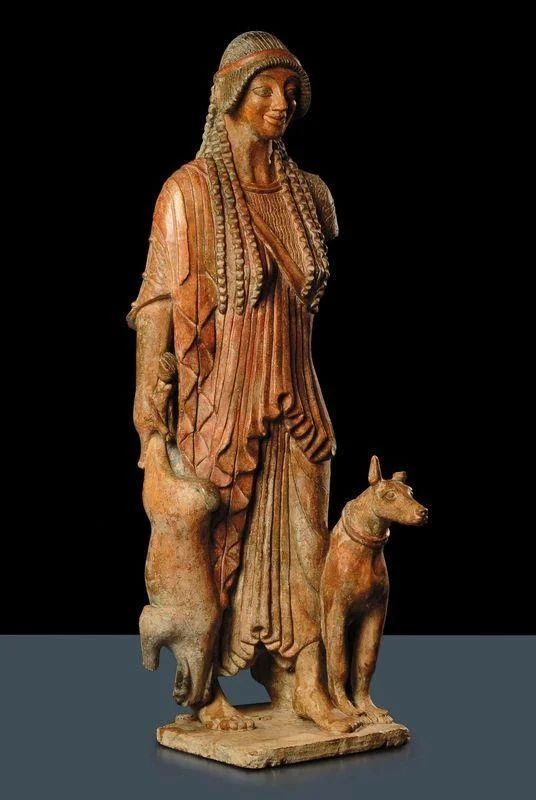 Etruscan sculpture of Diana, goddess of hunting, 5th century BC; an example of early Italic image tradition.
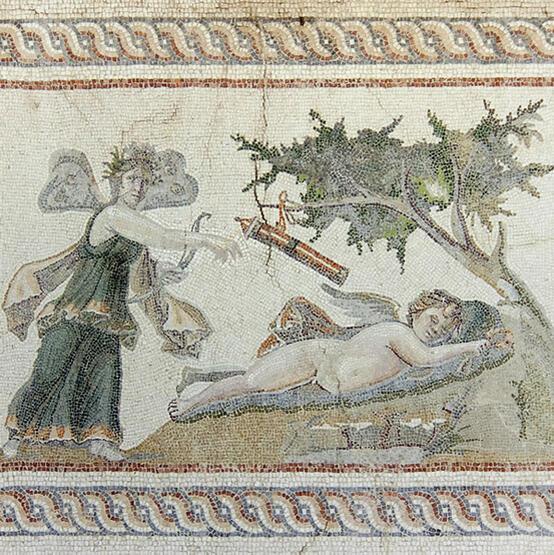 Venus and Cupid. Mosaic from Antioch, 4th century AD; a Late Antique image of the goddess of love.
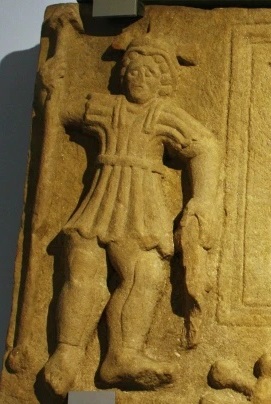 Sculpture of Mars found near the Roman fort of Bremenium, 3rd century AD.
Interested in Ancient Rome beyond reading? Join Legio X Fretensis or explore our reenactment directions.


