Roman Household Religion
Roman household religion connected family, enslaved people, clients, ancestors, hearth, storerooms, threshold and protective household gods. It was not private belief in the modern sense: the Roman house was part of the civic community, and the pater familias was responsible for the order of the family almost as a magistrate was responsible for the order of the city. Domestic cult therefore joined daily food, birth, marriage, memory of the dead, property and the welfare of the whole family line.
The central figures are the Lares, Penates, the household genius and the lararium. Through them one can see that Roman religion functioned not only in large temples and state festivals. It entered the house through small images, niches, frescoes, incense, cups of wine, garlands, portions of food and brief prayers that accompanied ordinary days.
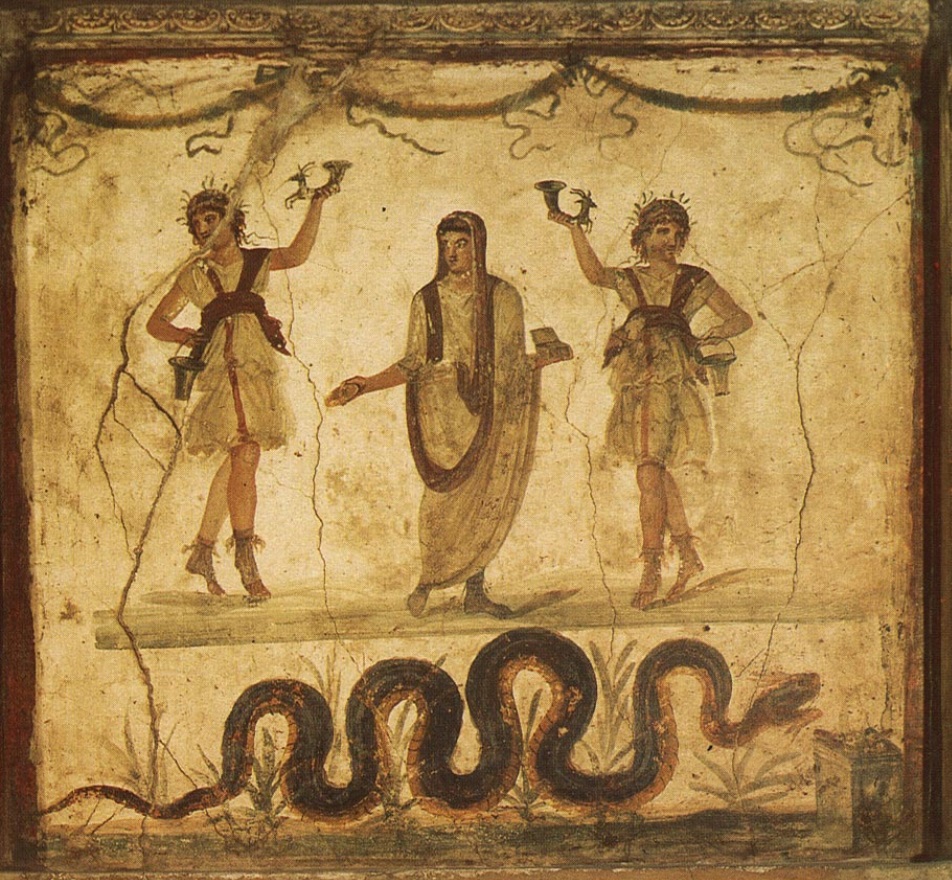 Lararium of the House of the Vettii in Pompeii (VI.15.1), kitchen area: the household genius between Lares, with serpent and altar; AD 60-79.
The House as a Religious Space
The Roman house had several places where religious meaning was especially visible. The threshold protected the boundary between outside world and family; the atrium and courtyard connected the house with guests and clients; kitchen, storeroom and hearth pointed to food and supplies; bedroom, marriage room and childbirth space joined the family to the chain of generations. Even without an elaborate architectural niche, a small altar, shelf with statuettes or painted wall could perform the same function.
Domestic cult did not require a permanent priest. It was maintained by the master of the house, the mistress, children, enslaved people and freedpeople. In a wealthy house the rite could take place in the atrium before a visible lararium, while in a shop, workshop or apartment of an insula it was simpler and tied more directly to labour. Household religion therefore shows the social breadth of the Roman world: the cult of one house included people of different status without erasing the differences between them.
Lares, Penates, Genius and Manes
The Lares protected place, crossroads, household and the people living around it. In domestic contexts they are often shown as a pair of dancing youths with rhyton or bowl: they look light and festive, but their function was serious, preserving the welfare of the house and restoring order after dangerous transitions. The Penates were connected with stores, pantry, bread, wine and the family's ability to feed itself. Their cult emphasised that household prosperity depended not only on labour, but also on proper relations with the gods.
The genius of the head of the household expressed life force, fertility and legal continuity of the family line. In the female sphere it corresponded to the woman's Juno, although in domestic cult she is less visible than the male genius. Beside them stood the Manes of the dead ancestors: they were not merely "spirits", but part of family memory that had to be acknowledged and appeased. Household religion therefore joined the living, the dead and the not-yet-born members of a family into one line.
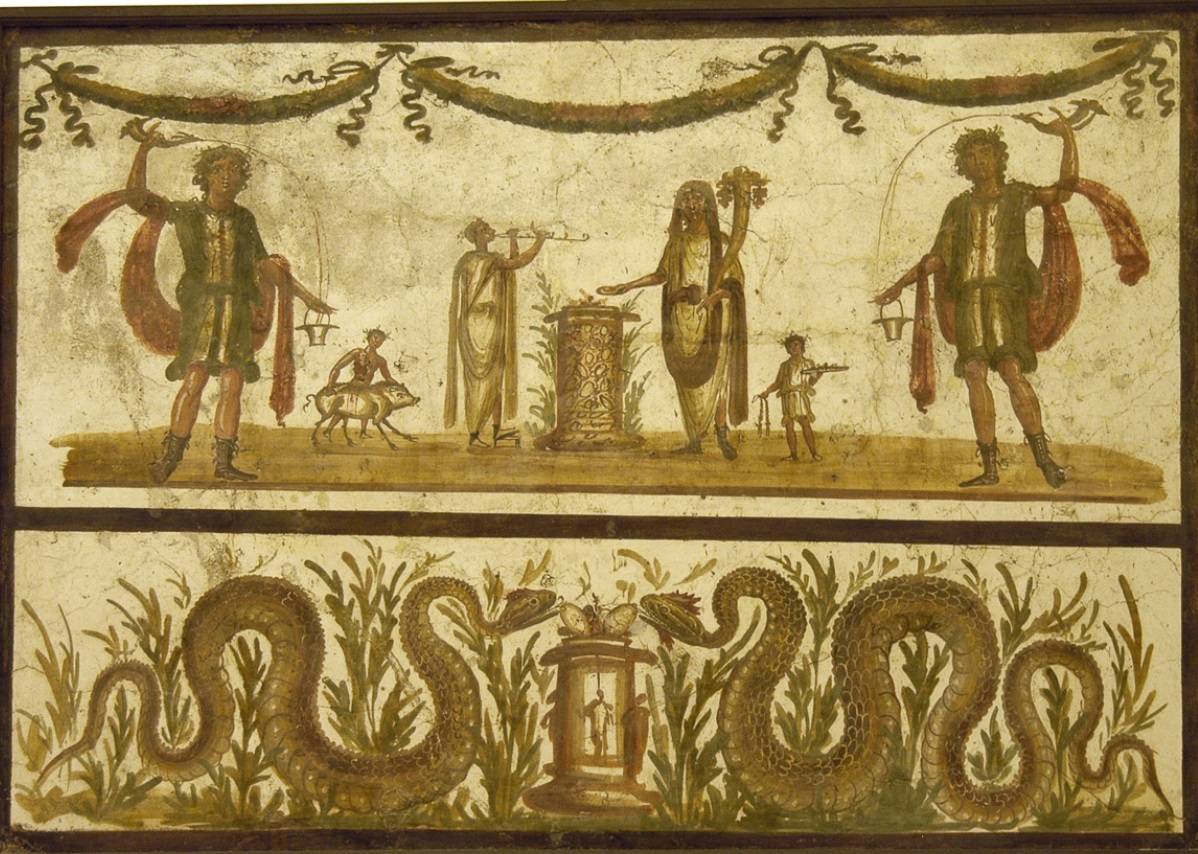 Lares, genius and serpents on a fresco from a Pompeian lararium, Insula VIII.2; Naples, National Archaeological Museum, inv. 8905, AD 69-79.
 Bronze statuette of a Lar or participant in household cult holding a libation bowl; a portable image from the sphere of Roman domestic religion, 1st century AD.
Lararium and Domestic Images
A lararium could be an architectural niche, a painted part of a wall, a small temple facade, a shelf with statuettes or a combination of these forms. At Pompeii and Herculaneum lararia occur in atria, kitchens, gardens, shops and workrooms. Their location matters: a domestic shrine often stood where the house fed people, received visitors or displayed the status of its owner. The lararium was therefore a religious place, a family sign and part of the presentation of the house at the same time.
Snakes often appear beside the Lares in wall paintings. They are connected with fertility, earth, protection of place and household welfare. A composition may show the veiled genius performing sacrifice; Lares stand at the sides, while snakes move below toward an altar or vessel. Such a scene shows the ritual itself: the house needs not only gods as figures, but also repeated action that renews the bond between them and the family.
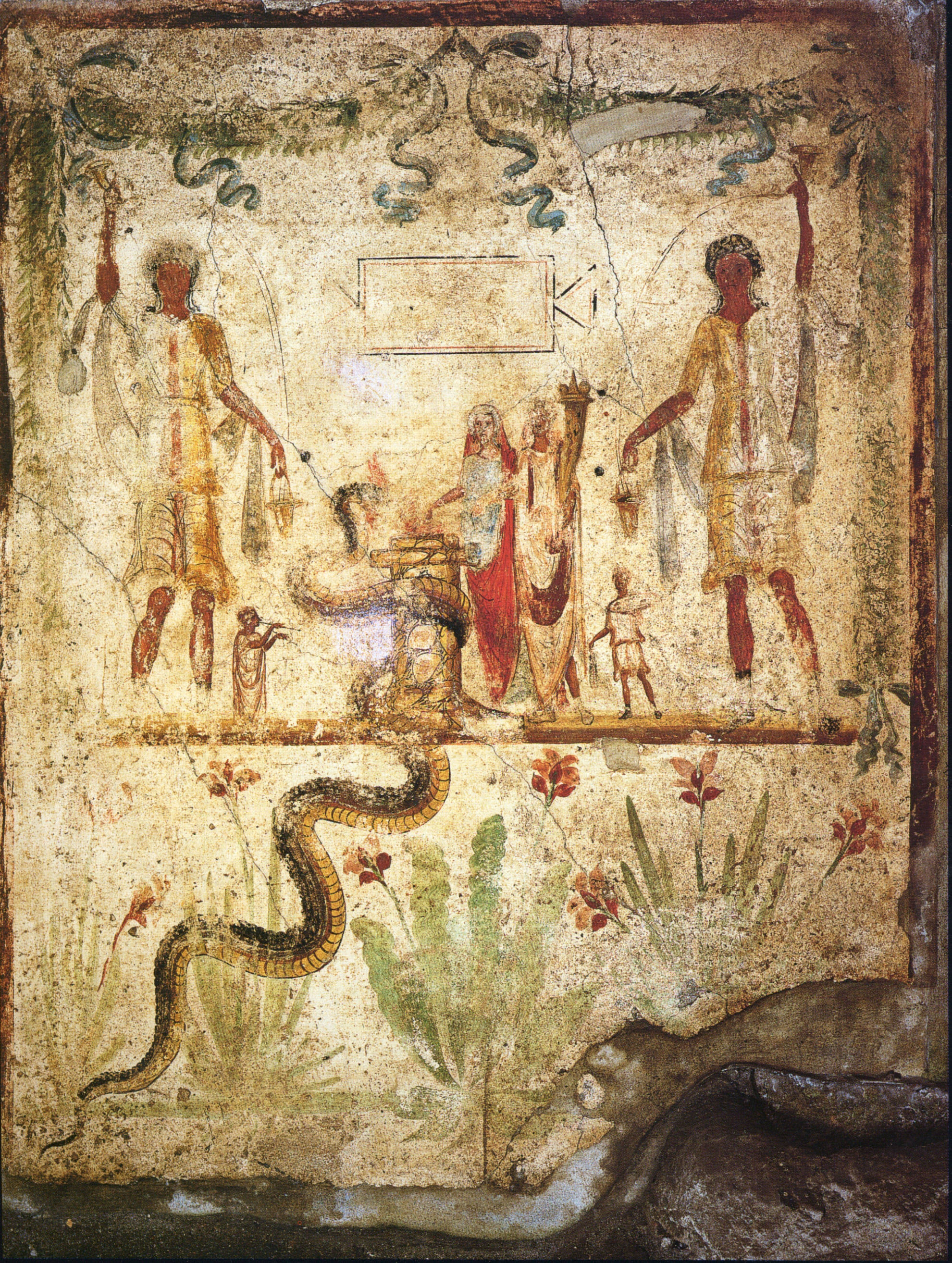 Fresco from the lararium of the House of Julius Polybius in Pompeii, 1st century AD; a household shrine with Lares, genius, serpents and altar.
Daily Rites
A daily rite could be brief: a few words, incense, garland, drop of wine or small portion of food. Regularity mattered more than length. The Lares and Penates were addressed before meals, during family events, at departure, return home, income, illness or danger. On festivals the lararium was decorated, and images could be cleaned, anointed or surrounded with fresh greenery. This cult was a practical language of gratitude, request and memory.
Household religion accompanied the main transitions of life. At childbirth the family thanked the gods for the safety of mother and child; at coming of age a boy dedicated childhood signs and put on the toga virilis; at marriage a woman entered a new house and its cult; at death the family cared for burial, commemoration and relations with the Manes. Domestic rites thus connected body, name, clothing, food and legal status.
Family, Women, Children and Enslaved People
Formally the pater familias stood at the head of the household cult, but this does not mean that other members of the house were passive. The matron was responsible for many actions connected with hearth, food, textiles, children, marriage and internal order. Children learned religious norms through repeated domestic gestures. Enslaved people and freedpeople participated in the cult of the Lares with the household in which they lived and worked, although their participation did not cancel dependence on the master.
For clients and visitors household cult was also a visible sign. A lararium in the atrium or near a reception area reminded people that the house had its own memory, gods and social hierarchy. In large houses the cult could support family prestige as strongly as ancestor portraits and expensive decoration. In small houses, shops and workshops it expressed a more modest but equally important idea: the place of work and residence was protected, and income depended on proper order.
Household Hearth and Vesta
The hearth was one of the oldest religious images of the house. In the real urban architecture of the imperial period it did not always look like a central fire in an old house, but the symbolism of food, warmth and continuity remained. On the public scale this idea corresponded to Vesta: her temple in the Forum and the fire guarded by the Vestals presented Rome as one household. Romans therefore understood a parallel between domestic hearth and state cult.
This parallel did not make domestic cult a miniature copy of state religion. Vesta, Jupiter, Mars or the imperial genius could appear in the house, but the main logic remained familial: preserve prosperity, health, ancestral memory and internal peace. State cult spoke for people, senate and magistrates; household cult spoke for a specific house and the people who ate at one table, worked in one space and depended on one estate.
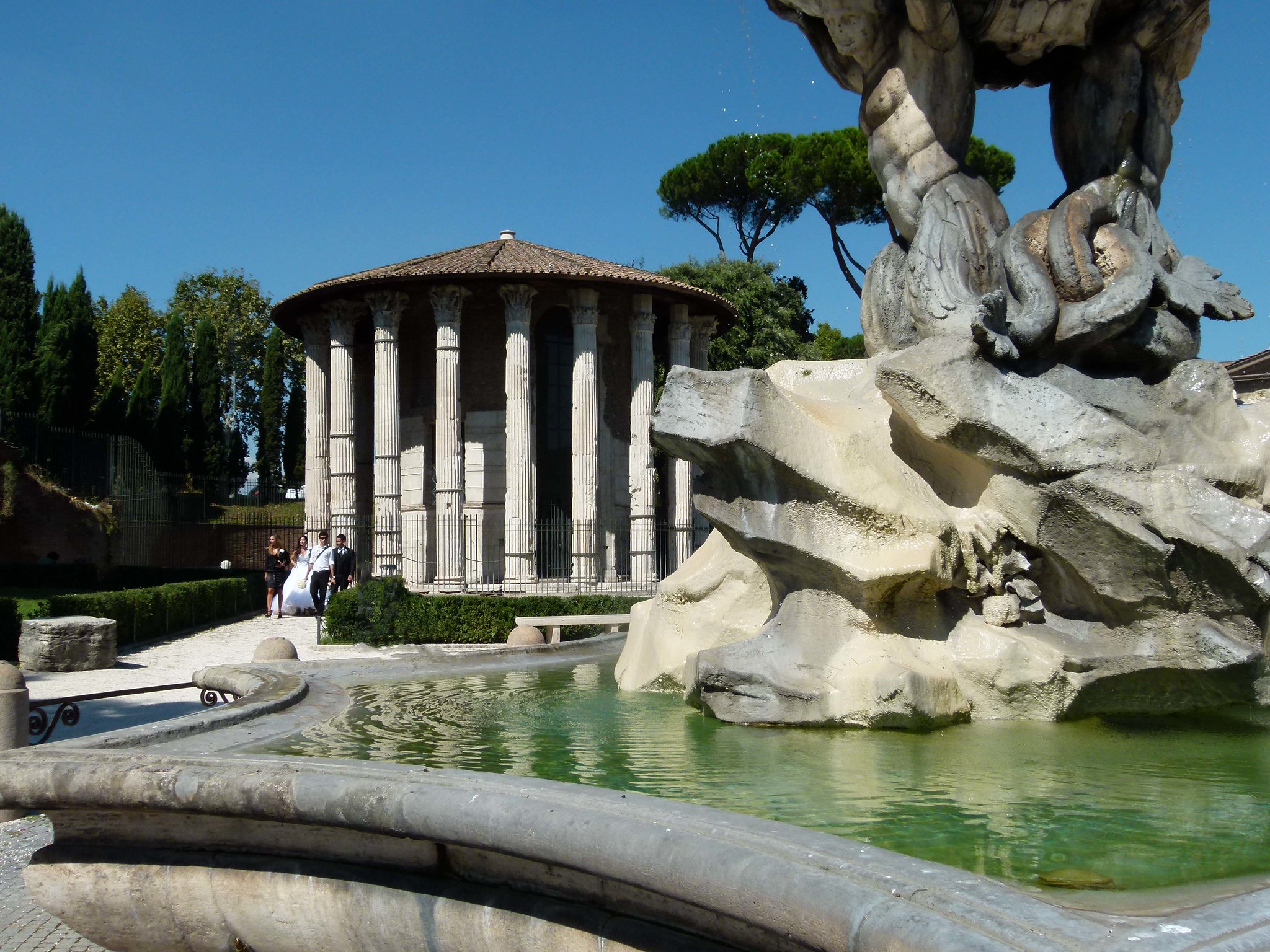 Temple of Vesta in the Roman Forum; the public sacred fire was understood as the hearth of the Roman people.
Festivals and the Household Calendar
Domestic rites grew more intense on certain calendar days. On Kalends, Nones and Ides small offerings and decoration of the lararium could take place. The Compitalia connected household Lares with the Lares of crossroads and neighbourhood. The Saturnalia temporarily changed ordinary roles, including relations between masters and enslaved people. The Parentalia and Feralia turned family attention toward the dead, while the Lemuria concerned the dangerous side of the dead who had to be driven from the house.
The household calendar therefore cannot be reduced to one niche on a wall. It included seasonal work, payments, the master's return, birthday, dedication of a child, wedding, funeral and ancestral memory. For Romans religious action was often a way to give an event its proper form. The house became the place where personal biography received recognised shape: a child entered the family, a boy became adult, the dead became ancestors.
Archaeological Evidence
The best evidence for household religion comes from cities where domestic interiors survive, above all Pompeii and Herculaneum. There one can see not only fine frescoes, but also the position of the lararium inside the house and its relation to kitchen, garden, shop, stairway or reception area. Bronze statuettes, terracottas, small altars, soot traces, paint remains, inscriptions, vessels and images of snakes are also important. They show ritual as part of material environment rather than as abstract doctrine.
Archaeological evidence must still be used carefully. Pompeii gives an exceptional snapshot of AD 79, but not all of Rome looked like Pompeii. A wealthy house, shop, rural villa and cramped urban apartment left different traces. Some rites barely survive materially: prayer, gesture, smell of incense, family story and memory of a particular dead person disappear faster than plaster or bronze. Household religion must therefore be reconstructed from a combination of objects, texts, layout and repeated images.
Short Chronology
- Archaic and early Republican periods - household hearth, ancestor cult, protection of threshold and stores shape the basic language of family and lineage.
- Middle and Late Republic - the growth of the city and contact with Italy and the Greek world complicate the pantheon, but household Lares, Penates and genius retain stable importance.
- 1st century BC-1st century AD - wealthy houses make greater use of frescoes, statuettes and architectural niches; domestic cult becomes a visible part of status display.
- AD 79 - the destruction of Pompeii and Herculaneum preserves a large body of lararia, wall paintings and domestic contexts.
- 2nd-3rd centuries AD - household cult continues to combine with imperial imagery, urban associations and regional traditions.
- 4th-5th centuries AD - Christianisation changes the public status of traditional cults, but memory of house, ancestors, threshold and family protection survives in new forms.
Related Topics
Literature
- Beard M., North J., Price S. Religions of Rome. Vol. 1: A History. Cambridge University Press, 1998.
- Beard M., North J., Price S. Religions of Rome. Vol. 2: A Sourcebook. Cambridge University Press, 1998.
- Bodel J., Olyan S. M. Household and Family Religion in Antiquity. Blackwell, 2008.
- Orr D. G. Roman Domestic Religion: The Evidence of the Household Shrines // Aufstieg und Niedergang der romischen Welt II.16.2. 1978.
- Scheid J. An Introduction to Roman Religion. Indiana University Press, 2003.
- Flower H. I. The Dancing Lares and the Serpent in the Garden: Religion at the Roman Street Corner. Princeton University Press, 2017.


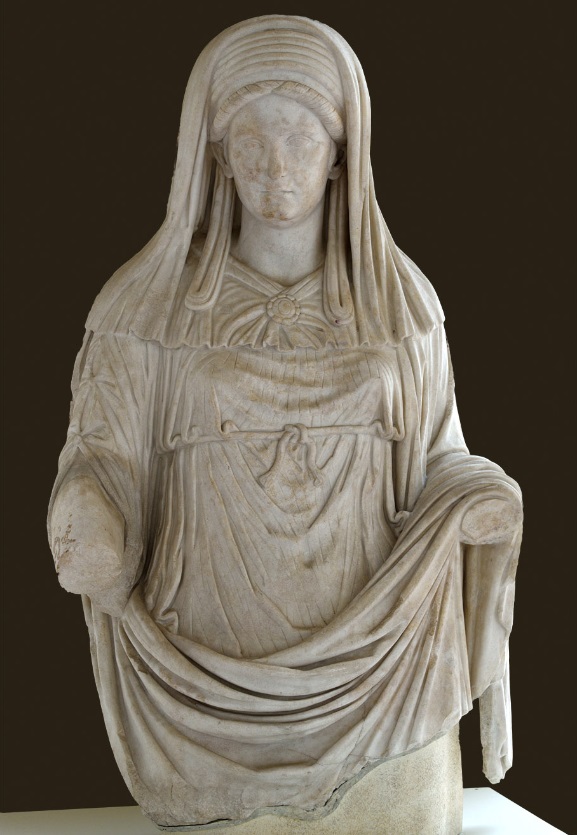 Statue of a Vestalis Maxima, Roman Forum, 2nd century AD; the public cult of Vesta paralleled the household hearth.
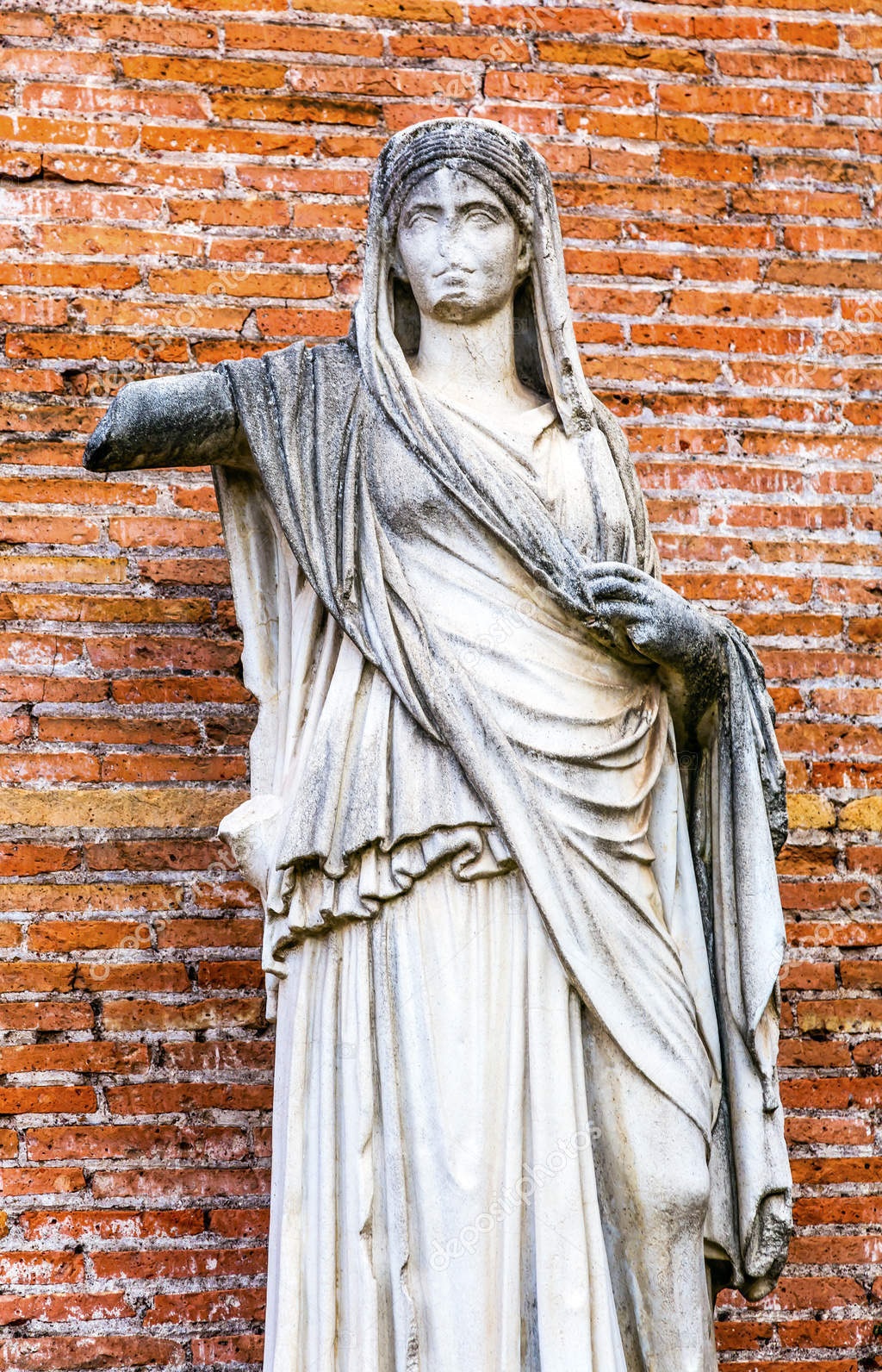 Statue of a Vestal from the Temple of Antoninus and Faustina in Rome, 2nd century AD.
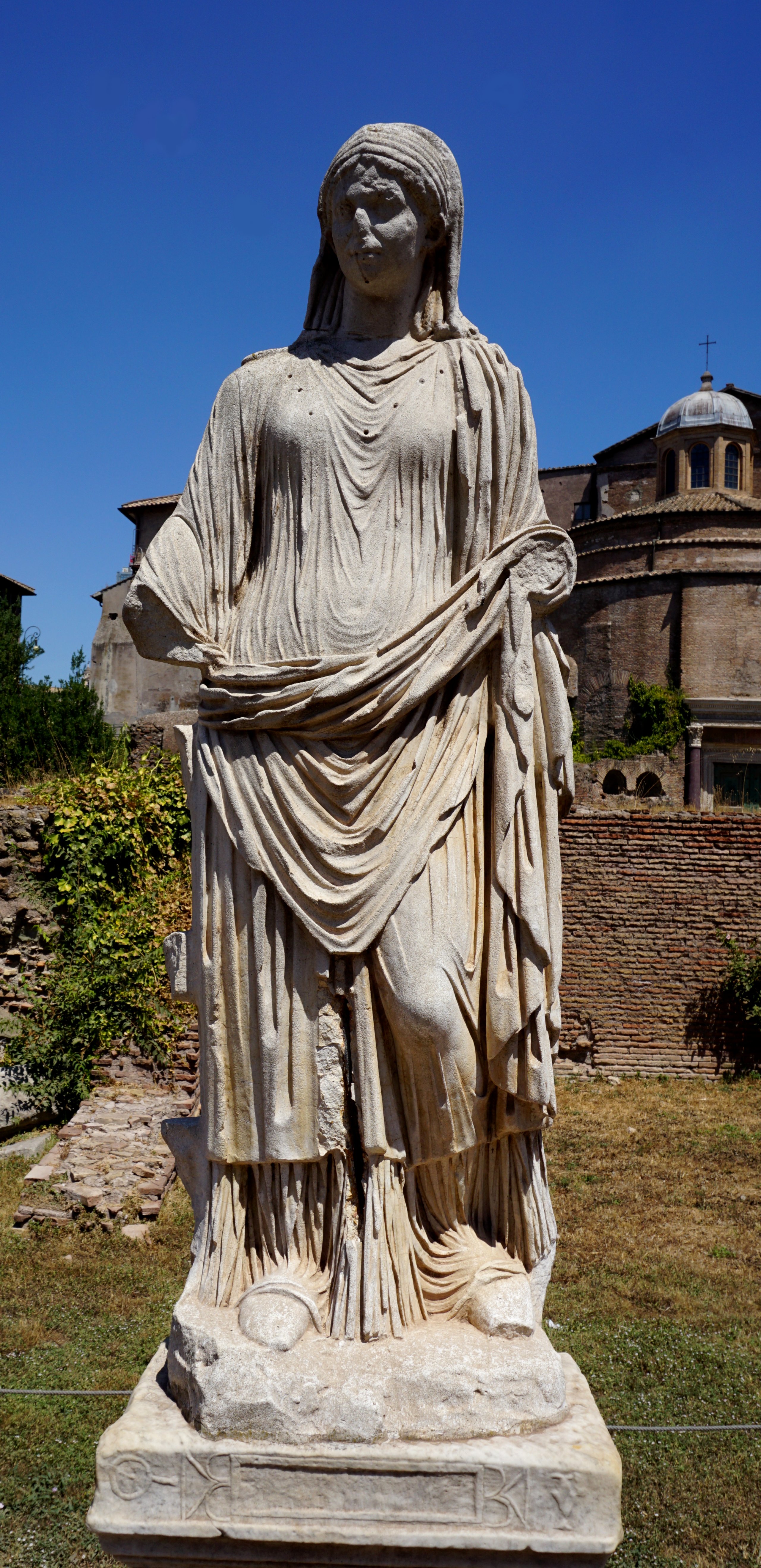 Statue of a Vestal, Rome, 1st-2nd centuries AD; an image of a priestess connected with preserving sacred fire.
Interested in Ancient Rome beyond reading? Join Legio X Fretensis or explore our reenactment directions.


