Penates
The Penates (Di Penates) were Roman deities of household provision, inner stores and family continuity. Their name was connected with penus: the inner supply of the house, pantry, food and the resources that sustain family life from within. They were therefore not simply 'small gods in a cupboard': they expressed the idea that the house exists through stores, hearth, food, memory and proper ritual.
Household Cult
In household religion the Penates are often mentioned together with Lares, Vesta, the genius of the head of the household and the lararium. Their sphere is closer to stores, table, hearth and the inner prosperity of the house. At a family meal, part of the food could be offered to the household gods; on festive days this could be joined by wine, incense, cakes, garlands or other offerings.
The Penates are harder to recognise on an archaeological object than the Lares. Lares have the stable image of dancing youths with rhyton and bowl; Penates more often appear as a category of gods of household provision and can merge with the wider group of domestic protectors. A fresco or statuette should therefore be read through context rather than through one fixed iconography: kitchen, pantry, hearth, table, altar and neighbouring figures all matter.
Difference from Lares
Lares are more strongly tied to place and to the protection of a house, crossroads or community. Penates are more strongly tied to inner prosperity, stores, the continuation of family life and sacred continuity. In practice these categories could overlap: a Roman household did not divide cult into strict modern labels, but addressed a group of powers that sustained place, people and food.
In real domestic practice the distinction between Lares and Penates was not always rigid. A single lararium could include figures of the Lares, the genius of the household, snakes, Vesta, Mercury, Dionysus or other deities, while the Penates remained part of the same prayer for stores, food and family well-being. Ancient texts are therefore often more informative than a single archaeological figurine: they show not only an image but the function of the gods within the house.
Public Penates
The Penates had not only a private but also a public level. Roman tradition knew the Penates Publici, protectors not of one household but of the Roman people and state. Their cult was connected with Vesta, Lavinium and the legend of Rome's Trojan origin. In this setting the Penates become not only gods of provisions, but a sign of a preserved community.
Ancient authors did not always explain the public Penates in the same way. In some accounts they are deities, in others sacred objects or images tied to the old memory of Lavinium and Rome. This uncertainty matters in itself: the Penates were not only mythical figures, but part of ritual secrecy, where exact knowledge belonged to priests and the community.
Aeneas and the Carrying of Sacred Things
In Roman memory the Penates are especially connected with Aeneas and the Aeneid. Aeneas carries away from ruined Troy his father, family and sacred things; with them he carries not only objects, but the people's right to a future. In Virgil the Penates become a voice of destiny: they remind Aeneas that his path must lead not to an accidental new settlement, but to Italy.
This theme explains why household gods could become a civic symbol. House and city were not completely separate in Roman thought: family, hearth, ancestors, stores and sacred things formed a model of stable order. When Aeneas preserves the sacred objects, he preserves the possibility of a new home, which later tradition connects with Lavinium, Alba and Rome.
Visual and Archaeological Sources
Material sources for the Penates require caution. Pompeian lararia show the setting of household cult - Lares, genius, serpents, altar, food and the place of ritual - but they rarely allow the Penates themselves to be separated with certainty from the wider group of household gods. The frescoes from the House of the Vettii and the House of Julius Polybius are therefore useful as context rather than literal portraits of the Penates.
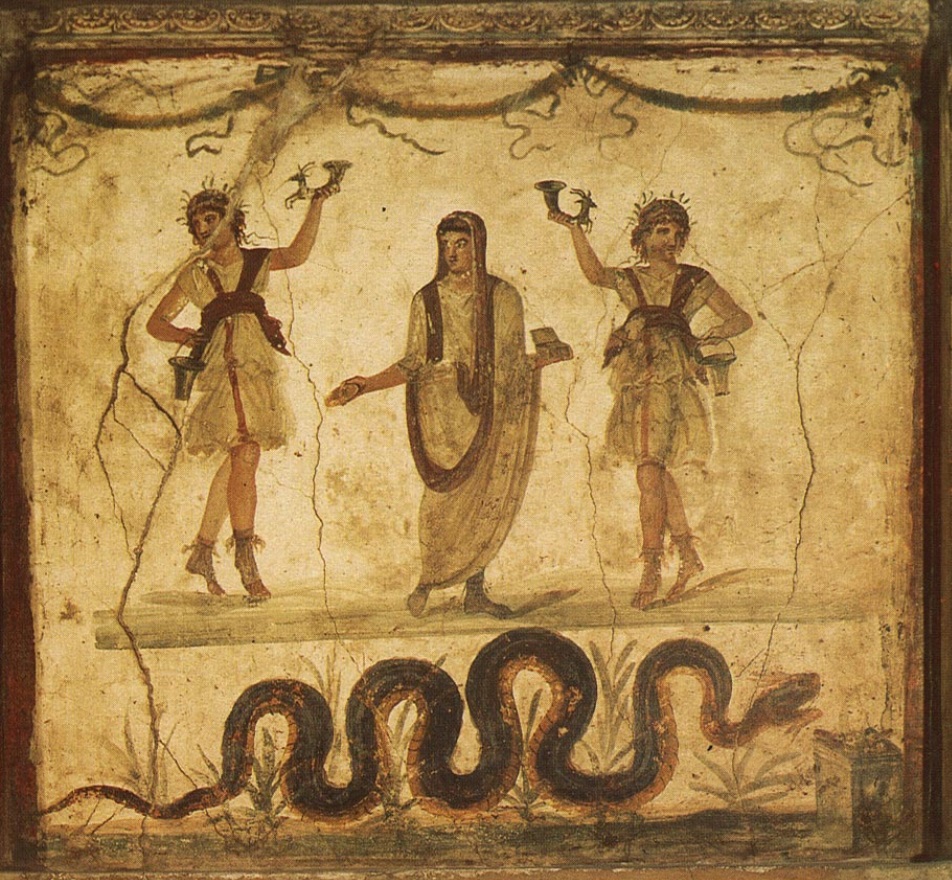 Lararium of the House of the Vettii in Pompeii (VI.15.1), kitchen area: the household genius between Lares, with serpent and altar; AD 60-79.
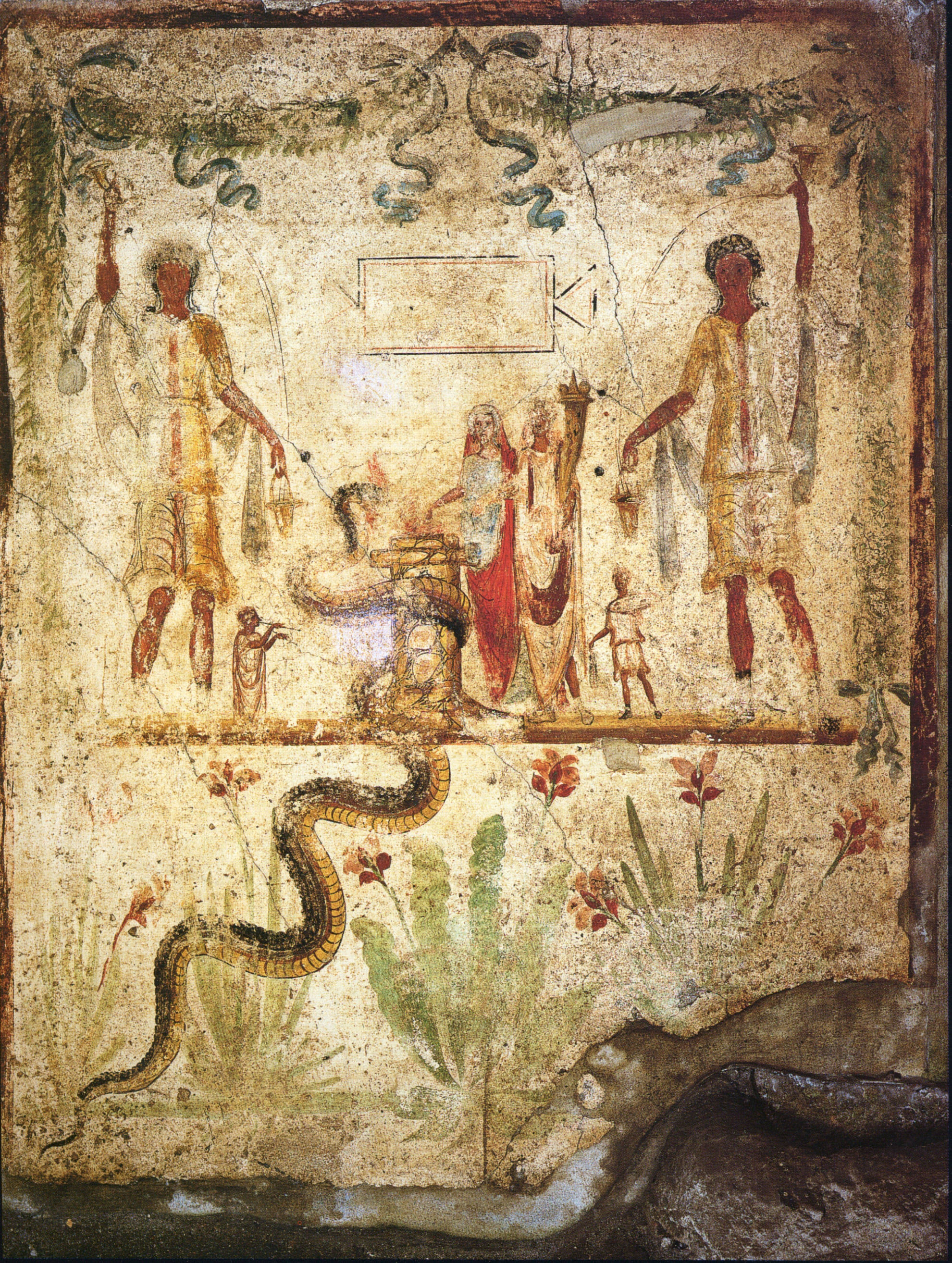 Fresco from the lararium of the House of Julius Polybius in Pompeii, 1st century AD; a household shrine with Lares, genius, serpents and altar.
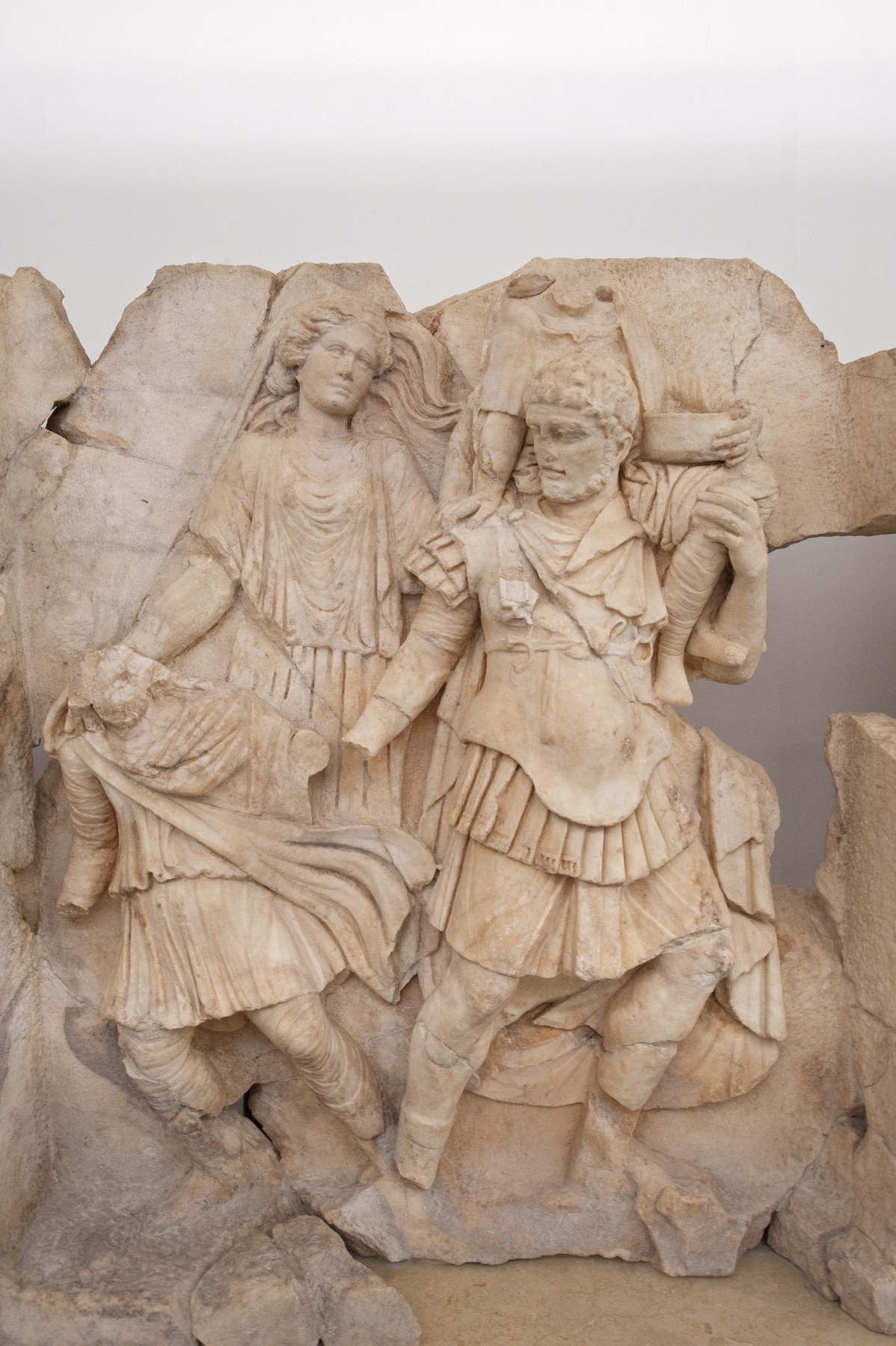 Aeneas fleeing Troy on a relief from the Sebasteion at Aphrodisias, 1st century AD; the Trojan ancestor myth is absorbed into imperial imagery.
Images of Aeneas leaving Troy give another type of evidence. They do not always show the Penates as separate objects, but they fix the story of preserving family and sacred things. The Sebasteion relief at Aphrodisias, like Roman images of Aeneas' arrival in Italy, shows how the myth of carrying Trojan sacred things became a language of origin, power and continuity.
Penates in Everyday Life
The Penates stood closest to the inner part of the house: the storeroom, hearth, table, preparation of food and family meal. In prayers they could be remembered together with the Lares and Vesta; during ordinary meals, family festivals or moments of transition, a small share of food and wine marked the gods' participation in household life. In this cult the crucial point was not the portrait of an individual deity, but the connection between food, fire, stored supplies and the continuity of the family.
The same logic could be transferred to the city and the people. The public Penates connected the stability of Rome with preserved sacred objects and the tradition of Aeneas. The private and public levels were not identical, but both rested on one idea: life continues while household and common sacred things are preserved.
Related Topics
Literature
- Virgil. Aeneid, Books II-III.
- Dionysius of Halicarnassus. Roman Antiquities, Book I.
- Cicero. On the Nature of the Gods, II.
- Ovid. Fasti.
- Dubourdieu, A. Les origines et le développement du culte des Pénates à Rome. Rome, 1989.
- Beard, M.; North, J.; Price, S. Religions of Rome. Vol. 1. Cambridge, 1998.
- Orr, D. G. Roman Domestic Religion: The Evidence of the Household Shrines. ANRW II.16.2, 1978.
- Boyce, G. K. Corpus of the Lararia of Pompeii. Memoirs of the American Academy in Rome, 1937.
Interested in Ancient Rome beyond reading? Join Legio X Fretensis or explore our reenactment directions.


