Lares
The Lares were Roman guardian deities of place, house, road, crossroads, rural plot, community and family. They were not worshipped as distant Olympian gods, but as close protectors of the spaces in which people lived, worked, ate, traded, travelled and gathered. The Lares therefore connect religion with a specific place: house, courtyard, street, field boundary or urban neighbourhood.
In household cult the Lares often appeared beside the Penates, the genius of the head of the household and the lararium, the place where images were set and small rites were performed. But the Lares are not the same thing as the lararium. The lararium is the shrine, niche, painting or shelf; the Lares are the divine recipients of worship, remembered in the house, at the crossroads and in public cult.
Origin and Meaning
Ancient authors explained the Lares in different ways. In some traditions they were close to ancestral spirits and household memory; in others they were deities of place, road or boundary. This is not a contradiction but a feature of Roman religion: family memory, land, passage, neighbourhood and protection of the house could be understood as different aspects of one stable relationship between people and their space.
The word lar usually matters less as the name of one god than as the designation of a type of guardian. The sources therefore mention Lares familiares, Lares compitales, Lares praestites, Lares viales, Lares rurales and other names. These forms show that the Lares could belong to a family, crossroads, city, road or countryside. A Roman could address them not for abstract mythology, but for the safety of house, journey, community and daily order.
Household Lares
The Lares familiares, the household Lares, stood closest to the everyday life of the family. They could be remembered during meals, family festivals, moments of transition, departure, return home or calendar rites. Offerings were small: wine, food, garlands, incense, sometimes a portion from the table. The important point was not the size of the gift, but the repeated gesture and recognition that the house stood under protection.
Household cult included more than free family members. Women, children, clients, slaves and freedmen lived within the house; all of them occupied the space protected by the Lares. The Lares therefore show the house as a small community, not merely as the private property of the head of the family. Pompeii makes this especially clear: lararium paintings occur not only in formal rooms, but also in kitchens, shops and work spaces.
Image and Attributes
The most recognisable image of the Lares is a pair of young dancing figures placed on either side of the genius, altar or sacrificial scene. They usually wear a short tunic, raise one arm and hold a rhyton, bowl or other vessel for libation. Their pose is not static: the Lares seem to participate in the festival, receive the offering and animate the space of the house.
The serpents that often appear below the main scene are not the Lares themselves. They are connected with fertility, earth, protection and the prosperity of the place. Together with altar, garlands, vessels and figures of the Lares they form a single image of household cult: deities, people, food, fire and space are bound into one ritual ensemble.
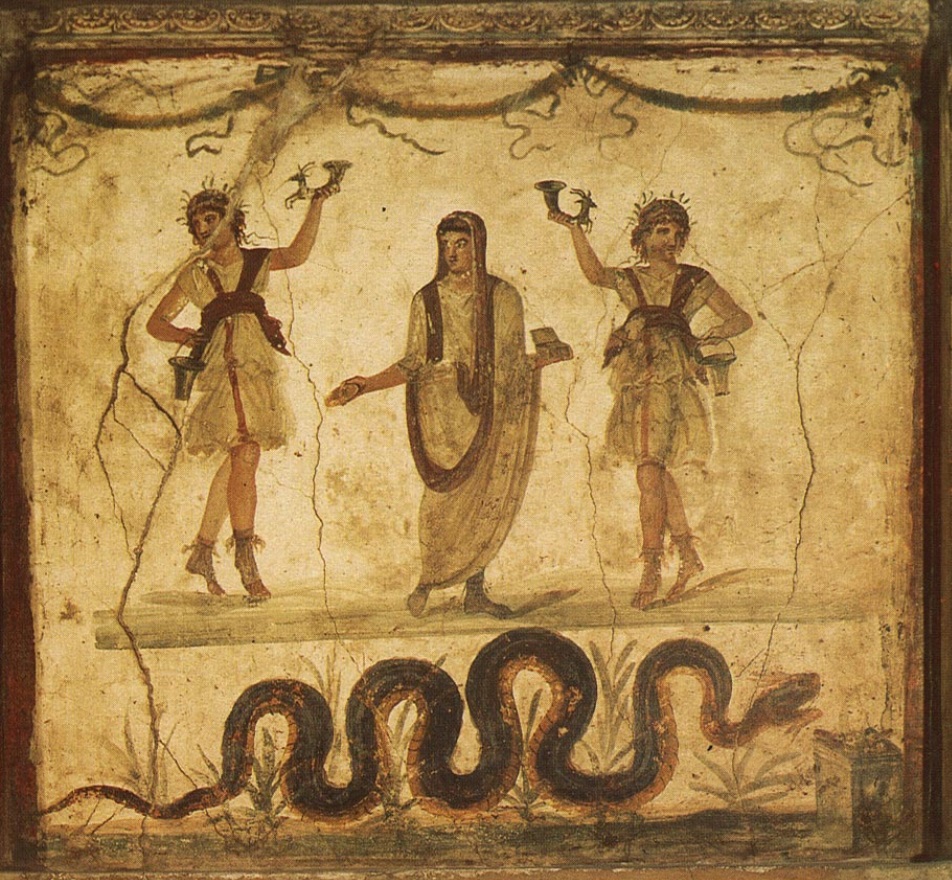 Lararium of the House of the Vettii in Pompeii (VI.15.1), kitchen area: the household genius between Lares, with serpent and altar; AD 60-79.
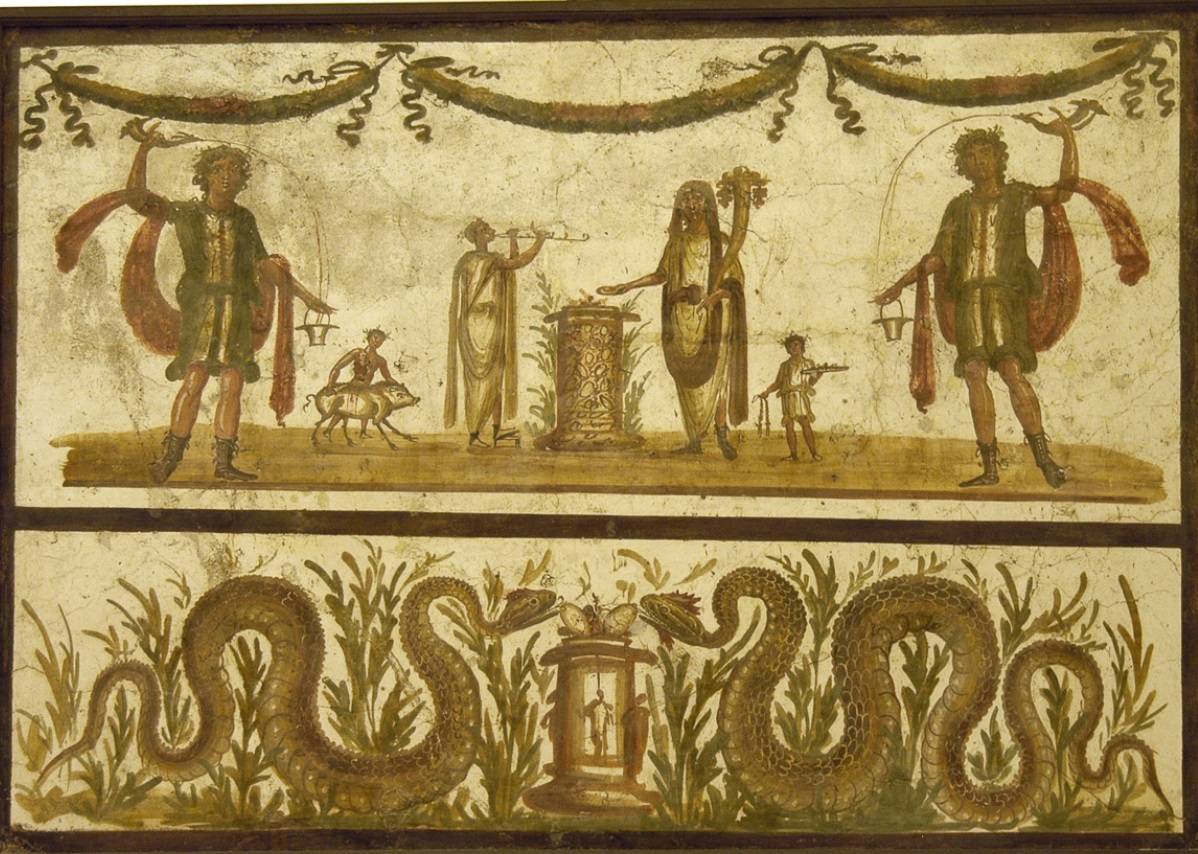 Lares, genius and serpents on a fresco from a Pompeian lararium, Insula VIII.2; Naples, National Archaeological Museum, inv. 8905, AD 69-79.
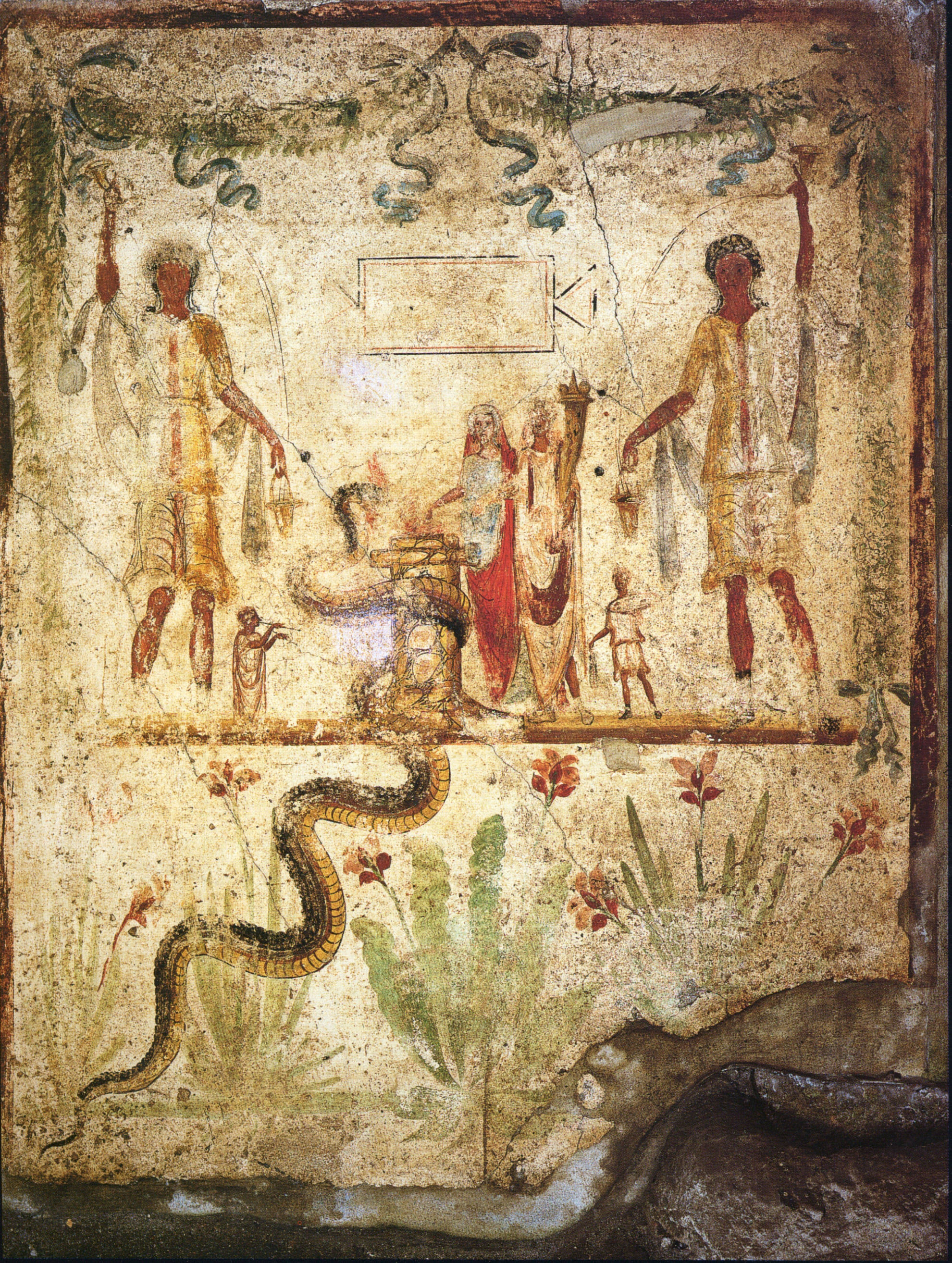 Fresco from the lararium of the House of Julius Polybius in Pompeii, 1st century AD; a household shrine with Lares, genius, serpents and altar.
Lares, Penates and Genius
Lares, Penates and genius often appear together, but their functions differed. The Lares protected the place and people of the house; the Penates were tied to internal stores, food and family prosperity; the genius expressed the life force of the head of the family or, more broadly, the capacity of the family to continue. In actual practice these boundaries could overlap, but the distinction explains why several figures appear in a single household scene.
An article on the Lares should not dissolve them into the subject of the lararium. Lares may appear in a lararium painting, a bronze figurine, a prayer, the name of a festival, a street shrine or state cult. Their independent subject is not the architecture of a household altar, but the idea of divine protection of place and community.
 Bronze statuette of a Lar or participant in household cult holding a libation bowl; a portable image from the sphere of Roman domestic religion, 1st century AD.
Crossroads and Urban Communities
The Lares were not only household gods. The Lares compitales were worshipped at crossroads and in neighbourhoods, and the festival of the Compitalia connected neighbours, households, slaves and urban space. A crossroads in a Roman city was not merely a point of movement: it joined houses, streets, shops, rumours, neighbourly obligations and local memory.
Crossroads shrines of the Lares could be modest, but their social meaning was substantial. They made the small urban community visible and religiously defined. In such cult the house extended beyond its walls: the family remained part of street, neighbourhood and city.
The Augustan Lares
In the age of Augustus the cult of the Lares received a new political layer. The reform of urban districts linked the Lares compitales with the Lares Augusti and the emperor's genius. This did not abolish the older local cult, but incorporated it into the language of imperial order: the protection of neighbourhood, house and city was associated with the authority of the princeps.
This transition shows the flexibility of Roman religion. The Lares could remain close household protectors and at the same time become part of official ideology. Rome did not always replace old cults with new ones; more often it adjusted familiar forms by adding a new political meaning.
Roads, Fields and Special Lares
Ancient tradition knew other groups of Lares as well. The Lares viales were connected with roads and travel, the Lares rurales with the countryside and rural plot, and the Lares praestites with the guarding of the city. These names should not be read as a strict theological system. They show rather how one idea of guardians of place could adapt to different environments.
A Roman encountered the Lares not only in a private house. They could be part of the rural calendar, urban topography, movement along roads and memory of boundaries. The Lares are therefore important for understanding Roman space: it was filled not only with legal and economic borders, but also with religious ties.
Monuments and Written Evidence
Material evidence for the Lares is best known from Pompeii and Herculaneum: wall paintings, niches, images of serpents, altars, soot marks and the context of neighbouring rooms have survived there. Such finds show not only the appearance of the Lares, but also where the cult took place: in kitchen, atrium, shop, garden or service area of the house.
Written sources provide another layer. Ovid describes festivals and old customs, Cato preserves formulas of rural agricultural rite, and Varro and later authors explain names and varieties of Lares. Together texts and monuments show that the Lares were a stable part of Roman religion from family to city.
Related Topics
Literature
- Ovid. Fasti.
- Cato the Elder. De Agricultura.
- Varro. De Lingua Latina.
- Plautus. Comedies.
- John Scheid. An Introduction to Roman Religion.
- Harriet I. Flower. The Dancing Lares and the Serpent in the Garden: Religion at the Roman Street Corner. Princeton, 2017.
- Mary Beard, John North, Simon Price. Religions of Rome. Vol. 1. Cambridge, 1998.
- George K. Boyce. Corpus of the Lararia of Pompeii. Memoirs of the American Academy in Rome, 1937.
- David G. Orr. Roman Domestic Religion: The Evidence of the Household Shrines. ANRW II.16.2, 1978.
Interested in Ancient Rome beyond reading? Join Legio X Fretensis or explore our reenactment directions.


