Lararium
A lararium was a household shrine of a Roman house, shop or workshop, connected with daily address to the protectors of place and family. It could be a niche, a painted wall, a small architectural aedicula, a shelf for figurines, an altar or a combination of several elements. It was not a 'small church' in the modern sense: it belonged to the route of the house, near food, hearth, passage, courtyard or workplace.
Deities and Images
The lararium most often includes Lares, Penates, the genius of the head of the household, serpents, altar and signs of offerings. Lares are usually shown as a pair, with rhyton and bowl; the genius can perform a libation as the figure of family vitality and the master's status. Serpents in the lower part of the painting are not merely decorative: they are connected with fertility, place and household prosperity.
The set of deities could change. In Pompeian houses and shops Mercury, Bacchus, Isis-Fortuna or other figures important for a particular family, occupation or place may appear beside the Lares. A lararium therefore cannot be read by name alone: one has to look at who is represented, where the shrine stands and what objects were near it.
Place in House and Shop
Lararia are known not only in formal atria of wealthy houses. Pompeii shows them in kitchens, service areas, gardens, shops, thermopolia and workshops. This changes the meaning of the monument: household cult was connected not only with family memory, but also with cooking, trade, craft, entrance and the safety of everyday space.
The status of the household affected the shrine's form. In a wealthy house it could be painted, architecturally framed and visible to visitors; in a more modest space the cult might be limited to a niche, shelf, portable bronze figurines or a simple wall painting. For reconstruction, scale, height, access to shelf or altar and proximity to everyday objects matter.
Ritual and Traces of Use
Ritual at the lararium could include wine libation, incense, food offerings, garlands and address to household gods on family or calendar occasions. It was a repeated gesture, not only a festive ceremony. The head of the household is often imagined as the central participant, but in a real house women, children, slaves, freed people and workers also lived and acted near the shrine.
Archaeologically, the images are not the only evidence. Soot, organic offering remains, places for vessels, nails, shelves or small statuettes show that the lararium was an active ritual point. If hearth, amphorae, counter or tools stand nearby, the cult should be tied to the specific practice of the room rather than separated from everyday life.
Visual and Archaeological Sources
Lararium paintings give not an isolated portrait of a deity but an ensemble. The genius may stand in the centre, the Lares at the sides, snakes and an altar below; real vessels, lamps, shelves and traces of offerings could stand nearby. The painting from the House of the Vettii shows the classical arrangement with genius and Lares, the painting from the House of Julius Polybius shows a household shrine in domestic space, and the bronze figure from Boscoreale reminds us that the cult could include portable objects.
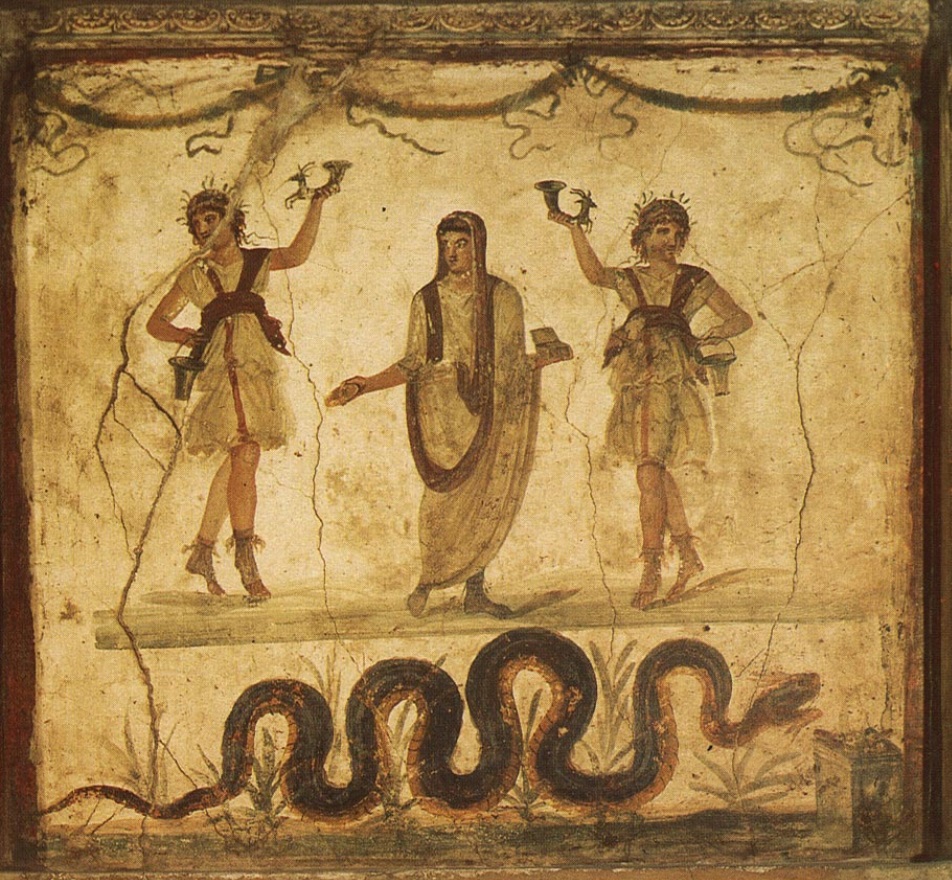 Lararium of the House of the Vettii in Pompeii (VI.15.1), kitchen area: the household genius between Lares, with serpent and altar; AD 60-79.
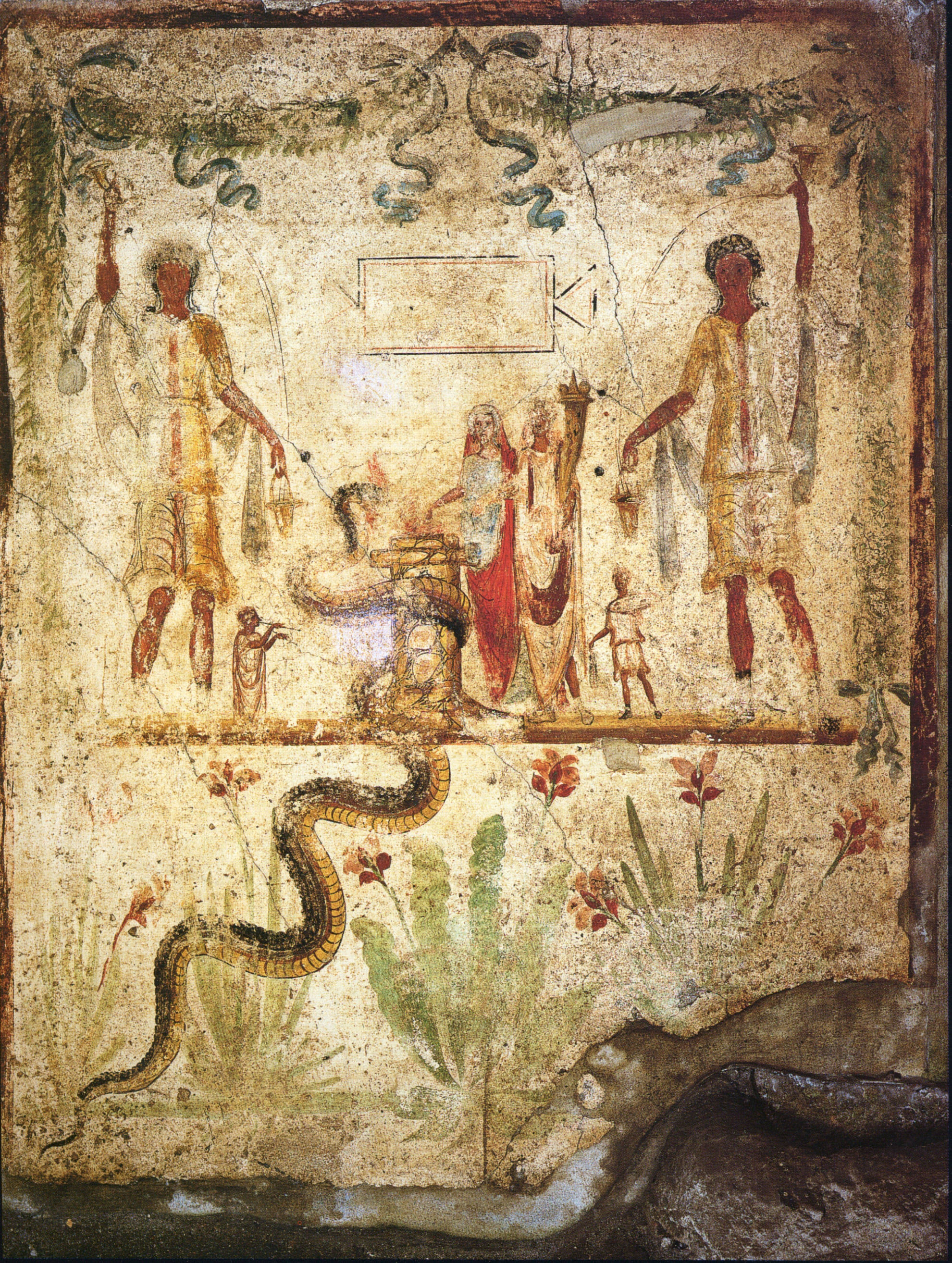 Fresco from the lararium of the House of Julius Polybius in Pompeii, 1st century AD; a household shrine with Lares, genius, serpents and altar.
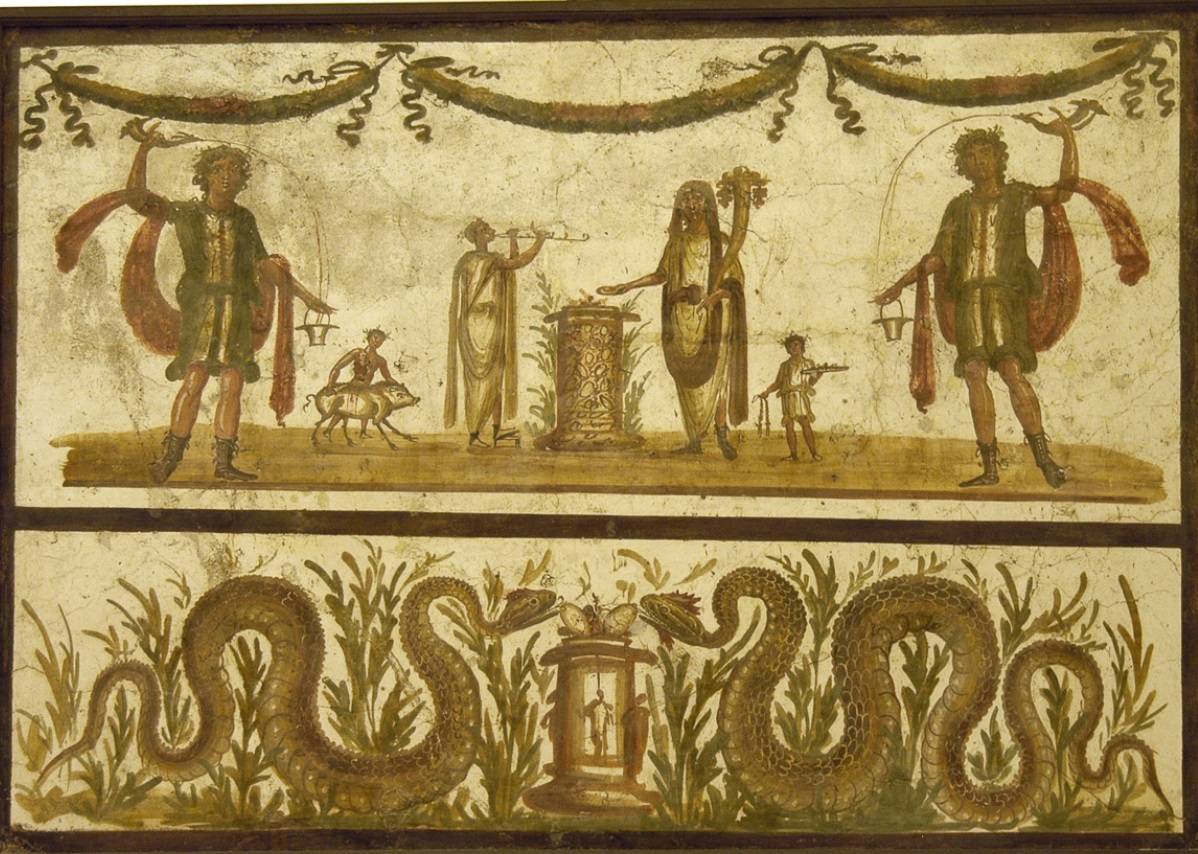 Lares, genius and serpents on a fresco from a Pompeian lararium, Insula VIII.2; Naples, National Archaeological Museum, inv. 8905, AD 69-79.
Pompeii as Primary Evidence
Pompeii provides the main archaeological evidence for lararia because the eruption of AD 79 preserved walls, niches, paintings and the position of objects. The House of the Vettii is especially useful: the official guide of the Archaeological Park of Pompeii notes that the lararium painting was in the kitchen area. This matters because the shrine connects cult with the work of the house, not only with its formal spaces.
The Lararium in Everyday Space
The lararium was part of movement through a house, shop or workshop. In a kitchen it stood near the hearth, water, vessels and stores; in an atrium it could be visible to visitors; in a shop it linked trade with the protection of place. The height of the painting, traces of soot, niches, shelves and small altars show that people approached the shrine, set vessels before it and made brief offerings.
The lararium should therefore not be reduced to a wall picture. Its meaning appears through its relation to a door, table, hearth, storeroom, workplace or garden. In these places household religion was not a separate sphere but part of cooking, receiving guests, trade and family memory.
Related Topics
Literature
- John Scheid. An Introduction to Roman Religion.
- Harriet I. Flower. The Dancing Lares and the Serpent in the Garden: Religion at the Roman Street Corner. Princeton, 2017.
- George K. Boyce. Corpus of the Lararia of Pompeii. Memoirs of the American Academy in Rome, 1937.
- David G. Orr. Roman Domestic Religion: The Evidence of the Household Shrines. ANRW II.16.2, 1978.
- Penelope M. Allison. Pompeian Households: An Analysis of the Material Culture. Los Angeles, 2004.
- Annalisa Marzano. Roman Villas in Central Italy: A Social and Economic History. Leiden, 2007.
Interested in Ancient Rome beyond reading? Join Legio X Fretensis or explore our reenactment directions.


