Roman Religion
Roman religion was a system of rites, calendar, priestly offices, household cults and public duties. It had no single sacred book, common dogma or separate church organisation. For Romans the central issue was correct action: to whom, where, on what day, with what words and on whose authority a sacrifice, vow, purification or request for a sign was made.
At the centre stood the idea of pax deorum, concord between humans and gods. It did not mean personal inward harmony: it referred to the condition of the community when city, household, army and magistrates fulfilled their duties toward divine powers. An error in words, date, status of the performer or ritual sequence could require repetition because a religious fault was understood as a risk to public order.
This article treats Roman religion as a social system. The deities themselves are discussed in more detail in Roman Gods, household cult in Roman Household Religion, and ritual procedure in Sacrifices in Ancient Rome. Here the focus is on how cult connected law, calendar, war, family, Senate, emperor and provinces.
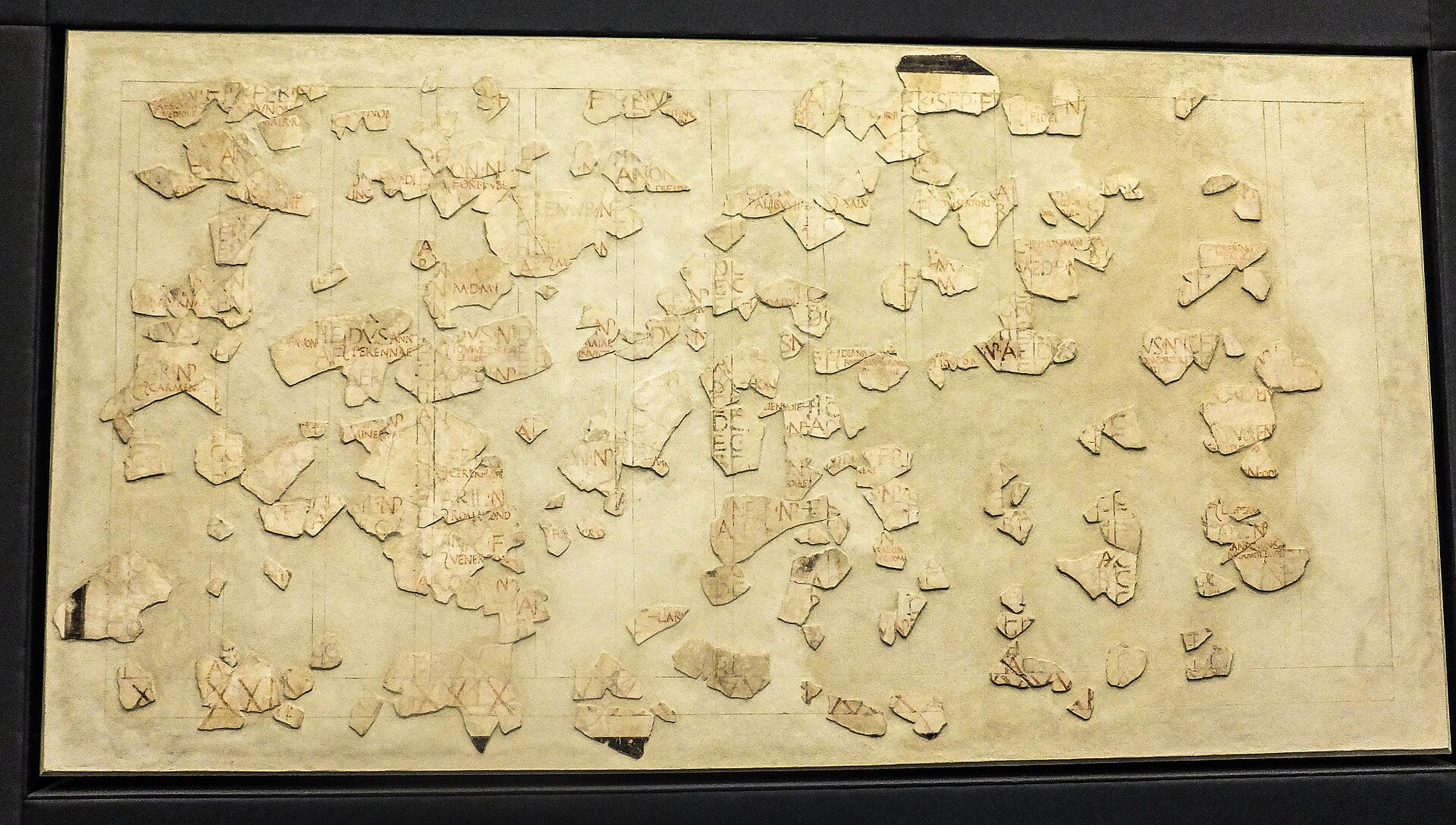 Fasti Antiates Maiores: fragments of a pre-Julian Roman calendar from Antium, first half of the first century BC; Museo Nazionale Romano, Palazzo Massimo. Photo: Carole Raddato / Wikimedia Commons, CC BY-SA 2.0.
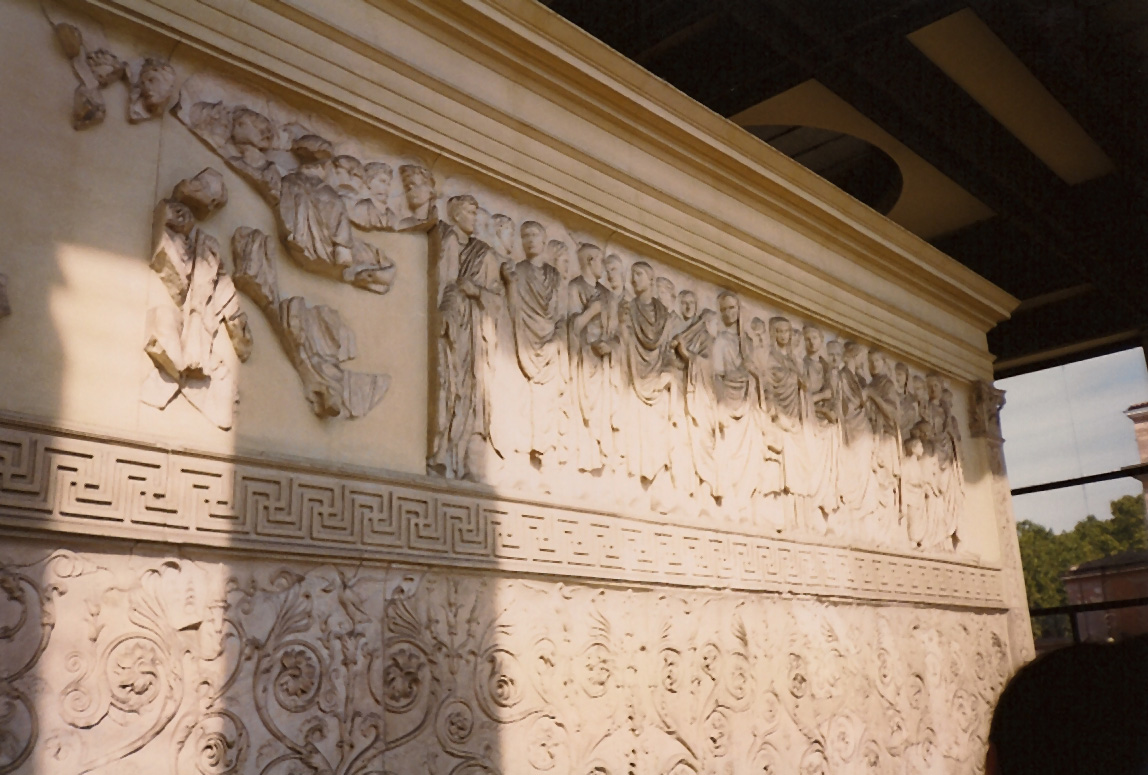 Processional frieze of the Ara Pacis Augustae in Rome. The altar was voted by the Senate in 13 BCE and dedicated in 9 BCE. The north and south sides show priests, magistrates and members of Augustus' family; the exact event and several identifications remain debated.
Rite and Public Order
Romans often described religious action through the precision of form. Prayer was spoken in set words; the sacrificer might cover his head with the edge of the toga; musicians drowned out accidental sounds; the animal was inspected before sacrifice; after the offering specialists could examine the entrails. This order was not empty formality. It showed that the community addressed the gods lawfully, through the right person and in an acknowledged place.
Religion at Rome therefore overlapped closely with law. A magistrate did not merely direct politics: he had authority to act on behalf of the people. The Senate could appoint festivals, decide on a new cult, order expiatory rites after prodigies or restrict a dangerous religious practice. Assemblies, elections, war, triumph, census, foundation of colonies and treaties all had a religious side.
This link separates Roman religion from the idea of faith as private conviction. A person could believe, doubt, philosophise or follow family habit, but public cult required recognised action. The city had to know that its relationship with the gods had been maintained, and if a bad sign appeared it had to be ritually corrected rather than only discussed.
Calendar and Sacred Time
The Roman calendar structured religious and civic life. It distinguished dies fasti, when certain public business could be done, dies nefasti, when such actions were forbidden, comitial days, festivals, temple anniversaries, commemorations of victories and days connected with the imperial house. It was not a simple list of holidays, but a system that distributed authority, labour, courts, assemblies, games and sacrifices through time.
The pontifices supervised the calendar. Before calendar rules became publicly available, knowledge of permissible days gave priestly and political elites real power over civic life. Later the calendar became more public, but the religious logic remained: festivals of Vesta, Mars, Jupiter, Ceres, the Mother of the Gods, Fortuna and other cults kept the city within the repeated order of the year.
The fasti preserved in inscriptions are especially valuable. They show not only months and numbers, but what events Romans considered worthy of annual memory: dedication of an altar, victory, closing of the temple of Janus, acceptance of a title, a deity's festival or a prohibition on ordinary activity. Such calendars reveal how religion turned Roman history into a repeated ritual year.
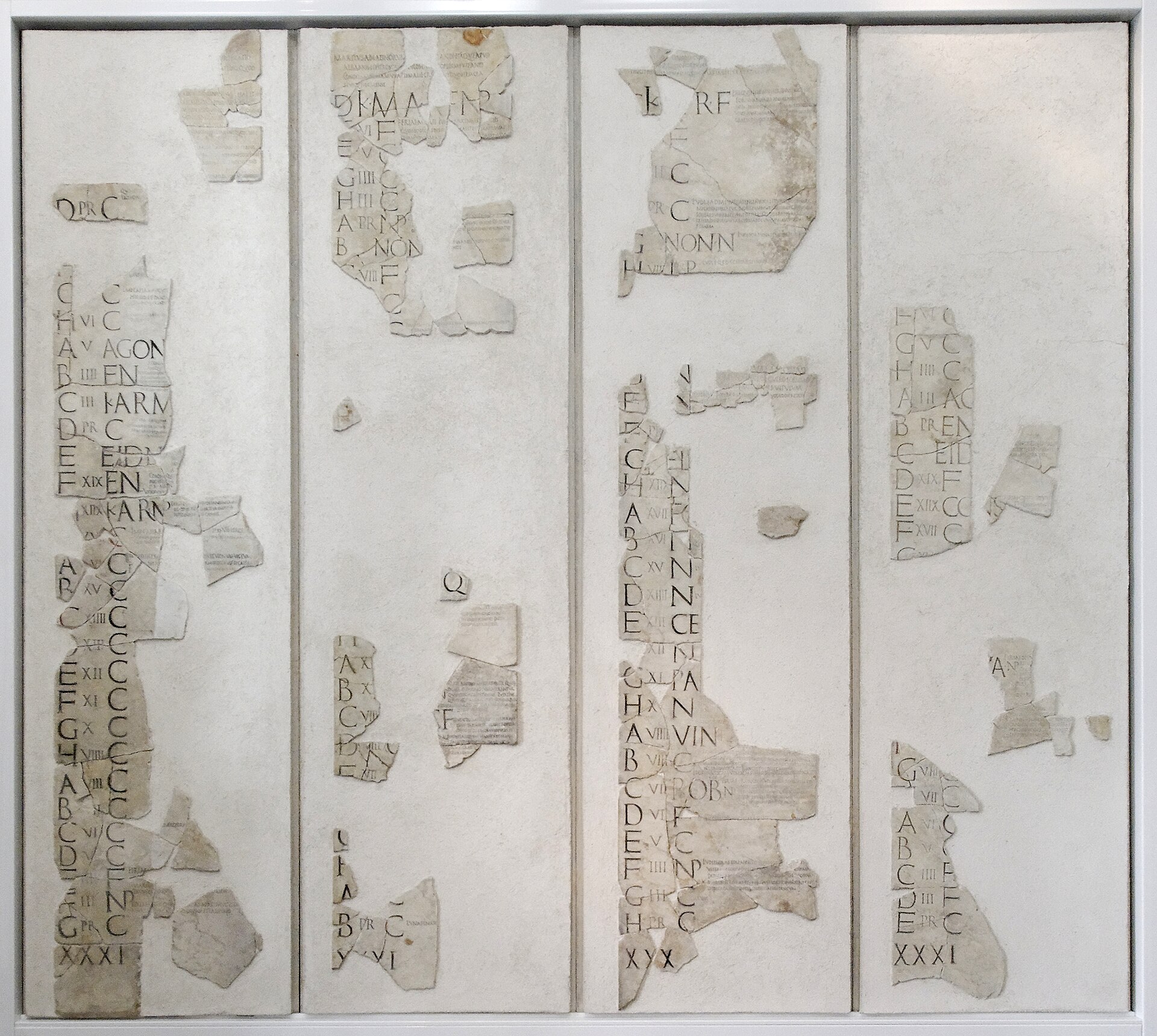 Fasti Praenestini, the calendar of Verrius Flaccus with festivals, commemorations and legal markings of days, AD 6–9; Museo Nazionale Romano, Palazzo Massimo. Photo: Jastrow / Wikimedia Commons; public domain.
Priestly Colleges and Magistrates
Roman priesthood was not a separate spiritual estate. Many priestly offices were held by members of the political elite, for whom cult duty formed part of service to the state. The pontifices preserved sacred law, calendar, rules of burial, marriage and vows; the augurs determined whether signs were favourable for public action; the flamines served the cults of individual gods; the Vestal Virgins guarded Vesta's fire and held exceptional status in the city.
Other colleges also existed: the decemviri, later quindecimviri sacris faciundis, consulted the Sibylline Books; the septemviri epulonum oversaw sacred banquets; haruspices, connected with the Etruscan tradition, interpreted entrails of sacrificial animals and unusual portents. These functions reveal a Roman feature: ritual knowledge was not private charisma but public competence that could be incorporated into a senatorial or magisterial decision.
Supreme power also had a religious face. The title pontifex maximus belonged first to one of the chief priests, and in the principate became part of imperial image. Octavian Augustus made this especially clear: restoration of temples, new festivals, the cult of Peace, association with Apollo and the office of chief pontiff made religion one of the languages of the new political order.
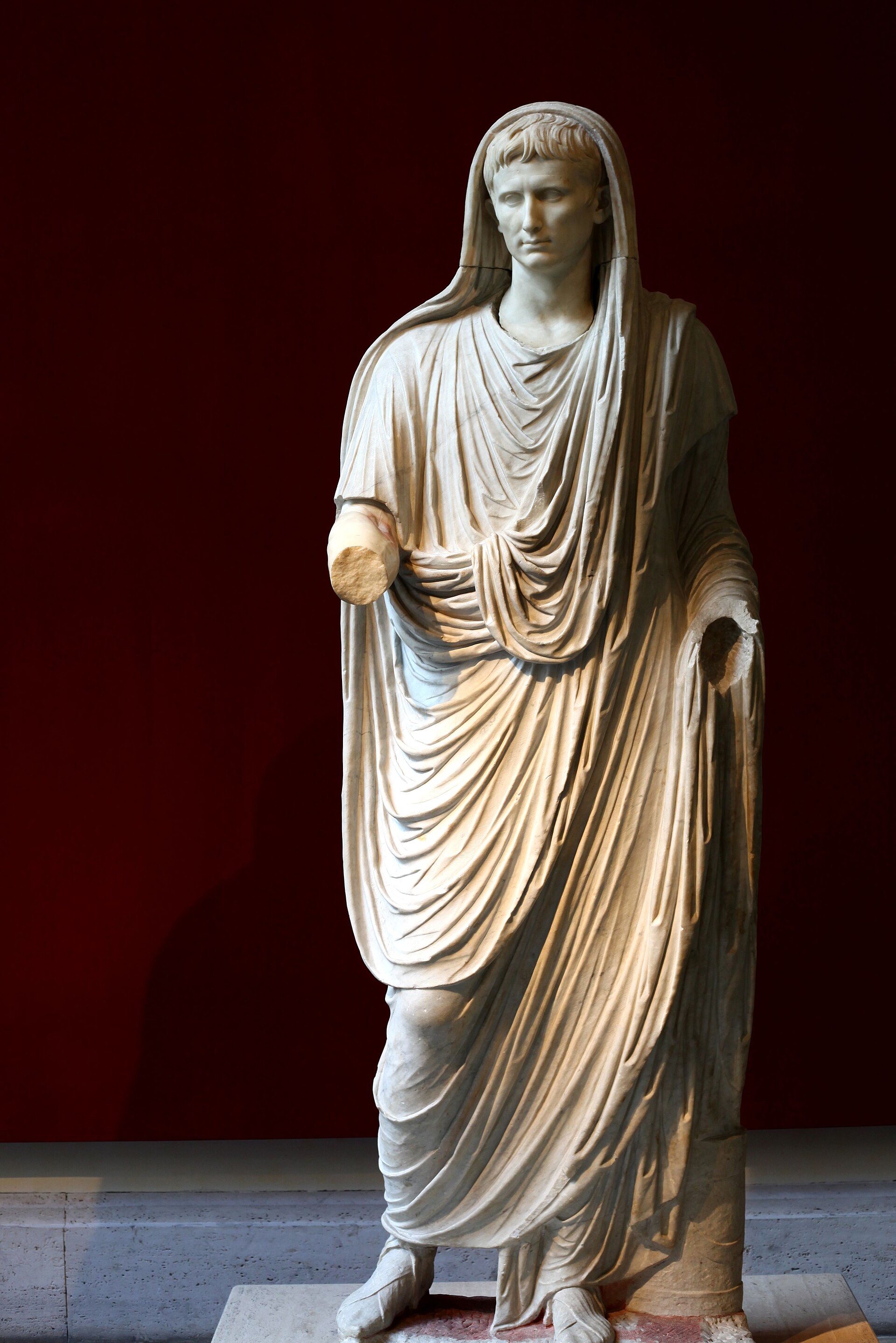 Augustus as pontifex maximus, the so-called Via Labicana Augustus, c. 12 BC; Museo Nazionale Romano, Palazzo Massimo.
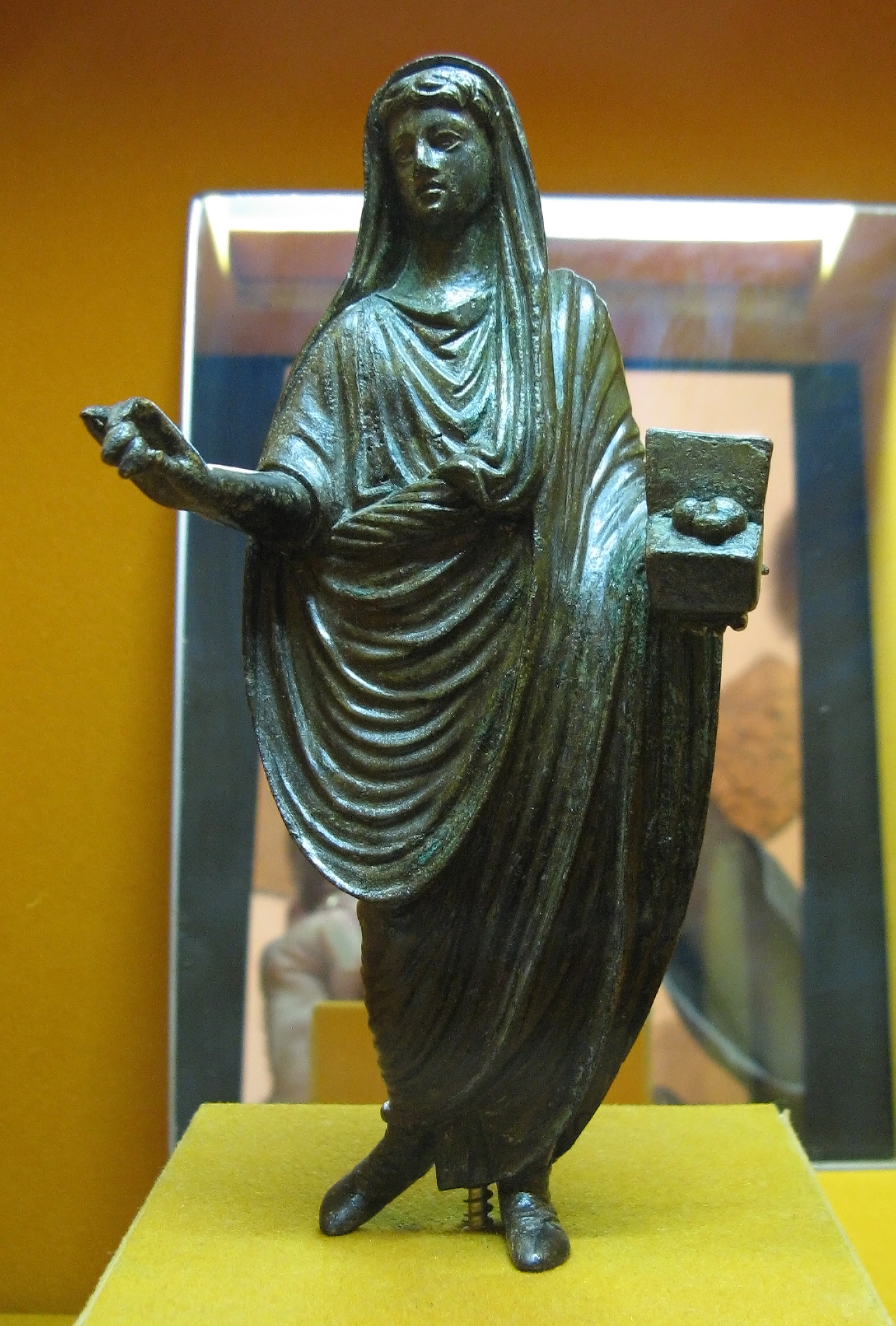 Bronze figurine of a Roman priest with covered head, Lyon; Musée gallo-romain de Fourvière, inv. Br 73.
Sacrifice, Vow and Divination
The chief public way of communicating with the gods was sacrifice. It could accompany a festival, military campaign, election, treaty, purification, fulfilment of a vow or troubling omen. Sacrifice was not limited to killing an animal: procession, prayer, libation of wine, sprinkling with mola salsa, music, division of portions and later interpretation of the result all mattered. Bloodless rites used wine, incense, grain, cakes, garlands and first fruits.
A vow, votum, bound a person or community to a future act. A commander could promise a temple to a deity in return for victory; a city could appoint a festival after deliverance from danger; a private person could dedicate an altar, statuette or inscription after a request was fulfilled. Roman temples often arose as fulfilments of vows, so the city's architecture was not only construction but also memory of religious obligations.
Divination helped determine whether action could begin. Auspices considered the flight of birds, behaviour of sacred chickens and other signs; haruspicy examined the entrails of the sacrificial animal; reports of prodigia could lead to expiatory rites. What mattered was not belief in a random omen, but public procedure: a sign had to be recognised, interpreted and incorporated into a decision of authority.
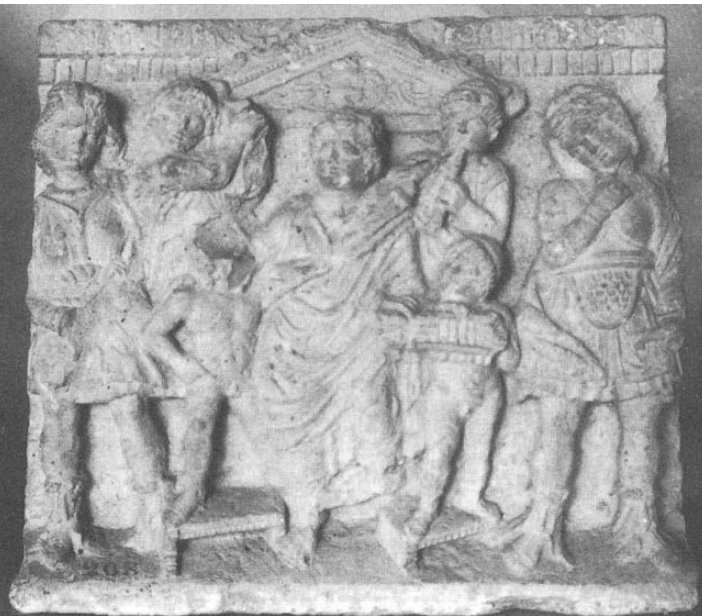 Roman relief with a priest, Perusia, early first century BC; an image of a ritual participant with covered head.
Gods, Household and Place
Roman religion knew the great gods of the state pantheon: Jupiter, Juno, Minerva, Mars, Vesta, Venus, Apollo, Ceres, Diana, Mercury and others. But it was not reduced to a list of Olympian names. A deity could govern a door, boundary, beginning of an action, fertility of a field, safety of a road, merchant's luck, child's health, trustworthiness of an oath or memory of the dead. Romans cared not only about the deity's name but about the precise field of address.
Household cult connected this system with daily life. The Lares, Penates, the household genius, the Manes of ancestors and the lararium show that religion operated not only in the forum. House, shop, crossroads, military camp and rural villa had their own forms of protection and gratitude. Yet household cult was not a separate religion: it spoke the same language of gift, prayer, wine, fire and correct order.
Rome's ability to accept new deities rested on this flexibility. A local god could be compared with a Roman one, receive a Latin name, altar, inscription or place in provincial cult. The empire did not therefore destroy all local religions in the same way: it often translated them into a system of loyalty, public gift and recognised sacred place.
Temples, City and Memory
A Roman temple was not a place for weekly congregation, but the deity's house, a store of gifts and a visible sign of relations between gods and community. Altar, open space before the temple, stair, podium, statue, treasury and dedicatory inscription worked together. Architectural details are treated in Roman Temples, but for religion another point matters: a temple fixed an event in urban space.
A commander could vow a temple before battle, the Senate could decree construction after victory or deliverance, and an emperor could restore an old sanctuary as a sign of pietas. In the forum, on the Capitoline, in the Campus Martius and in provincial cities, temples created a map of memory: where Rome had won, to whom it had given thanks, which gods protected order and which events should be remembered every year.
Public festivals and games extended that memory through time. Processions, sacrifices, banquets, theatrical performances, contests and distributions created the religious rhythm of the city. Not only priests and senators took part: spectators, members of processions, artisans, merchants and families saw cult as part of urban experience.
Adoption and Control of Cults
Roman religion was open to adoption, but that openness was joined to control. Sabine, Latin, Etruscan, Greek and eastern elements entered the city. The cult of Apollo gained an important place in the state; the Great Mother was brought to Rome during the Second Punic War; Egyptian, Syrian, Phrygian and Persian-origin cults spread in the imperial period. A new deity could be accepted if its cult could be fitted into the order of the city.
The state could nevertheless intervene sharply. The best-known case is the affair of the Bacchanalia in 186 BC. The Senate was not merely arguing with a foreign god: it restricted assemblies, secret oaths, nocturnal rites and networks of influence that appeared dangerous to public order. The bronze tablet of the Senatus consultum de Bacchanalibus shows that a religious question could become a legal and political matter.
The same mechanism operated in other situations. The Sibylline Books were consulted in crises; foreign rites could be temporarily banned and later admitted in another form; provincial cults could receive Roman inscriptions, sacrificial formulas and a connection with the emperor. Roman religion is therefore better understood not as a closed list of old cults, but as a system of selection, translation and control of sacred practices.
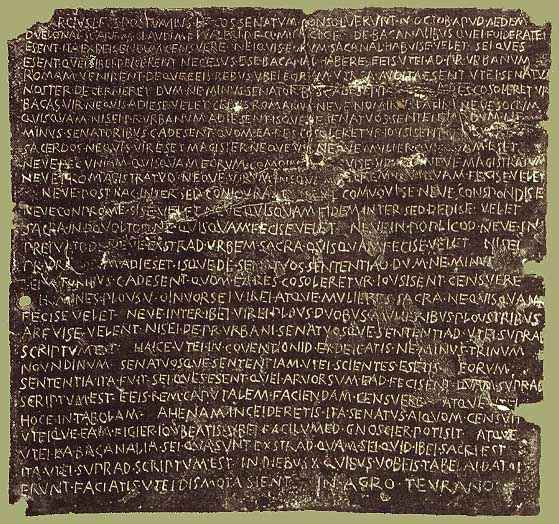 Senatus consultum de Bacchanalibus: bronze tablet with the Senate's decree on the Bacchanalia, 186 BC; Kunsthistorisches Museum, Vienna.
Empire, Army and Provinces
As Rome expanded, religion became a language of imperial administration. In the provinces older local sanctuaries, civic cults, Roman gods and worship of power existed side by side. The cult of Roma and Augustus, altars to the emperor's genius, inscriptions for the ruler's health and dynastic festivals connected civic elites with the imperial system. This did not always mean personal belief in the divinity of a living ruler; more often it meant public acknowledgement of power, peace and benefaction.
The army had its own religious rhythm. Legions and auxiliary units sacrificed to Jupiter, Mars, Minerva, Vesta, the imperial house, standards, Victory and local gods. A military camp was not only a technical space: it contained shrines of the standards, a calendar of festivals, vows for the emperor and rites before campaign. Through the army Roman forms of cult spread along the frontiers, but there too they mixed with local traditions.
In the provinces it is especially clear that Roman religion was not identical everywhere. In Gaul and Britain Roman names joined Celtic deities; in Syria and Egypt local cults preserved old forms; in the cities of Asia Minor the imperial cult received rich temple complexes. Roman order supplied the language of inscriptions, status and loyalty, but it did not erase all local material.
Late Antiquity
In the third and fourth centuries the religious map of the empire became still more complex. Traditional cults continued beside mystery communities, philosophical schools, the cult of Sol Invictus, Jewish communities and growing Christianity. Crises of power, wars, epidemics and struggles for legitimacy sharpened the question of which rites truly protected the empire.
Under Diocletian the state tried to restore the unity of traditional cult and discipline. Under Constantine Christianity received imperial support and later began to alter the legal status of older cults. This transition was not an instant disappearance of paganism: temples, priests, festivals, images and local habits continued to exist, but their public position gradually weakened.
The conflict between traditional cults and Christianity was not only theological. It touched sacrifice before the emperor's image, participation in civic festivals, funding of temples, elite careers, military loyalty and memory of the past. The article on paganism and Christianity therefore continues the topic of Roman religion under the conditions of the Late Empire.
Chronology
- Eighth-sixth centuries BC - early Latin and Roman cults, sacred places of the city, archaic priestly offices and calendar rites take shape.
- Late sixth century BC - the Capitoline temple of Jupiter, Juno and Minerva becomes the chief symbol of state cult.
- Fifth-fourth centuries BC - publication of legal and calendar knowledge gradually reduces the closed power of priestly elites over the timing of public actions.
- 304 BC - tradition connects publication of the calendar with Gnaeus Flavius; knowledge of dies fasti and nefasti becomes more accessible.
- 204 BC - the cult of the Great Mother is brought to Rome during the Second Punic War.
- 186 BC - the Senatus consultum de Bacchanalibus shows senatorial intervention in religious associations.
- First century BC - civil wars strengthen the link between religion, family myths, vows, temples and the image of the victor.
- 13-9 BC - the Ara Pacis Augustae fixes the religious language of Augustan peace and public gratitude.
- 12 BC - Augustus becomes pontifex maximus, joining supreme power and the highest priestly dignity.
- First-third centuries AD - imperial cult, military calendars and provincial altars spread Roman forms of worship through the empire.
- Fourth century AD - Christianity receives imperial support and gradually changes the legal position of traditional cults.
Related Topics
- Religion in Antiquity
- Religion of Ancient Greece and Ancient Rome
- Roman Gods
- Greek and Roman Gods
- Roman Household Religion
- Roman Temples
- Sacrifices in Ancient Rome
- Pontifex
- Augur
- Flamen
- Vestal Virgin
- Paganism and Christianity
Literature
- Beard M., North J., Price S. Religions of Rome. Vol. 1: A History. Cambridge University Press, 1998.
- Beard M., North J., Price S. Religions of Rome. Vol. 2: A Sourcebook. Cambridge University Press, 1998.
- Rüpke J. Religion of the Romans. Polity Press, 2007.
- Scheid J. An Introduction to Roman Religion. Indiana University Press, 2003.
- Rives J. B. Religion in the Roman Empire. Wiley-Blackwell, 2006.
- Orlin E. Foreign Cults in Rome: Creating a Roman Empire. Oxford University Press, 2010.
- North J. A. Roman Religion. Oxford Classical Dictionary.
- Wissowa G. Religion und Kultus der Römer. München, 1912.
- MacMullen R. Paganism in the Roman Empire. Yale University Press, 1981.
- Degrassi A. Inscriptiones Italiae XIII.2: Fasti et elogia. Rome, 1963.
- Livy. Ab urbe condita.
- Cicero. De natura deorum; De divinatione.
- Ovid. Fasti.
- Res Gestae Divi Augusti.
- Wikimedia Commons: Fasti Antiates Maiores; Fasti Praenestini; Via Labicana Augustus; Ara Pacis; Senatus consultum de Bacchanalibus; Bronze figurine of a priest from Lyon.
Interested in Ancient Rome beyond reading? Join Legio X Fretensis or explore our reenactment directions.


