Pompeii
Pompeii (Latin: Pompeii) was an ancient city in Campania near the foot of Vesuvius and close to the Bay of Naples. In AD 79 it was buried by volcanic ash and lapilli during the eruption of Vesuvius. The catastrophe destroyed the town, but also sealed its streets, houses, shops, paintings, inscriptions, vessels, food remains and traces of daily life.
Pompeii is therefore important not as a narrow resource for one audience, but as one of the major archaeological complexes of the Roman world. The city shows public spaces, private houses, trade, food, religion, spectacles, craft, social differences and the visual culture of the early Empire in one dated environment.
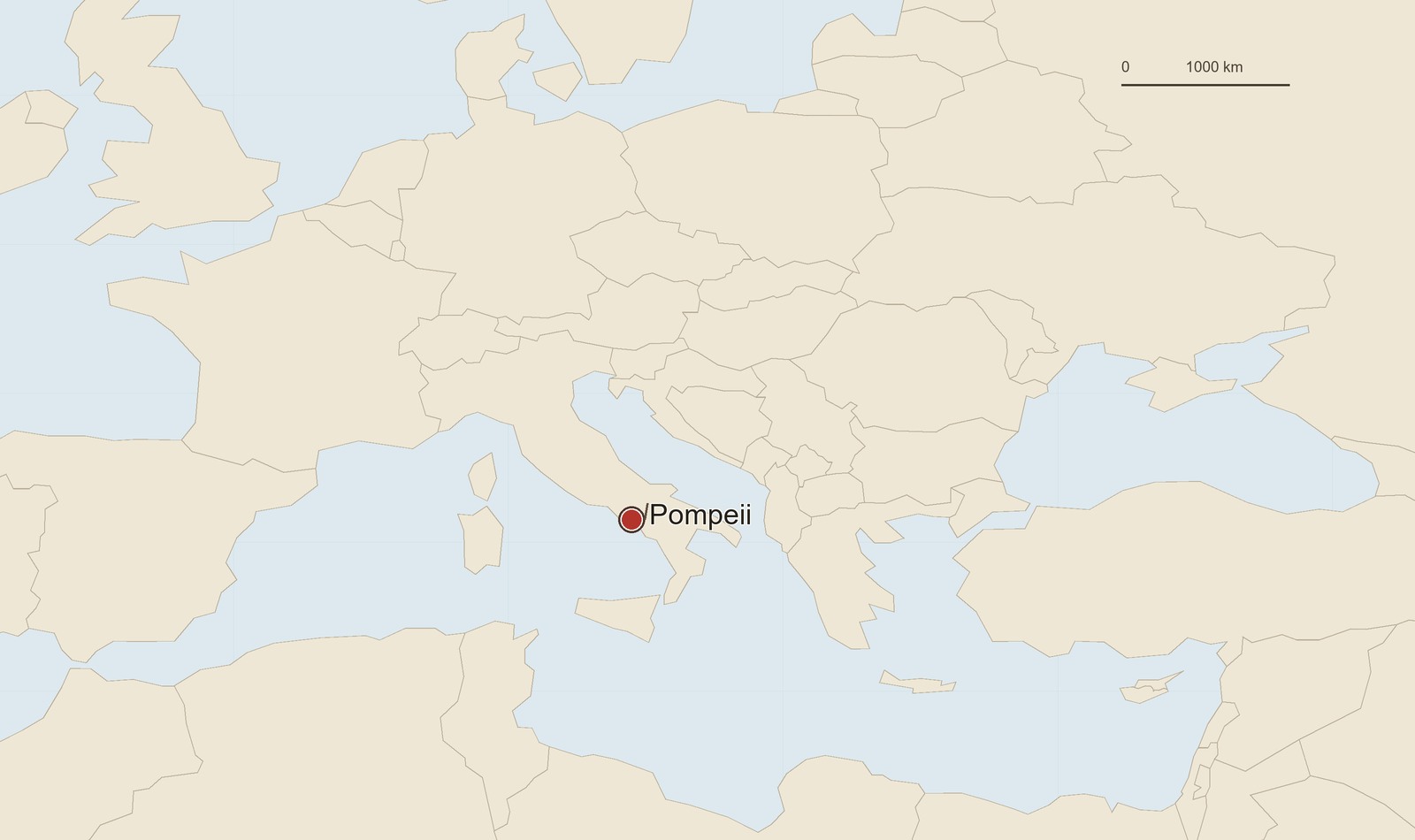 Location map: Pompeii. The marker shows the ancient site or main archaeological complex.
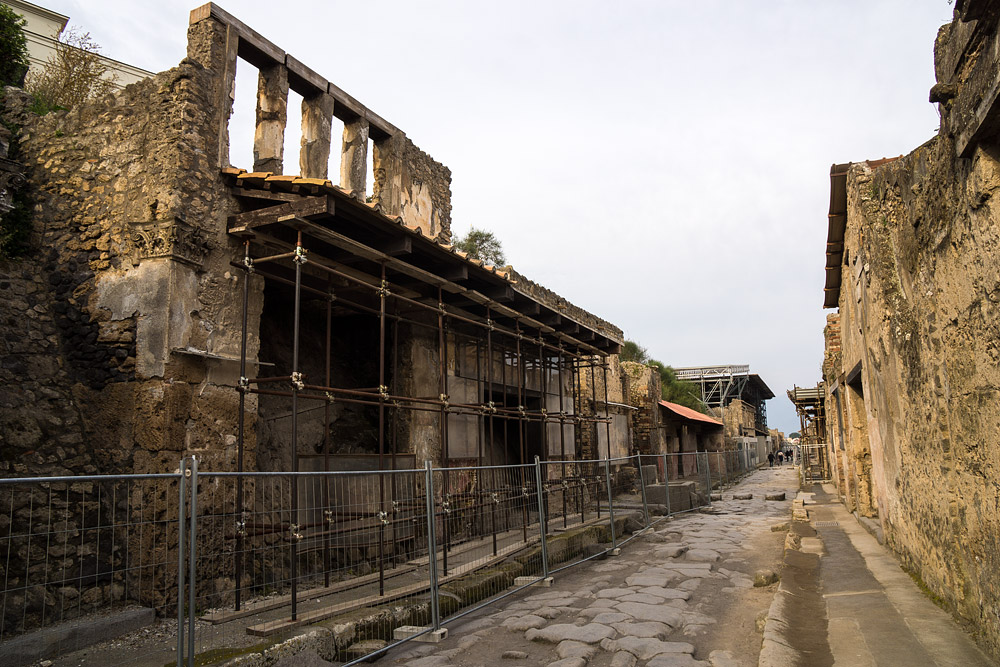 Street of Plenty. Pompeii,modern view
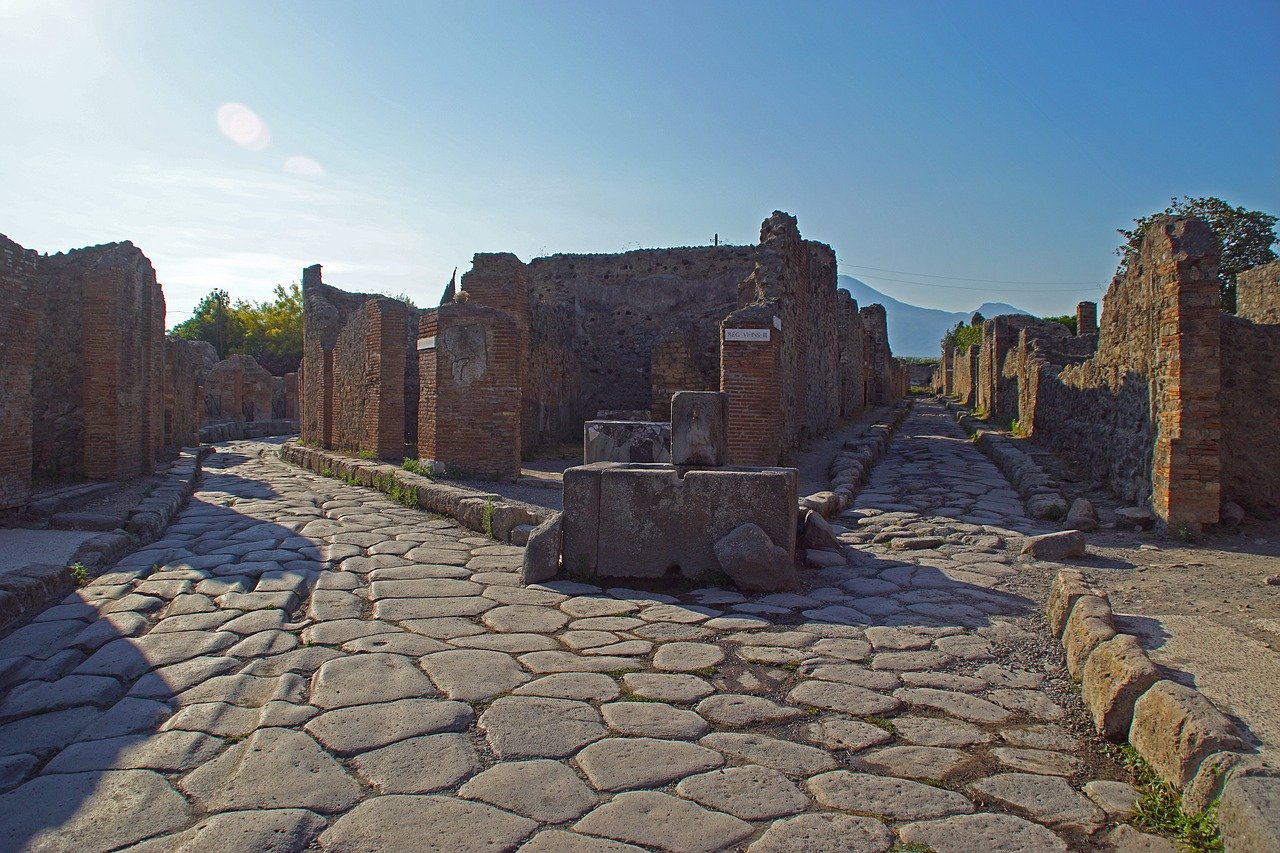 Crossroad. Pompeii,modern view
History of the City
A settlement existed on the site of Pompeii long before the city became part of the Roman state. Campania lay within a zone of Oscan, Greek, Etruscan and Samnite contacts, and this mixture is visible in the early history of the city, its cult practices, fortifications and links with neighbouring centres.
After the Social War Pompeii became a Roman colony. Veterans were settled there, Latin and Roman institutions gained strength in public life, but local traditions did not disappear at once. By the first century AD Pompeii was a lively provincial town with a forum, temples, a basilica, baths, theatres, an amphitheatre, shops, workshops and suburban villas.
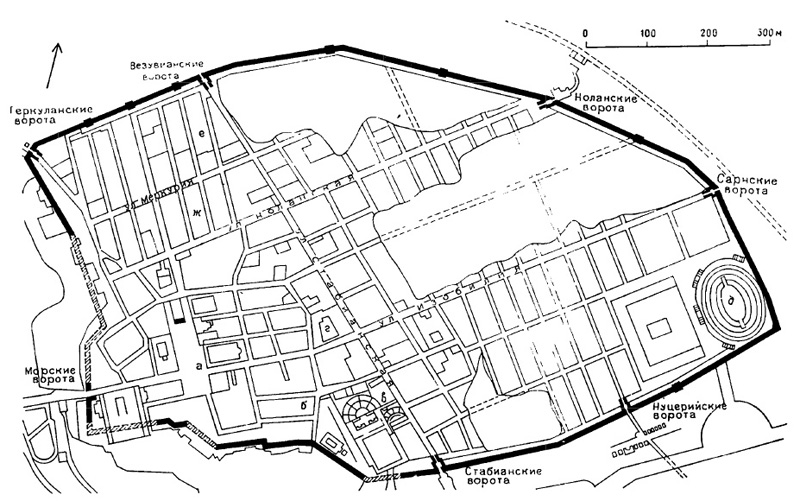 Map of Pompeii with the names of the main streets. 2nd floor of the 20th century.
Streets and Urban Setting
The layout of Pompeii clearly shows the structure of a medium-sized Roman town. The forum combined administrative, commercial and cult functions. Streets had stone paving, sidewalks and raised stepping-stones; beside them stood fountains, drains, shops, house entrances and rooms opening directly onto the street.
The urban environment was not divided into museum-like zones. A house could stand beside a workshop, shop or tavern; a single room could serve as dwelling, workplace and point of sale. Election notices, announcements of games, ownership marks and graffiti show the city as a living social environment with politics, advertising, jokes and conflicts.
Graffiti, Elections and Urban Speech
Pompeian walls preserve a vast layer of urban text. They include electoral notices, candidates' names, visitors' inscriptions, jokes, love lines, accounts, greetings, insults and short everyday phrases. For the history of the town this is no less important than wall paintings and mosaics: inscriptions show how people of different status spoke, argued, advertised, asked for support and left memory of themselves.
Electoral notices are especially valuable. They show that urban politics was not confined to the forum and official documents. The facades of houses, shops and workshops became surfaces for public campaigning, while the names of craftsmen, neighbours, collegia and female supporters entered the urban space. Graffiti add a more personal level: through them one sees tavern visitors, pupils, craftsmen, lovers, spectators and people for whom a wall was a quick way to speak.
Houses, Cult and Daily Life
Pompeian houses varied greatly according to wealth. Alongside small shops and modest rooms there were richly decorated houses with atria, peristyles, gardens, mosaics and wall painting. The atrium was not just an architectural form: visitors passed through it, and it could contain household objects, ancestral imagery and elements of household cult.
Household religion is visible through lararia, images of Lares, Penates, the household Genius, snakes and sacrificial scenes. Such images matter together with their findspot: courtyard, kitchen, entrance zone or service room changes the meaning of the painting and shows how cult belonged to daily domestic life.
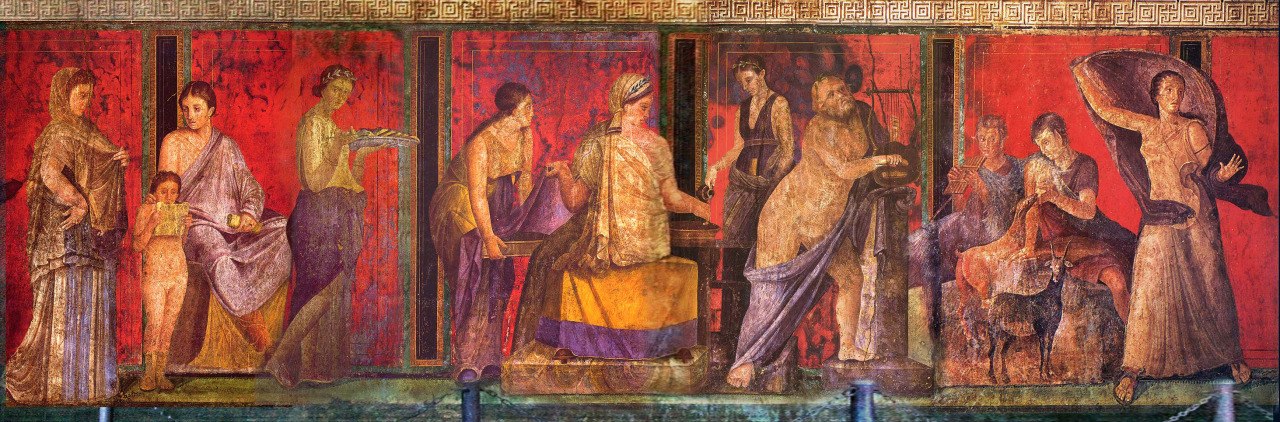 Fragment of the monumental wall painting from the Villa of the Mysteries near Pompeii, mid-1st century BCE. Second-Style figures form a continuous ritual and mythological frieze; the scene's precise interpretation remains debated.
Food, Craft and Trade
Pompeii is especially important for the study of ancient Roman food. Bakeries with mills and ovens, wine shops, amphora stores, commercial rooms and snack bars have been excavated in the city. Thermopolia with masonry counters and built-in vessels show how hot food and drinks were sold to passers-by.
Not every inhabitant had a convenient kitchen, so street food, taverns, popinae and cauponae played a visible role in daily life. Pottery, bronze vessels, bread, nuts, fruit, wine containers, scales and working tools allow us to study not only the elite but also craftsmen, traders, slaves, freedmen and small householders.
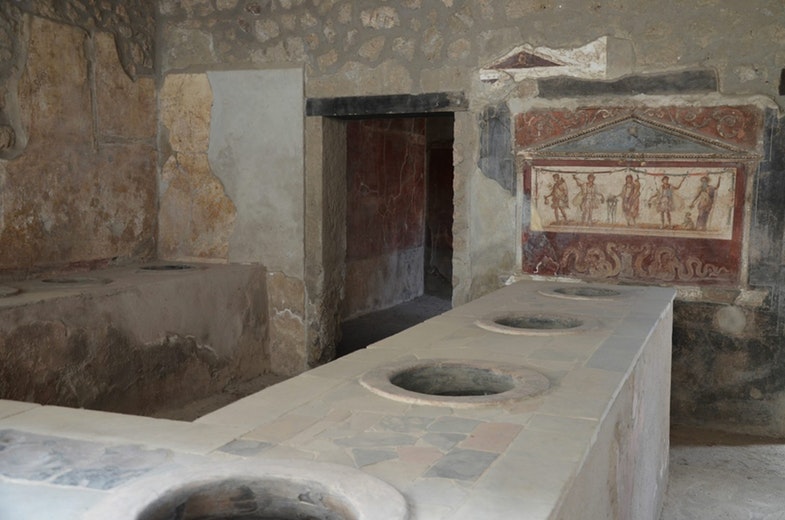 Thermopolium of Vetucia Placida. Pompeii. 1st century AD
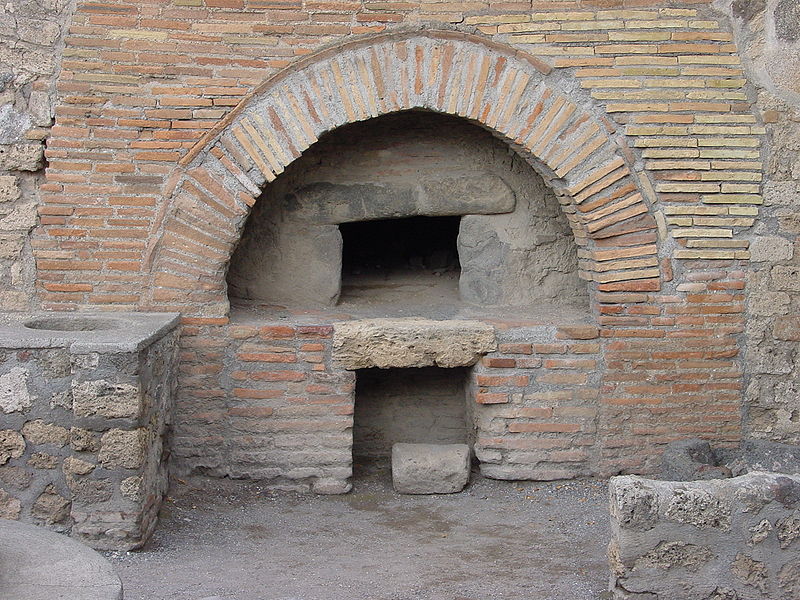 Oven in a public bakery in Pompeii
 Bronze cooking vessels from the Gragnano area, displayed in the Pompeii Archaeological Park; first century CE.
Public Buildings and Spectacles
Pompeii's public buildings show the active life of a provincial town. The forum, basilica, temples, markets, baths, theatres and amphitheatre formed a network of places where citizens traded, took part in cults, discussed business, watched performances and displayed status.
The amphitheatre of Pompeii is among the earliest known stone amphitheatres in the Roman world. The city is associated with the clash between Pompeians and people from Nuceria during the games, after which the authorities temporarily restricted such spectacles. Gladiatorial reliefs and finds from Pompeii matter not only for military themes but also for the urban culture of public entertainment.
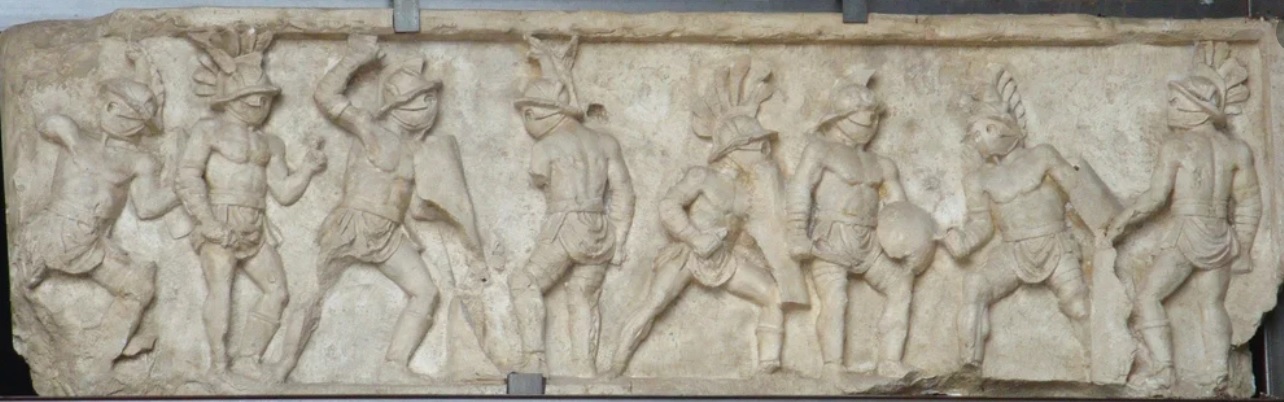 Marble relief with gladiatorial scenes from the necropolis at Pompeii's Stabian Gate, ca. 20–50 CE. National Archaeological Museum, Naples. The sequence shows how relief compresses different moments of a spectacle into a single band.
The Eruption of Vesuvius
In AD 79 the eruption of Vesuvius destroyed Pompeii, Herculaneum and several villas around the Bay of Naples. Pompeii was mainly covered by volcanic ash and lapilli, while Herculaneum was more heavily affected by pyroclastic flows and hot volcanic material.
The ancient literary tradition connects the catastrophe with Pliny the Younger's letters to Tacitus. His account became one of the key texts for studying the eruption and the death of Pliny the Elder, who commanded the fleet at Misenum and tried to approach the disaster zone. For archaeology, the crucial point is not only the moment of destruction but also the fact that the urban environment was sealed from later rebuilding.
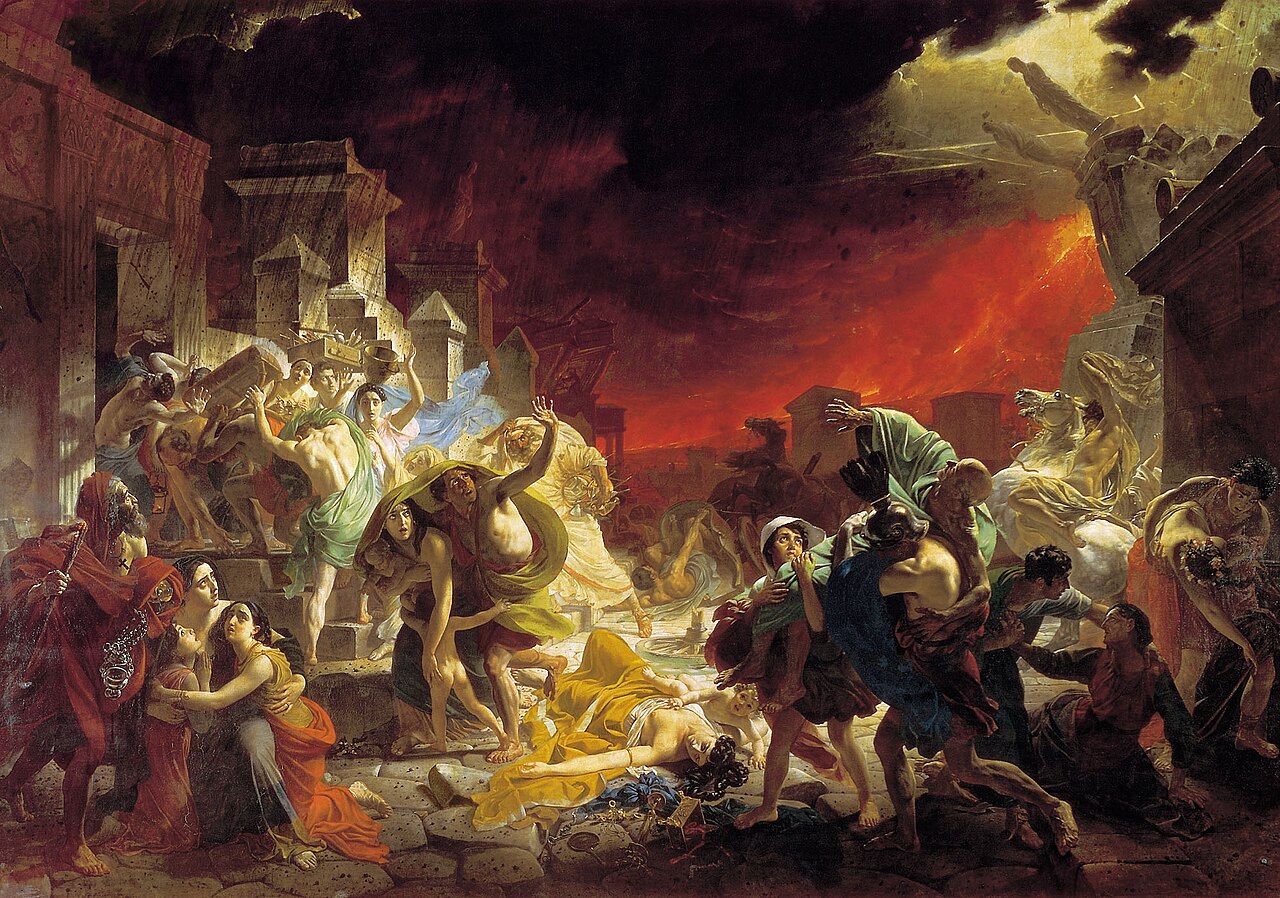 The eruption of Vesuvius in AD 79. Event reconstruction.
Chronology of the Town
- Sixth-fourth centuries BC - development of the early settlement in the Oscan-Samnite environment of Campania.
- Fourth-third centuries BC - strengthening of the town and Pompeii's inclusion in the network of Italic contacts with Rome.
- 89 BC - Pompeii is taken by Sulla during the Social War.
- 80 BC - foundation of the Roman colony Colonia Cornelia Veneria Pompeianorum.
- First century AD - active urban life: rebuilding of houses, trade, electoral notices, operation of baths, theatres and amphitheatre.
- AD 59 - disorder in the amphitheatre between Pompeians and Nucerians; spectacles were temporarily restricted afterward.
- AD 62 - a strong earthquake damages the town; repairs to many buildings continue up to the disaster.
- AD 79 - the eruption of Vesuvius buries Pompeii under ash and lapilli.
- Eighteenth century - beginning of systematic excavation, making Pompeii one of the main archaeological monuments of antiquity.
Archaeology and Finds
Excavations at Pompeii began in the eighteenth century and strongly influenced archaeology, interest in ancient art and ideas about Roman daily life. The plaster casts of the victims are especially significant: they were made by pouring plaster into voids left in the hardened volcanic material after bodies had decomposed.
Pompeii's great strength lies in the connection between objects and rooms or streets. A jug, hearth, painting, counter, graffito or working tool does not exist in isolation: it belongs to a house, shop, workshop, bath, shrine or public building. The city's material therefore allows scenes of life to be studied through their setting rather than through isolated objects.
The history of excavation affects how the town is understood today. Early work in the eighteenth and nineteenth centuries often selected attractive paintings, bronzes and marbles for collections, while layers and small finds were recorded less fully than in modern archaeology. The same Pompeian object can therefore have different value: an item with precise findspot, room and context tells much more about daily life than an object labelled only "from Pompeii".
Preservation is also not a completed task. Vesuvian ash sealed Pompeii, but walls, paintings, plaster and floors exposed by excavation began to suffer from rain, sun, tourism and old restorations. Modern study of Pompeii includes not only new excavation, but conservation, documentation, digital plans, rereading of old diaries and publication of archival material.
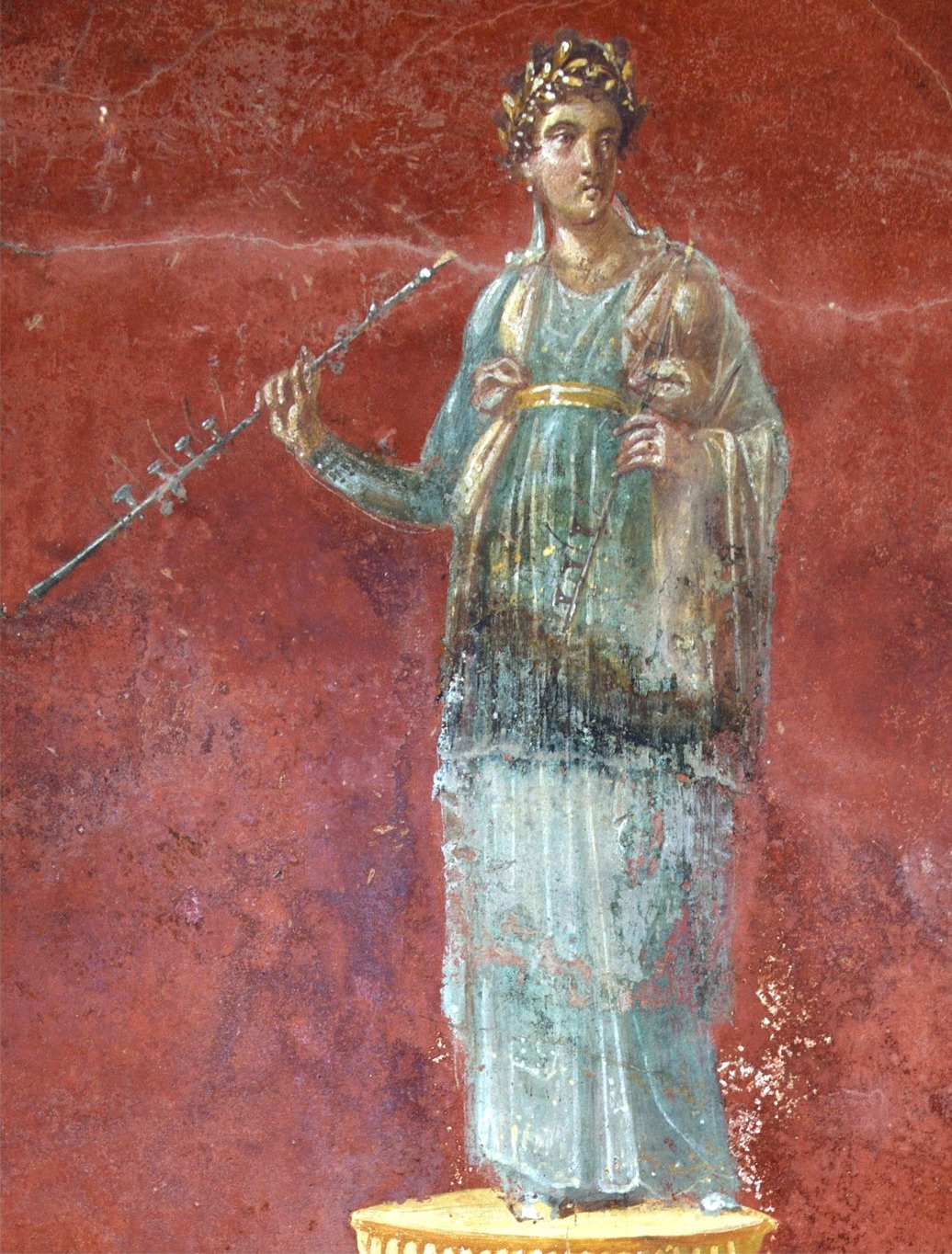 Muse Euterpe or an actress of the Neronian period. Pompeii, Villa Moregine, east triclinium. 1st century AD.
 Craftsman in a tunic worn over one shoulder. Pompeii, 1st century AD.
Images and Caution
Pompeian frescoes, reliefs and mosaics are indispensable for studying gestures, poses, furniture, clothing, footwear, hairstyles, interiors and the visual language of the house. But an image is not always a literal portrait of daily life. A mythological scene, theatrical mask, decorative figure or idealized person should be read together with the house, room, date and function of the image.
Military and ceremonial objects from the Pompeian context do not turn the city into a military camp. Gladiatorial reliefs, swords, a parazonium, belt fittings and images of armed figures show how military and spectacle symbolism appeared within the urban culture of first-century AD Campania.
Related Topics
- Herculaneum
- Archaeology and museums
- Roman Household Religion
- Lararium
- Lares
- Penates
- Thermopolium
- Food in Ancient Rome
- Roman Streets
- Architecture in Ancient Rome
- Clothing in Ancient Rome
- Gladiator
- National Archaeological Museum of Naples
Literature and sources
- Beard, Mary. Pompeii: The Life of a Roman Town. Profile Books, 2008.
- Dobbins, J. J.; Foss, P. W. (eds.). The World of Pompeii. Routledge, 2007.
- Cooley, A. E.; Cooley, M. G. L. Pompeii and Herculaneum: A Sourcebook. Routledge, 2014.
- Ling, Roger. Pompeii: History, Life and Afterlife. Tempus, 2005.
- UNESCO World Heritage Centre. Archaeological Areas of Pompei, Herculaneum and Torre Annunziata.
- Wallace-Hadrill, Andrew. Houses and Society in Pompeii and Herculaneum. Princeton University Press, 1994.
- Ling, Roger. Roman Painting. Cambridge University Press, 1991.
- Allison, Penelope M. Pompeian Households: An Analysis of the Material Culture. Cotsen Institute of Archaeology, 2004.


 Mural with the image of kitchen utensils. Julia Felix House,Pompeii
 A glass tumbler. Pompeii. 1st century AD
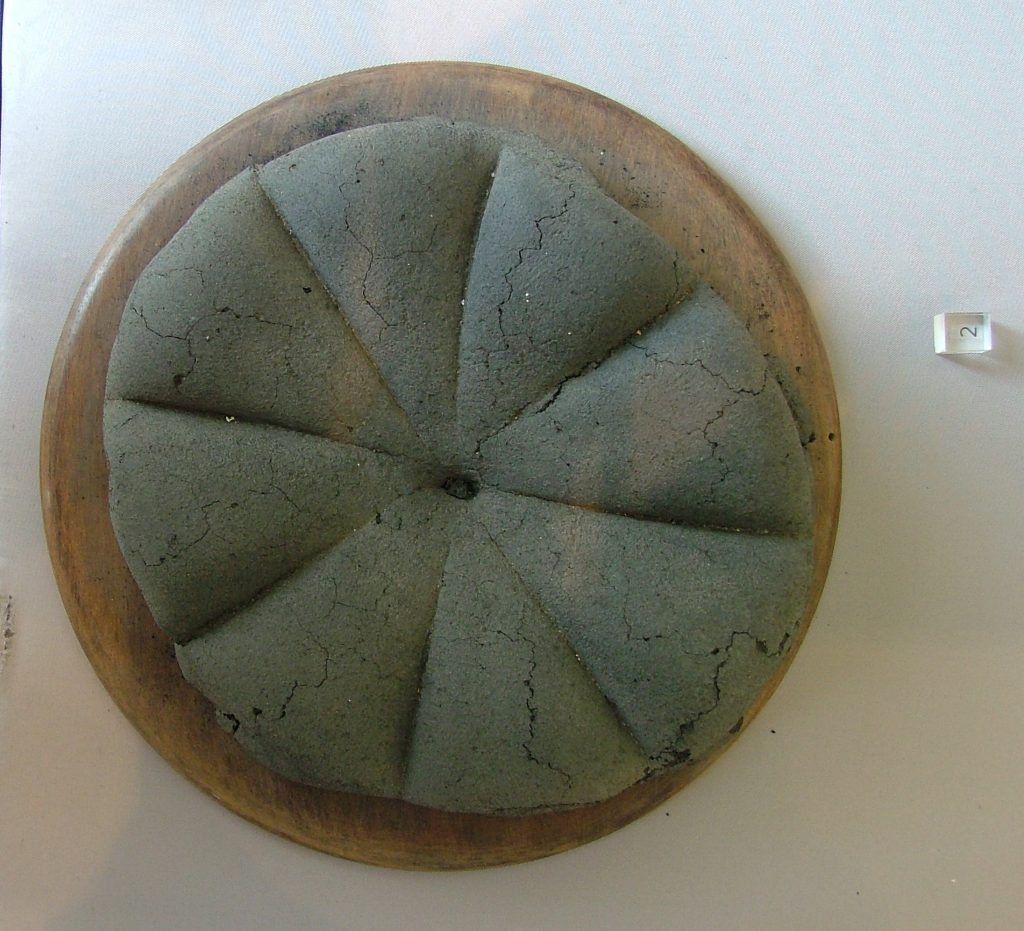 Round bread with cuts to make it easier to break. Pompeii.
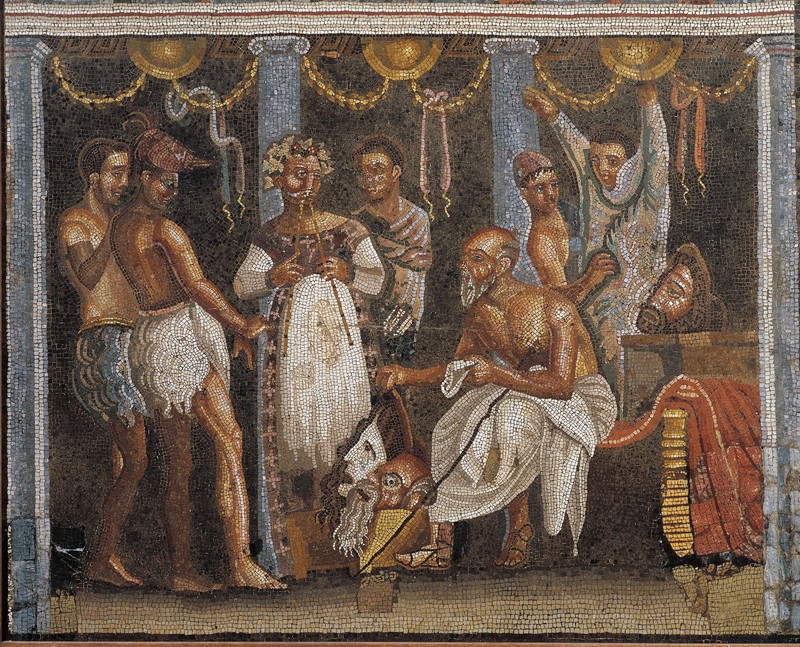 Actors preparing for a satyr play. Mosaic from the House of the Tragic Poet at Pompeii, 69–79 CE; Naples, National Archaeological Museum, inv. 9986. Masks, costume, danced movement and a double-pipe player turn a lost performance into a carefully organised image.
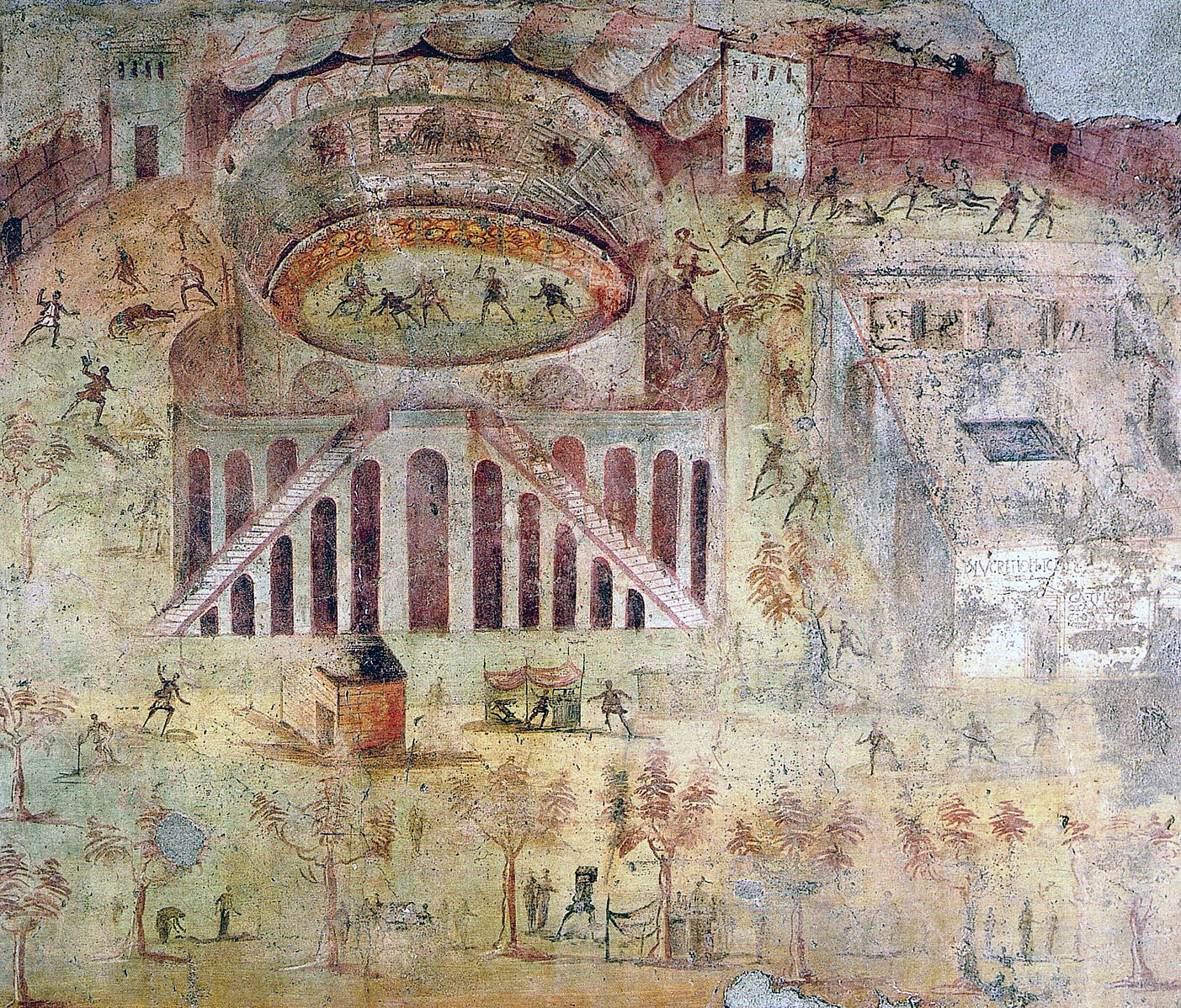 Mural with an amphitheater. Found in Pompeii. National Archaeological Museum,Naples. 1st century AD
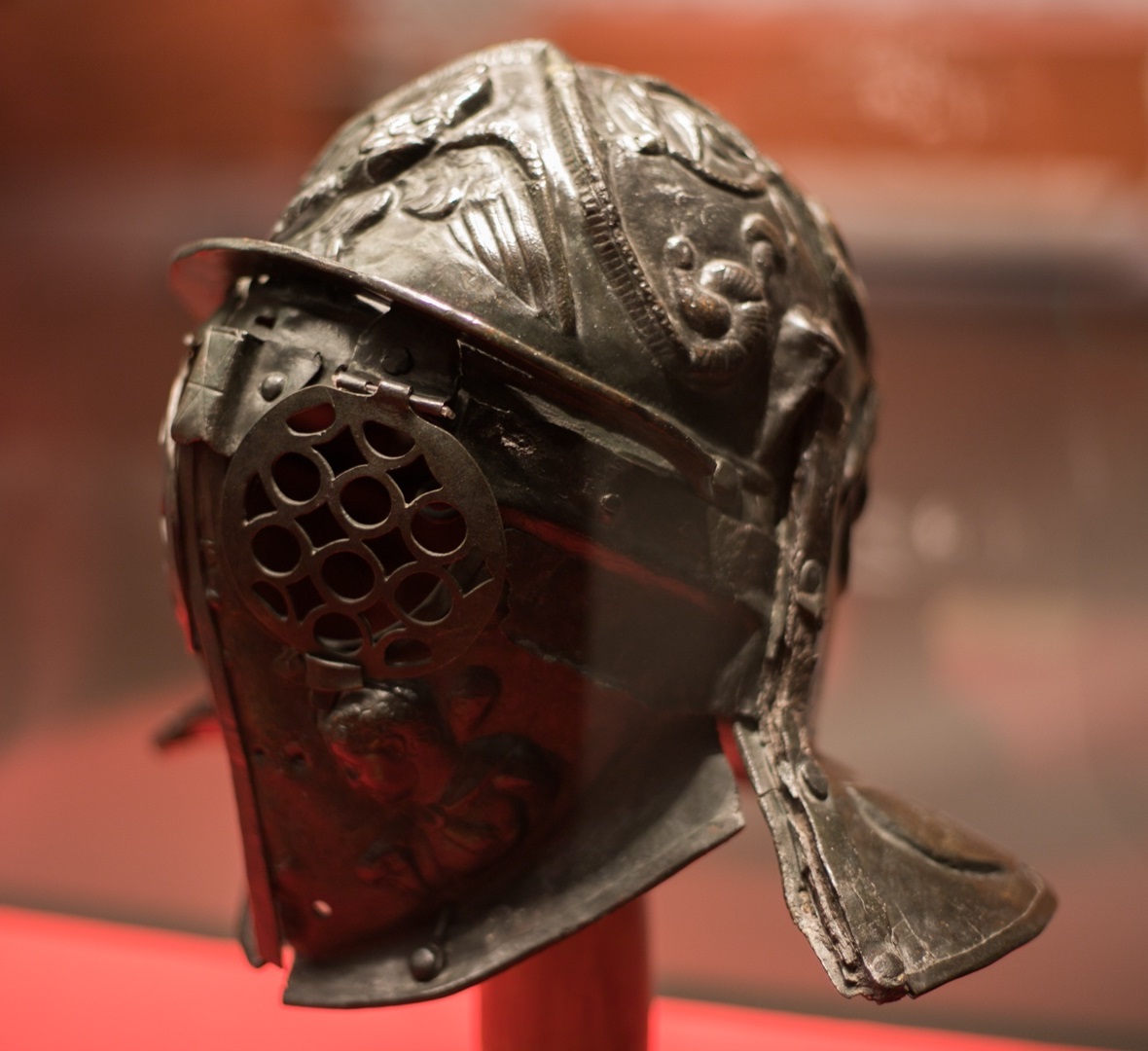 The provocateur's helmet. Bronze. Pompeii,portico of theaters. National Archaeological Museum,Naples,inv. no. 5658. Mid-1st century
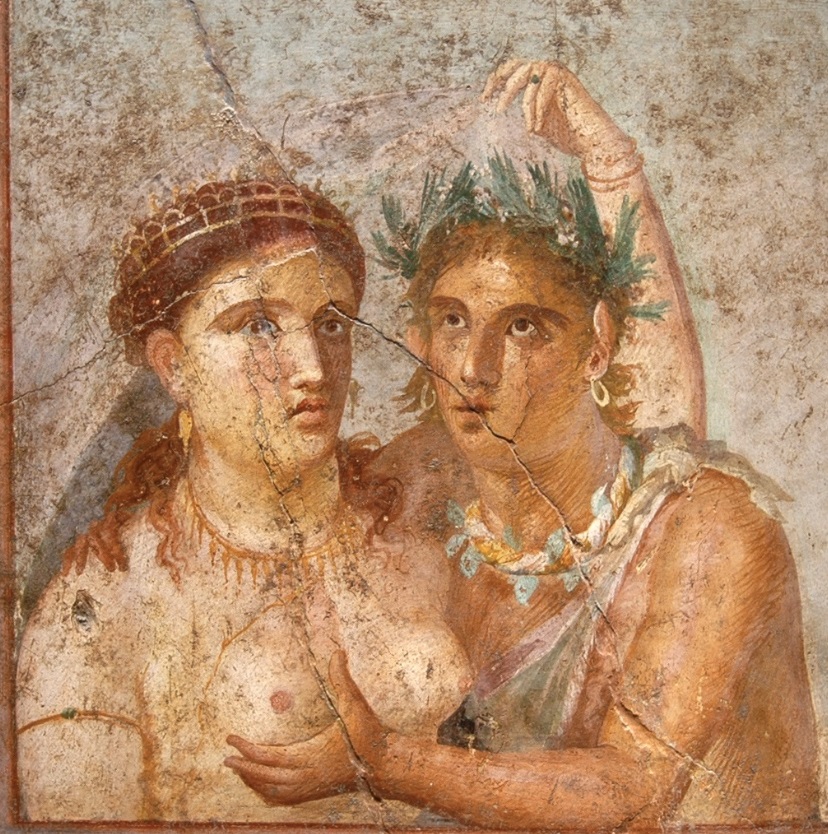 Satyr embracing a maenad. Pompeii; National Archaeological Museum, Naples, inv. 110590. Early first century CE.
 Mosaic "Inhabitants of the sea". Pompeii.
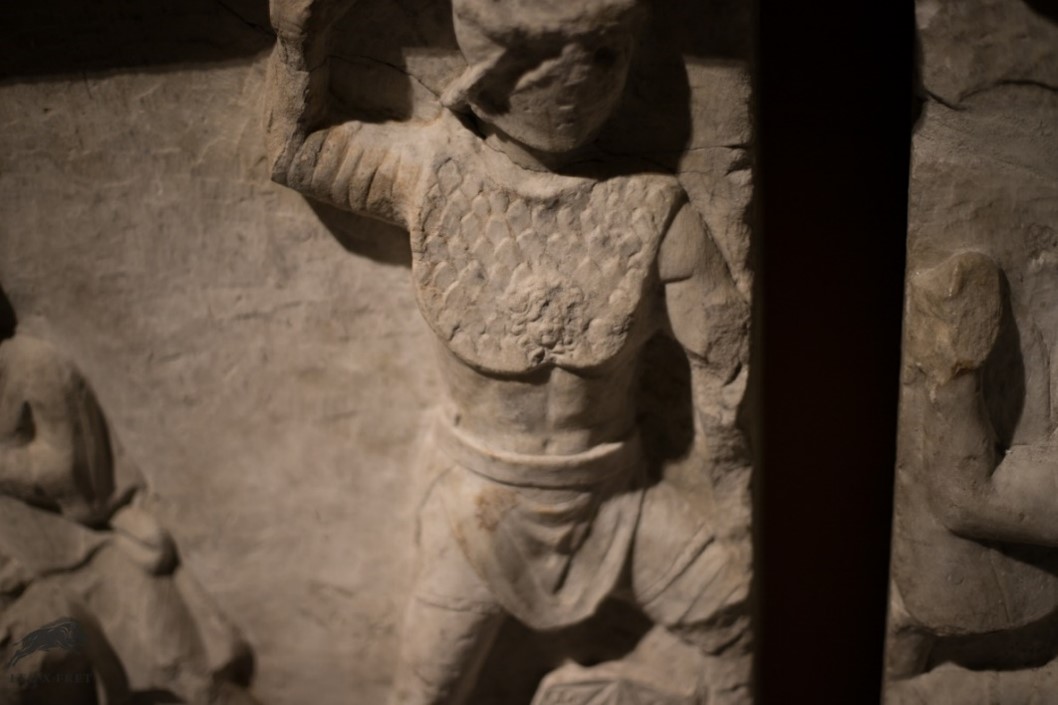 Relief with gladiators. Marble, AD 20-50; found near the Stabian Gate at Pompeii, National Archaeological Museum of Naples.
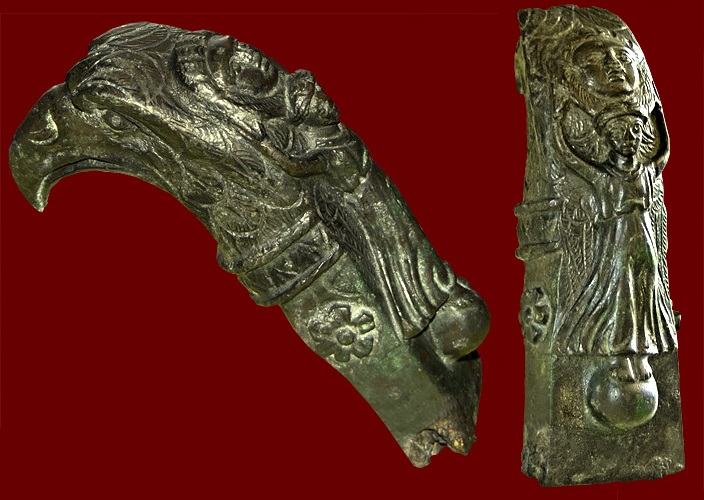 Bronze eagle head, probably from a parazonium handle. Found in the theatre area of Pompeii. Second half of the 1st century AD.
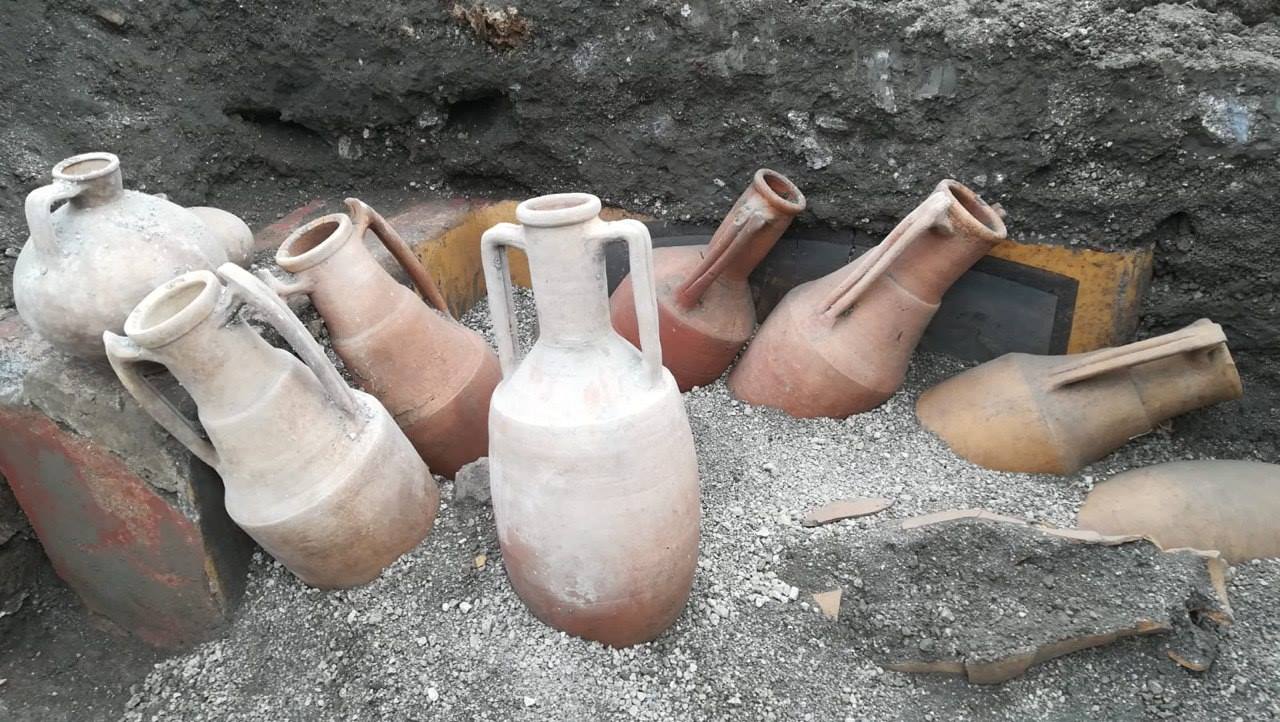 A thermopolium at Pompeii during excavation. Counter, vessels and room show urban commerce in its street context.
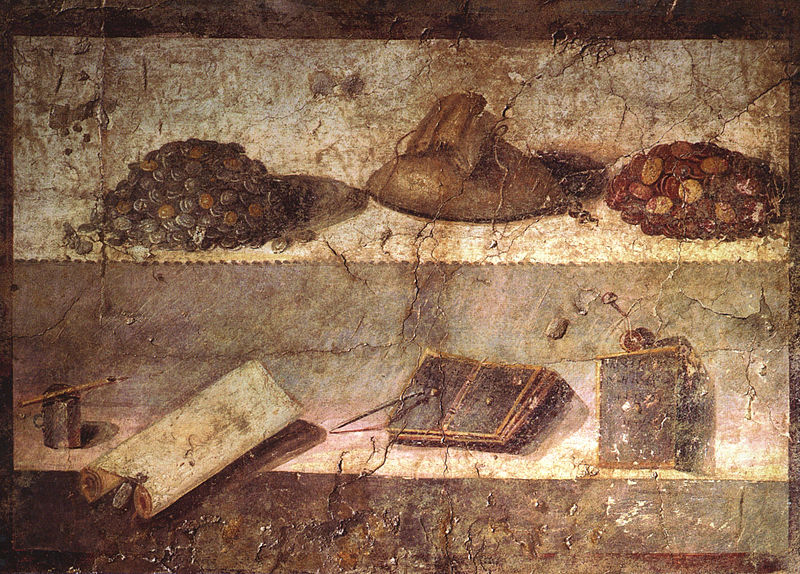 Fresco from Pompeii. Archaeological Museum of Naples. 1st century AD
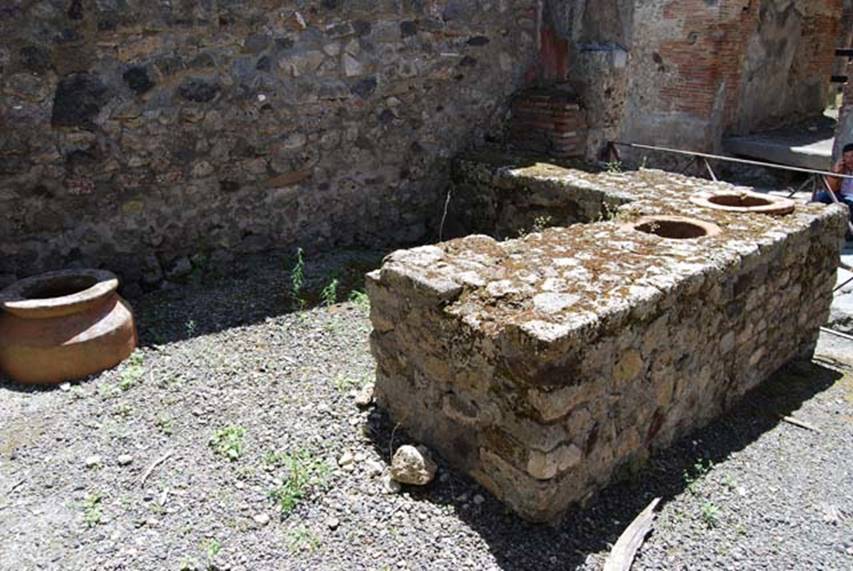 Caupona in Pompeii
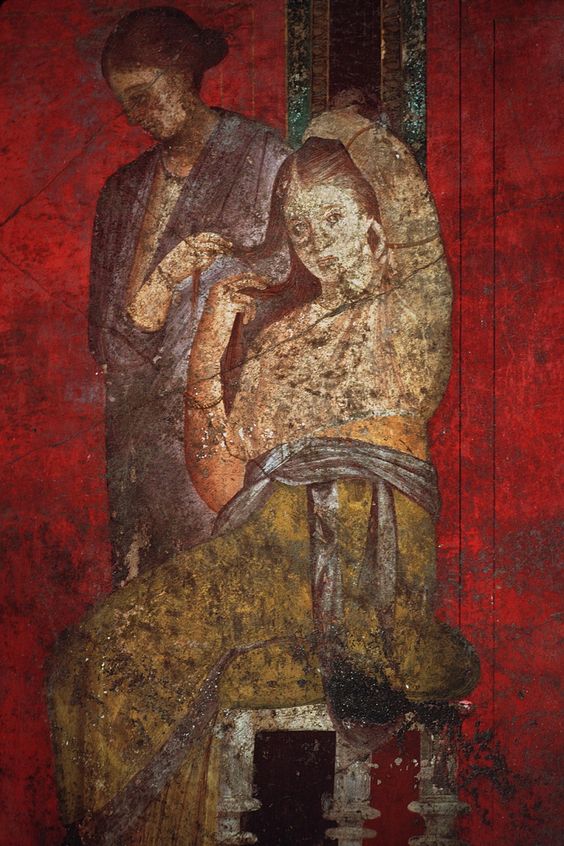 Fresco from the Villa of the Mysteries,Pompeii. 1st century AD
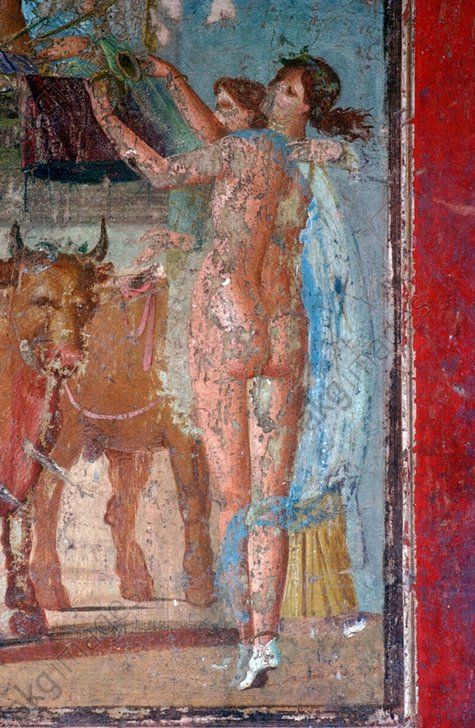 Fresco of a woman in closed shoes from Pompeii. Forum Baths (VII,5,built),Stucco Relief,Campania. 1st century AD
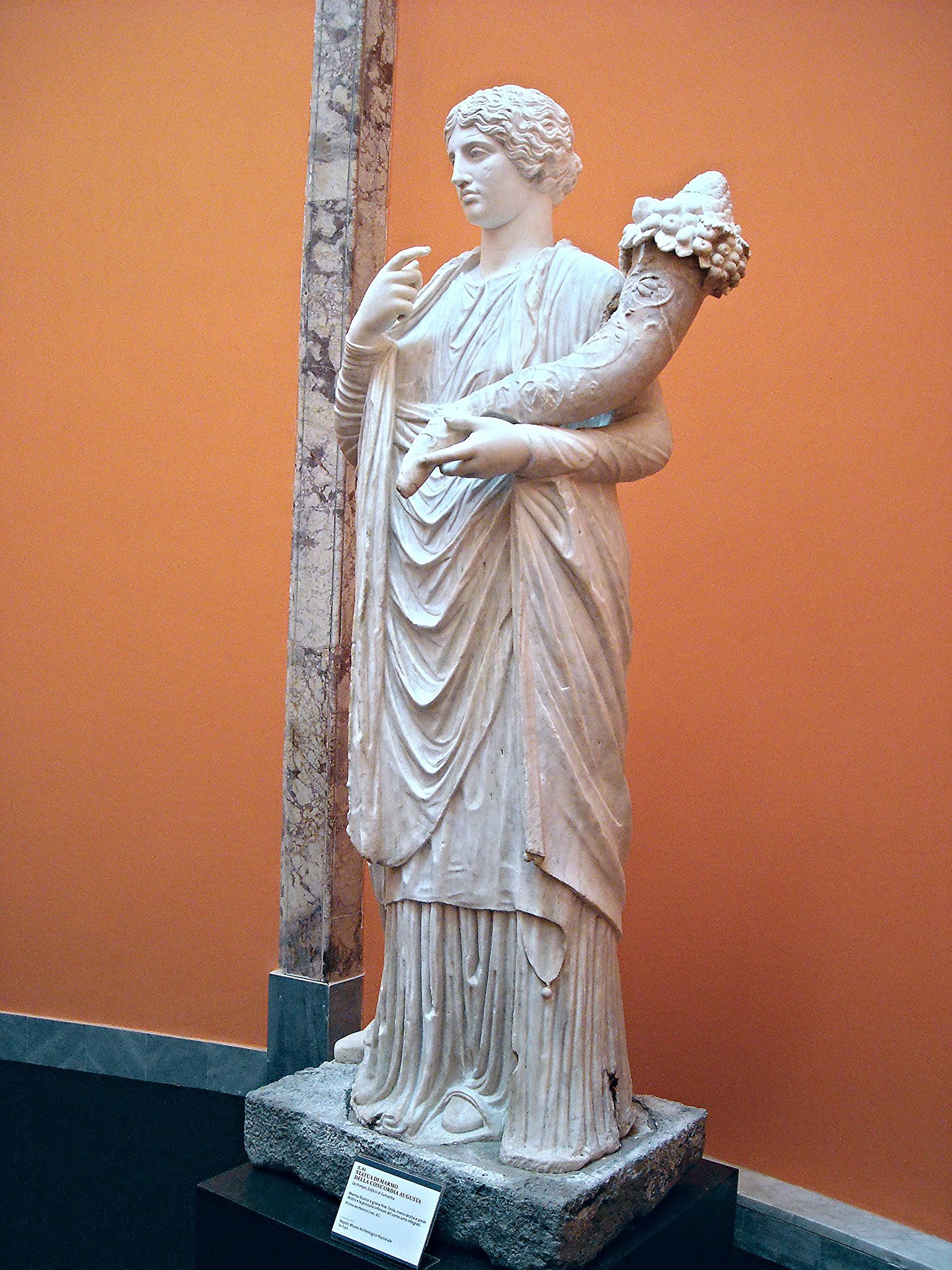 Concordia of August. Pompeii. Naples Archaeological Museum. Early 1st century AD
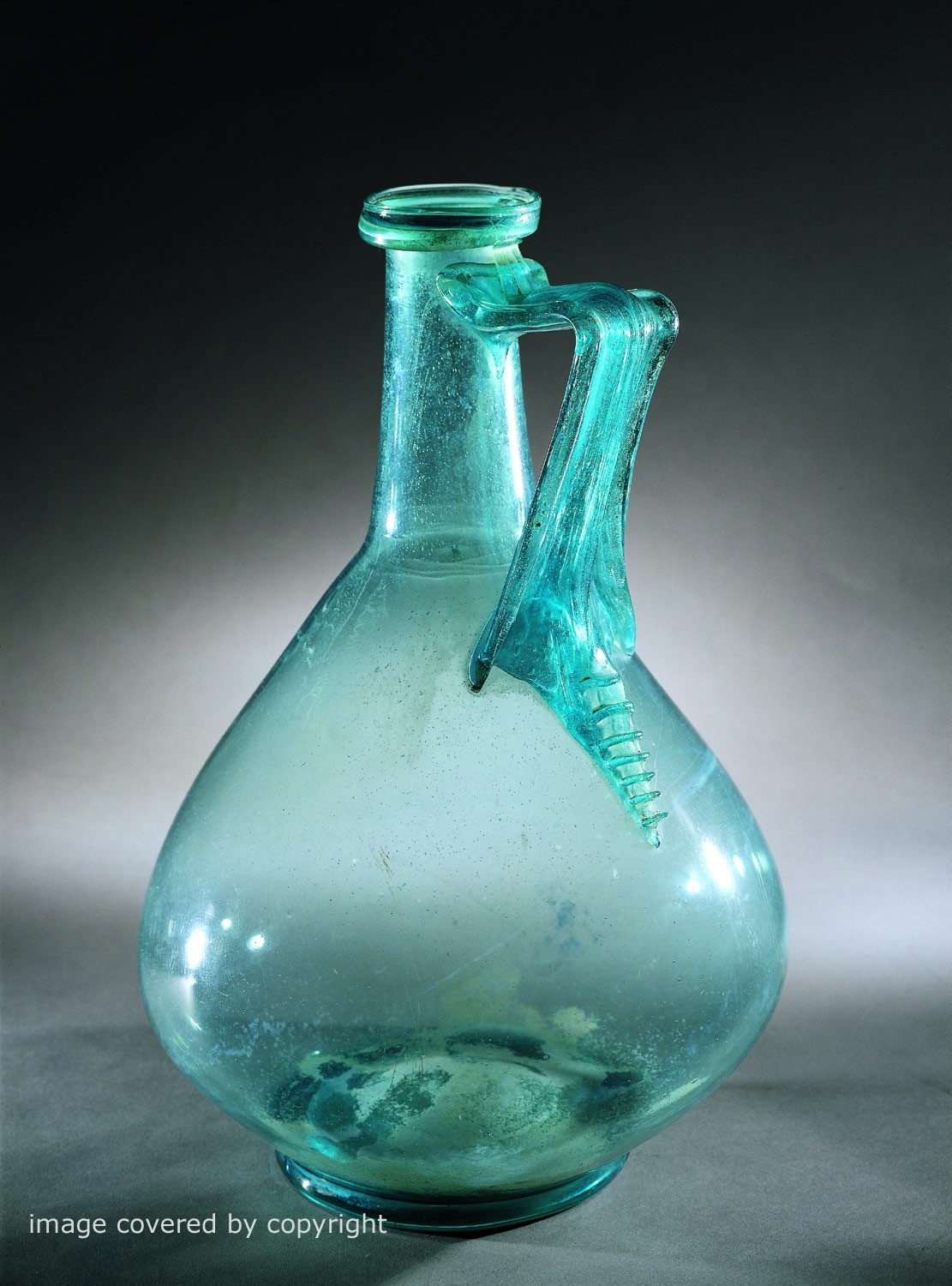 Glass amphora from Pompeii, first century AD; an expensive vessel form connected with storing and serving drinks.
 Parazonium with an eagle head from Pompeii, Regio VII, Insula 7. Second half of the 1st century AD.
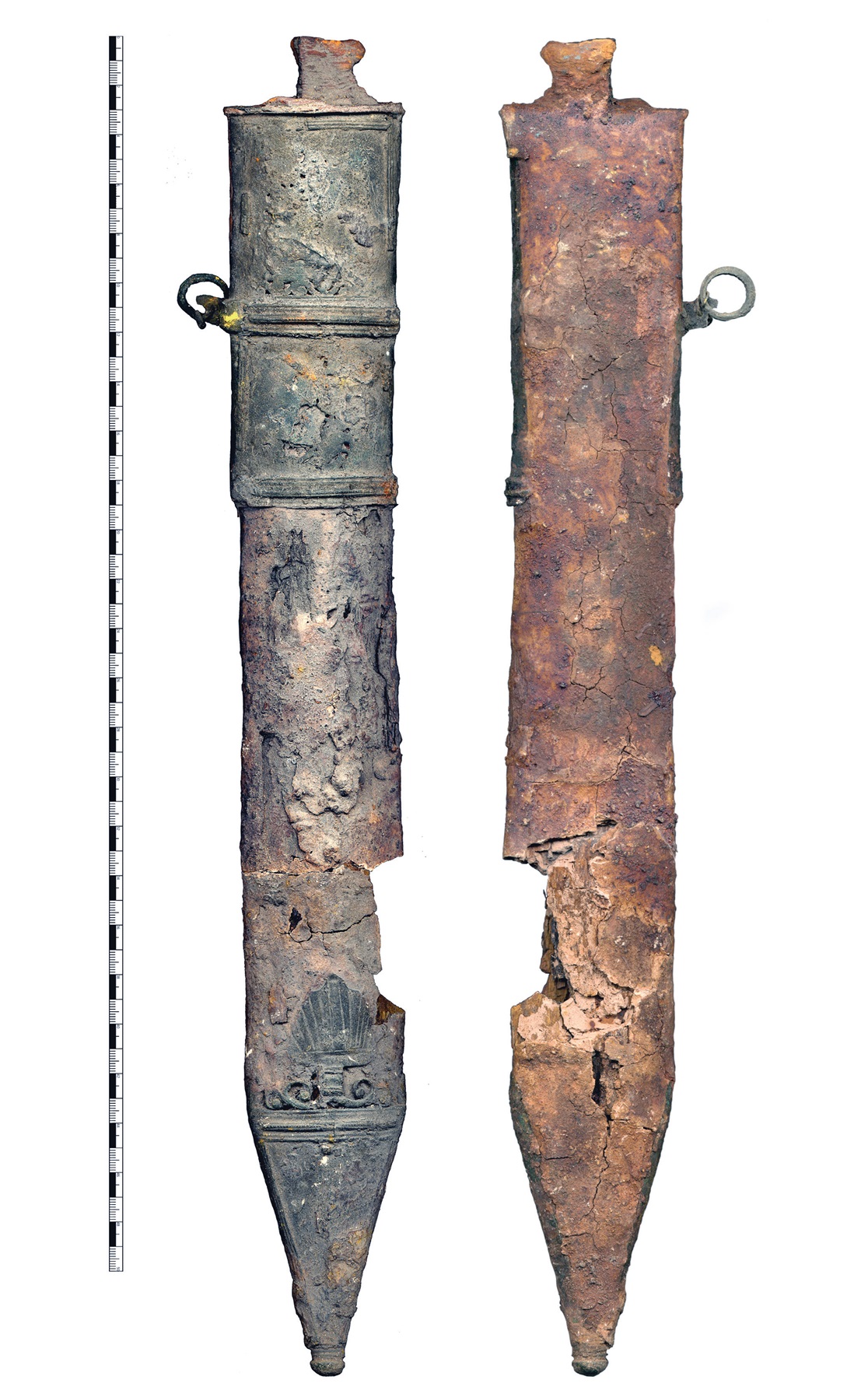 Pompeii-type sword with scabbard from the Villa of the Mysteries. Pompeii, AD 79.
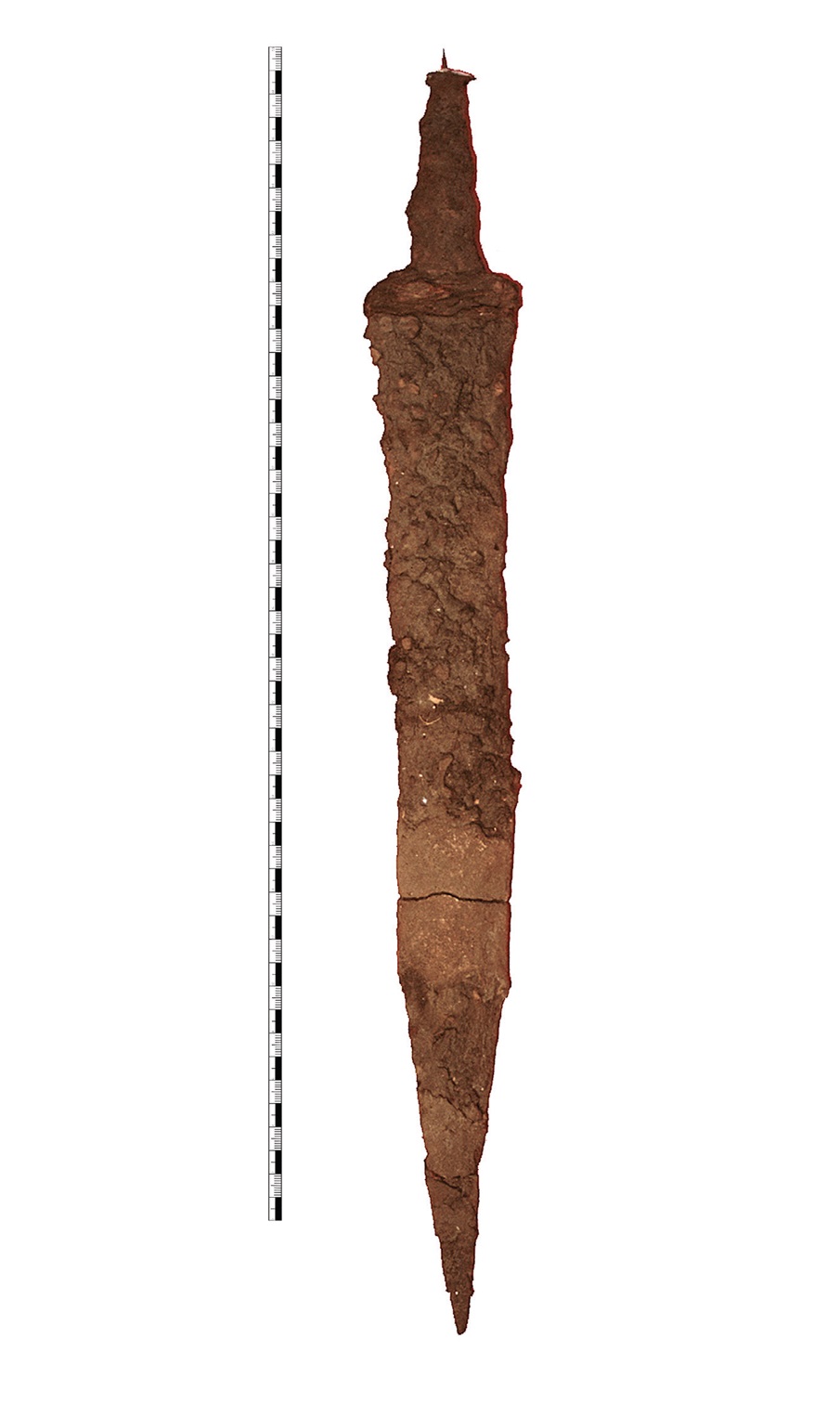 Mainz-type gladius from the Bay of Naples area, possibly Pompeii. AD 79.
Interested in Ancient Rome beyond reading? Join Legio X Fretensis or explore our reenactment directions.


