Arbeia
Arbeia was a Roman fort at South Shields, near the mouth of the River Tyne, on the eastern flank of Hadrian's Wall. It did not stand on the Wall line itself, but it controlled the sea and river route by which people, grain, building material and military equipment reached the garrisons of northern Britain.
For the history of the Roman Empire in Britain, Arbeia matters as more than a fortification. In different phases it was an early military point, a stone fort with a mixed garrison, a major Severan supply base and a late Roman fortified complex. Excavation makes the site unusually legible: gates, barracks, the commander's house, granaries, headquarters buildings, streets, funerary monuments and museum finds can be studied together.
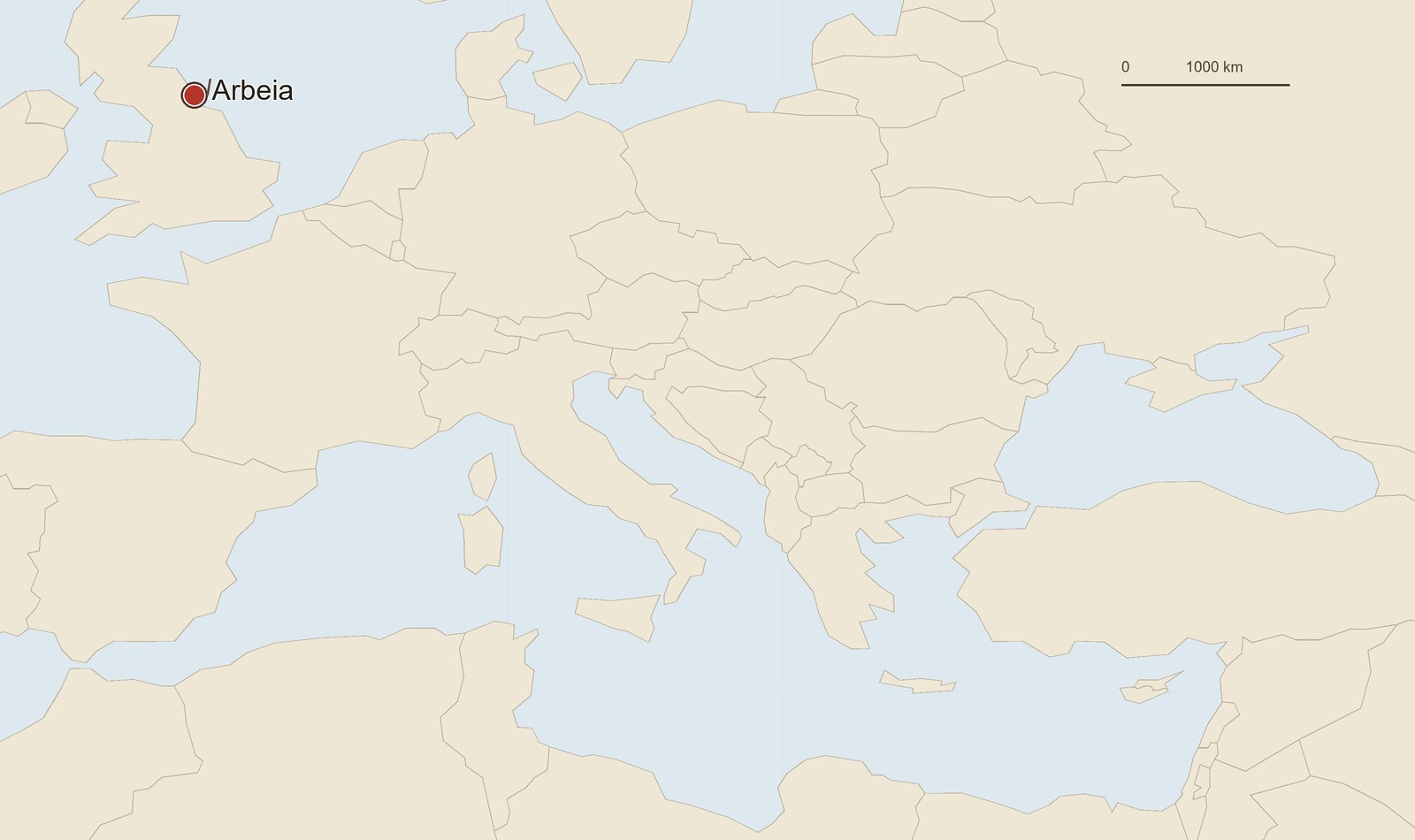 Location map: Arbeia. The marker shows the ancient site or main archaeological complex.
Site and Early History
The site lies on the Lawe, a high area on the south bank of the Tyne. The position was practical: it controlled the river mouth, the harbour approaches and movement toward the eastern end of the Wall near modern Wallsend. Pre-Roman occupation is also attested, including Neolithic and Iron Age material, but the role of the place changed after northern Britain entered the military system of the empire.
An early timber fort or associated settlement existed here before Hadrian's Wall or in the first decades of the second century. Work on the Wall began around AD 122, and the lower Tyne became part of the frontier landscape. When the Romans briefly shifted the main frontier line north to the Antonine Wall, South Shields may have declined in importance; after the return to Hadrian's Wall in the mid-second century, the site became important again.
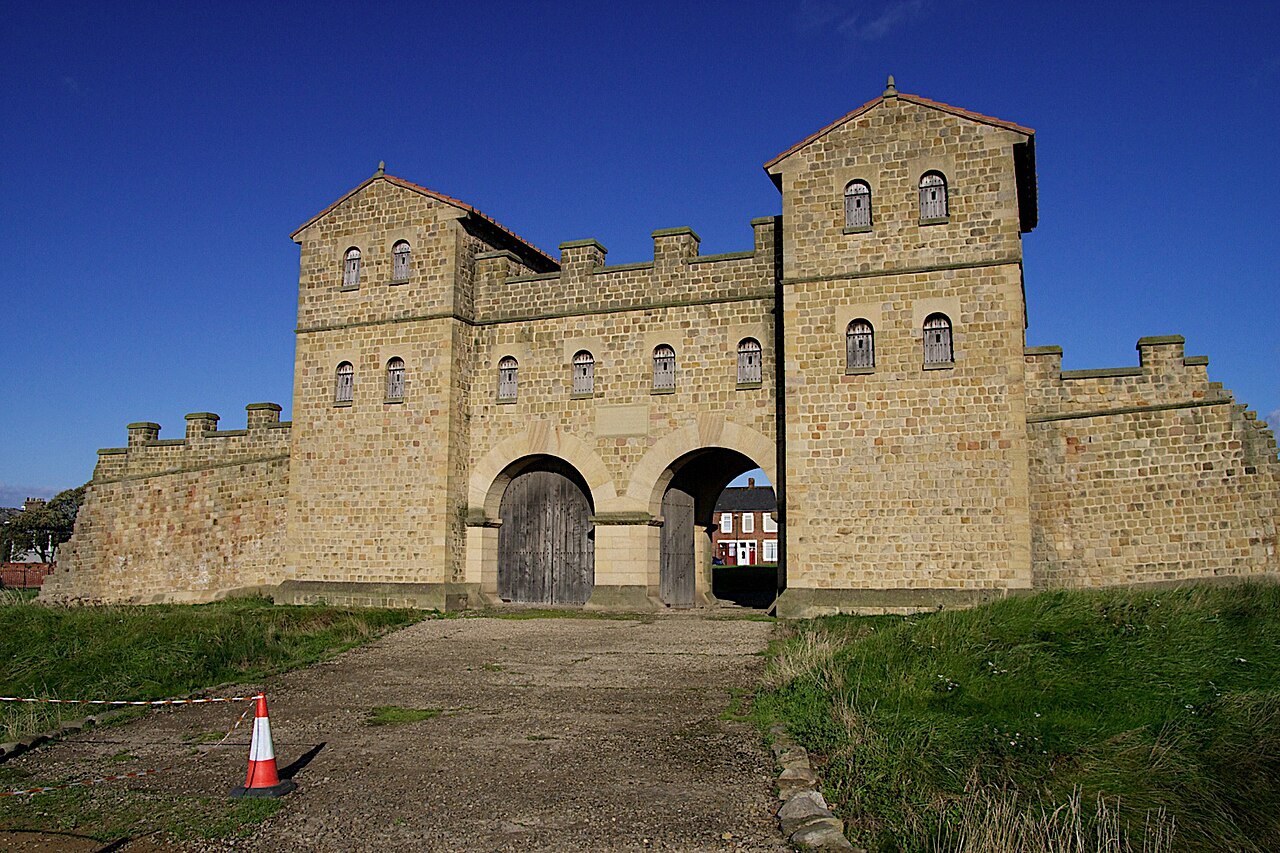
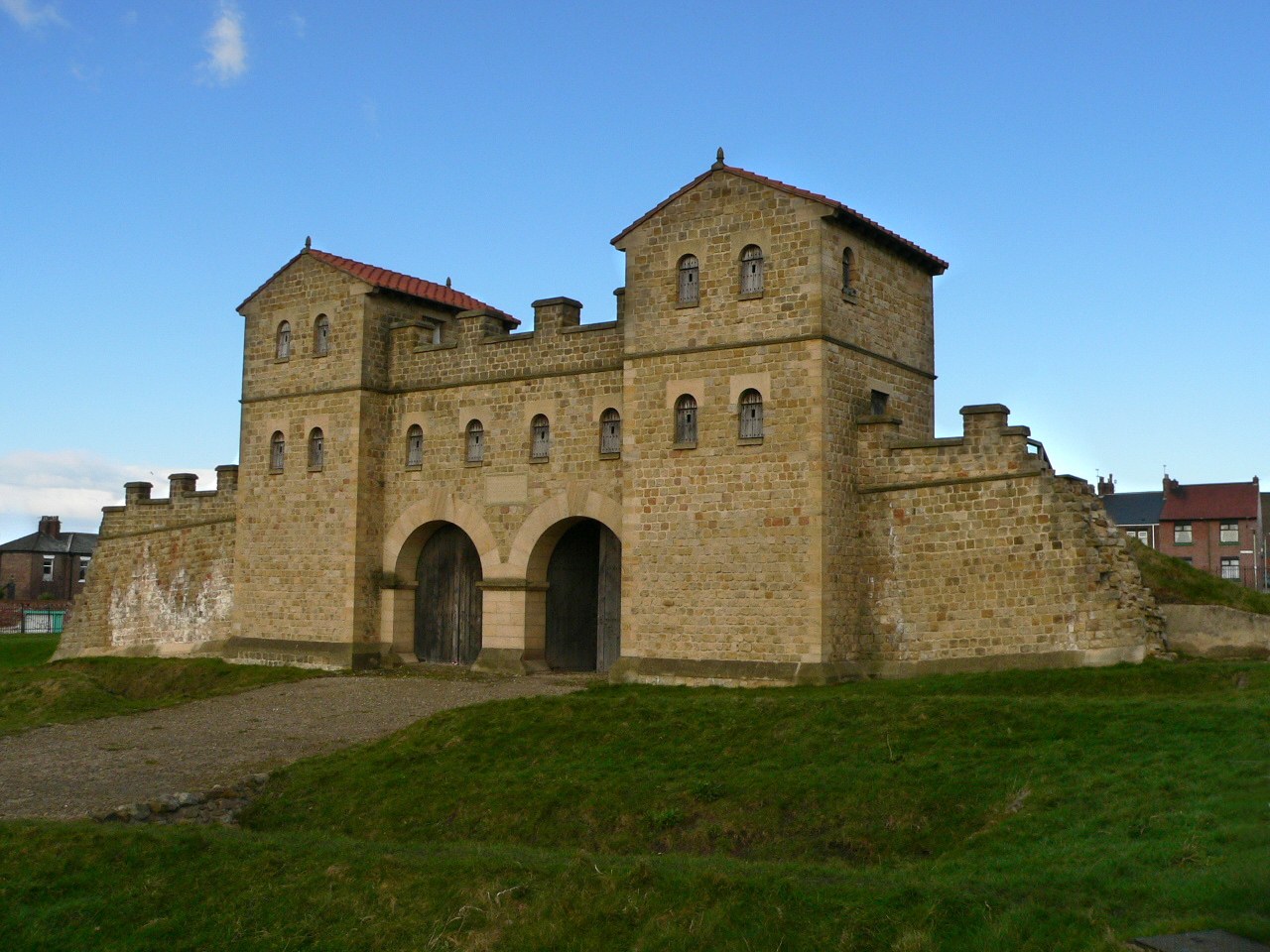 Reconstructed west gate at Arbeia, South Shields. The modern structure stands over Roman remains and presents a second-century gate form.
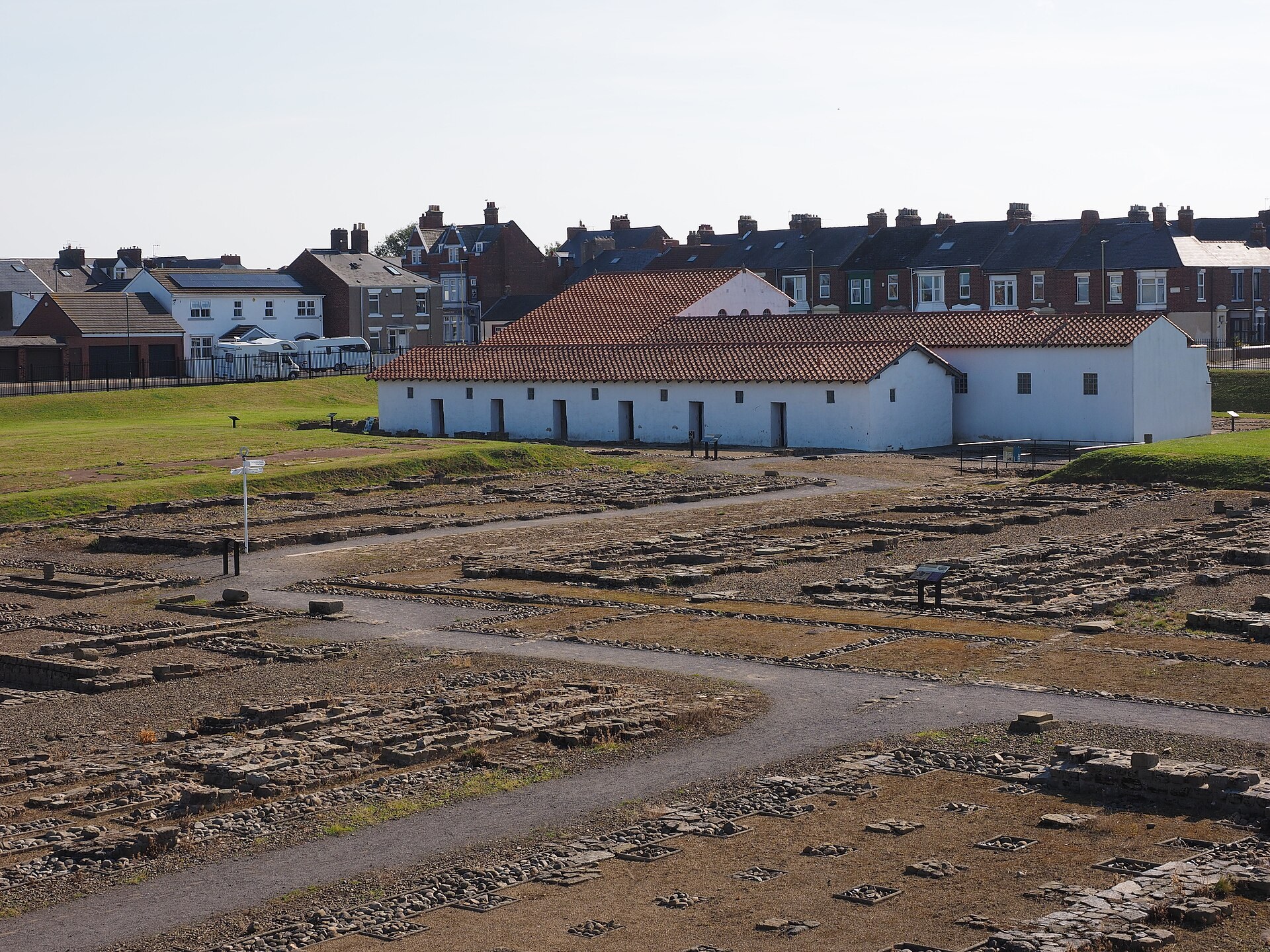 Reconstructed barracks and granary foundations at Arbeia. The view shows both museum reconstruction and exposed archaeological remains.
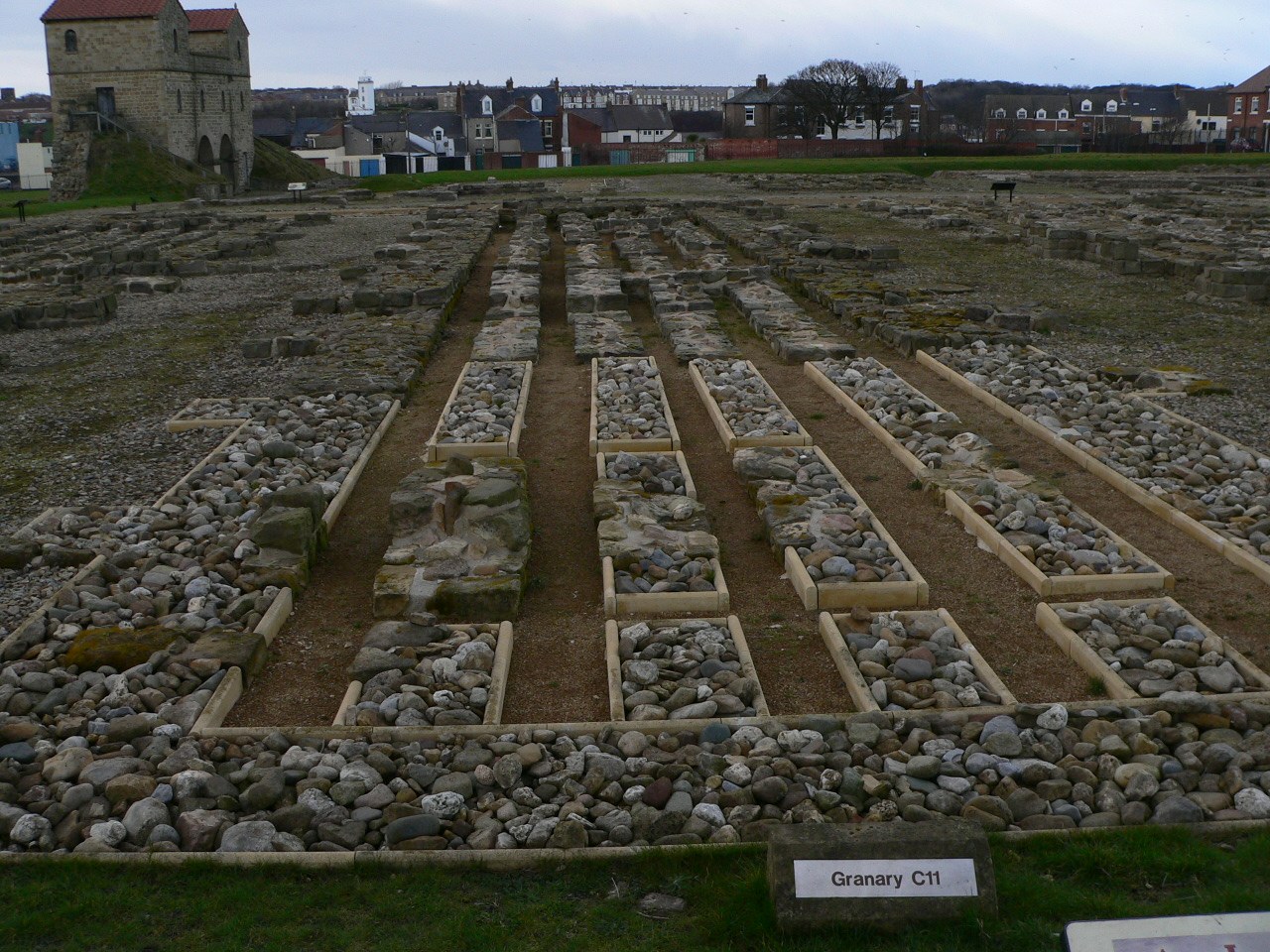 Granaries at Arbeia. The stone foundations belong to the phase when the fort became a supply base for the eastern sector of Hadrian's Wall.
The Second-Century Stone Fort
Around AD 163 a stone fort of about 1.67 hectares was built at South Shields. Its garrison combined infantry and cavalry, and the plan makes the barracks, gates, defensive ditches and internal streets readable. This mixed structure suited the control of river traffic and support for the frontier zone, not merely the defence of one stretch of wall.
The west gate, reconstructed in the modern museum over Roman remains, conveys the scale of the fort entrance. It is not an intact ancient building, but a scholarly reconstruction based on excavation and comparison with other Roman gates. Its value lies in clarifying the plan: street axes, tower positions, carriageways and the relationship between fortification and internal layout become visible.
Supply Base and the Severan Campaigns
In the early third century Arbeia was reorganised as a supply base. Around AD 205-207 many earlier buildings were demolished, the fort was enlarged to about 2.1 hectares, and stone granaries occupied the north-western part. Accommodation for the garrison remained to the south; the Fifth Cohort of Gauls is among the units associated with this period.
The rebuilding belongs to the context of the Severan dynasty and its Scottish campaigns of AD 208-210. Granaries, lead baggage sealings of the imperial household and the position on the maritime route show that Arbeia served more than a local garrison. It became a place where the army could receive, store and distribute supplies for the eastern sector of the Wall and for troops operating farther north.
This function explains why Arbeia should not be treated as an ordinary small fort. It shows the rearward side of the Roman army especially clearly: sea-borne grain, cargo control, protected stores, and the connection between harbour, garrison and roads to the Wall. Without this logistics, the northern frontier could not operate as a permanent military system.
Late Roman Arbeia
In the late third or early fourth century the fort suffered a fire or attack, followed by another rebuilding. Some southern granaries were converted into barracks, new accommodation was added, and a large commander's house appeared in the southern corner, with reception rooms, private quarters and a bath suite. The headquarters building was also altered while retaining links with the earlier plan.
The late phase is associated with a unit known as the numerus barcariorum Tigrisiensium, the Tigris Boatmen from the eastern provinces. The name Arbeia is usually explained in connection with this unit, as a "place of Arabs" or as a name reflecting the eastern identity of the garrison. Another tradition places an earlier name, Lugudunum, at the site.
After the formal end of Roman rule in Britain in the early fifth century, occupation did not vanish immediately. The archaeology records late changes to the gate, dismantling of some structures, pits and traces of violence. In the early medieval period the place still mattered for local power and memory, even though the Roman military system had collapsed.
Archaeological Material
The main evidence for Arbeia consists of the fort plan, building phases, granaries, inscriptions, funerary monuments, military equipment and everyday finds from the fort, vicus and cemeteries. These materials show different levels of the complex: official military architecture, storage systems, families and traders beside the garrison, contacts with the eastern provinces and ordinary daily life.
Stone monuments are especially important. The tombstone of Regina, wife of Barates of Palmyra, combines Latin and Palmyrene Aramaic inscriptions and shows how mixed the world of the northern frontier could be. Other inscriptions, altars and architectural fragments help us see not only a garrison as a military unit, but also the people who lived, traded, died and left memory around the fort.
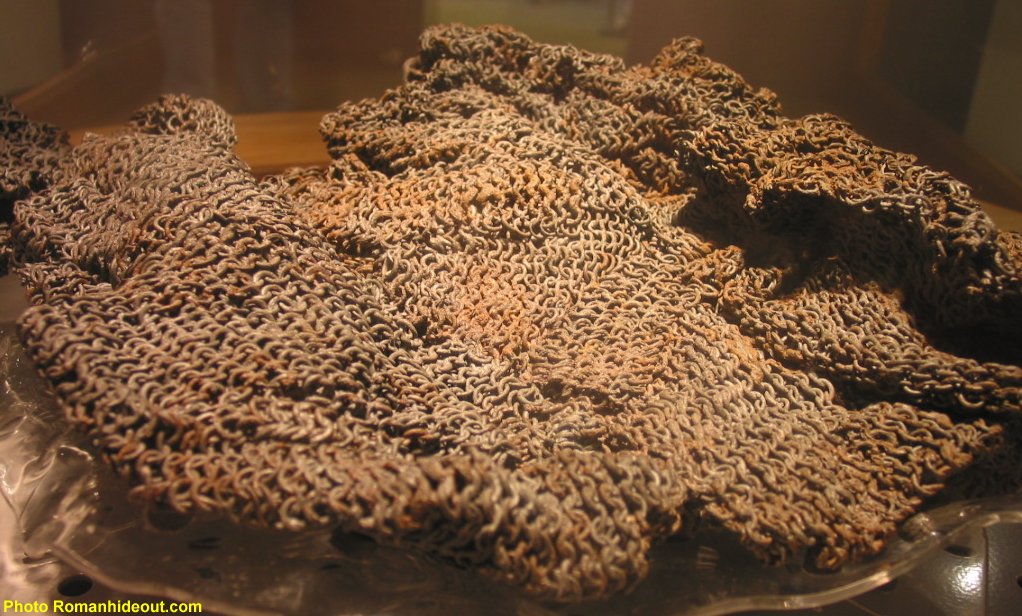 Fragment of Roman mail armour from the Arbeia Roman Fort and Museum, South Shields. 1st-2nd century AD.
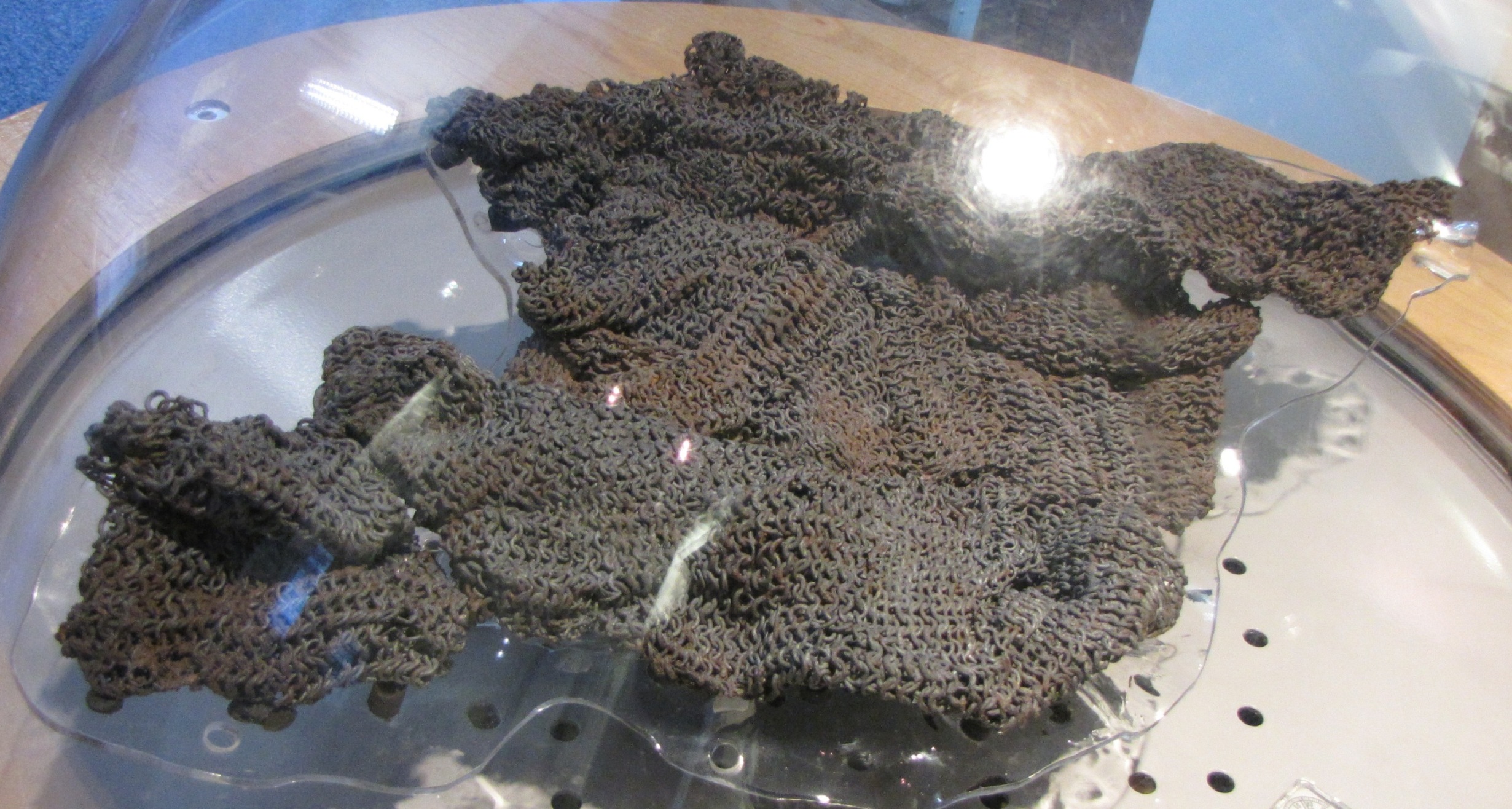 Detail of Roman mail armour from the Arbeia Roman Fort and Museum, South Shields. 1st-2nd century AD.
Chronology
- Before the Roman period - earlier occupation on the Lawe is attested, including Neolithic and Iron Age material.
- Before or around AD 122 - an early timber fort or associated settlement appears in the South Shields area.
- Around AD 122 - Hadrian's Wall is begun; the lower Tyne becomes part of the northern frontier system.
- Around AD 163 - a stone fort of about 1.67 hectares is built.
- Around AD 205-207 - the fort is reorganised as a supply base, with stone granaries.
- AD 208-210 - the Scottish campaigns of Septimius Severus increase Arbeia's importance as a rearward node.
- After AD 211 - the supply function continues for Hadrian's Wall and forts in its hinterland.
- Late third or early fourth century - fire or attack is followed by a late Roman rebuilding.
- Fourth century - the fort is associated with the Tigris Boatmen; the name Arbeia belongs especially to this late phase.
- Early fifth century and later - the Roman military system disappears, but the site continues to be used and reinterpreted.
Related Topics
Literature and sources
- Bidwell P., Speak S. Excavations at South Shields Roman Fort. Volume 1. Newcastle upon Tyne: Society of Antiquaries of Newcastle upon Tyne, 1994.
- Bidwell P., Hodgson N. The Roman Army in Northern England. South Shields: The Arbeia Society, 2009.
- Breeze D. J., Dobson B. Hadrian's Wall. London: Penguin Books, 2000.
- Breeze D. J. Handbook to the Roman Wall. Newcastle upon Tyne: Society of Antiquaries of Newcastle upon Tyne, 2006.
- Snape M. E. An Excavation in the Roman Cemetery at South Shields. Archaeologia Aeliana, Series 5, 22, 1994.
- Roman Inscriptions of Britain: inscriptions from South Shields / Arbeia.
- North East Museums: Arbeia, South Shields Roman Fort, site history and museum galleries.


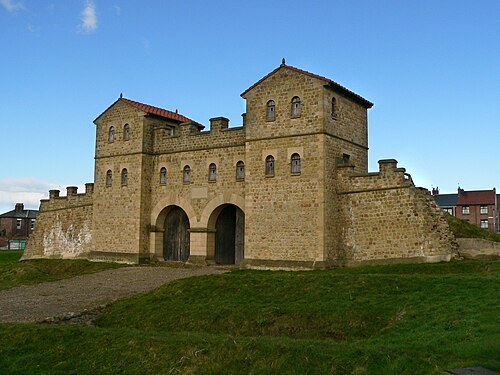 Modern reconstruction of the gate at Arbeia Roman Fort, South Shields.
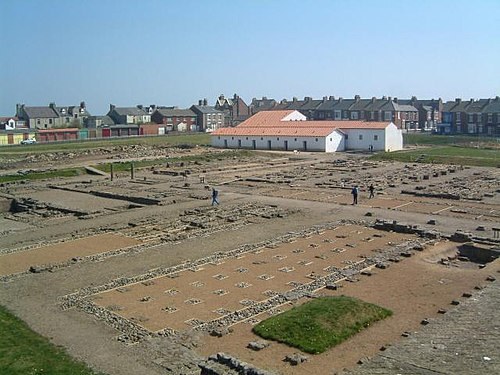 Arbeia Roman Fort, South Shields.
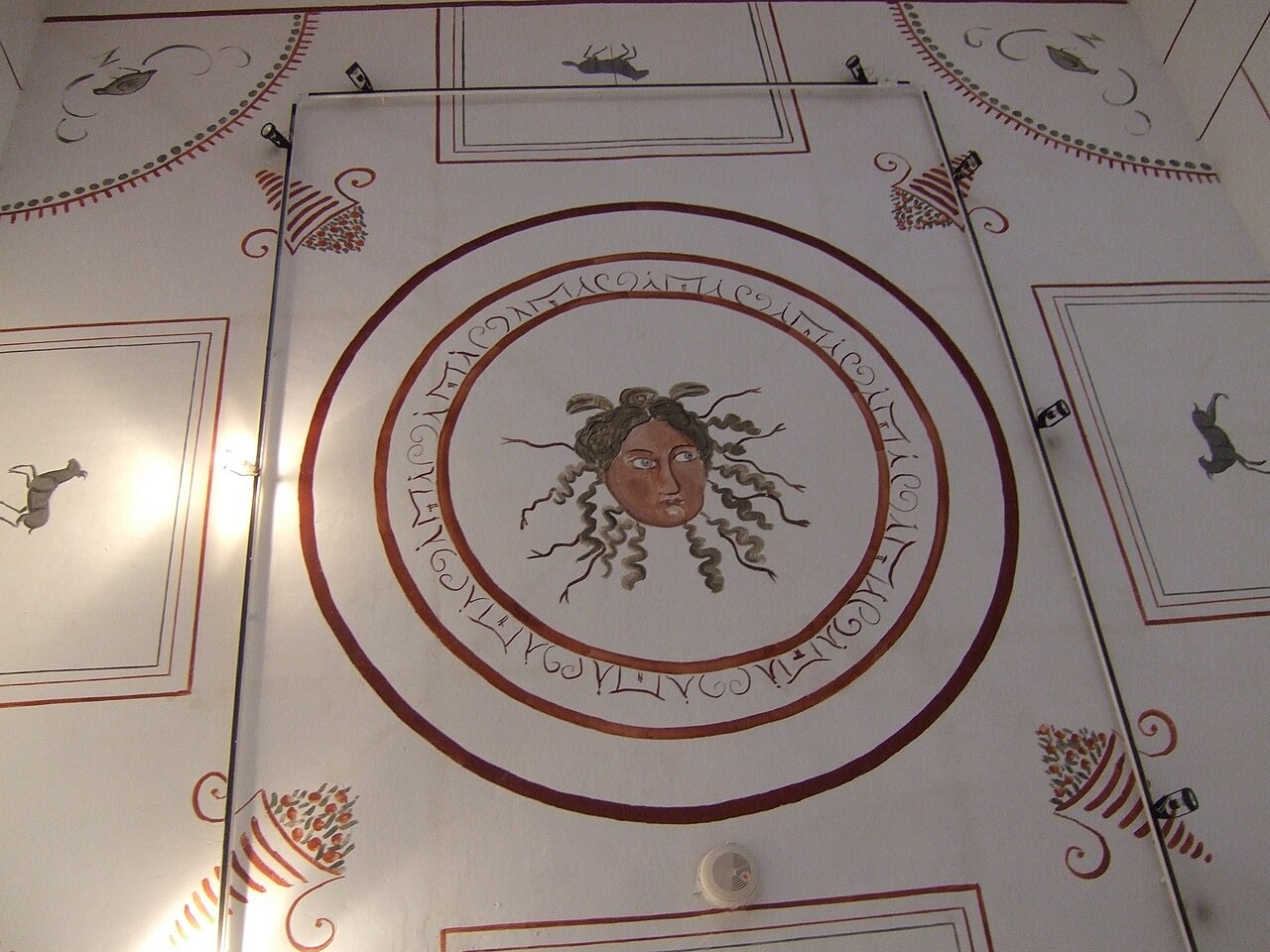 Wall painting in the museum complex at Arbeia Roman Fort.
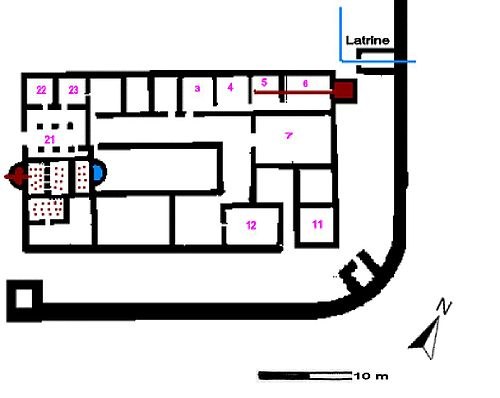 The commanding officer’s house in the Arbeia museum complex.
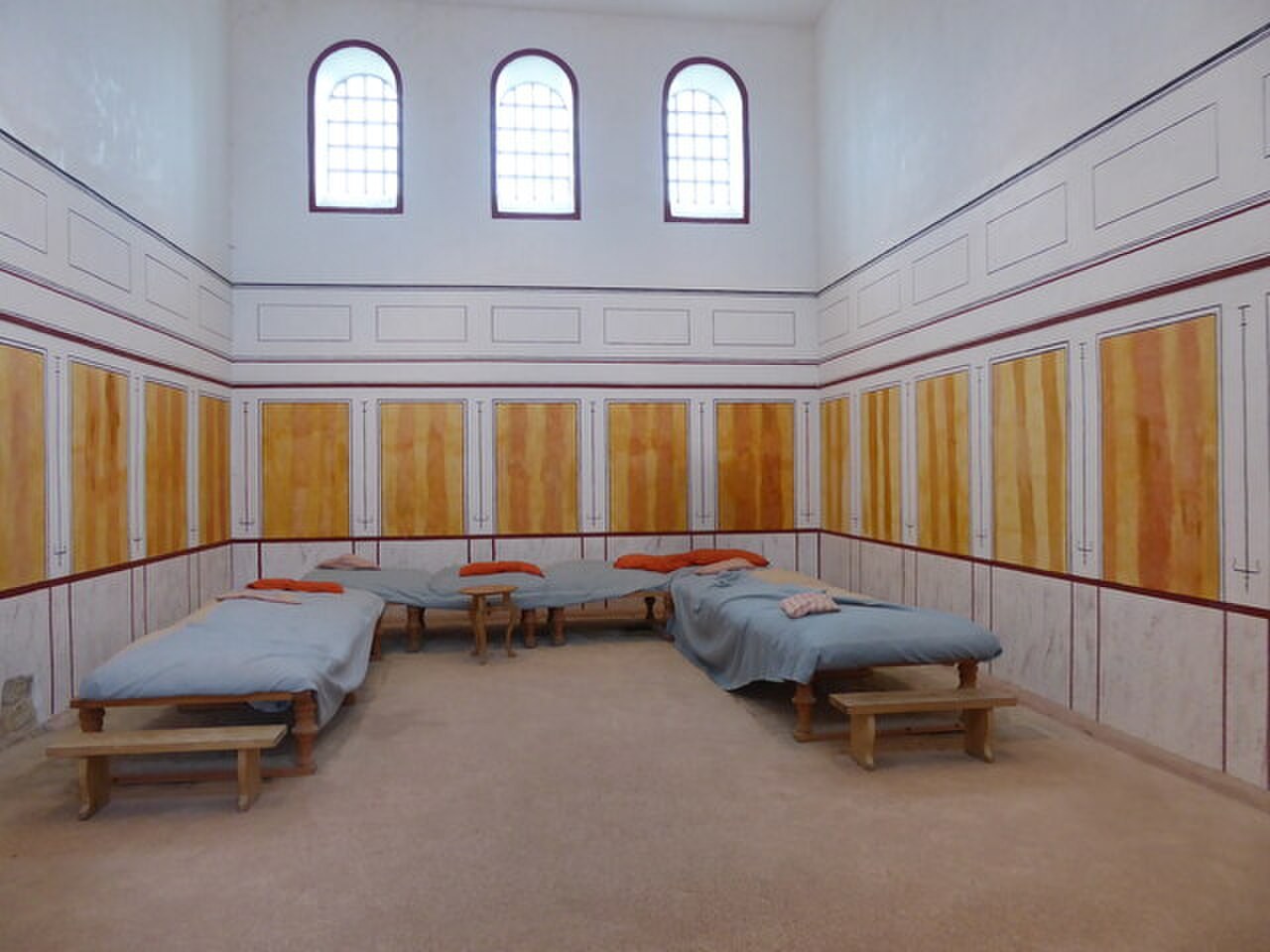 Room in the commanding officer’s house, Arbeia museum complex, South Shields.
 View of the Arbeia complex, South Shields.
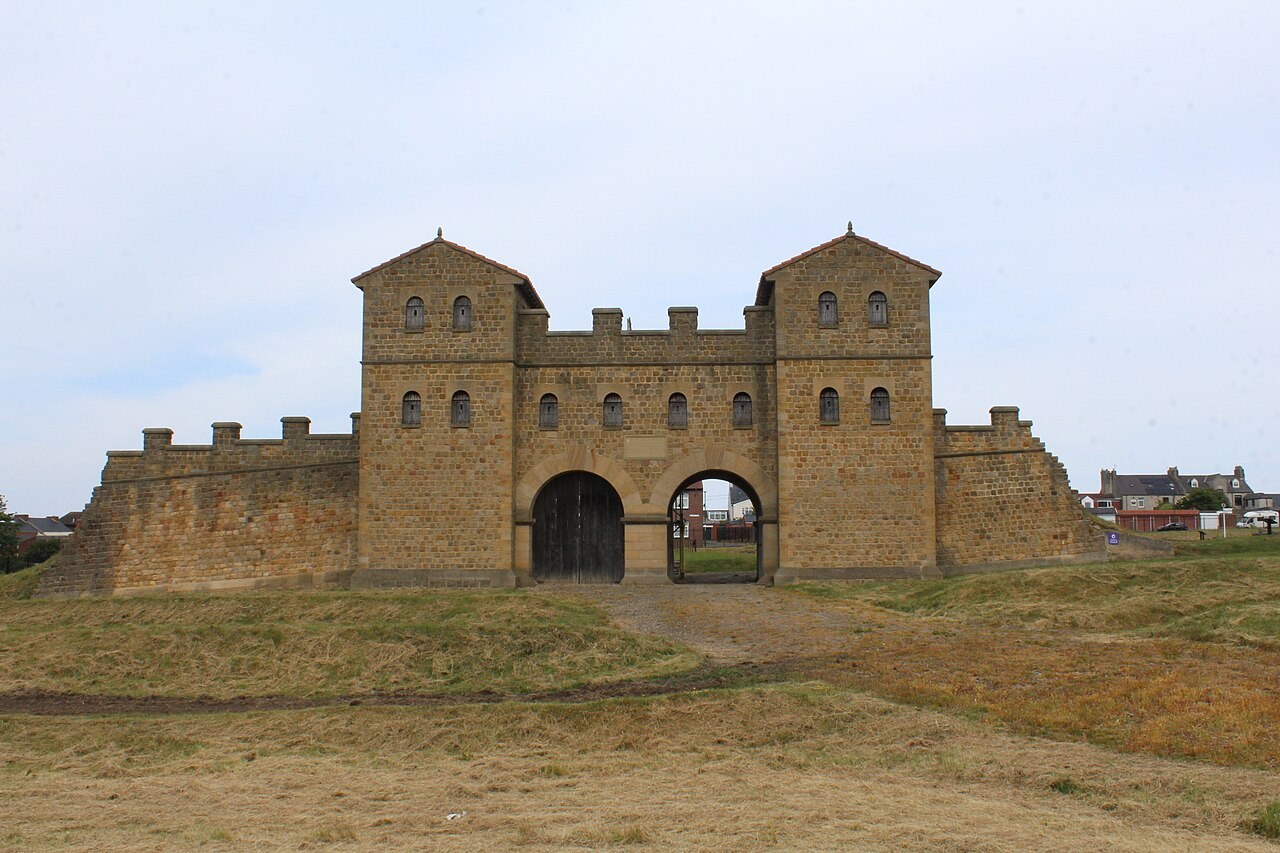 The Arbeia Roman Fort complex, South Shields.
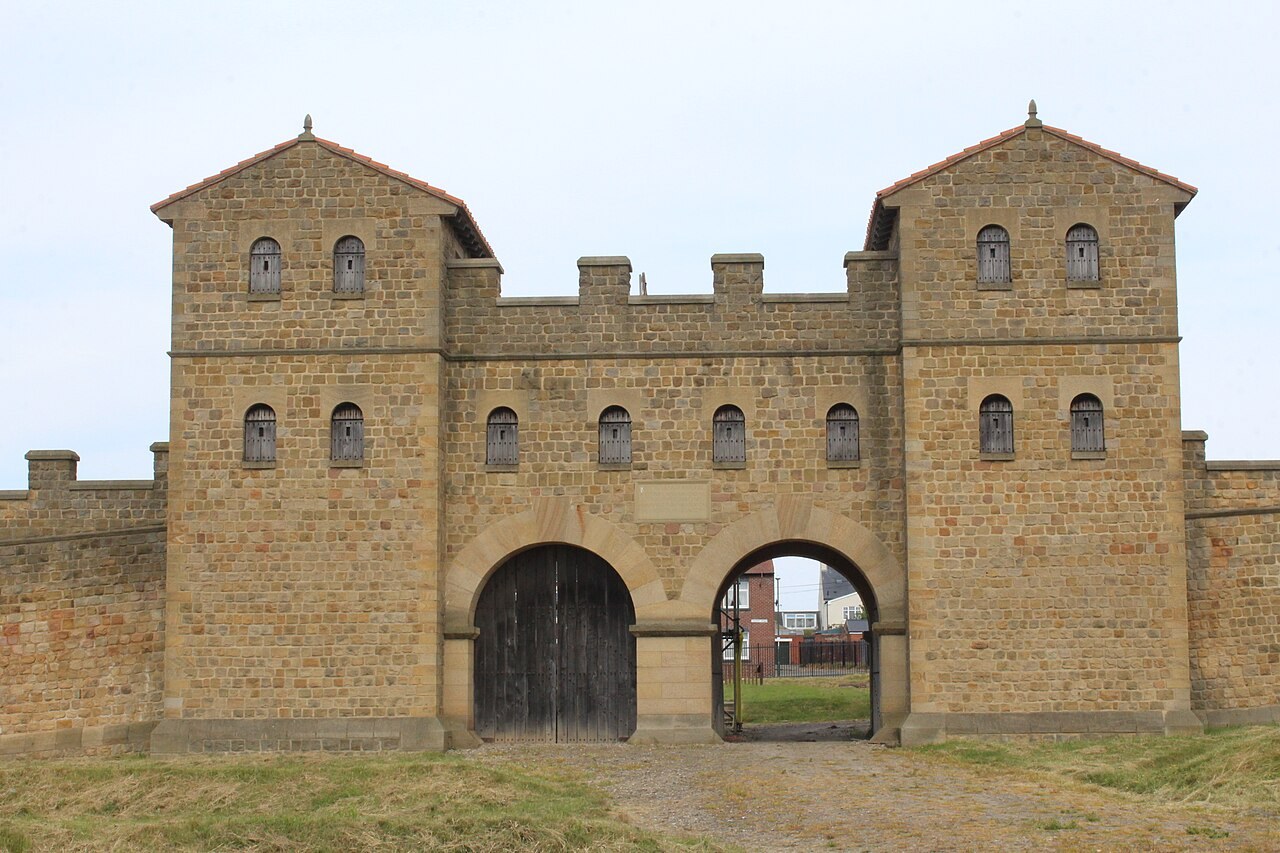 The Arbeia Roman Fort complex, another view. South Shields.
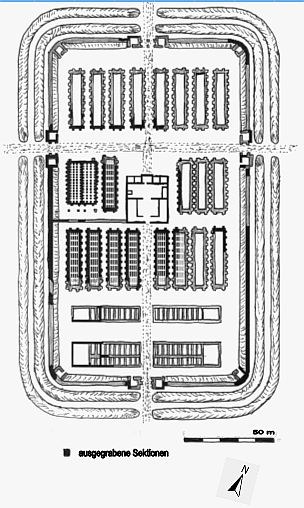 Plan of Arbeia around AD 210: the fort has been enlarged and adapted as a supply base with a series of granaries.
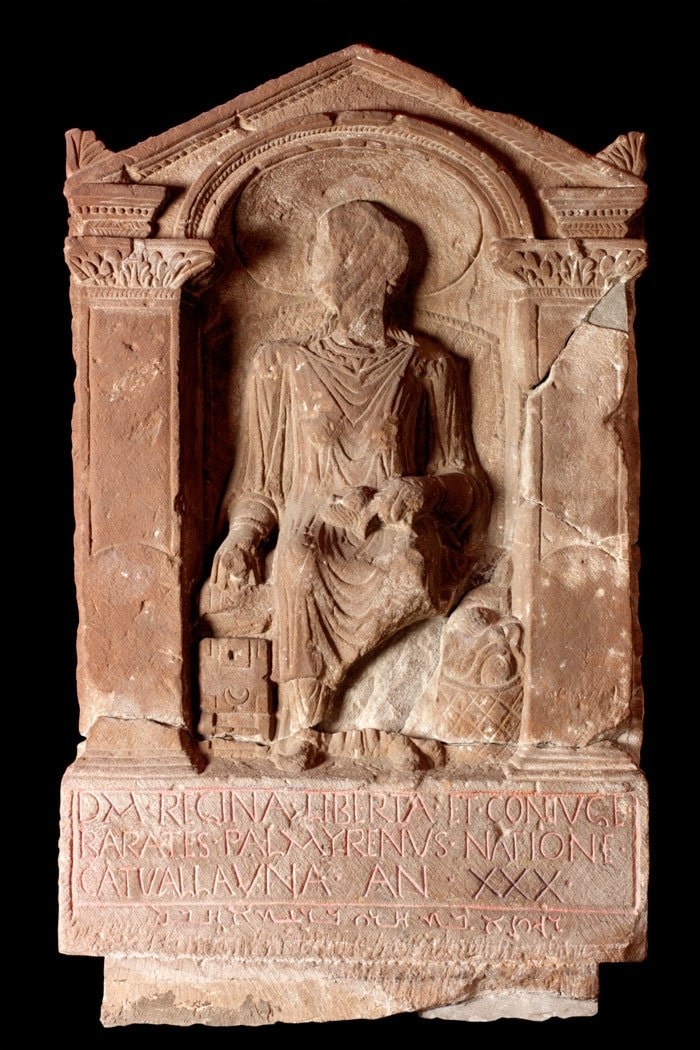 Tombstone of Regina from Arbeia: AN XXX in the Latin epitaph gives her age as 30; a Palmyrene Aramaic inscription appears below. Buff sandstone, second century AD; Arbeia Roman Fort and Museum, South Shields, inv. TWCMS: T765. RIB 1065.
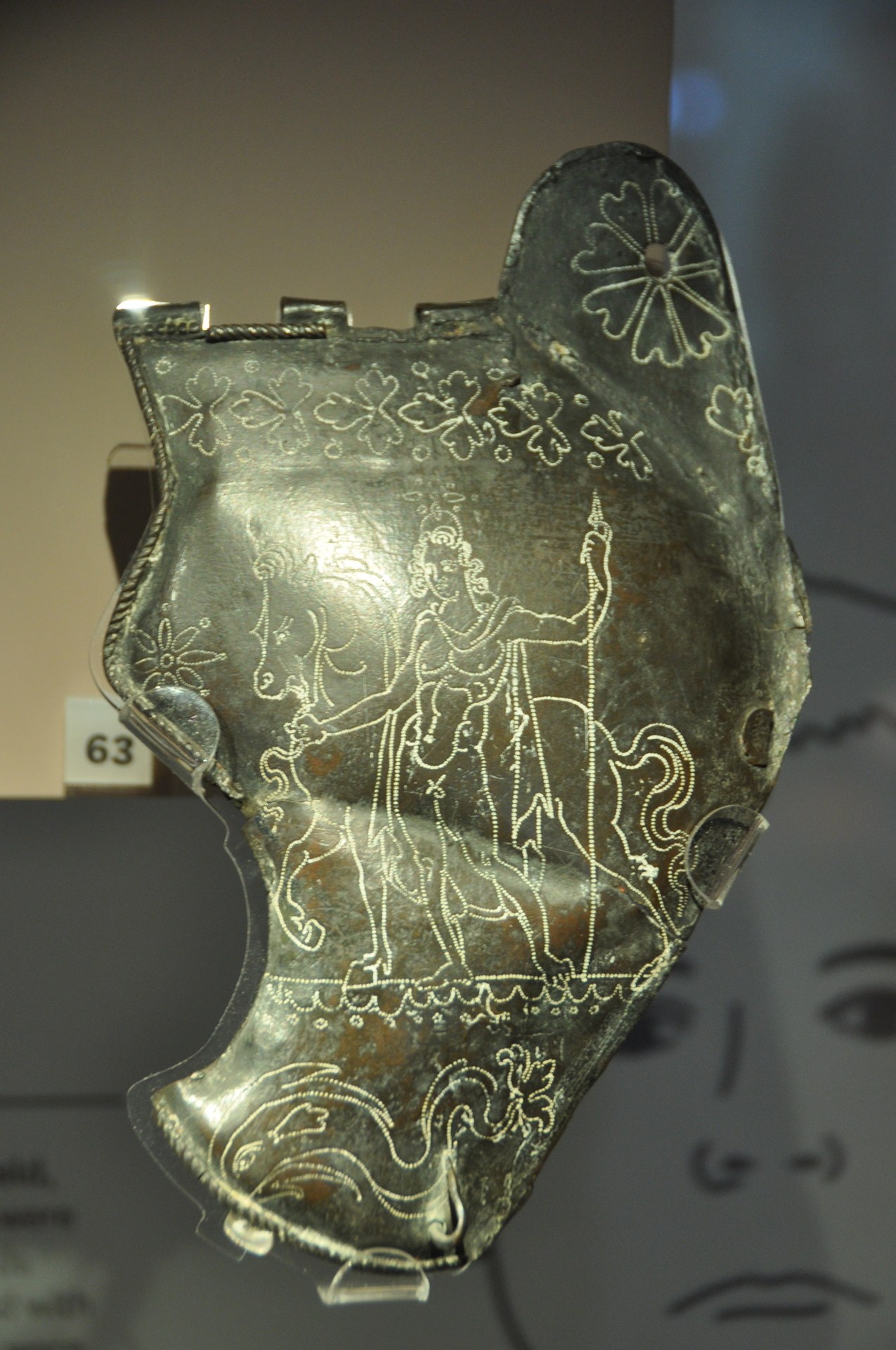 Bronze cheek-piece from a Roman helmet found at Arbeia. Roman period, second-third century AD; Arbeia Roman Fort and Museum, South Shields.
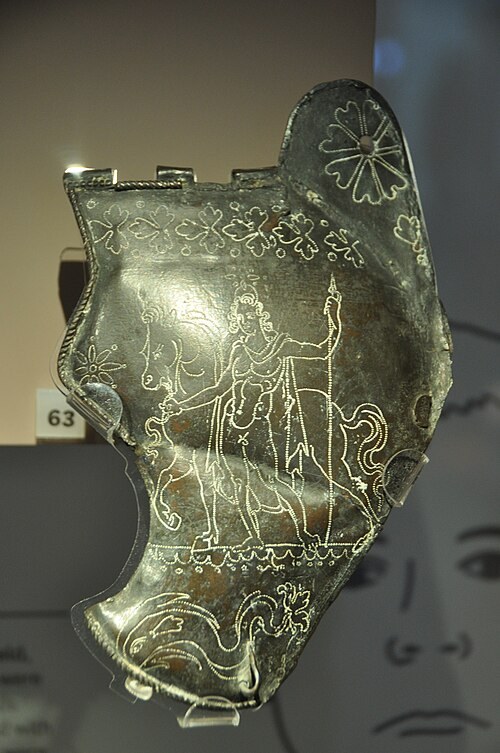 Helmet cheek-piece. Arbeia.
Interested in Ancient Rome beyond reading? Join Legio X Fretensis or explore our reenactment directions.


