Roman Army
The Roman army was Rome's armed force from the early citizen militia to the professional legions of the Principate and the Late Roman armies of the Dominate. It included legions, allied and auxiliary troops, the fleet, engineers, baggage trains, command staffs and a developed system of military camps. In brief: - the main unit of the classic army was the legion; - a legion was divided into cohorts, centuries and contubernia; - auxiliaries, cavalry, the fleet and specialists served alongside the legions; - the army's strength rested not only on weapons, but also on discipline, roads, camps, supply and provincial administration.
Topic guide
In brief
| Question | Answer |
|---|---|
|
What it was |
Rome’s armed forces from the early citizen militia to the late antique army. |
|
Core unit |
In the classical period the main unit was the legion, supported by auxilia. |
|
Why it changed |
The army changed with Roman society, frontiers, taxation, supply and enemies. |
Composition and organisation
| Level | Meaning | Read next |
|---|---|---|
|
Legion |
A large heavy-infantry formation with its own command structure. |
|
|
Cohort and century |
The main internal subdivisions of a legion. |
|
|
Soldiers and auxiliaries |
Legionaries, auxiliaries, commanders and specialists. |
Timeline
| Period | Army model | What changed |
|---|---|---|
|
Early Republic |
Citizen militia. |
Military service is tied to citizen property status. |
|
Late Republic |
Professionalisation and long campaigns. |
Commanders and standing armies become more important. |
|
Principate |
Legions, auxilia and permanent garrisons. |
The army becomes anchored on the imperial frontiers. |
|
Late Empire |
Field armies and frontier troops. |
Comitatenses and limitanei appear. |
Key articles
- Legion
- Legionary
- Cohort
- Century
- Recruitment in the Roman army
- Roman army helmets
- Gladius, pilum, scutum
- Lorica segmentata
- Castrum
- Roman numerals in legion names and inscriptions
FAQ
Was the Roman army always the same? No. The early Republican army, Caesar’s armies, the army of the Principate and late Roman armies differed substantially.
How many men were in a legion? Strength varied by period and by the condition of the unit. For the classical period it is usually several thousand soldiers, but the exact number depends on context.
Where should I start? Start with the legion, cohort and century, then move to equipment, recruitment and individual legions.
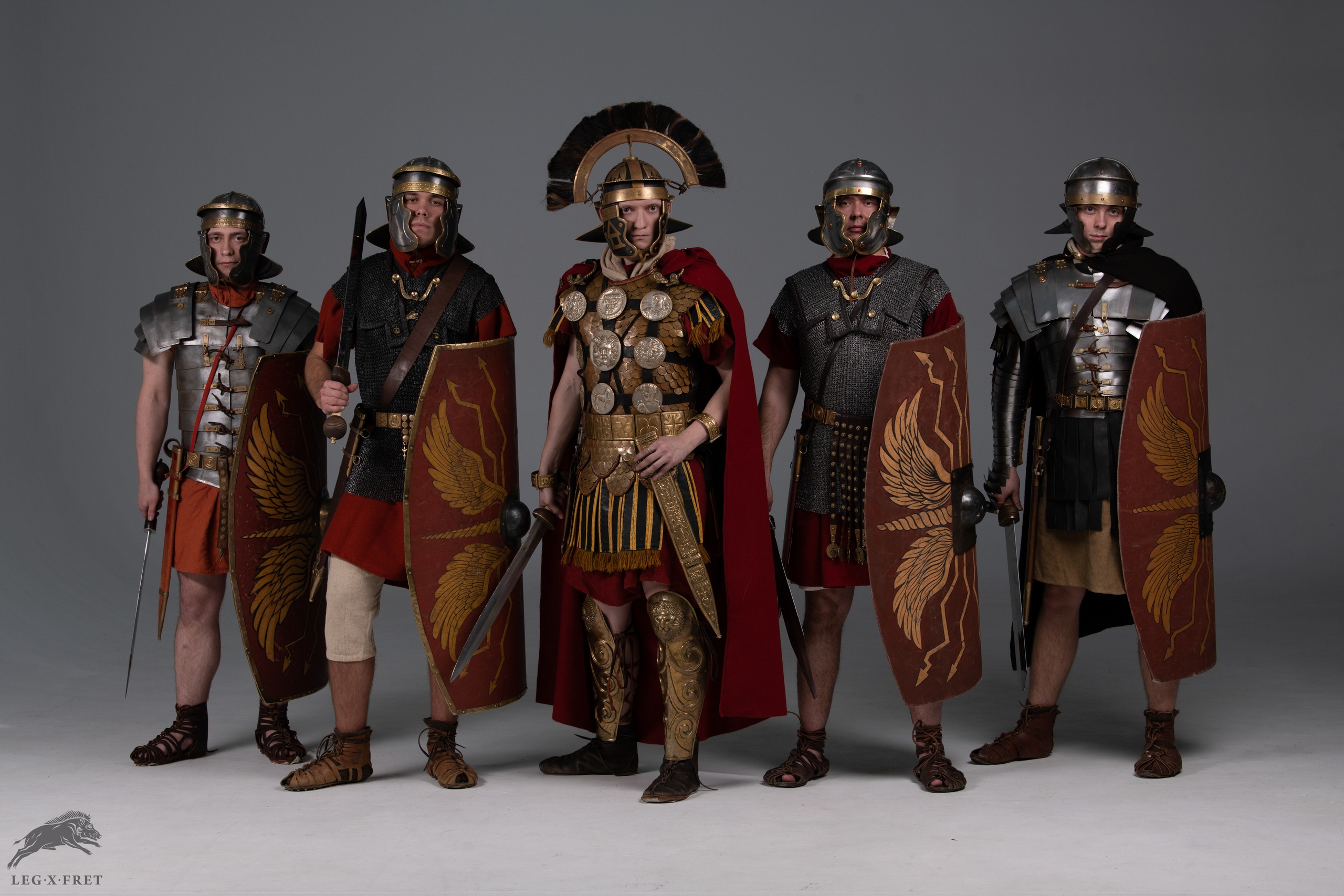 Legionnaires of Legio X Fretensis. Reconstruction
Army structure
Under the Principate the Roman army was built around legions and auxiliaries. A legion was a heavy infantry formation of citizens; its soldiers were legionaries. Inside the legion the main levels were the contubernium,century and cohort. They were commanded by decani, centurions, tribunes and a legate. The auxilia supplemented the legions with cavalry, light infantry, archers, slingers and specialized contingents. After service many auxiliaries received Roman citizenship. Alongside the land forces, the navy protected communications, transport and river frontiers.
Command and ranks
The command system combined political and professional elements. A legion was usually led by a legate, while everyday discipline and combat training depended heavily on the centurions. Within a century the optio, tesserarius and other junior officers played important roles. Standard-bearers — aquilifer, signifer, imaginifer and vexillarius — guarded the military standards and the sacred identity of the unit. Special units such as the Praetorians had political importance because they stood close to the emperor. In the Late Empire the structure changed: field armies, frontier troops, comitatenses, limitanei and new command posts appeared.
Equipment, camps and supply
The Roman army is often associated with the gladius,pilum,scutum and armour such as lorica segmentata,hamata,squamata and helmets. In practice, equipment depended on period, region, unit type and supply. Infrastructure mattered just as much. The castrum allowed the army to create a protected camp quickly, roads accelerated marching and supply, and engineers built bridges, fortifications and siege engines. The Roman army was therefore not only a fighting force, but also an instrument of construction, territorial control and the Romanization of provinces.
Periods of development
I. Republic The early army was a citizen militia. During the Republic, manipular tactics and allied contingents developed, followed by the professionalization of the late Republic and reforms associated with Gaius Marius. II. Principate After Augustus, the legions became a permanent professional army stationed on the frontiers of the empire. They were supported by auxiliaries, the fleet and a network of military camps. III. Late Empire After the third-century crisis the army became more fragmented and flexible. For soldiers of this period, see Soldiers of the Roman Empire in the Dominate.
Related topics
I. Organization - Legion - List of Roman legions - Legionary - Cohort - Century - Contubernium - Centurion - Legate II. Units and services - Auxilia - Praetorians - Ancient Roman navy - Castrum III. Equipment - Roman army helmets - Scutum - Gladius - Pilum - Lorica segmentata - Lorica hamata - Lorica squamata
Literature and sources
Ancient sources 1. Polybius. The Histories. 2. Julius Caesar. Commentaries on the Gallic War. 3. Vegetius. Epitoma Rei Militaris. Modern studies 1. Adrian Goldsworthy. The Complete Roman Army. 2. Lawrence Keppie. The Making of the Roman Army. 3. M. C. Bishop, J. C. N. Coulston. Roman Military Equipment. 4. Yann Le Bohec. The Imperial Roman Army.
Interested in Ancient Rome beyond reading? Join Legio X Fretensis or explore our reenactment directions.


