Dura-Europos
Dura-Europos was an ancient city on the Middle Euphrates in modern Syria. It was founded in the Hellenistic period, lived under the Seleucids and Arsacids, and in the Roman period became one of the most important frontier points on the eastern line of the Roman Empire. Its history ended abruptly: in the mid-third century the city was taken by the Sasanians and was not rebuilt as a major centre. For that reason many buildings, paintings, documents and pieces of military equipment survive as a cross-section of the city's final generation.
The special value of Dura-Europos lies in the combination of different worlds. One fortified city contained a Greek urban grid, Parthian and Palmyrene traditions, a Roman garrison, temples of local and eastern gods, a painted synagogue, a Christian house with a baptistery, and documents in Greek, Latin, Aramaic and other languages. For military history the key evidence includes shields, scale armour, organic material, horse equipment, towers and siege traces; for cultural history, the city shows how different communities shared one urban space.
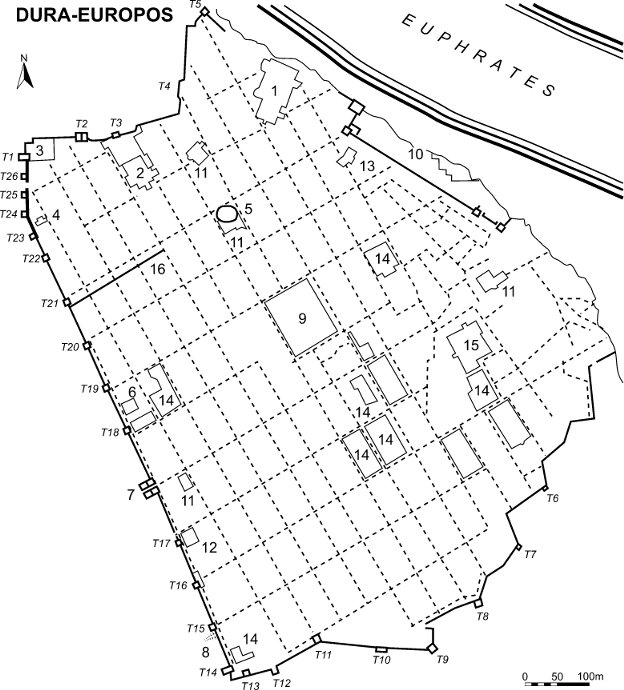 Plan of Dura-Europos: palace of the dux ripae, headquarters, Temple of the Palmyrene Gods, Mithraeum, amphitheatre, synagogue, Palmyrene Gate, siege ramp, agora, citadel, baths, Christian building and military boundary wall. Plan by Mike Bishop /.
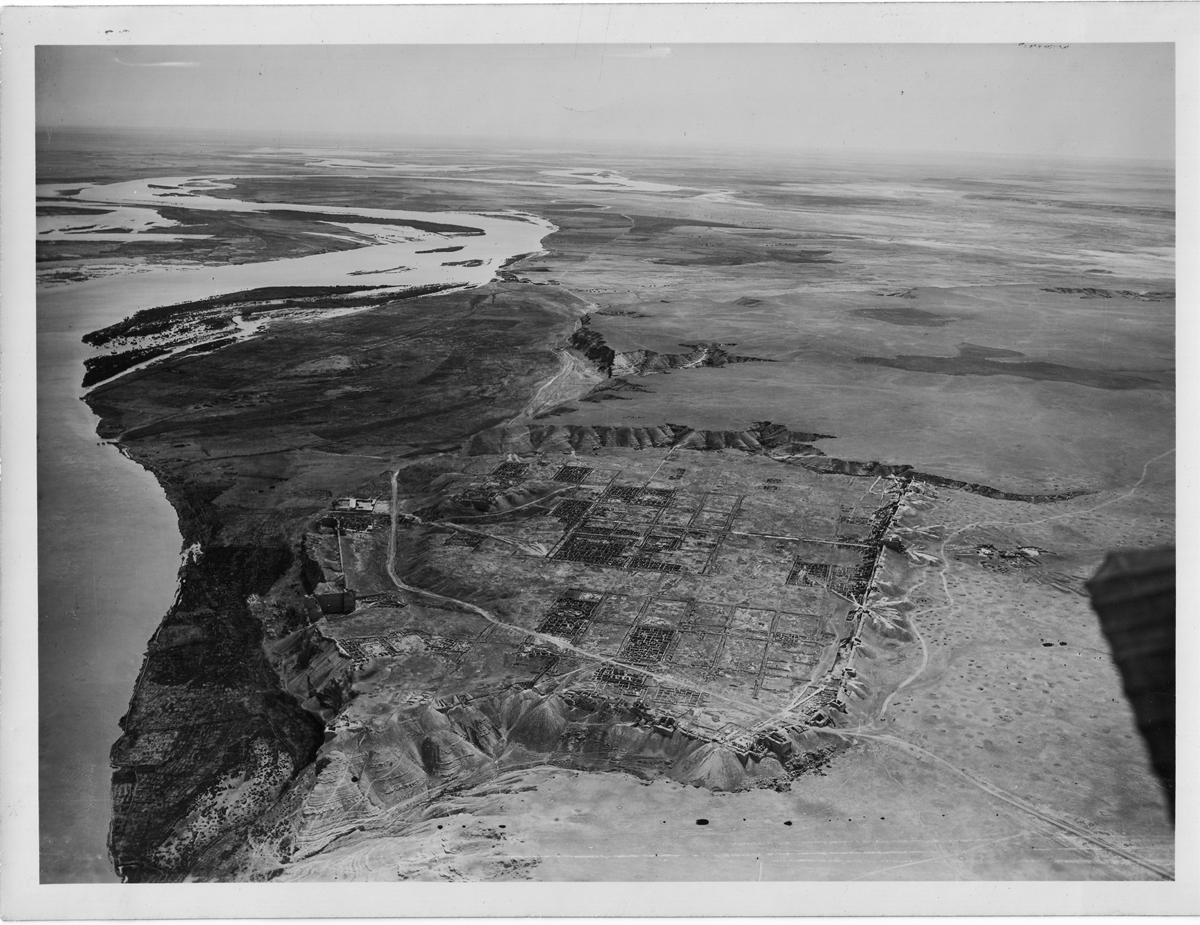 Aerial view of Dura-Europos in the late 1930s. The photograph shows the street grid, western defences and the site's position above the Euphrates. Yale-French Excavations /.
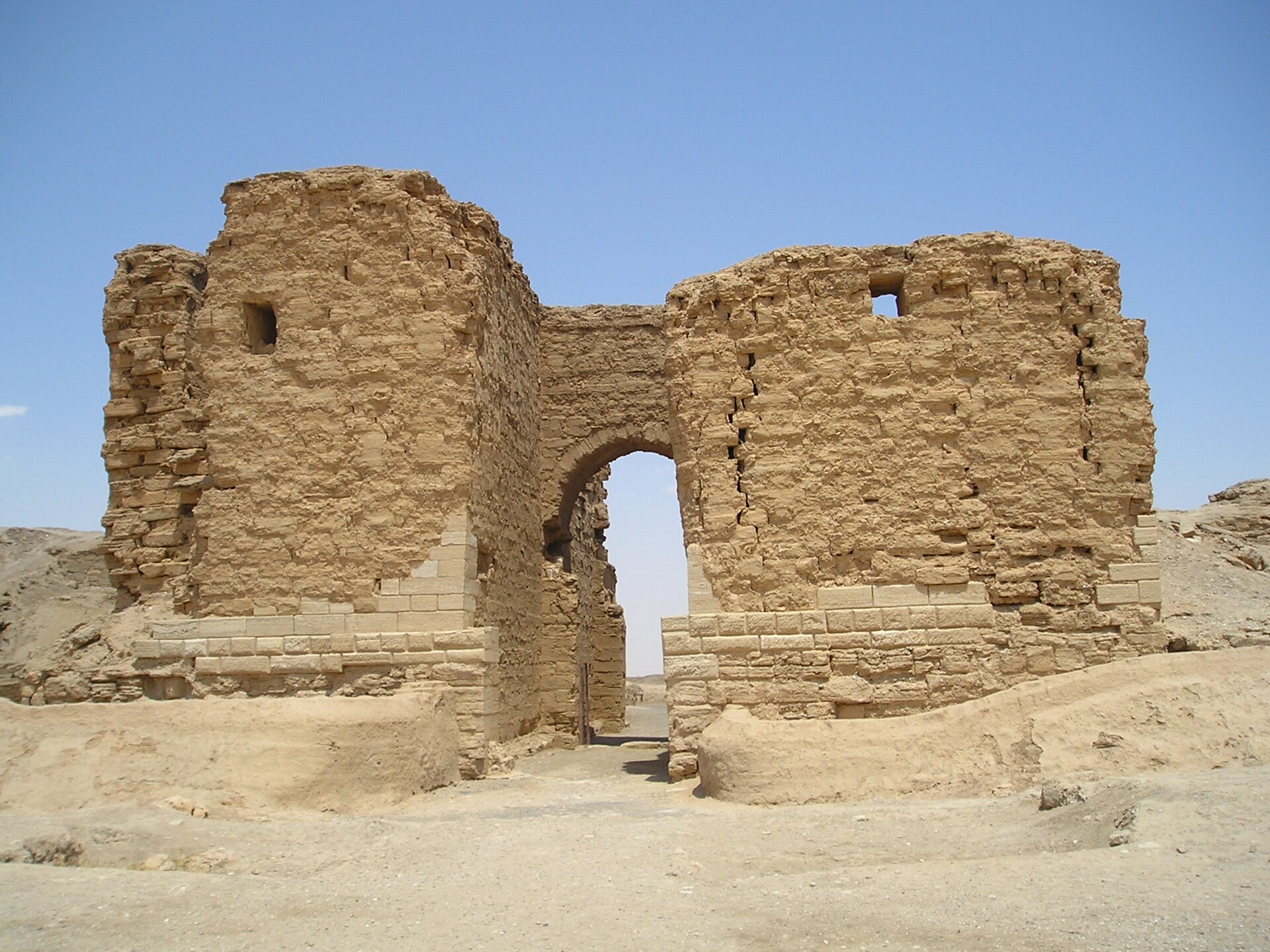 The Palmyrene Gate of Dura-Europos. The gate connected the urban plan with routes of eastern Syria and the Palmyrene cultural environment.
City on the Euphrates
The city stood high above the Euphrates, near routes between Syria, Mesopotamia and the desert roads toward Palmyra. Its foundation is usually connected with the early third century BC and Seleucid colonisation: the name Europos recalled Macedonian memory, while the street grid, blocks, agora and fortifications expressed a Hellenistic urban form. Yet Dura was not a Greek island in a foreign land. From the Hellenistic and Parthian periods onward, local, Mesopotamian, Iranian and Palmyrene connections all met there.
In the second century BC the city came under Arsacid power. The Parthian phase did not erase the Greek plan, but it changed the social and cultural composition: families and cults connected with Palmyra, Aramaic-speaking circles and eastern traditions became more prominent. Temples, inscriptions, names and artistic forms show not a replacement of one culture by another, but a long layer of coexistence. Dura remained a frontier and trading point where command of river and road mattered more than a decorative classical shell.
The Romans took control of the city after the eastern wars of the mid-second century AD, usually connected with the campaign of Lucius Verus against Parthia. From then on Dura was not merely a town on a trade route, but part of the military system on the Euphrates. Roman units were stationed there, administration operated there, military buildings were constructed, and the older urban fabric adapted to the presence of a garrison. The Roman period did not erase the local environment; it made the city still more multilingual and diverse.
Garrison, Fortifications and Siege
Roman Dura-Europos was a fortified city, not an isolated camp. The military quarter occupied the northern part of the city, close to the western wall and key gates. Documents and finds reveal the world of the Roman army: auxilia units, cavalry, archers, clerks, suppliers, craftsmen and local inhabitants serving the garrison. Among the known units the Twentieth Palmyrene Cohort is especially important, linking the garrison to the eastern military environment and to archers.
The material from Dura-Europos is unusual because it preserved more than metal and stone. The dry climate, defensive fills along the walls and the abrupt end of occupation produced painted shields, wooden and leather parts, textile fragments, scale armour, horse protection and documents. For the scutum and other shields this is especially important: most Roman shields are known from images and rare fragments, whereas at Dura form, boards, curvature and some paint survived.
The final major episode in the city's history was the Sasanian siege around AD 256/257. The western defensive line was strengthened by an internal embankment: it covered buildings along the wall, including the synagogue and Christian building, and thus preserved their paintings. Near Tower 19 excavators found mines, countermines and the remains of defenders; this area became one of the major archaeological witnesses to siege engineering on the eastern frontier. After the capture the city did not return to its former life, turning destruction into a rare archaeological snapshot of the Late Roman Euphrates.
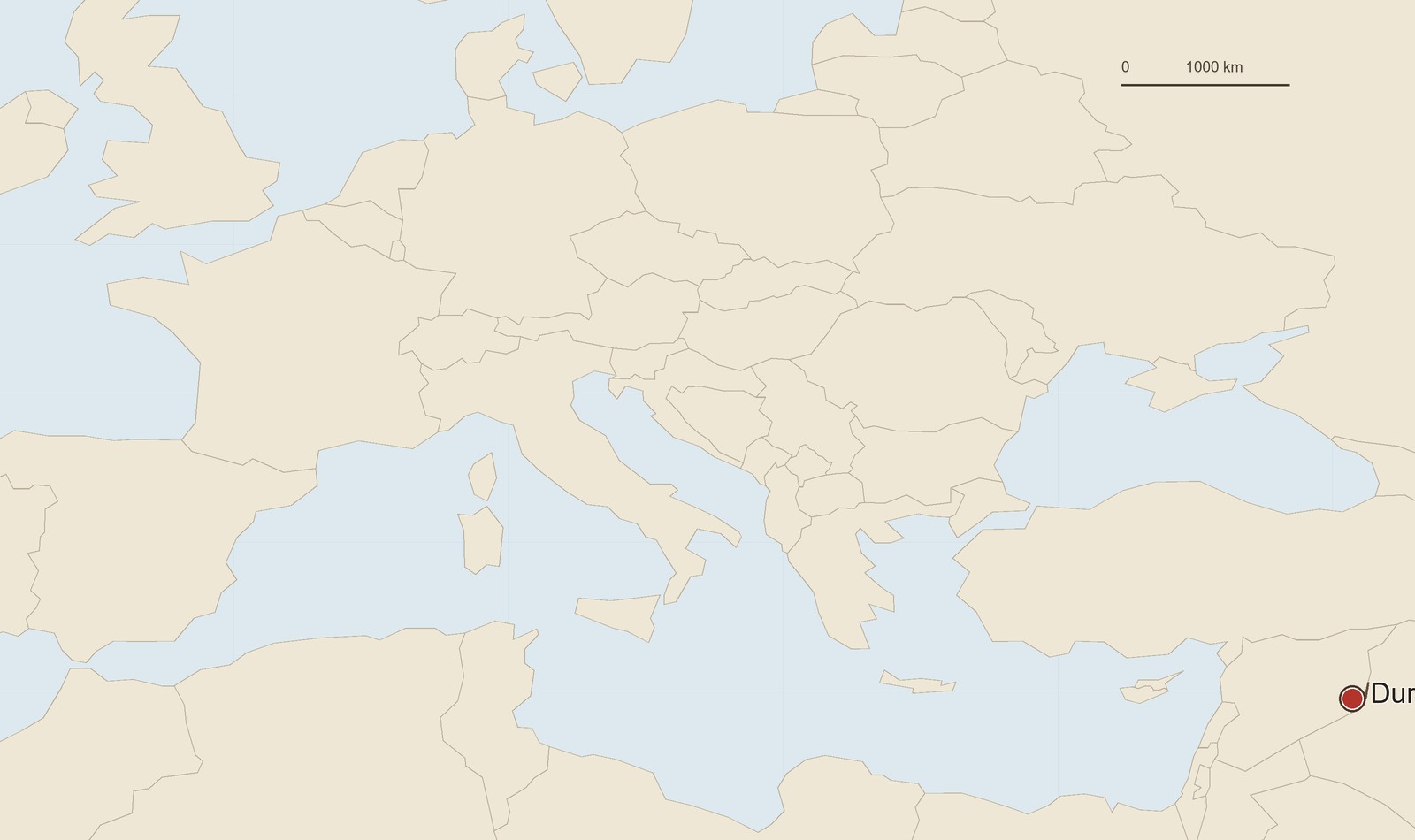 Location map: Dura-Europos. The marker shows the ancient site or main archaeological complex.
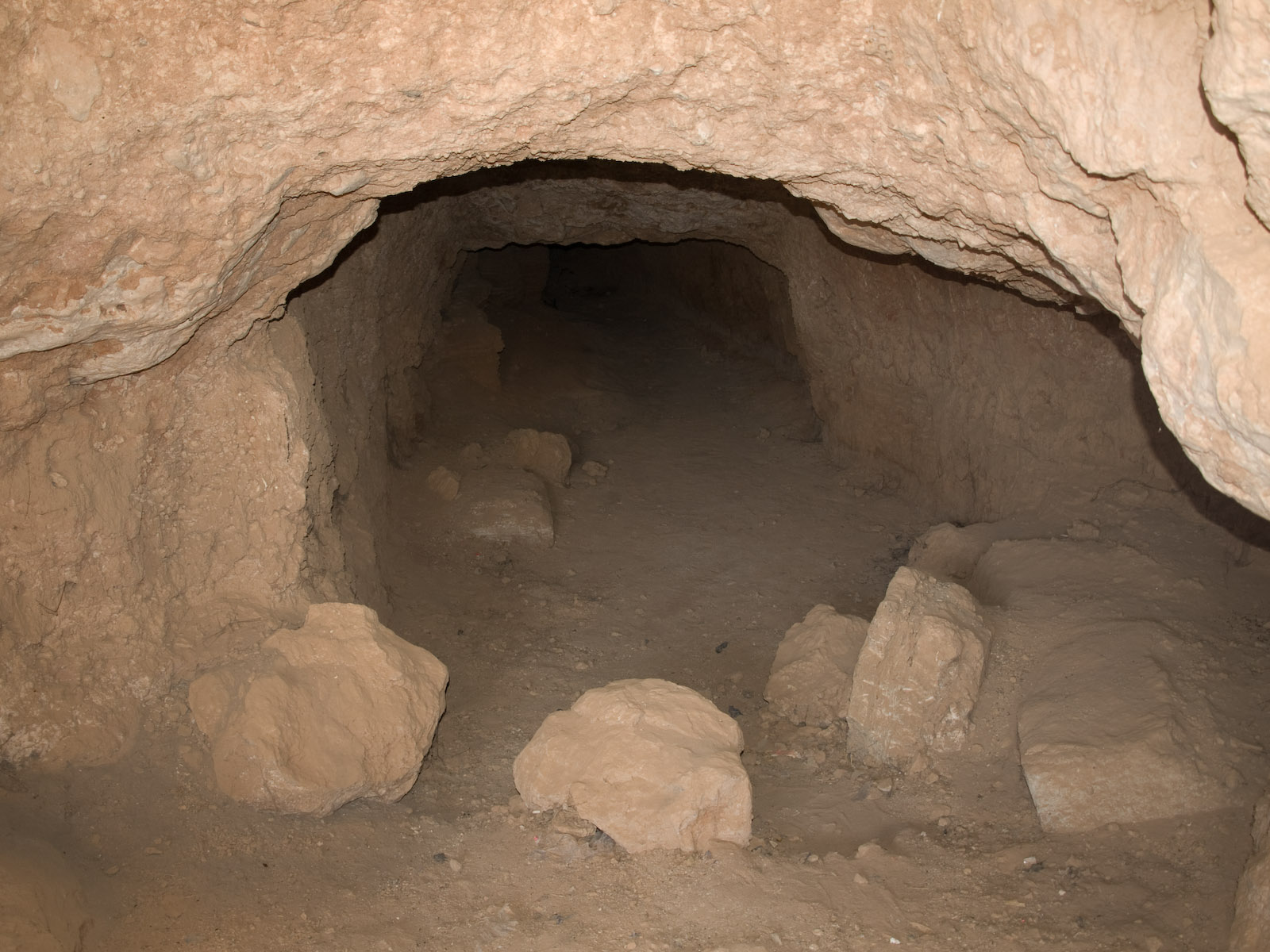 The Roman countermine near Tower 19 at Dura-Europos. The underground works belong to the mid-third-century siege and to the clash between Roman defence and Sasanian sappers.
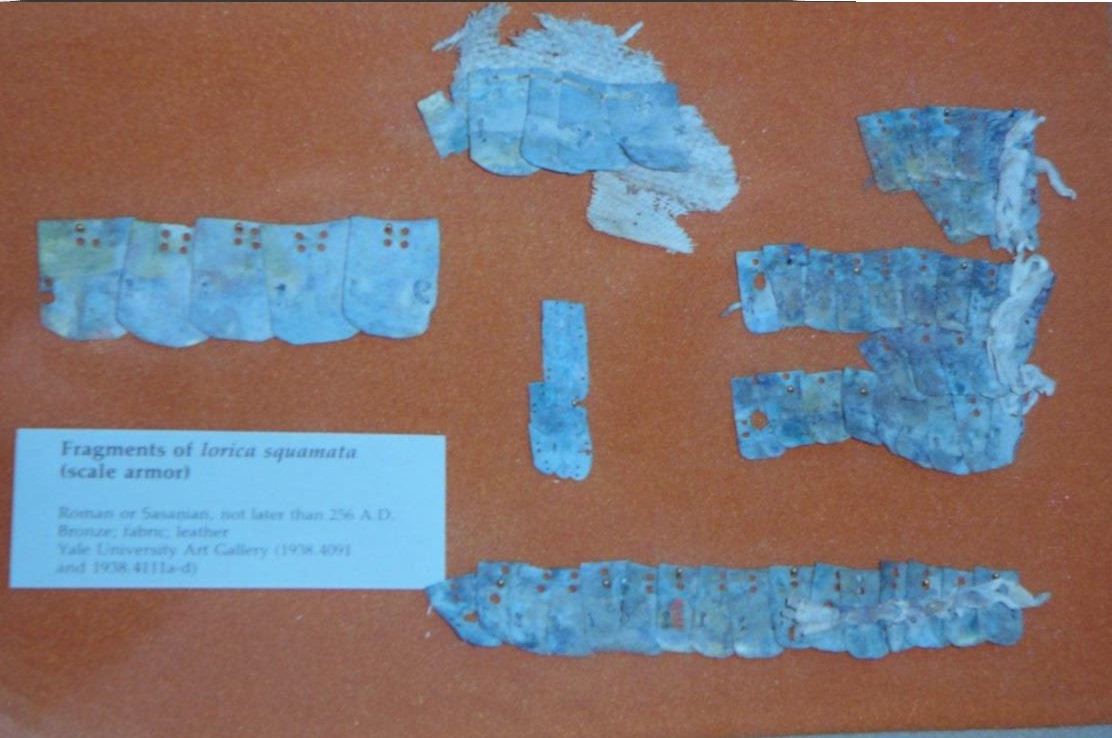
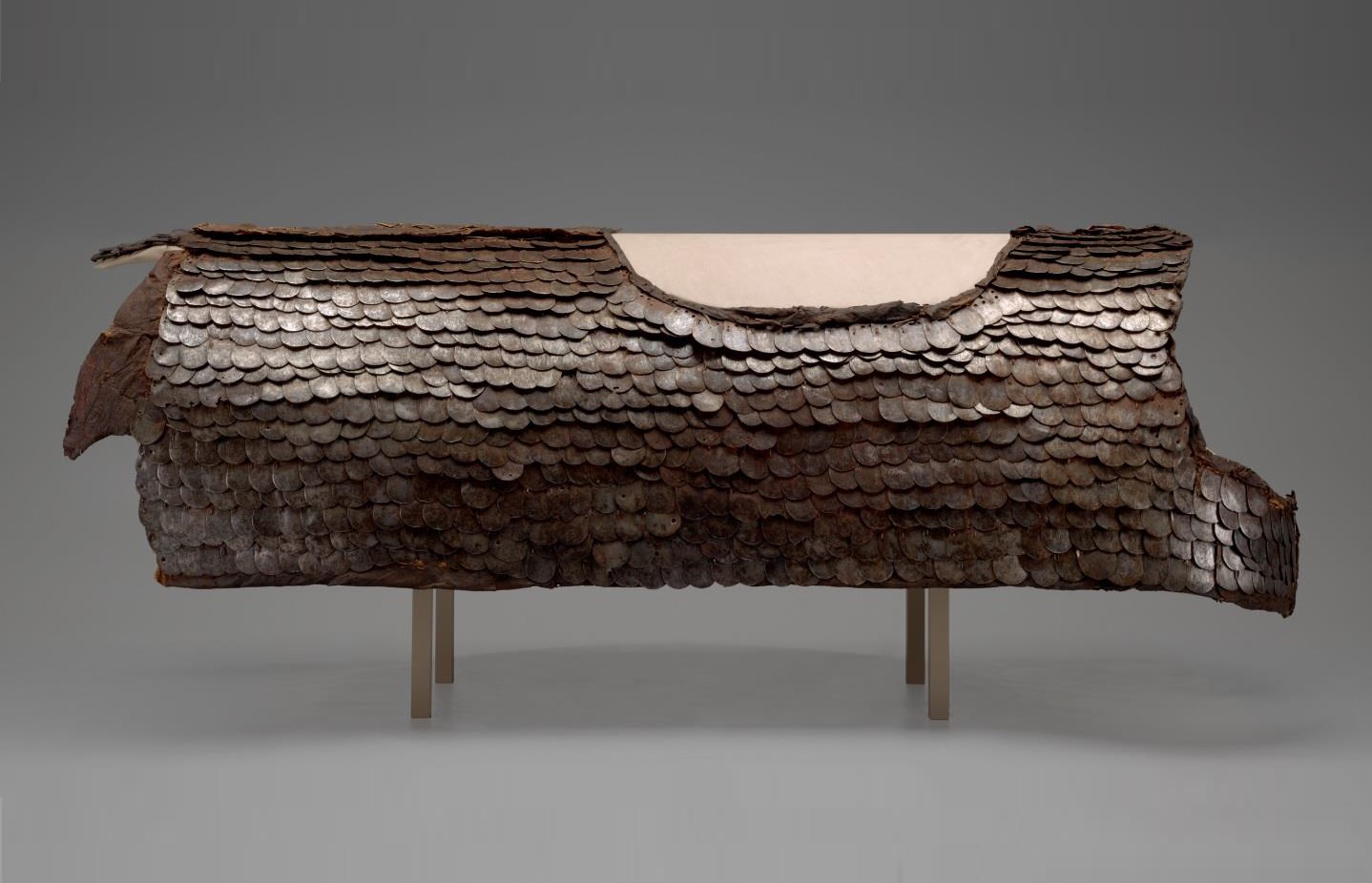 Scale armour from Dura-Europos. The preserved section shows how small plates were joined into flexible body protection.
Temples, Synagogue and Christian Building
The religious landscape of Dura-Europos cannot be reduced to one cult or one community. The city contained sanctuaries of Zeus Kyrios, Artemis, Atargatis, Adonis, the Palmyrene gods, a military temple, a Mithraeum and other cult spaces. Dura provides evidence for temple life in a city where temple life combined local, Greek, Roman and eastern forms. Dedications and paintings show not abstract "mixture", but specific people: soldiers, Palmyrenes, families, priests and townspeople.
The Dura-Europos synagogue was discovered during the 1932-1933 excavation seasons. Its final phase is dated to AD 244/245 by an Aramaic inscription, and its walls preserved an extensive cycle of biblical paintings. It is one of the most important monuments of Late Antique Jewish art: it shows that images could occupy a major place in communal space, even though later tradition is often imagined as stricter toward figural painting. The survival of the paintings resulted not from peaceful conservation but from the defensive fill laid against the wall before the siege.
The Christian building, located near the synagogue, was an ordinary private house adapted for gatherings. Its baptistery is especially important, with paintings of the Good Shepherd, Adam and Eve and other scenes. For Christianity in Antiquity it is an early example of a community using domestic space before the age of large church basilicas. Nearby, the Mithraeum shows another side of religion in a garrison city: mystery and military cults existed in the same quarters as Jewish and Christian monuments.
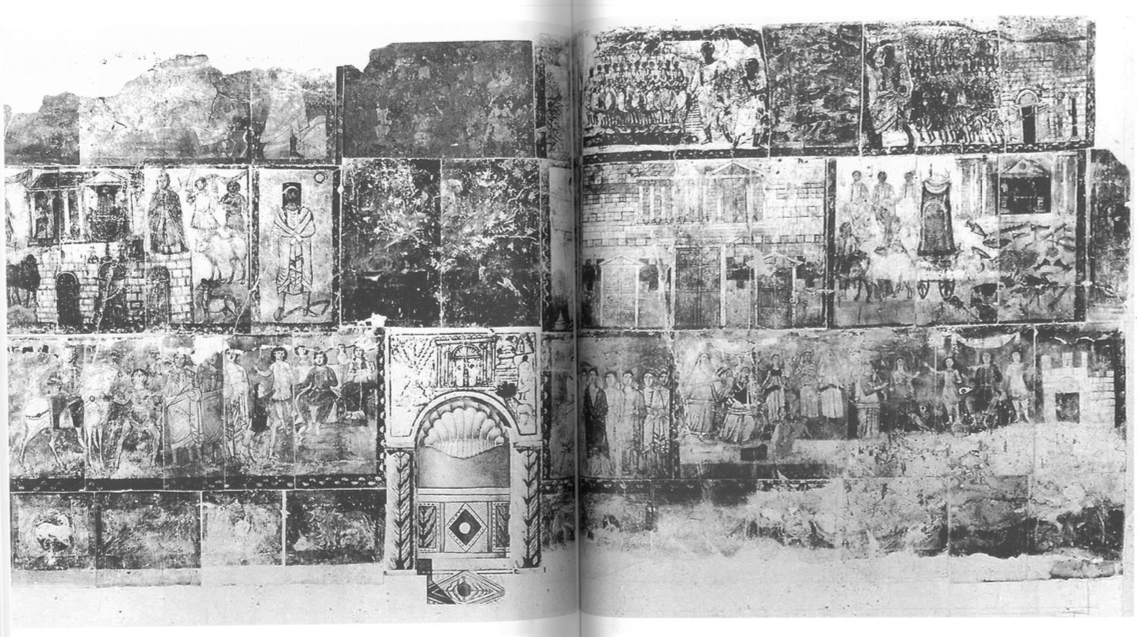 The west wall of the Dura-Europos synagogue with paintings of biblical scenes. The final phase of the synagogue is dated to AD 244/245 and was preserved by defensive fill before the city's fall.
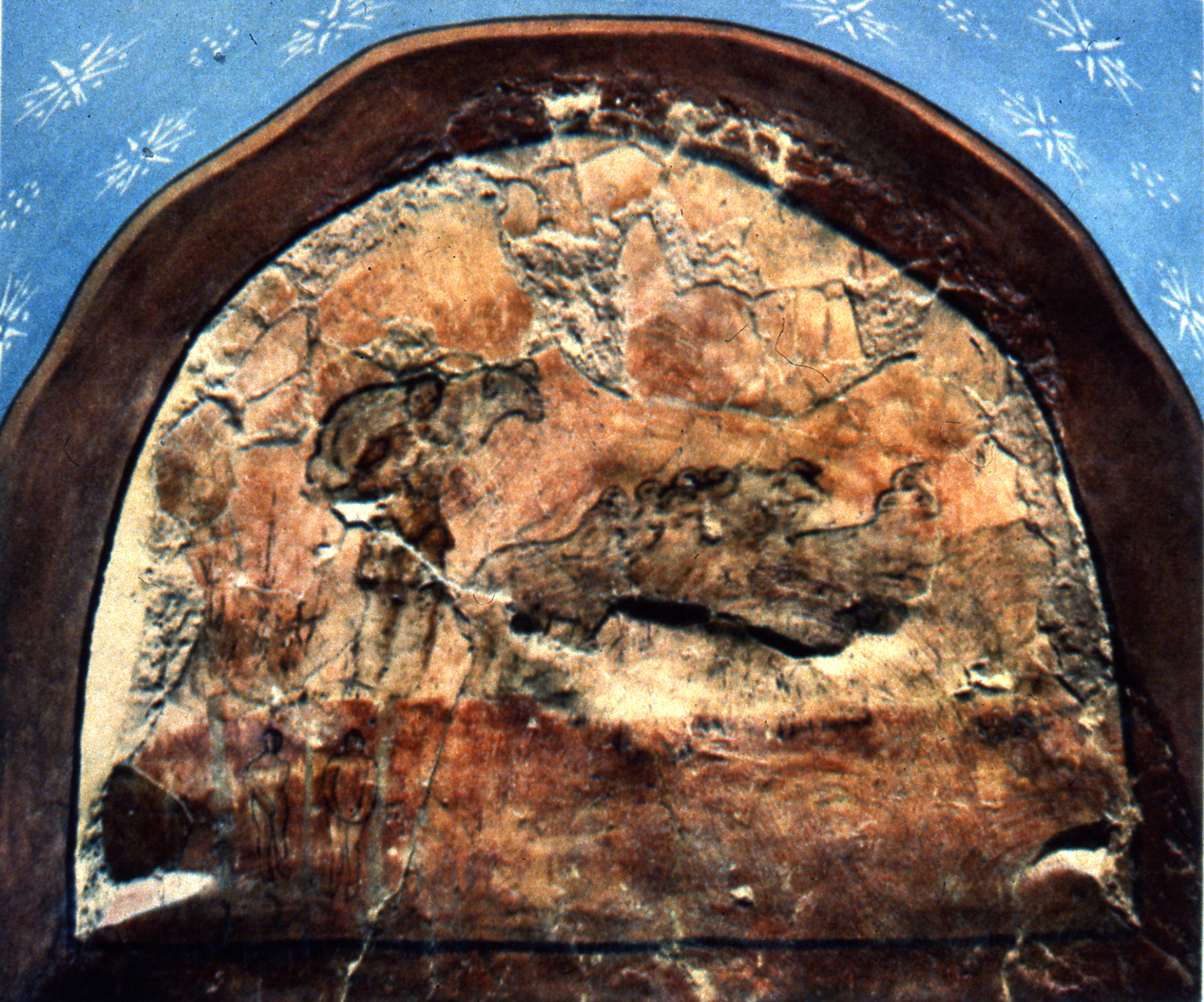 The Good Shepherd, Adam and Eve. Wall painting from the baptistery of the Christian building at Dura-Europos, mid-third century AD; one of the early monuments of Christian pictorial art.
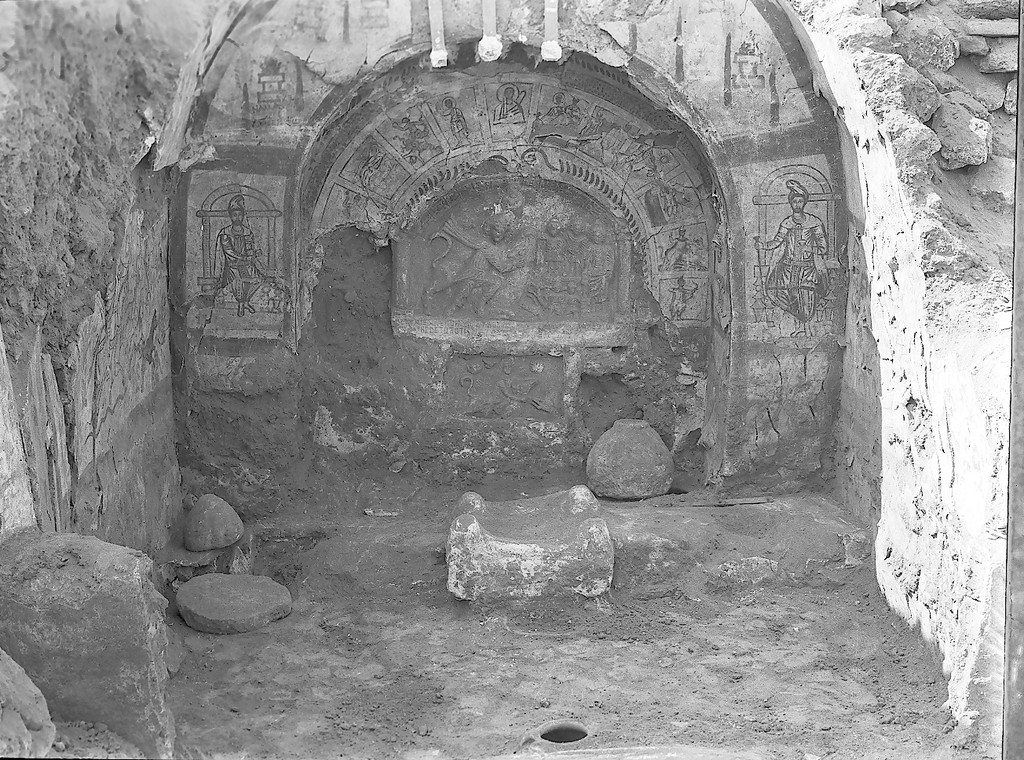 The Mithraeum at Dura-Europos. The shrine of Mithras shows military and eastern cult practice in the same urban space as the synagogue and Christian building.
Finds and Written Culture
The archaeology of Dura-Europos is especially strong because objects can be tied to places. A painted shield near the wall, scale armour from a military context, a synagogue fresco, a baptistery painting, a dedicatory inscription or a garrison document has a different meaning when the building, layer and date are known. The city therefore offers not a set of "beautiful antiquities", but a system: fortifications, blocks, sanctuaries, houses, military rooms and buried material work together.
Written sources from Dura reveal the multilingual environment of the eastern frontier. Greek, Latin, Aramaic, Palmyrene Aramaic, Parthian, Middle Persian and other linguistic forms were used in the city. Garrison documents concern accounts, people, supplies and service; inscriptions name gods, donors, offices and communities. Together with the objects, this material allows us to see not only a "Roman fortress", but a city in which the army was embedded in local economy, religious life and long-distance networks.
Among visual archaeological sources the painted shields, temple and synagogue wall paintings, depictions of soldiers in cult scenes, plans and archival excavation photographs are especially important. They are not merely illustrations of a text: shield form, figure position, dress, gesture, inscription language and findspot all provide separate evidence. At the same time Dura remains a third-century site on the eastern frontier; its materials cannot simply be transferred to Caesar's legionaries or to Danubian complexes of the second century.
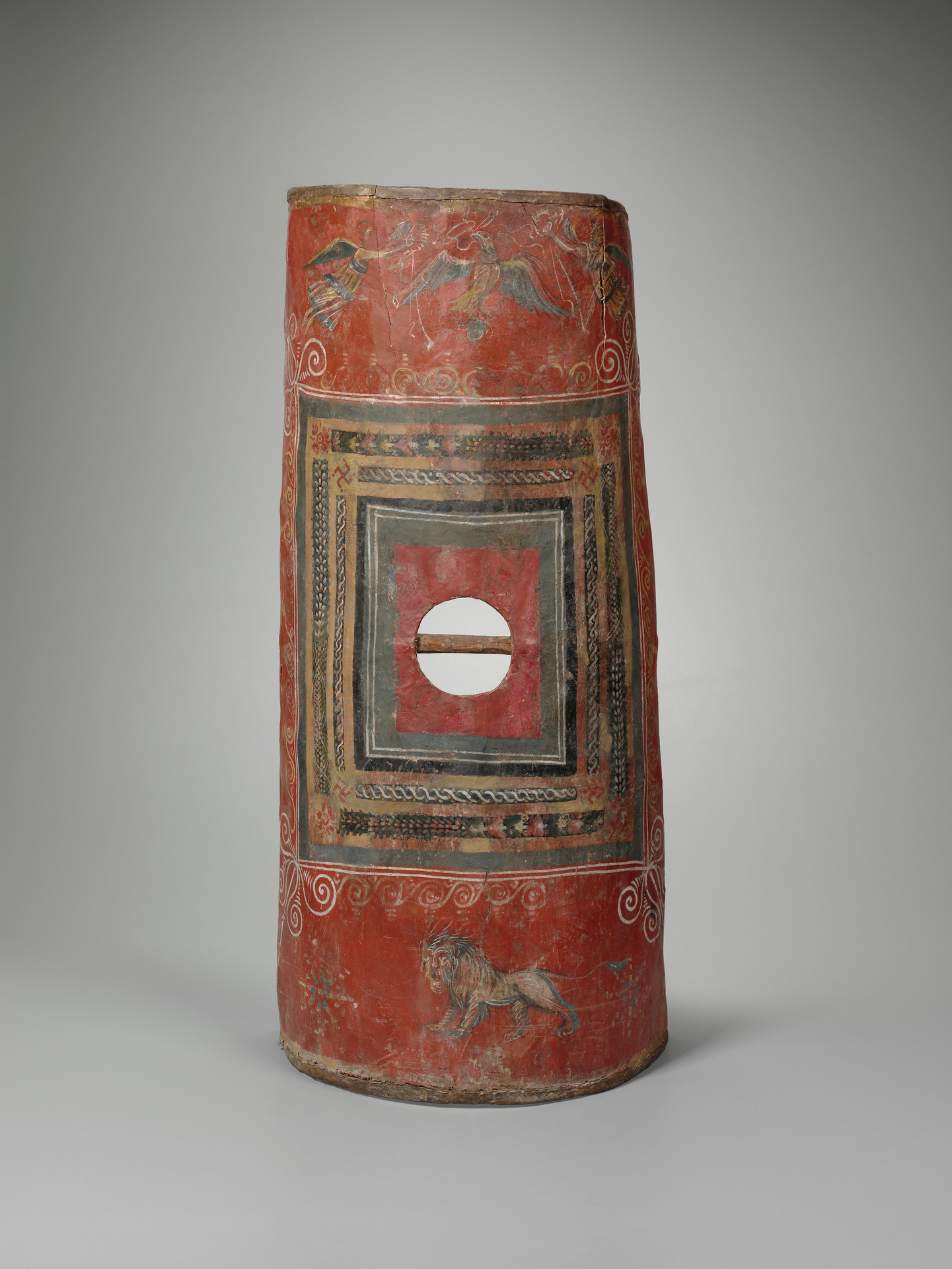 Painted Roman scutum from Dura-Europos. Wood and paint, mid-third century AD; the object belongs to the garrison context near the western wall.
 Fragment of a painted shield from Dura-Europos. Finds of this kind matter not only for shield form but also as rare evidence for surviving colour.
Material From the Complex
The material from Dura-Europos is best separated by the environments from which it comes. The military layer includes walls, towers, mines, shields, scale armour, leather parts, horse equipment, garrison documents and images of soldiers. The urban layer includes houses, streets, baths, the agora, private rooms, pottery and everyday objects. The religious layer includes temples, the Mithraeum, the synagogue, the Christian building, dedicatory inscriptions and paintings. None of these layers explains the city on its own.
The strength of the site lies in the intersection of these groups. The siege preserved religious paintings because military fortification required a fill against the walls. The Roman garrison left shields and organic material, but it lived in a city where Palmyrene, Greek, local, Jewish and Christian forms stood side by side. Written documents name people and duties, while images provide evidence for dress, posture, equipment and ritual scenes. Dura-Europos therefore matters as a whole urban organism, not as a single display case with a shield or a synagogue.
Chronology
- c. 303 BC - the Hellenistic Europos is founded on the Euphrates within the Seleucid sphere.
- Second century BC - the city enters the orbit of the Arsacids; Parthian, Aramaic and Palmyrene connections become stronger.
- First-second centuries AD - Dura develops as a frontier and trading centre between Syria, Mesopotamia and desert routes.
- AD 165/166 - after the Roman-Parthian war the city passes under Roman rule and becomes part of the Euphrates defence system.
- Late second to first half of the third century AD - the Roman military sector develops; garrison, administration, temples, synagogue and domestic cult spaces operate in the city.
- AD 244/245 - the final phase of the synagogue is dated by an Aramaic inscription; its painting cycle is created or completed.
- Mid-third century AD - the Christian building with its baptistery and the Mithraeum belong to the late urban phase before the siege.
- c. AD 256/257 - Sasanian siege, strengthening of the western wall, mines near Tower 19, capture of the city and end of urban life.
- 1920 - the site again draws attention after soldiers on the Euphrates encounter paintings and inscriptions.
- 1928-1937 - Yale University and the French Academy of Inscriptions and Letters conduct the main excavation seasons, after which Dura-Europos becomes one of the key sites of the eastern frontier.
Related Topics
- Archaeology and museums
- Roman Empire
- Roman Army
- Legion
- Auxilia
- Sagittarius
- Scutum
- Roman Equestrian Equipment
- Pugio
- Roman Temples
- Christianity in Antiquity
- Dominate
Literature and sources
- Rostovtzeff M. I., Brown F. E., Welles C. B. et al. The Excavations at Dura-Europos. Preliminary Reports. New Haven: Yale University Press, 1929-1952.
- Hopkins C. The Discovery of Dura-Europos. New Haven: Yale University Press, 1979.
- Baird J. A. Dura-Europos. London: Bloomsbury Academic, 2018.
- James S. The Roman Military Base at Dura-Europos, Syria: An Archaeological Visualization. Oxford: Oxford University Press, 2019.
- James S. The Excavations at Dura-Europos, Final Report VII: The Arms and Armour and Other Military Equipment. London: British Museum Press, 2004.
- Kraeling C. H. The Synagogue. The Excavations at Dura-Europos, Final Report VIII, Part I. New Haven, 1956.
- Dirven L. The Palmyrenes of Dura-Europos: A Study of Religious Interaction in Roman Syria. Leiden: Brill, 1999.
- Peppard M. The World's Oldest Church: Bible, Art, and Ritual at Dura-Europos, Syria. New Haven: Yale University Press, 2016.
- Pollard N. Soldiers, Cities and Civilians in Roman Syria. Ann Arbor: University of Michigan Press, 2000.
- Yale University Art Gallery: Dura-Europos digital archive and object records.


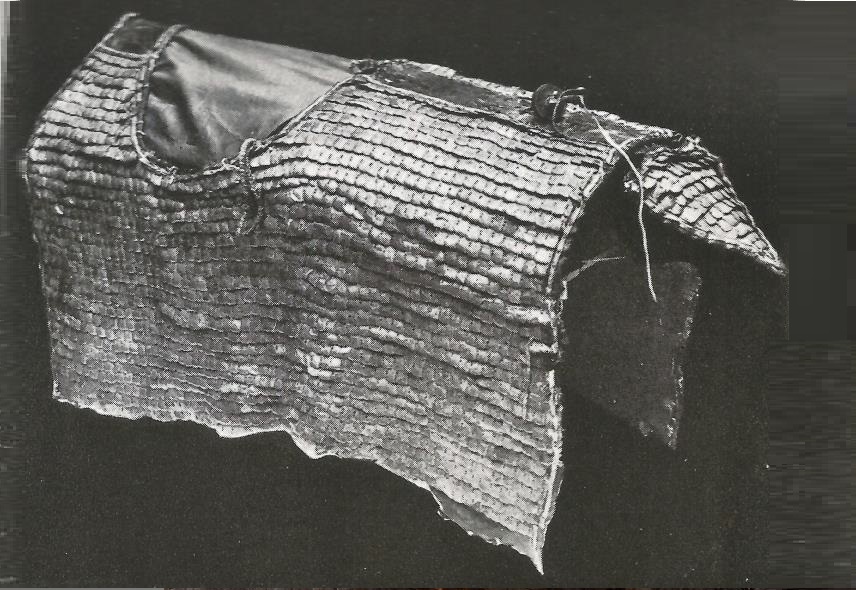 Archival photograph of scale armour from Dura-Europos. The side view shows the volume and fit of the preserved protective element.
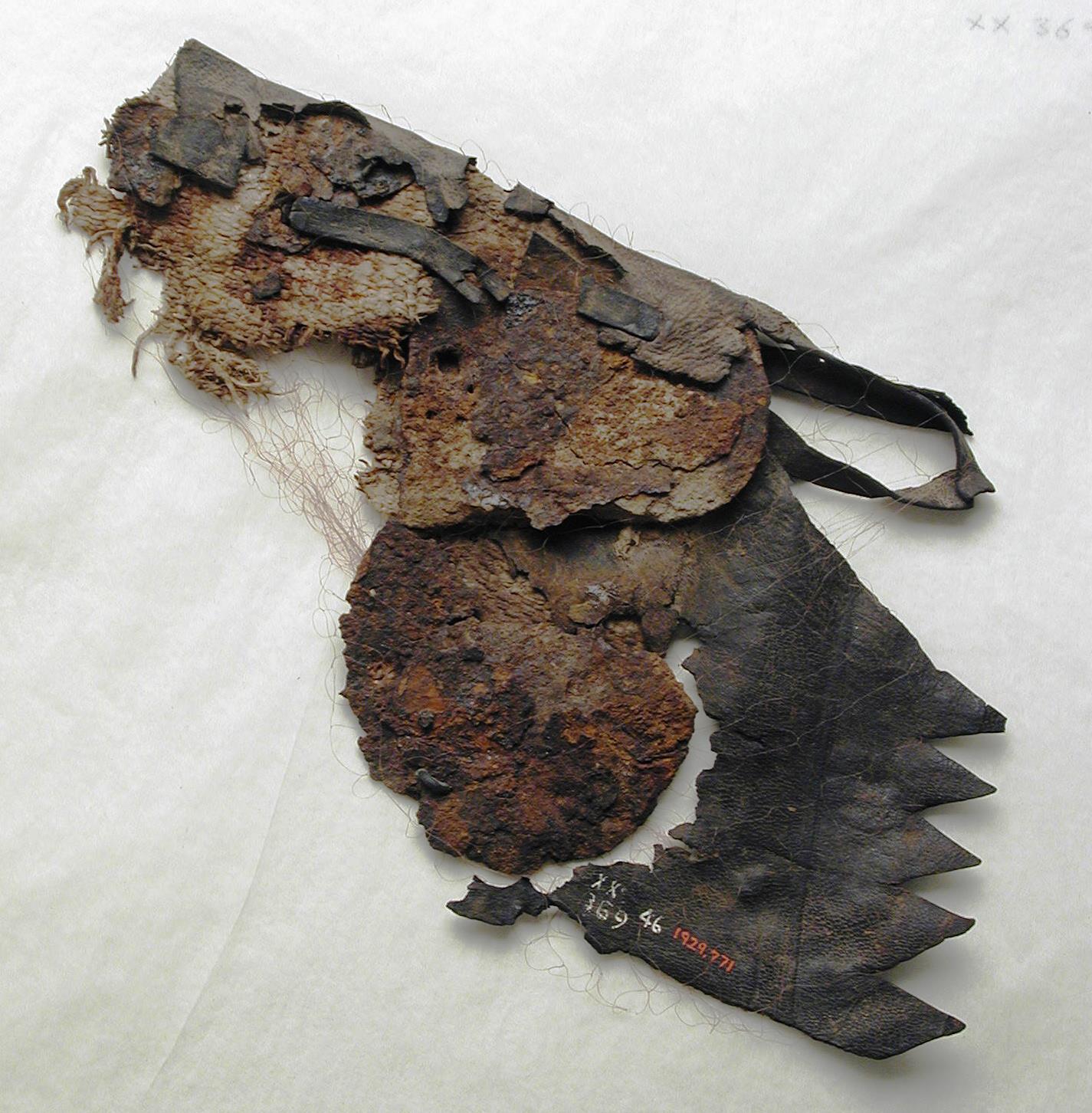
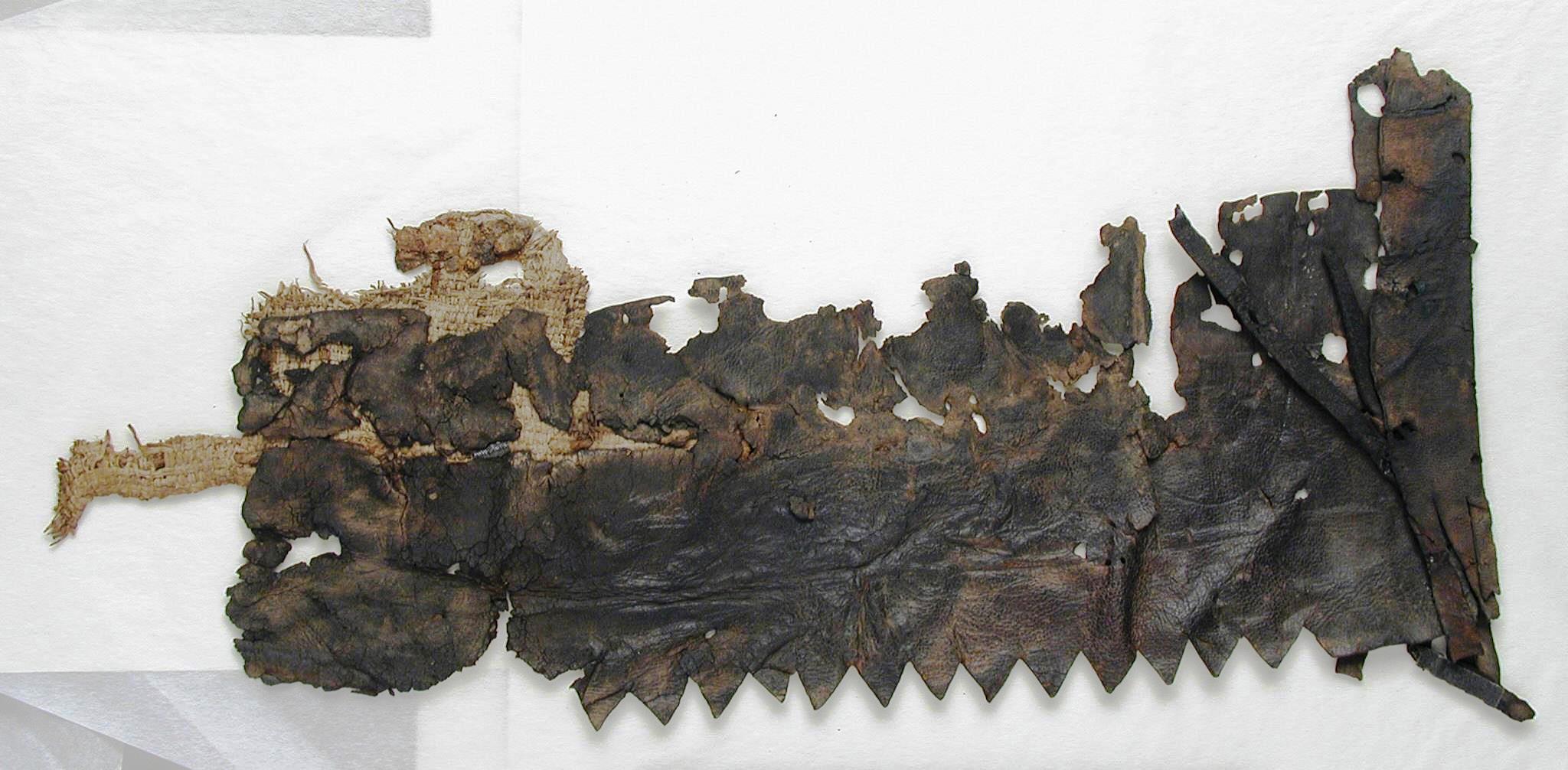 Leather fragment with a serrated edge from Dura-Europos. Organic finds of this kind reveal soft and composite parts of military equipment.
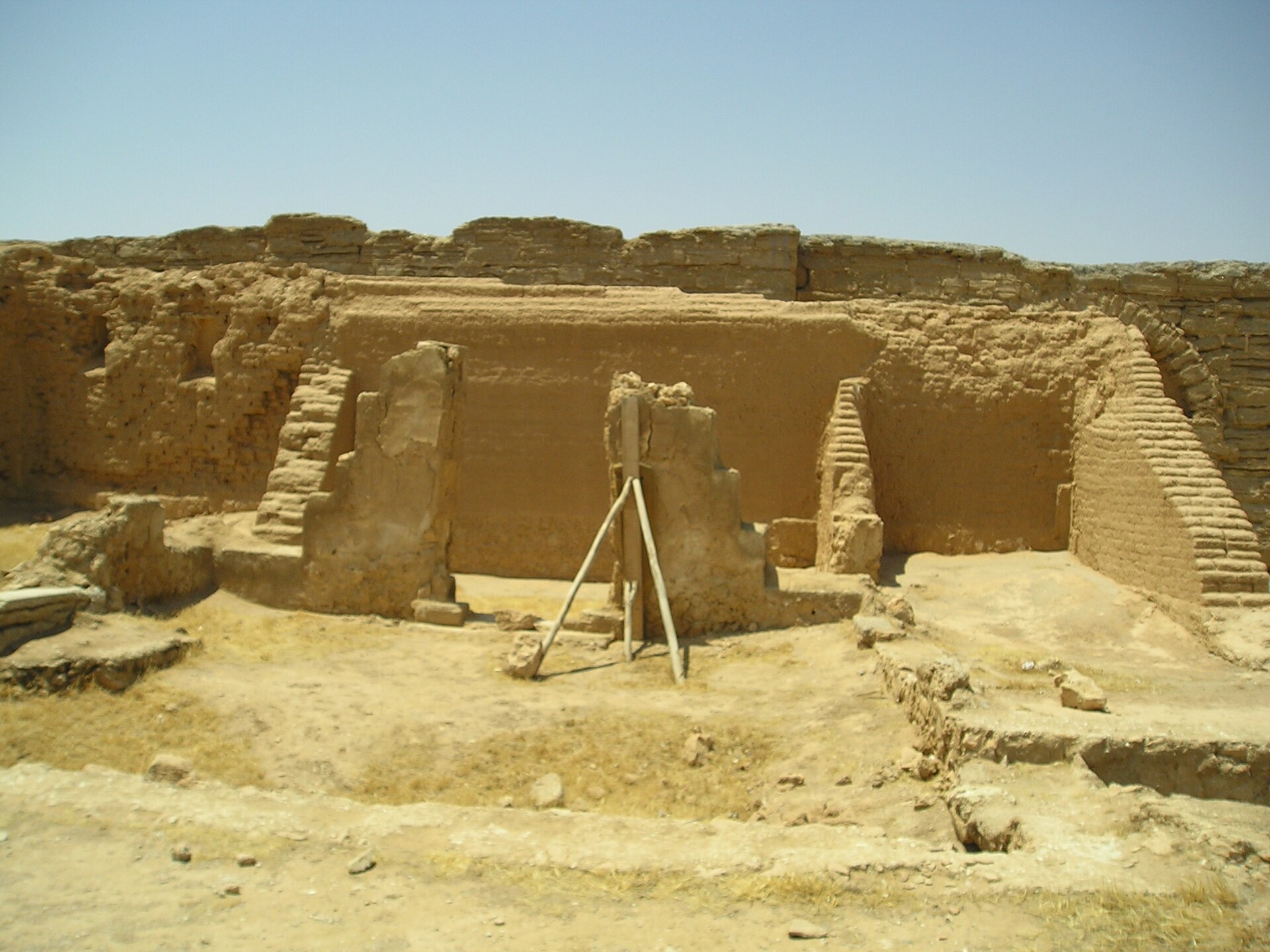 Remains of the Christian building at Dura-Europos. The structure was an ordinary house adapted for gatherings and a baptistery, without a monumental facade.
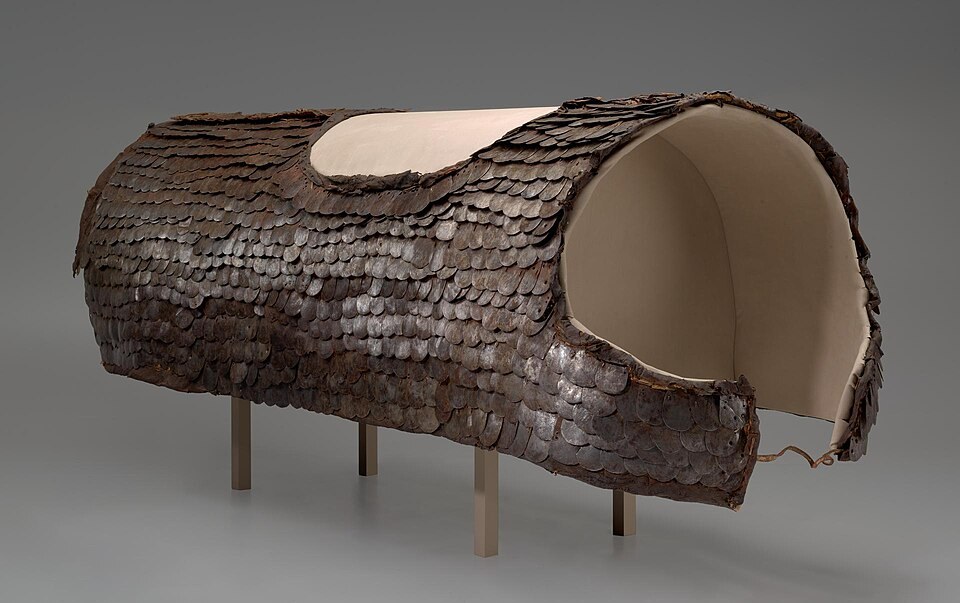 Dura-Europos: Horse Armor from Dura-Europos; material-culture object or museum find connected with the site, Roman period or local archaeological context.
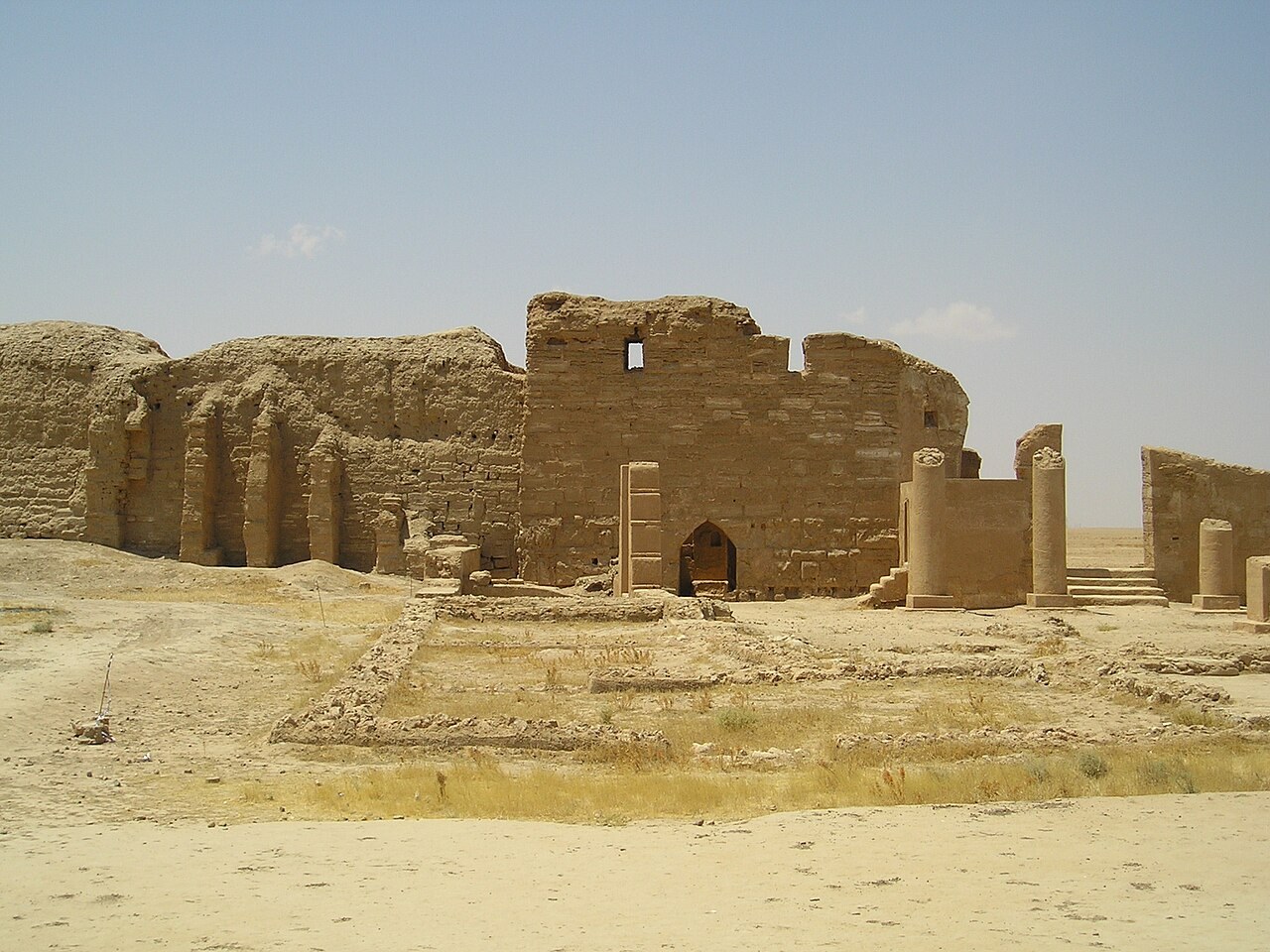 Dura-Europos: DuraEuropos-TempleOfBel; archaeological view, find or museum context connected with the site, Roman period or local archaeological context.
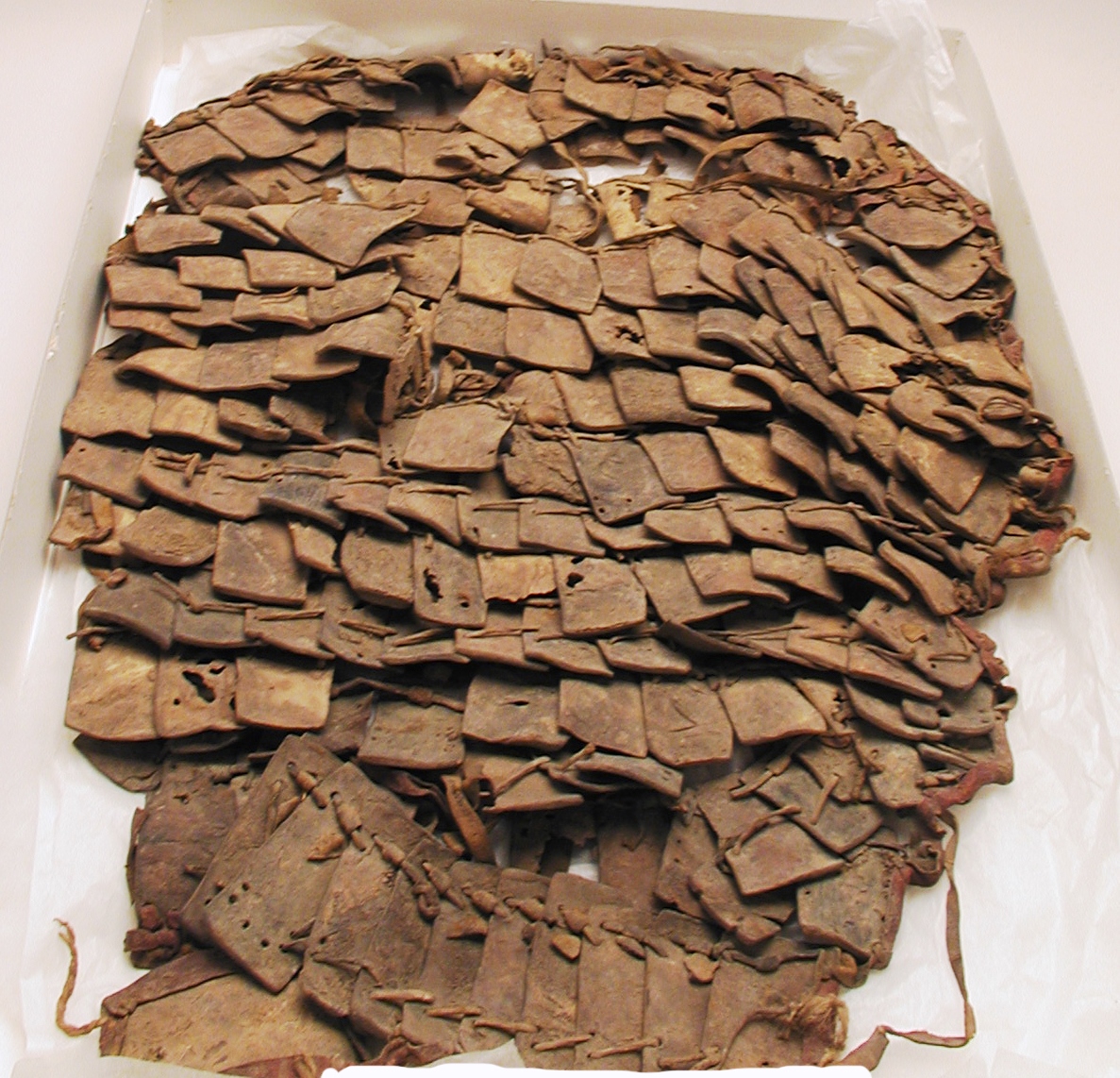 Organic and protective material from Dura-Europos: leather elements, scale armour and painted shields show the unusual preservation of military equipment.
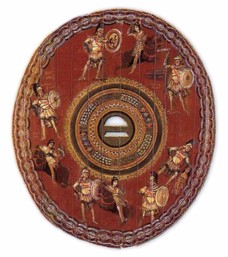 Painted round shield from Dura-Europos. Mythological and military scenes on the shield show that protective equipment could be brightly decorated.
 Painted oval shield from Dura-Europos, front-side detail. The dry environment preserved wood and pigment better than most western military sites.
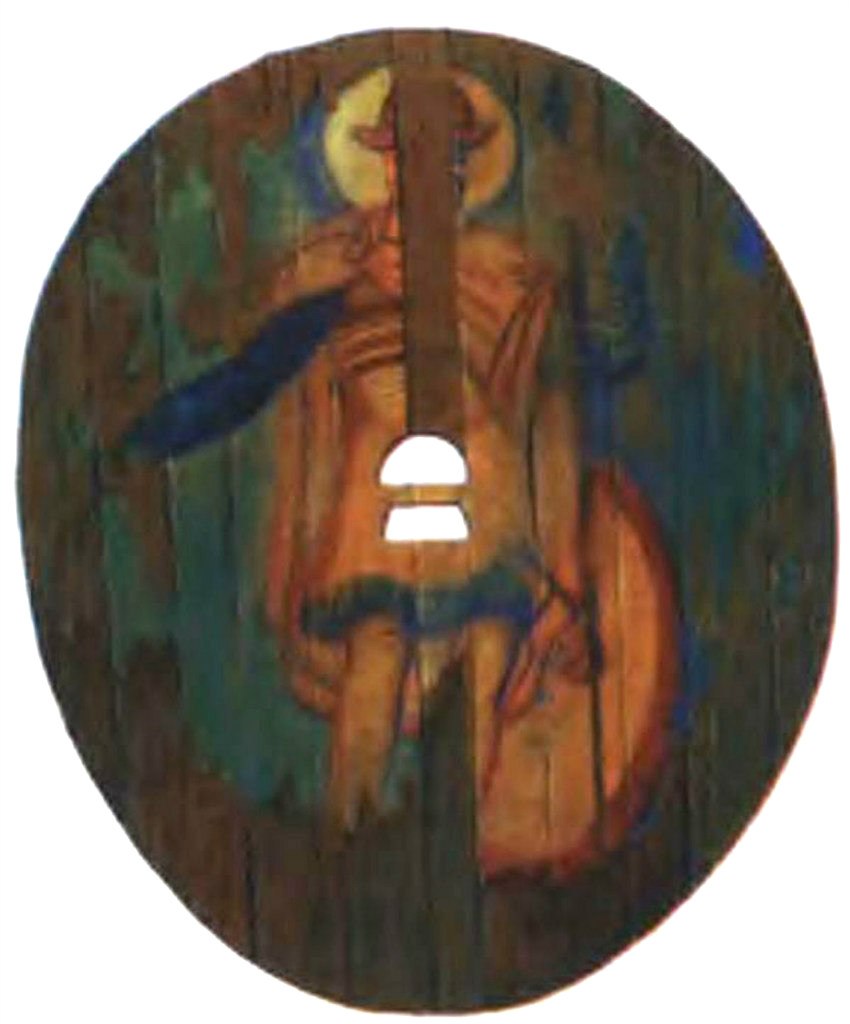 Painted oval shield from Dura-Europos, general view. The image helps show the shape, curvature and placement of decoration on a wooden base.
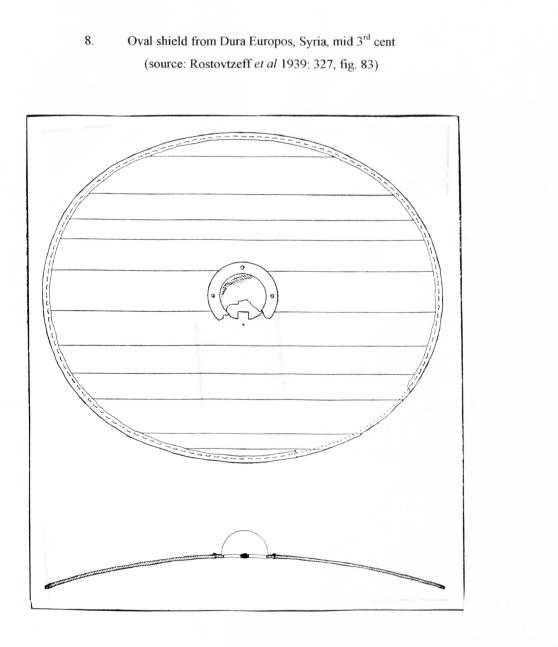 Drawing of the oval shield from Dura-Europos after the excavation publication. The drawing shows curvature, boards and boss placement better than the colour photograph.
 Leather equipment fragments from Dura-Europos. The label records the find context and underlines the importance of organic survival at this site.
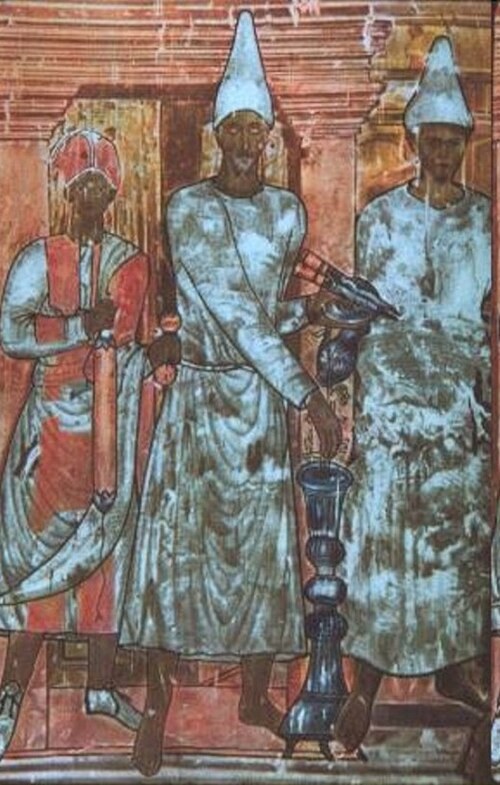 Dura-Europos: Dura Europos fresco Sacrifice of Conon; material-culture object or museum find connected with the site, Roman period or local archaeological context.
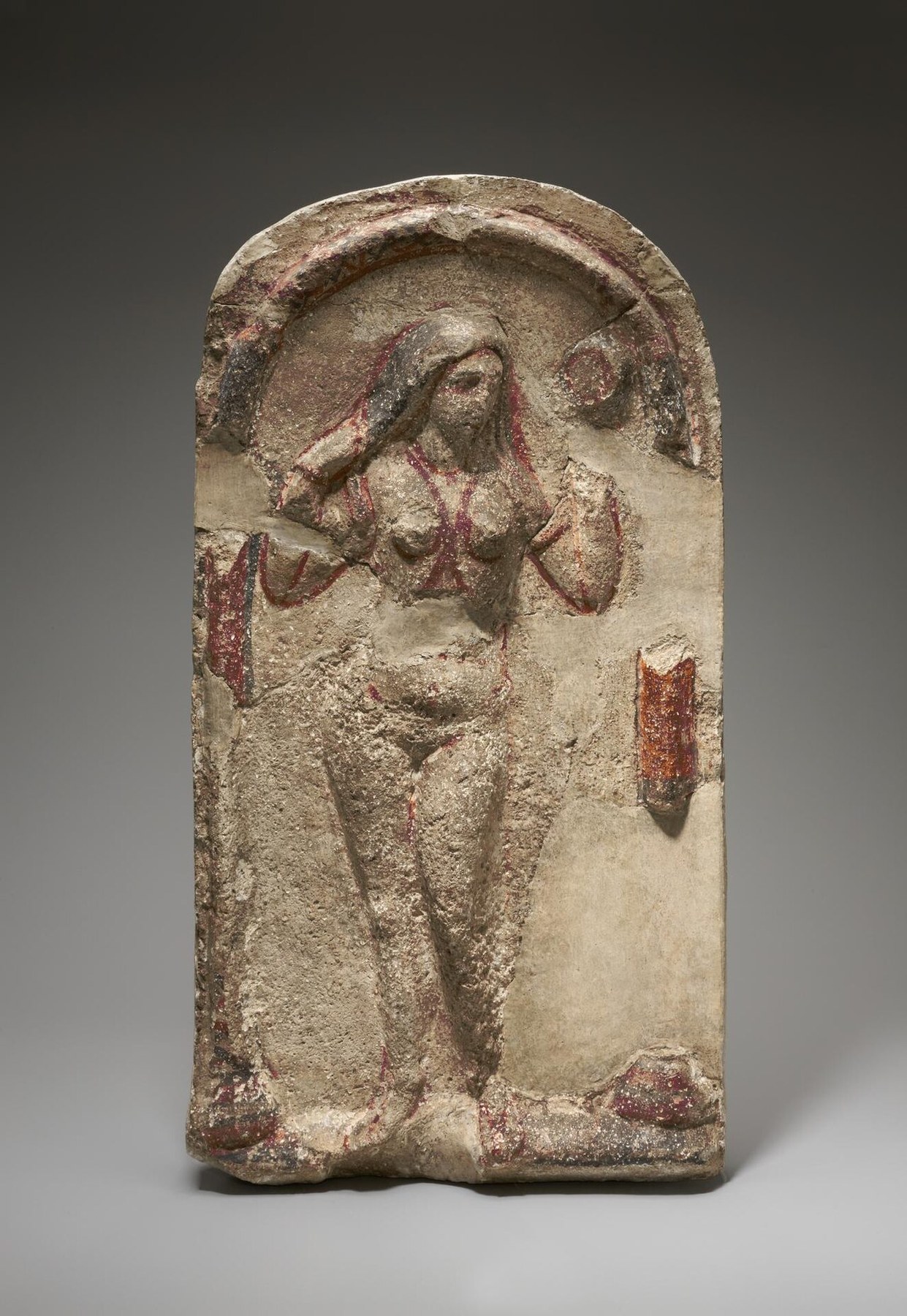 Dura-Europos: Relief of Aphrodite in a niche; material-culture object or museum find connected with the site, Roman period or local archaeological context.
Interested in Ancient Rome beyond reading? Join Legio X Fretensis or explore our reenactment directions.


