Hannibal Barca
Hannibal Barca (247-183/181 BCE) was a Carthaginian commander of the Barcid family and Rome's principal opponent in the Second Punic War. His march from Iberia across the Alps into Italy became one of the most famous military operations of antiquity.
In brief:
- state: Carthage;
- period: late third and early second century BCE;
- key events: the Alpine crossing, Trebia, Lake Trasimene, Cannae and Zama;
- significance: a classic example of mobile strategy tested against Rome's deeper reserves and alliance system.
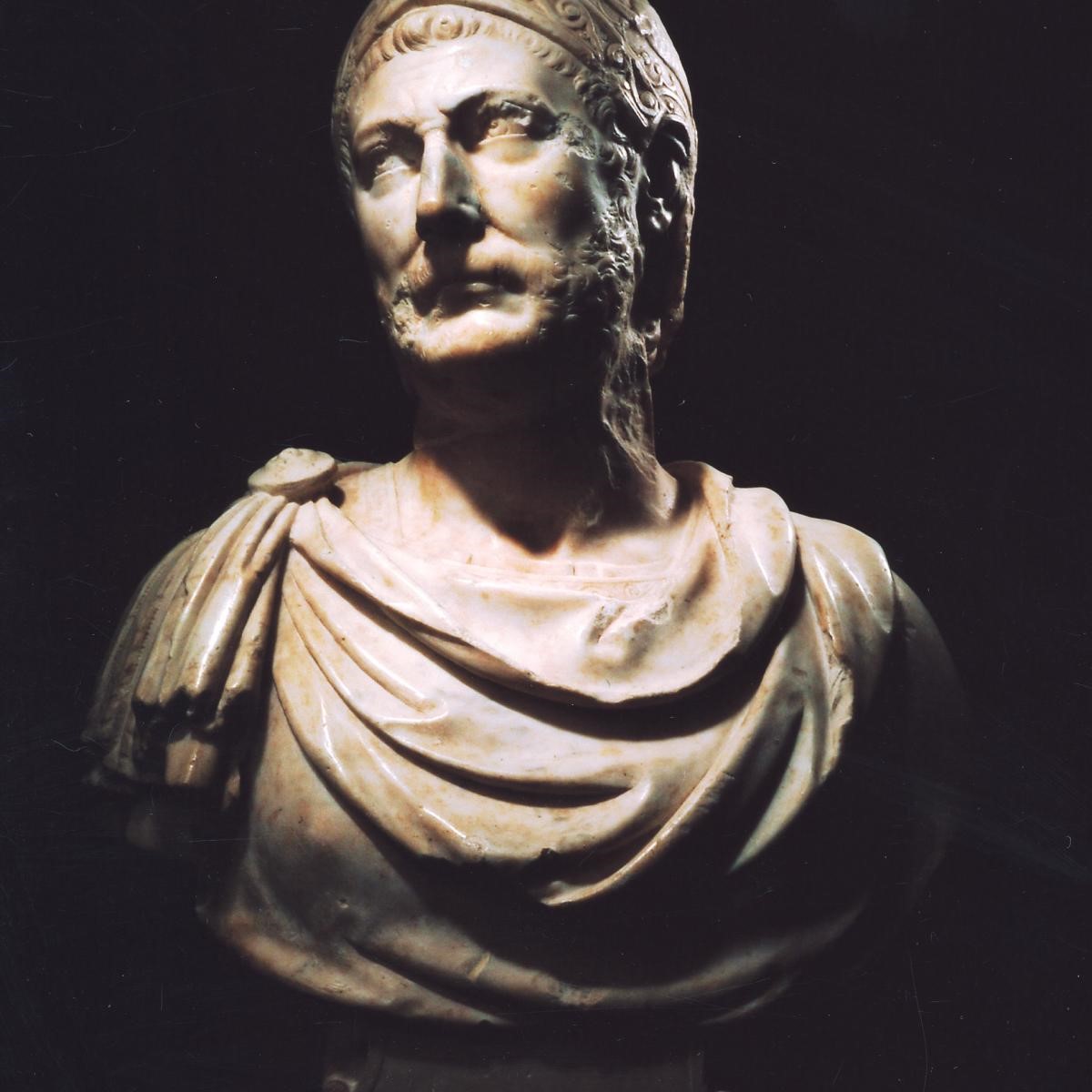 Bust of Hannibal. National Museum of Naples
Key Campaigns and Battles
| Date | Event | Result and significance |
|---|---|---|
|
218 BCE |
Alpine crossing and the Trebia |
Entry into Italy and a major victory over a Roman army |
|
217 BCE |
Lake Trasimene |
A Roman army was trapped and defeated in an ambush |
|
216 BCE |
Cannae |
A double envelopment destroyed much of the Roman army |
|
215-203 BCE |
War in Italy |
Victories did not break the core Roman alliance system |
|
202 BCE |
Zama |
Defeat by Scipio ended the Second Punic War |
Origin and Early Career
Hannibal was the son of Hamilcar Barca, a Carthaginian commander active after the First Punic War. Ancient authors tell how the young Hannibal swore never to be a friend of Rome. The story may have been shaped by later literary tradition, but it reflects the political outlook associated with the Barcid family.
After losing Sicily, Carthage needed a new base of manpower and revenue. The Barcids established that base in Iberia. There Hannibal learned to command a mixed army of Africans, Iberians, Numidians and Celts and to negotiate with communities whose interests did not always coincide.
The Alpine Crossing and War in Italy
The immediate cause of war was the conflict over Saguntum. In 218 BCE Hannibal marched from Iberia through Gaul and brought his army across the Alps. The crossing cost men, animals and supplies, but it placed a Carthaginian army in northern Italy before Rome could contain the war in Iberia.
Hannibal defeated Roman armies at the Trebia, Lake Trasimene and Cannae. After Cannae, several of Rome's allies defected to Carthage, but the core of the Roman alliance remained intact. Rome avoided another decisive battle, attacked Hannibal's support network and continued to raise armies. Tactical success therefore did not produce a negotiated Carthaginian victory.
Tactics and Command
Hannibal combined intelligence, choice of ground, timing and psychological pressure. At Cannae he used a yielding centre and strong wings to draw the Roman infantry forward before closing around it. The result became the best-known ancient example of double envelopment.
His army was not a single national force. Hannibal maintained cohesion through personal authority, rewards, diplomacy and an understanding of his allies' different fighting traditions. Heavy infantry, light troops and Numidian cavalry were assigned complementary roles rather than treated as interchangeable units.
Zama and Later Years
While Hannibal remained in Italy, Rome carried the war into Iberia and Africa. Scipio Africanus forced Carthage to recall him. At Zama in 202 BCE, Scipio's army and Numidian cavalry defeated the Carthaginians, bringing the war to an end.
Hannibal later pursued political and financial reforms in Carthage. Pressure from his opponents and from Rome drove him into exile, where he advised eastern rulers. Ancient tradition says that he took his own life rather than be surrendered to the Romans.
Historical Significance
Hannibal's career shows the limits of battlefield success when it is not matched by secure reinforcements, political support and a durable alliance system. Rome lost armies but retained the capacity to mobilise replacements, contest several theatres and prevent most Italian allies from abandoning the war.
For military history, Hannibal remains a central case study in manoeuvre, combined arms and the exploitation of terrain. His campaigns are also a warning against judging a war solely by its most dramatic battles.
Related Topics
- Great Figures of Antiquity
- Second Punic War
- Scipio Africanus
- Carthage
- Roman Republic
- Roman legion
- Punic Wars: Rome and Carthage
Literature and sources
1. Polybius. The Histories. 2. Livy. History of Rome. 3. Appian. Roman History. 4. Plutarch. Parallel Lives. 5. Cassius Dio. Roman History.
Interested in Ancient Rome beyond reading? Join Legio X Fretensis or explore our reenactment directions.


