Labours of Heracles
The Labours of Heracles are a cycle of ordeals performed by the hero at the command of Eurystheus, king of Mycenae. In ancient tradition they are connected with atonement, service, the cleansing of the land from monsters and journeys to the edges of the known world. They are not merely a list of victories: each labour shows a different kind of danger and a different way in which the hero acts.
Heracles does not win by strength alone. Sometimes he strangles a beast with his hands, sometimes he uses a helper, cunning, negotiation, labour, travel or endurance. The cycle therefore became a useful language for ancient art: on vases, reliefs, frescoes and sarcophagi a single episode could stand for strength, work, suffering, purification or the limits of human possibility.
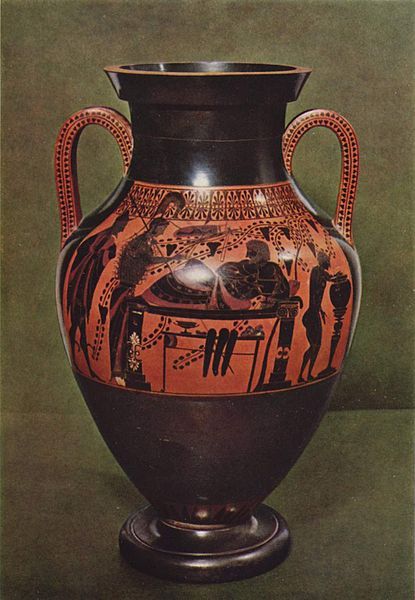 Athena beside Heracles on an Attic black-figure amphora, 520-510 BC; vase painting as evidence for myth.
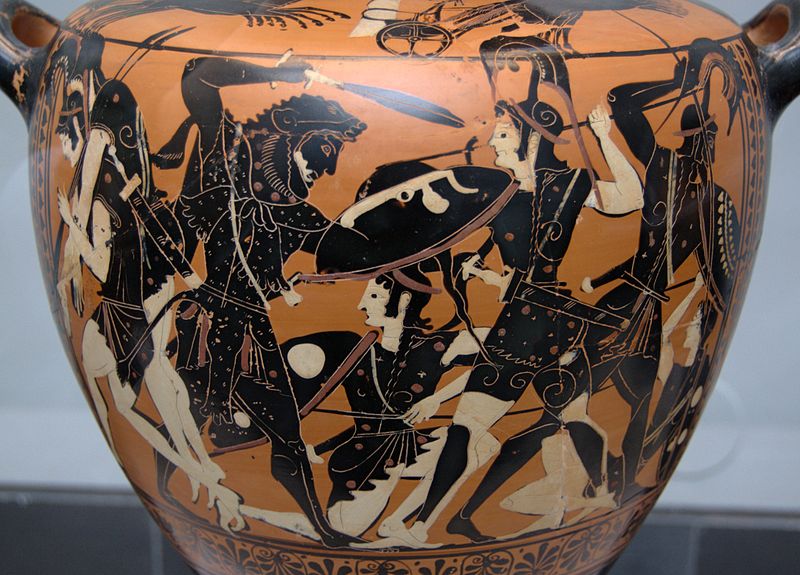 Hercules and the Amazons. Attic black-figure vase. Around 530 BC.
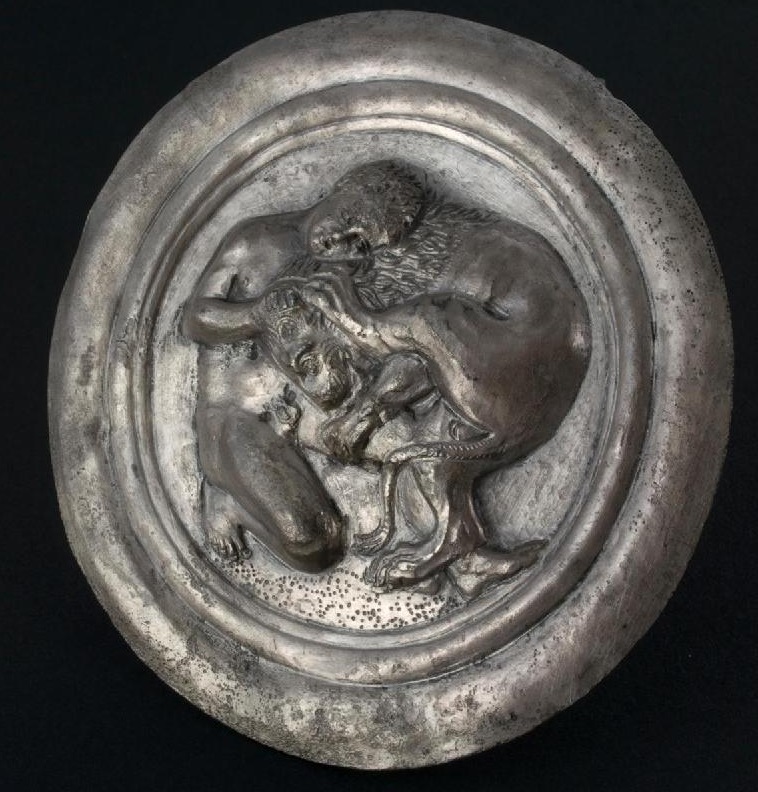 Disc ornament depicting Heracles. National Archaeological Museum, Sofia; fourth century BCE. Comparative evidence, not a Roman military award.
Why Heracles Serves Eurystheus
The background of the labours is connected with Heracles' madness and the death of his family. After the crime committed in frenzy, the hero seeks purification and is ordered to serve Eurystheus. Thus the greatest strength in Greece is placed under the authority of a weaker king. This contrast matters: the labours are not free adventure, but service in which the hero must obey, endure humiliation and perform impossible commands.
The number of labours was not fixed as twelve from the beginning. The story contains disputed cases: Eurystheus refuses to count the killing of the Hydra because of Iolaus' help and the cleaning of the Augean stables because of the promised payment. Two further tasks are therefore added to the original ten: the apples of the Hesperides and Cerberus. The final sequence became classical, although ancient images could select episodes freely and did not always follow one order.
I. The Nemean Lion
The first labour sends Heracles to Nemea, where a lion with an invulnerable hide lives. Ordinary weapons do not work: arrows, sword and spear are powerless against the monster. Heracles drives the lion into a cave and strangles it with his hands. He then skins it with the beast's own claws and makes the hide his chief protective sign.
The Nemean Lion sets the beginning of the whole cycle. The hero receives not only a victory but a lasting visual attribute: the lion skin makes Heracles recognisable in art. The labour shows the hero's basic strength, but even here it matters that victory requires understanding the enemy's nature: an ordinary blow does not work, and another method is needed.
II. The Lernaean Hydra
The second labour is connected with the Lernaean Hydra, a water monster of Argolis. When Heracles cuts off one head, new ones grow in its place; the monster's breath or blood carries poison. The labour therefore becomes a fight with a danger that returns after every partial success.
Iolaus, Heracles' nephew and companion, plays the decisive role. He cauterises the necks with a torch so that the heads cannot grow back. In some versions one head is immortal: Heracles cuts it off and buries it under a heavy stone. After the victory the hero dips his arrows in the Hydra's poison, and this victory later brings tragic consequences for centaurs, Philoctetes and Heracles himself.
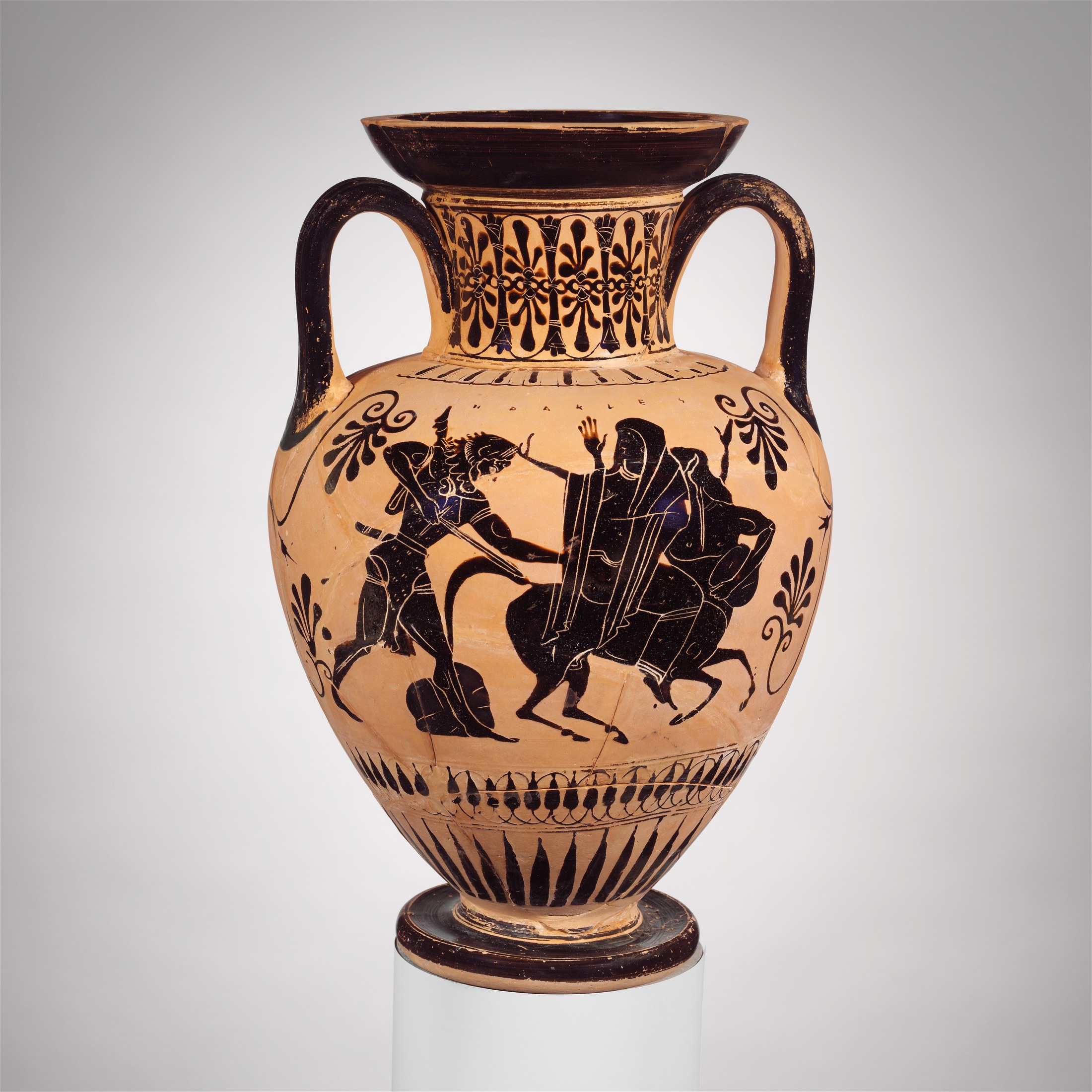 Attic neck-amphora with Herakles and the Hydra, ca. 510 BC. Metropolitan Museum of Art, 56.171.17.
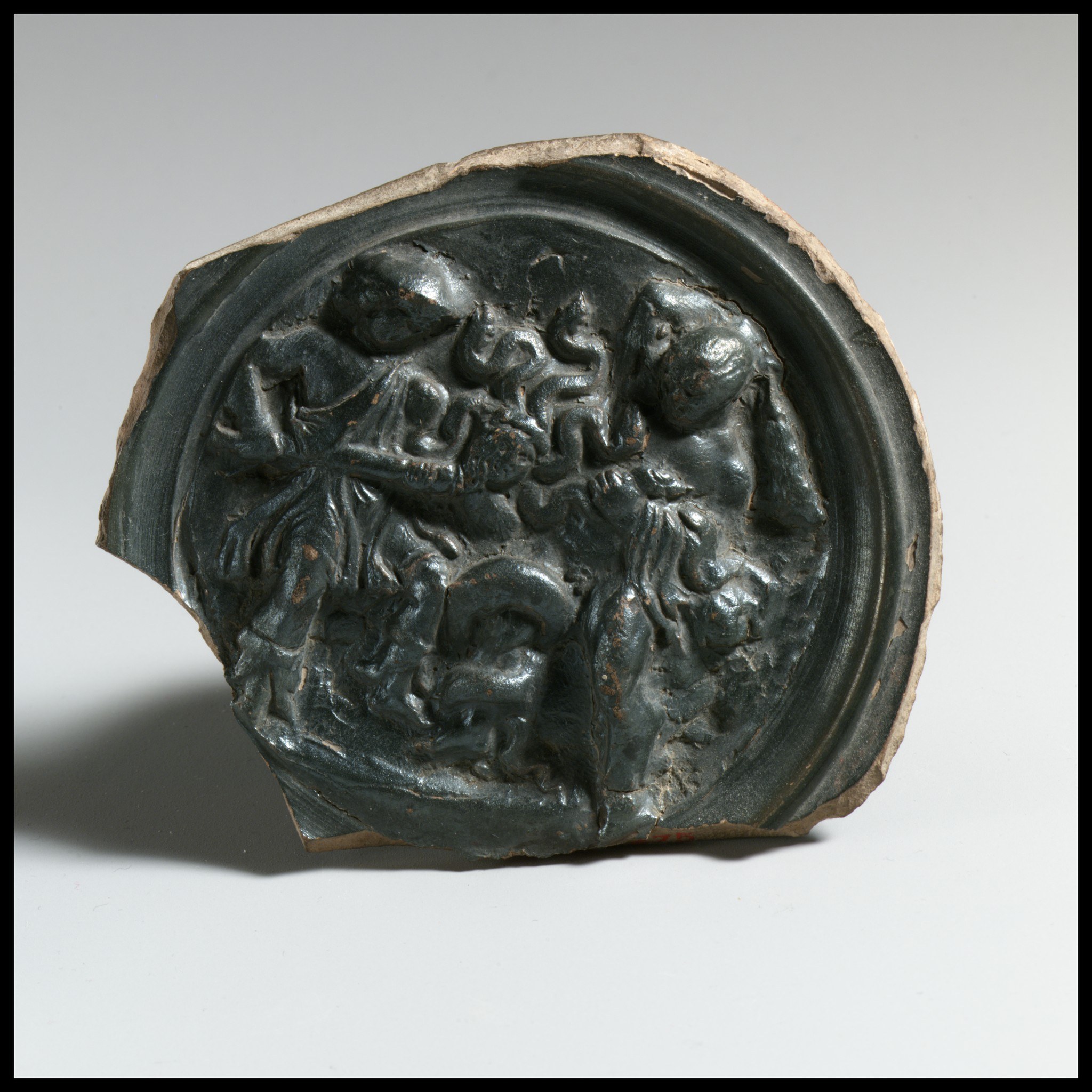 Terracotta tondo from a phiale with Herakles and the Lernaean Hydra, South Italy, late fourth-third century BC. Metropolitan Museum of Art, 17.190.138.
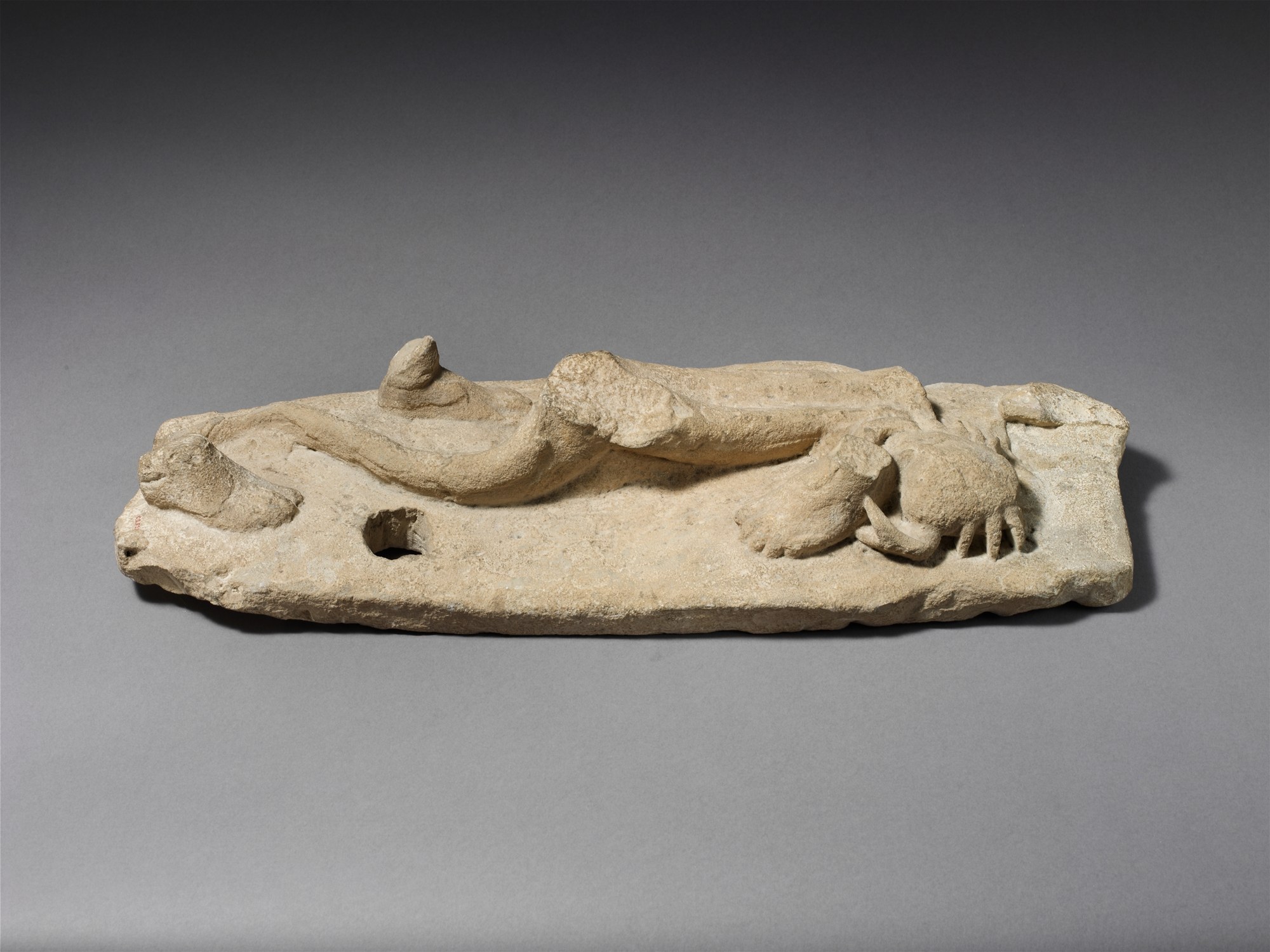 Cypriot limestone plinth with remains of a group of Herakles and the Hydra, late sixth-early fifth century BC. Metropolitan Museum of Art, 74.51.2471.
III. The Ceryneian Hind
The Ceryneian Hind belongs to Artemis: it is a sacred, swift and beautiful animal with golden antlers. The task differs from the killing of a monster. Heracles must capture the hind alive, without offending the goddess or destroying the animal's sacred status.
The chase lasts a long time, sometimes a whole year. The hero catches the hind, wounds or binds it and then explains to Artemis that he acts under Eurystheus' command. The labour tests not rage, but endurance, speed and the ability to bring back a living creature without turning sacred hunting into sacrilege.
IV. The Erymanthian Boar
The Erymanthian Boar is a destructive beast of mountainous Arcadia. Eurystheus orders Heracles to bring it alive, so once again the hero must capture rather than kill. He drives the boar from the forest and forces it into deep snow, where the heavy animal loses mobility.
This labour shows the hero as hunter and reader of terrain. He wins not only through strength, but by using the landscape. The story is also connected with the centaur cycle: on the way Heracles visits Pholus, a jar of wine is opened, and the encounter leads to the death of many centaurs from arrows poisoned with the Hydra's venom.
V. The Augean Stables
The fifth labour differs sharply from combats with monsters. Augeias owns enormous herds, and his stables have not been cleaned for years. Heracles must remove the filth in one day. He solves the task not with hands or weapons, but by engineering: he redirects rivers so that water passes through the stalls and cleans them.
This episode matters as a labour of work, measure and technical thought. Heracles cleanses not a wild ravine but the economic space of a king. The dispute over payment and Eurystheus' refusal to count the labour show that heroic glory depends not only on the result, but also on the conditions under which the task is performed.
VI. The Stymphalian Birds
The Stymphalian Birds live by a marshy lake and threaten people, animals and crops. In later descriptions their feathers may be bronze or sharp like arrows. The main difficulty is that the birds hide in the reeds and cannot be struck directly.
Athena helps Heracles: he receives rattles or noise-making objects made by Hephaestus. The sound forces the birds into the air, and then the hero shoots them with arrows. The labour shows the combination of divine aid, technique and weapon: first the danger must be driven out of hiding, and only then destroyed.
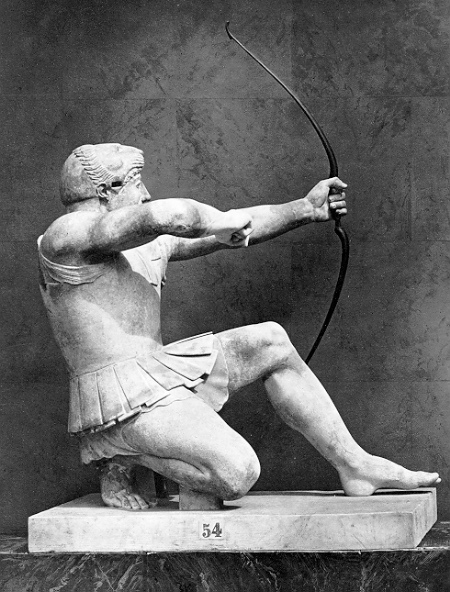 Heracles as an archer from the east pediment of the Temple of Aphaia on Aegina, 490-480 BC.
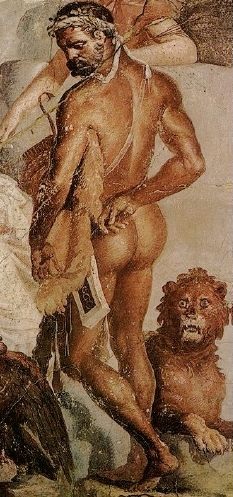 Detail from the fresco "Allegories of Hercules". Fresco from Herculaneum,National Archaeological Museum,Naples. 1st century AD
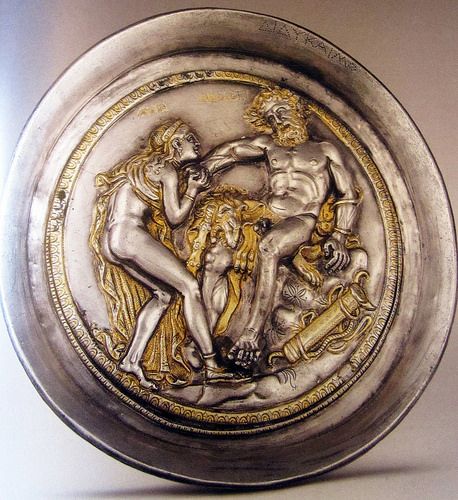 Silver dish with Heracles from the Rogozen treasure; fourth century BCE. Regional History Museum, Vratsa. A Thracian comparison, not a Roman catinum.
VII. The Cretan Bull
The Cretan Bull is connected with the power of Minos and with the memory of Cretan myths. In different versions it is the bull sent from the sea by Poseidon, or a creature connected with the birth of the Minotaur. Eurystheus orders Heracles to bring the bull alive, and Heracles travels to Crete.
The hero captures the bull and brings it to Greece. The labour joins physical force with maritime and island space: Heracles leaves mainland Greece and returns with a living sign of foreign and dangerous power. Later the bull appears again in the Attic cycle and is connected with the deeds of Theseus.
VIII. The Mares of Diomedes
The eighth labour takes Heracles to Thrace and to King Diomedes, owner of savage mares that feed on human flesh. Here the danger is not a wild beast but royal cruelty: monstrosity has been moved into the household and power of a human ruler.
Heracles captures the mares and, in some versions, feeds Diomedes himself to them. After this the animals become manageable and can be brought to Eurystheus. The labour shows that violence can come not only from a monster of nature, but also from a ruler who has made cruelty part of his order.
IX. The Belt of Hippolyta
The ninth labour is connected with the Amazons and the belt of their queen Hippolyta. Unlike many tasks, a peaceful outcome is possible at first: Hippolyta is ready to give the belt to Heracles. But Hera's intervention and mutual suspicion turn negotiation into battle.
This episode matters because the hero faces not a nameless beast, but a society of warrior women, royal authority and diplomacy. In vase-painting Heracles' battle with the Amazons became a popular subject in which the labour turns into a clash between heroic force and another, but organised, military culture.
X. The Cattle of Geryon
The tenth labour takes Heracles to the far west, to the island of Erytheia. There lives Geryon, a giant with several bodies or heads, with his herdsman Eurytion and the dog Orthos. The hero must seize the red cattle and drive them back across vast distances to Eurystheus.
Here the labour becomes a journey to the edge of the world. Heracles sets up the pillars by the strait, crosses lands, rivers and foreign peoples, fights Geryon and then faces the difficulties of the return. The victory over the giant is not the only point: the hero must bring the prize home, acting as warrior, herdsman and traveller at once.
XI. The Apples of the Hesperides
The eleventh labour is connected with the golden apples of the garden of the Hesperides. Heracles does not know the exact route and must pass through a chain of encounters: with Nereus or another old sea-god, with Antaeus, Busiris, Prometheus and Atlas. The story is a journey through distant regions, where the hero's strength must be joined with questioning and exchange of services.
Often Atlas retrieves the apples while Heracles holds up the sky. The hero then tricks Atlas into taking back the burden and carries off the prize. The labour shows the limit of physical strength: Heracles can bear the cosmic weight for a time, but final victory requires not holding the sky forever, but understanding how to escape a dangerous exchange.
XII. Cerberus
The final labour takes Heracles into the underworld for Cerberus, the hound of Hades. Here the hero faces not an ordinary danger but the boundary of death. In different versions he undergoes purification or initiation before the descent, receives help from Hermes and Athena and must act without ordinary weapons.
Heracles subdues Cerberus and brings him to Eurystheus, but then returns the guardian to Hades. This is essential: the hero can cross the boundary of death and temporarily master its keeper, but he does not abolish the power of the underworld. The final labour completes the cycle not by destroying a monster, but by a brief and authorised passage into the place where the living normally do not enter.
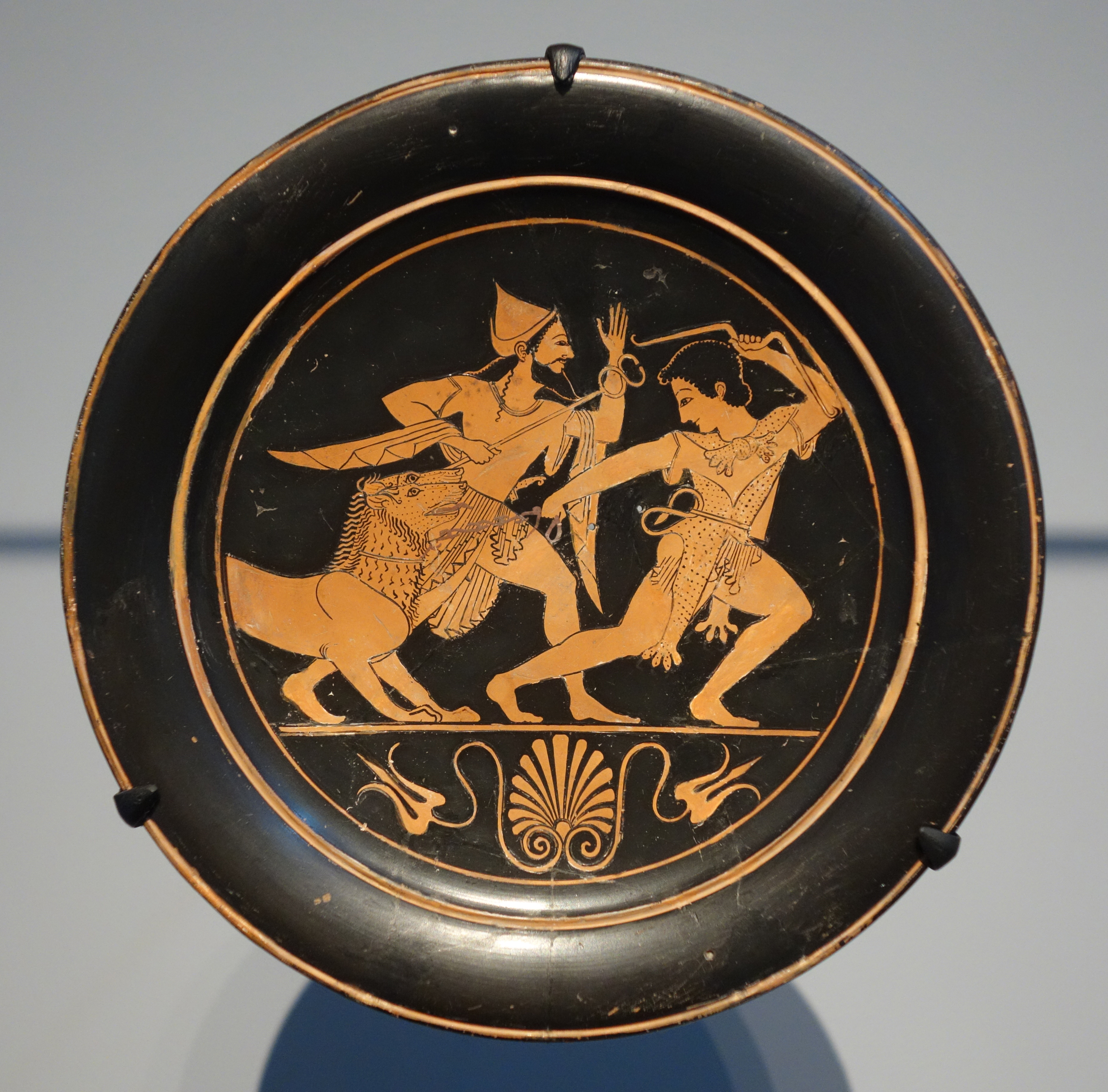 Attic red-figure plate: Heracles leading Cerberus, accompanied by Hermes. Attributed to Paseas, last quarter of the 6th century BC. Museum of Fine Arts, Boston, 01.8025.
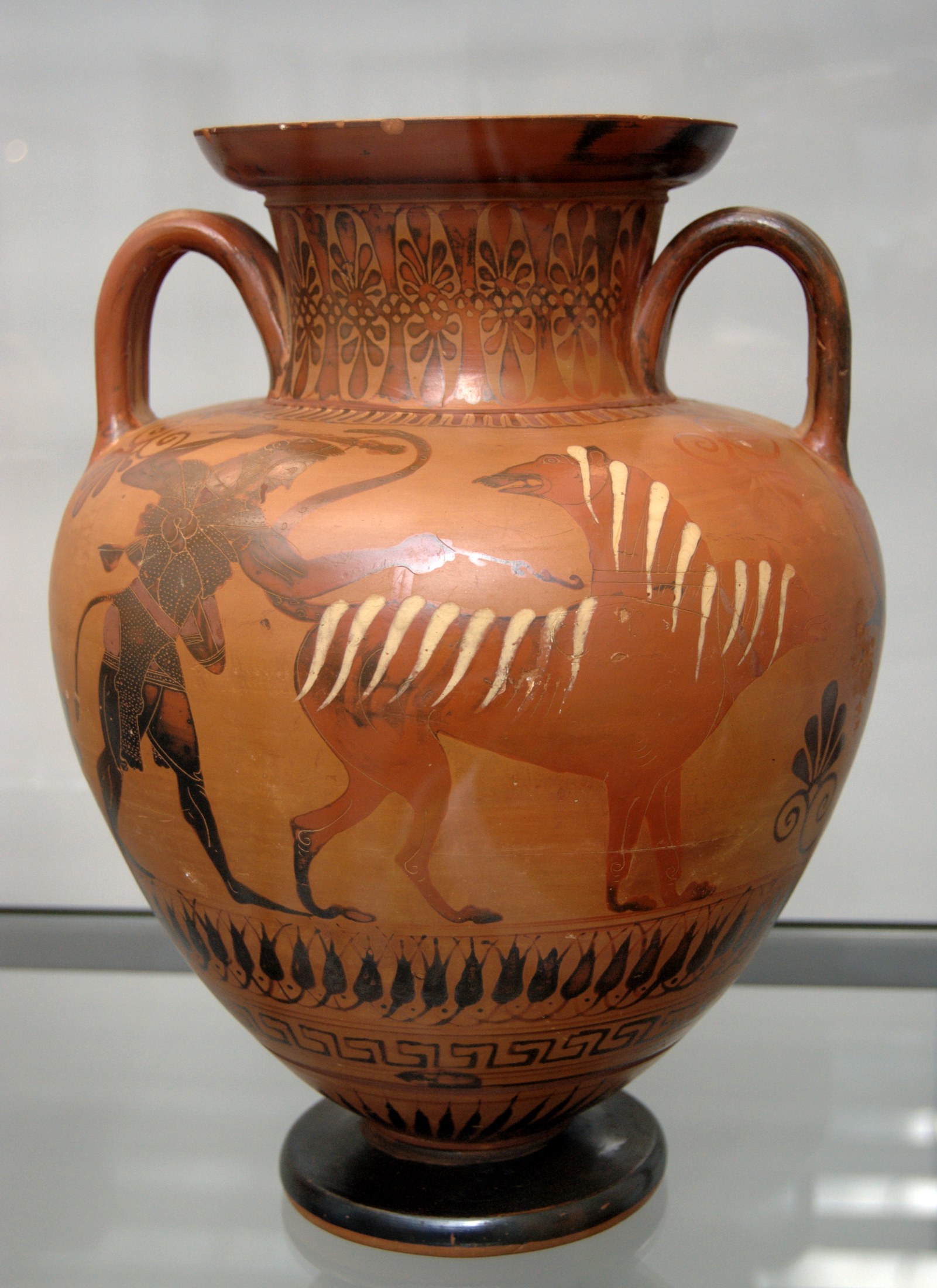 Attic amphora with Herakles and Cerberus, Staatliche Antikensammlungen, Munich.
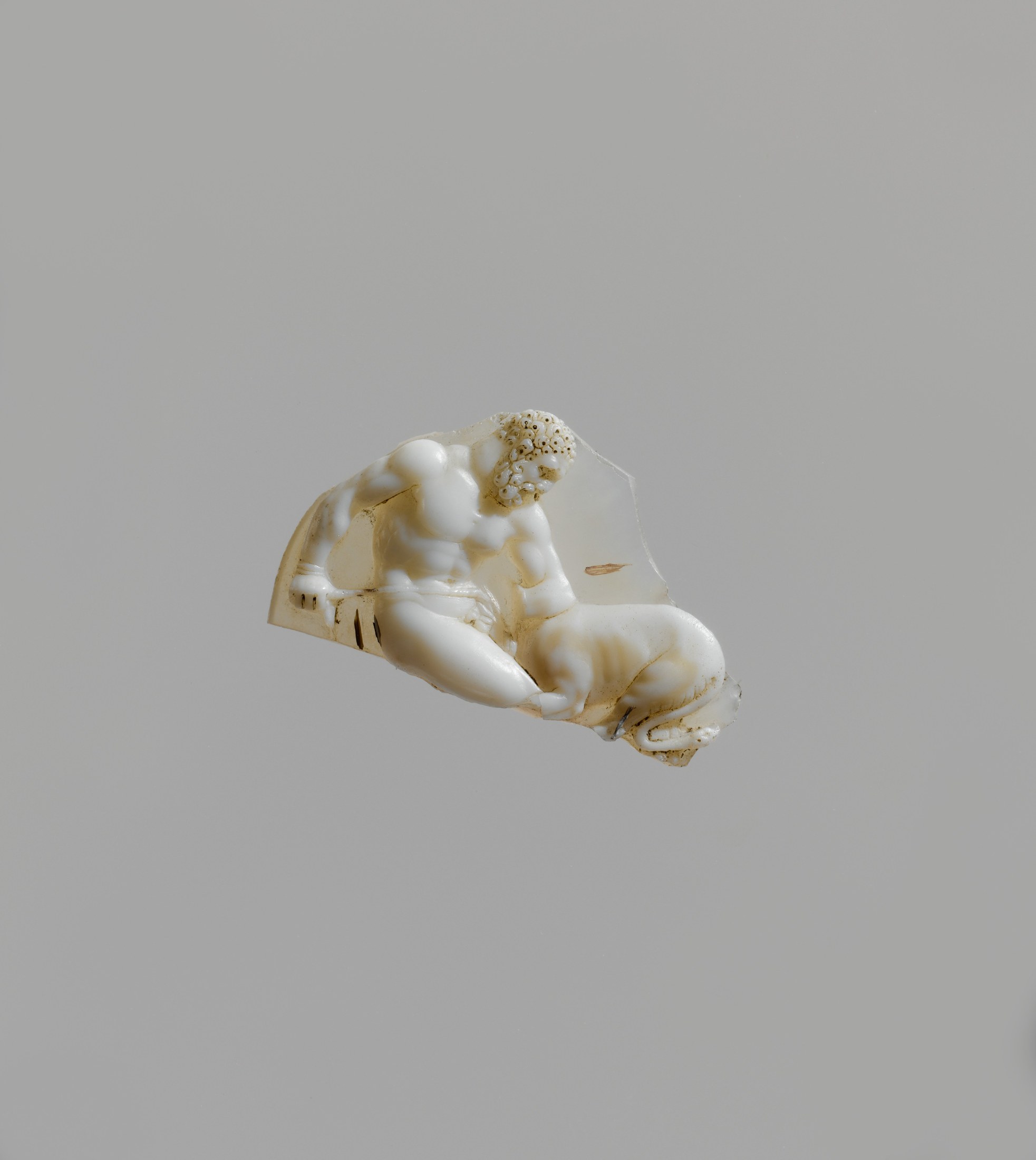 Sardonyx cameo fragment: Hercules tying up Cerberus, first century BC-first century AD. Metropolitan Museum of Art, 81.6.100.
After the Labours
The completion of the twelve labours does not turn Heracles into a quiet king or domestic hero. After his service to Eurystheus he continues to wander, joins new expeditions, takes revenge on enemies, establishes cults, helps other heroes and is again drawn into violence. This is a central feature of his myth: the labours free him from service, but they do not remove the tragic tension between superhuman strength and human fate.
The main later tragedy is connected with Deianeira and the centaur Nessus. When Nessus tries to abduct Deianeira, Heracles shoots him with an arrow poisoned by the Hydra's venom. As he dies, the centaur persuades Deianeira to keep his blood as a love charm. Later, fearing that she will lose her husband, she soaks Heracles' garment in this blood. The Hydra's poison, carried through Nessus' blood, causes unbearable pain and destroys the hero's body. The victory over the Hydra returns at the end of his life as the cause of his own death.
Heracles ascends a funeral pyre on Mount Oeta. In different versions the pyre is lit by Philoctetes or by his father Poeas, who receives the hero's bow and arrows in return. Heracles' death is not an ordinary disappearance: his mortal part perishes, while his divine part rises to Olympus. There he is reconciled with Hera, receives immortality and marries Hebe. The end of the myth therefore joins tragedy and apotheosis: the hero suffers from the consequences of his own victories, but after death becomes a god.
For ancient culture this conclusion was as important as the labours themselves. Heracles could stand for work, suffering and purification, but also for a hero who received divine reward. In Greek cult he occupied an intermediate position between hero and god, while in Rome Hercules was easily connected with victory, roads, trade, military fortune and the imperial image of burden overcome.
Meaning of the Cycle
The twelve labours join several kinds of heroic action. Heracles cleanses the land of monsters, captures living animals, performs heavy work, negotiates, travels to distant peoples, obtains royal and divine objects and descends into the underworld. The cycle therefore became not only a story of strength, but a model of passage through the whole cosmos: from local forests and marshes to Ocean, the garden of the gods and Hades.
In Greek and Roman culture Heracles easily became an example of labour, endurance and victory over limits. The Romans adopted him as Hercules and connected him with roads, trade, military fortune, victory and imperial self-presentation. The same labour could appear on a Greek vase as heroic combat, on a Roman fresco as decorative myth and on a sarcophagus as an image of victory over death.
Monuments and Images
Ancient images rarely showed the whole cycle at once. More often an artist selected one episode: the lion skin as the hero's sign, the Hydra as complex combat, the Amazons as a military subject, the apples of the Hesperides as distant travel or Cerberus as a passage toward death. The images in the article therefore do not replace the full text, but show different ways in which the labours lived in material culture.
Vase-painting is especially useful for Archaic and Classical versions of the labours: Athena, Hermes, Iolaus, Amazons, monsters and signs of distant travel appear beside Heracles. Roman frescoes, phalerae and silver objects show the later fate of the image, where Hercules becomes not only a figure of myth, but also a sign of strength, victory and status.
Related Topics
Literature and sources
- Hesiod. Theogony, 287-332.
- Pseudo-Apollodorus. Bibliotheca, II.5.
- Diodorus Siculus. Library of History, IV.8-39.
- Pausanias. Description of Greece.
- Sophocles. Trachiniae. - Ovid. Metamorphoses, IX.
- Euripides. Heracles.
- LIMC. Herakles.
- Stafford E. Herakles.
- Boardman J. Athenian Black Figure Vases.
- Boardman J. Athenian Red Figure Vases: The Archaic Period.
Interested in Ancient Rome beyond reading? Join Legio X Fretensis or explore our reenactment directions.


