Lernaean Hydra
The Lernaean Hydra was a many-headed water monster of Argolis, connected with the second of the Labours of Heracles. In myth it lived at Lerna, a marshy and lake district south of Argos. Ancient authors associated Lerna with subterranean waters, old cults and a dangerous boundary between the world of the living and the chthonic realm.
The Hydra was not just a large snake. Its image depends on the idea that the monster cannot be defeated by an ordinary blow: new heads grow in place of the severed one, while its breath or blood carries poison. The labour was therefore remembered as a struggle with a threat that returns after every partial success.
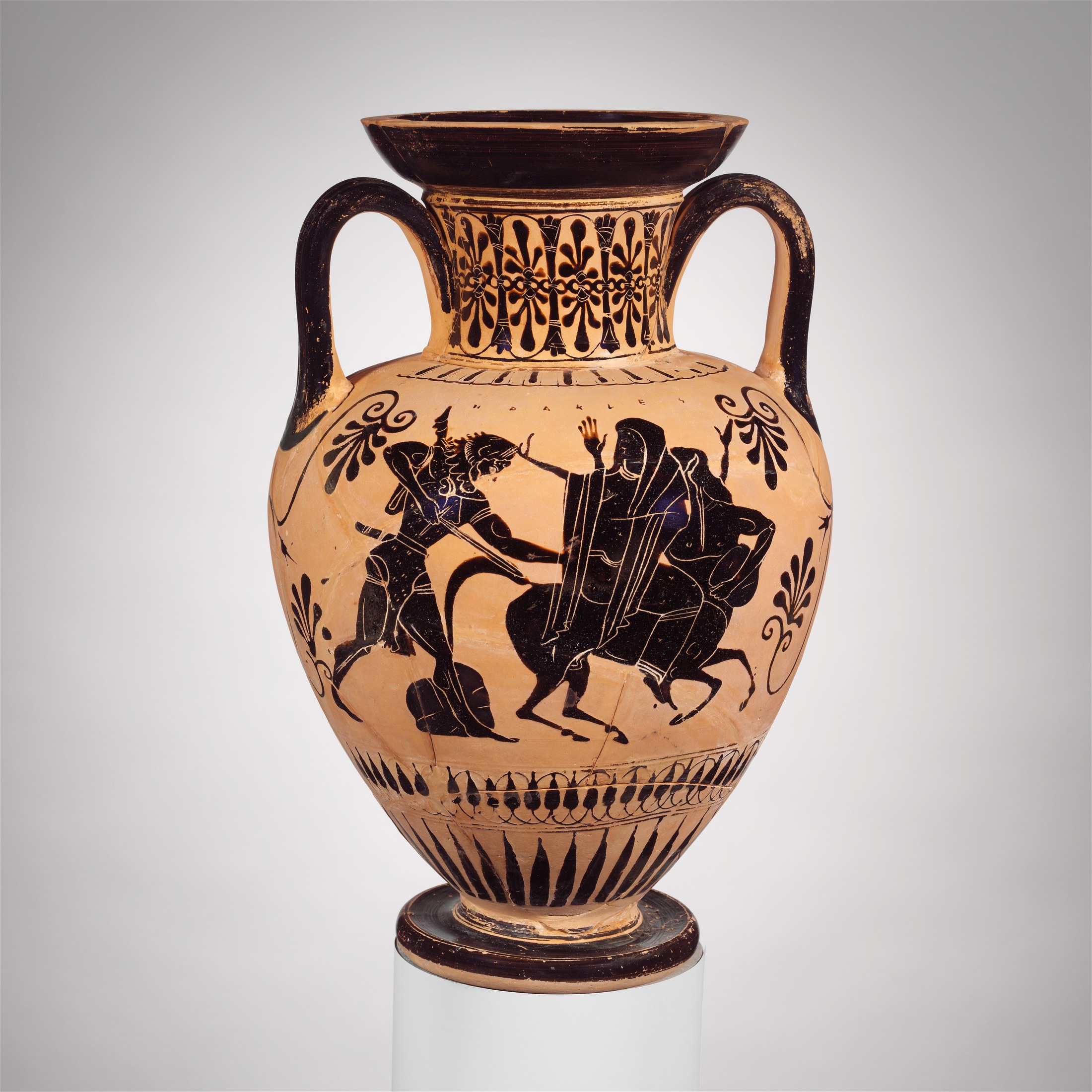 Attic neck-amphora with Herakles and the Hydra, ca. 510 BC. Metropolitan Museum of Art, 56.171.17.
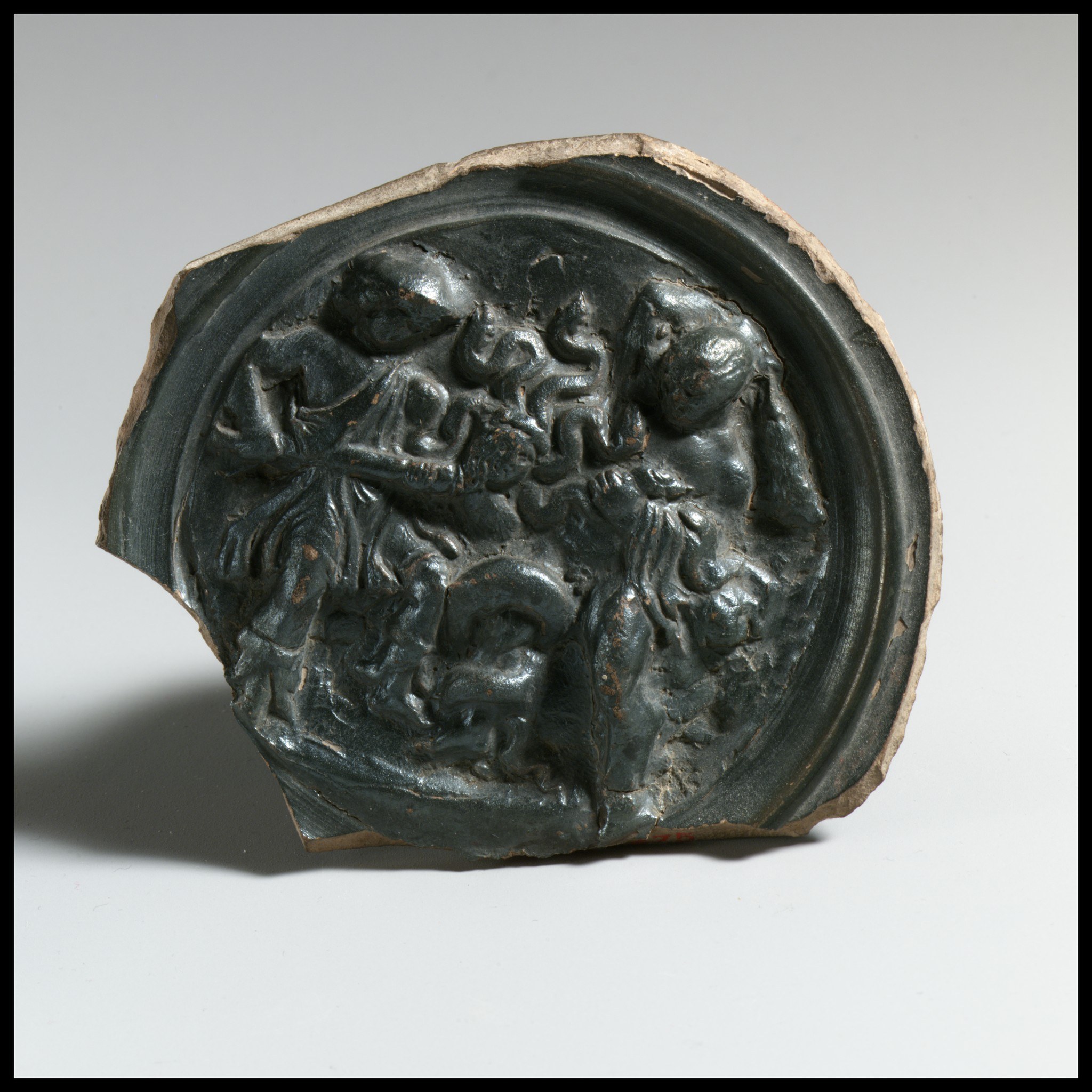 Terracotta tondo from a phiale with Herakles and the Lernaean Hydra, South Italy, late fourth-third century BC. Metropolitan Museum of Art, 17.190.138.
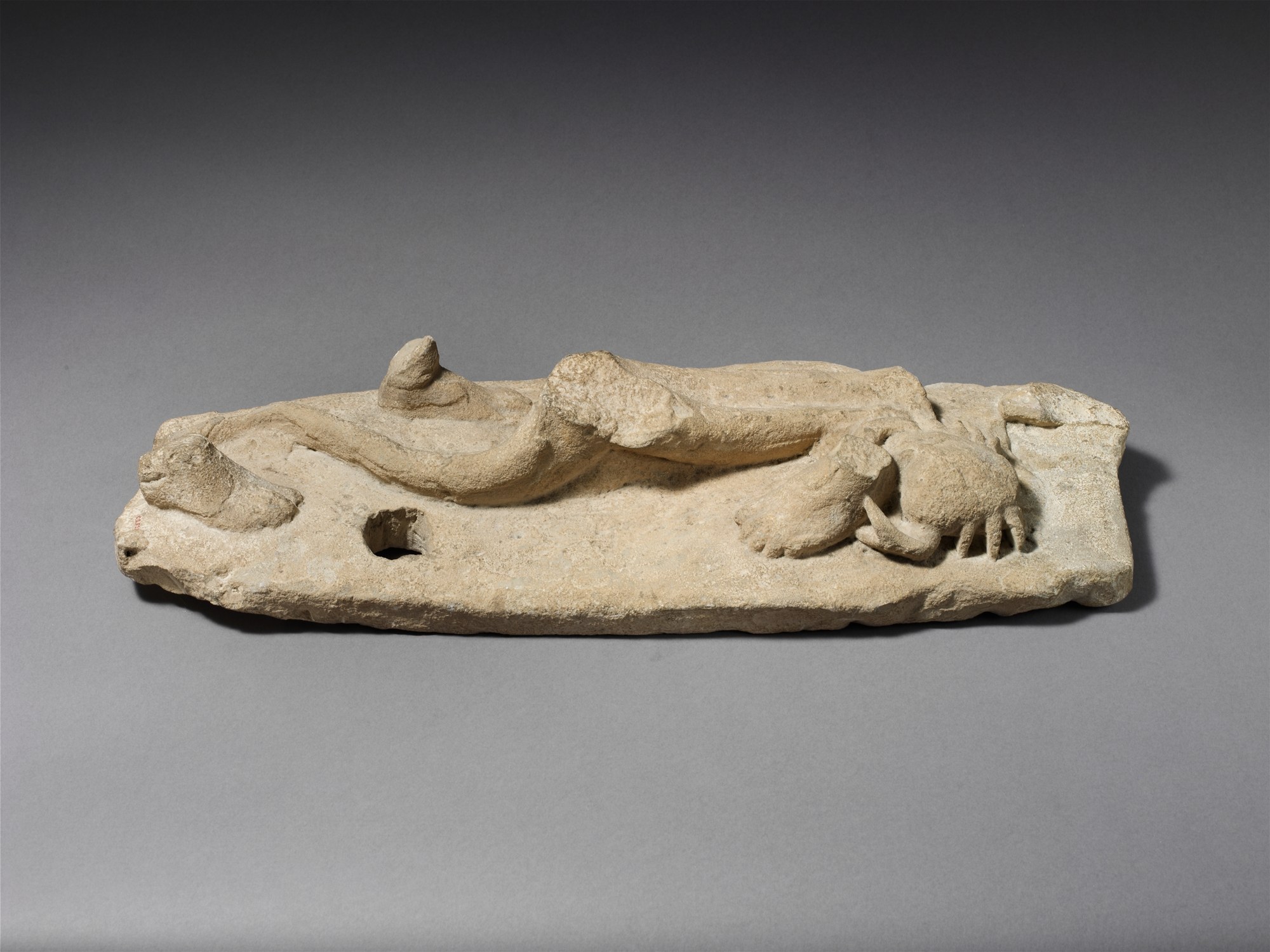 Cypriot limestone plinth with remains of a group of Herakles and the Hydra, late sixth-early fifth century BC. Metropolitan Museum of Art, 74.51.2471.
Origins and Lerna
In the genealogies of monsters the Hydra is usually called a daughter of Typhon and Echidna, belonging to the same chthonic family as Cerberus, the Chimera, the Sphinx and the Nemean lion. This genealogy was less about biology than about the Hydra's place in myth: it comes from an older and dangerous world that the hero must bring under human and divine order.
Lerna was a real place in Argolis, known for springs, a lake, marshes and sanctuaries. The myth uses that landscape effectively: water, reeds, vapours and difficult ground make the setting suitable for a monster. In later retellings the Hydra's lair is sometimes described as a cave or marsh hole from which the creature emerges to meet the hero.
The Second Labour of Heracles
After the victory over the Nemean lion, Eurystheus sends Heracles to Lerna. The hero does not come alone: he is accompanied by Iolaus, his nephew and charioteer. This matters both in texts and in images. On vases and reliefs the scene often appears as coordinated action: Heracles strikes with a sickle, sword or club, while Iolaus cauterises the necks with a torch so that the heads cannot grow back.
In some versions one of the heads was immortal. Heracles cut it off and buried it under a heavy stone by the road. This motif makes the victory literally incomplete: the hero does not destroy immortal force but seals it in the ground. The place of the labour therefore remains linked with danger even after the monster is overcome.
Iolaus, the Crab and the Disputed Labour
Iolaus has an unusually prominent role in the myth. Without him Heracles could not stop the heads from growing back, and for that reason Eurystheus later refused to count the labour as fully independent. The detail shows that the ancient story was concerned not only with heroic strength but also with the rules of glory: help from a companion could put formal victory in doubt.
A giant crab also appears in the battle, sent by Hera against Heracles. The hero crushes it, but Hera places it among the stars. Thus the labour leaves a celestial trace: the constellation Cancer is explained as the memory of a small but loyal ally of the goddess.
Hydra Venom and the Later Fate of Heracles
After the victory Heracles dips his arrows in the Hydra's blood or gall. From that point the monster continues to act after death: its poison kills the hero's enemies, but later returns to Heracles himself. The poisoned blood of the centaur Nessus, tied to the memory of the Hydra arrows, becomes the cause of the hero's agonising death on the funeral pyre.
This connection makes the Hydra important beyond a single labour. An early victory becomes the source of future death: the weapon that helps Heracles win carries the force of the defeated monster. This is a characteristic logic of ancient myth: victory over danger does not always erase its consequences.
Appearance in Ancient Art
Ancient artists did not represent the Hydra in one fixed way. The number of heads varies: sometimes there are only a few, sometimes the body becomes a complex cluster of snakes. The stable elements are more important: Heracles at the water monster, Iolaus with a torch, a tree or marsh setting, and sometimes a chariot beside the fight. In archaic Attic vase-painting the scene reads as heroic combat; in South Italian and Roman works it can become more decorative and theatrical.
The three images in the article show different kinds of evidence. An Attic amphora of about 510 BC preserves an early vase-painting version of the scene. A Campanian terracotta tondo of the late fourth to third century BC shows the myth in South Italian material culture. A Cypriot limestone pedestal of the late sixth to early fifth century BC is important as evidence for a sculptural group in which Heracles, Iolaus and the Hydra formed a single composition.
Meaning of the Image
The Hydra became a powerful image of ineradicable danger. In the myth it is a marsh monster, but more broadly it represents a problem that grows stronger after a direct and unprepared blow. That is why fire, a helper and a sequence of actions matter so much: the hero wins not only by strength but by finding the right method.
For ancient viewers the scene also connected Heracles with the cleansing of the land from monsters. Lerna, like the Nemean valley or the entrance to the underworld in the Cerberus labour, becomes a place where the hero crosses the boundary between ordinary human space and the world of older powers.
Brief Chronology of the Evidence
- Eighth-seventh centuries BC: early Greek epic tradition shapes the genealogies of monsters linked with Typhon and Echidna.
- About 570 BC: the archaic pediment from the Athenian Acropolis shows Heracles, Iolaus and the Hydra in monumental sculpture.
- About 510 BC: Attic vase-painting fixes a stable visual scheme for the fight with the Hydra.
- Fifth-fourth centuries BC: the subject spreads through vase-painting, terracotta and small-scale sculpture.
- Hellenistic and Roman periods: the Hydra remains a recognisable episode in the Heracles cycle.
Related Topics
Literature and sources
- Hesiod. Theogony, 313-318.
- Pseudo-Apollodorus. Bibliotheca, 2.5.2.
- Pausanias. Description of Greece, 2.36.6-8.
- Sophocles. Trachiniae.
- LIMC, Herakles / Hydra.
- Stafford E. Herakles.
- Ogden D. Dragons, Serpents, and Slayers in the Classical and Early Christian Worlds.
- Boardman J. Athenian Black Figure Vases.
Interested in Ancient Rome beyond reading? Join Legio X Fretensis or explore our reenactment directions.


