Centaurs
Centaurs are beings with a human upper body and a horse's body, one of the most persistent images in Greek mythology. They live at the edge of human space: in mountains, forests, on roads, at feasts and where the hero meets the wild. A centaur is therefore not merely a fantastic half-horse, but a boundary body: human hands, speech and reason are joined with animal force, impulse and danger.
Ancient tradition did not make all centaurs alike. Some are linked with drunkenness, violence and violation of hospitality; others, especially Chiron, carry knowledge, medicine, music and hunting. This ambiguity matters: a centaur can be an enemy of order, a teacher of heroes, an emblem of military force or a sign of nature that humans must not only defeat but also understand.
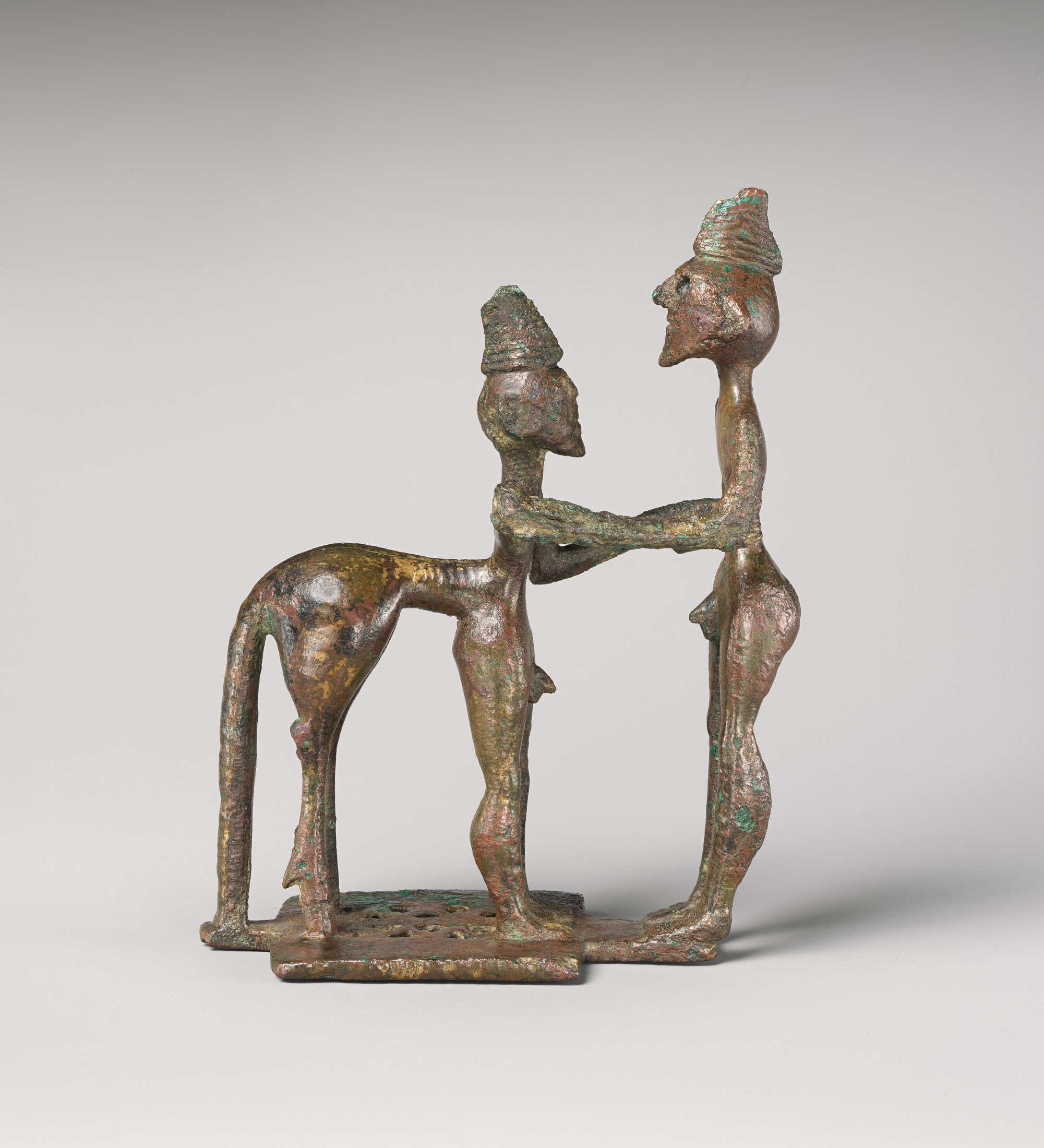 Greek bronze statuette of a man and centaur, ca. 750 BC. One of the early monuments of the centaur image. Metropolitan Museum of Art, 17.190.2072.
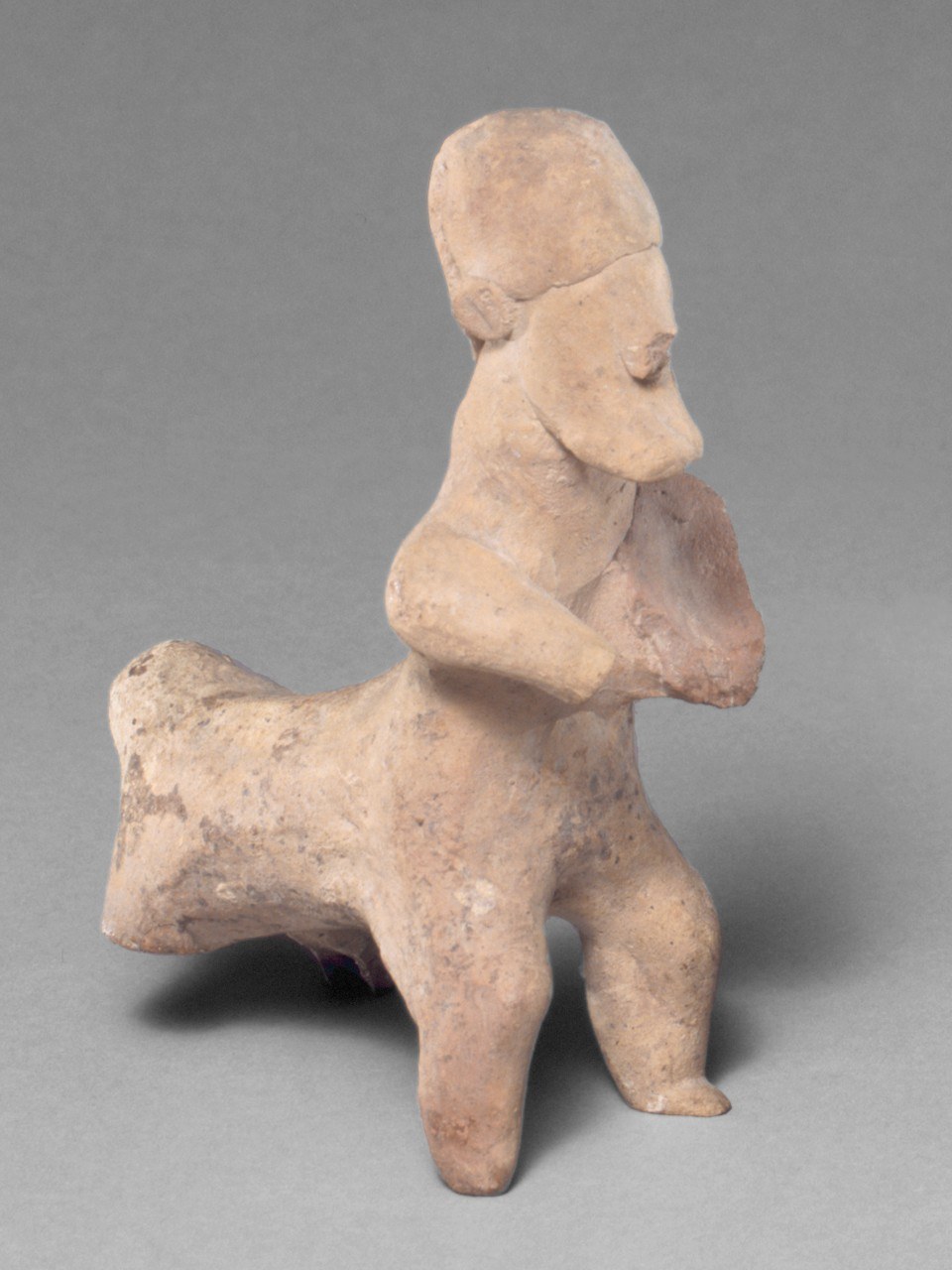 Cypriot terracotta figurine of a centaur, ca. 600-480 BC. Metropolitan Museum of Art, 74.51.1564.
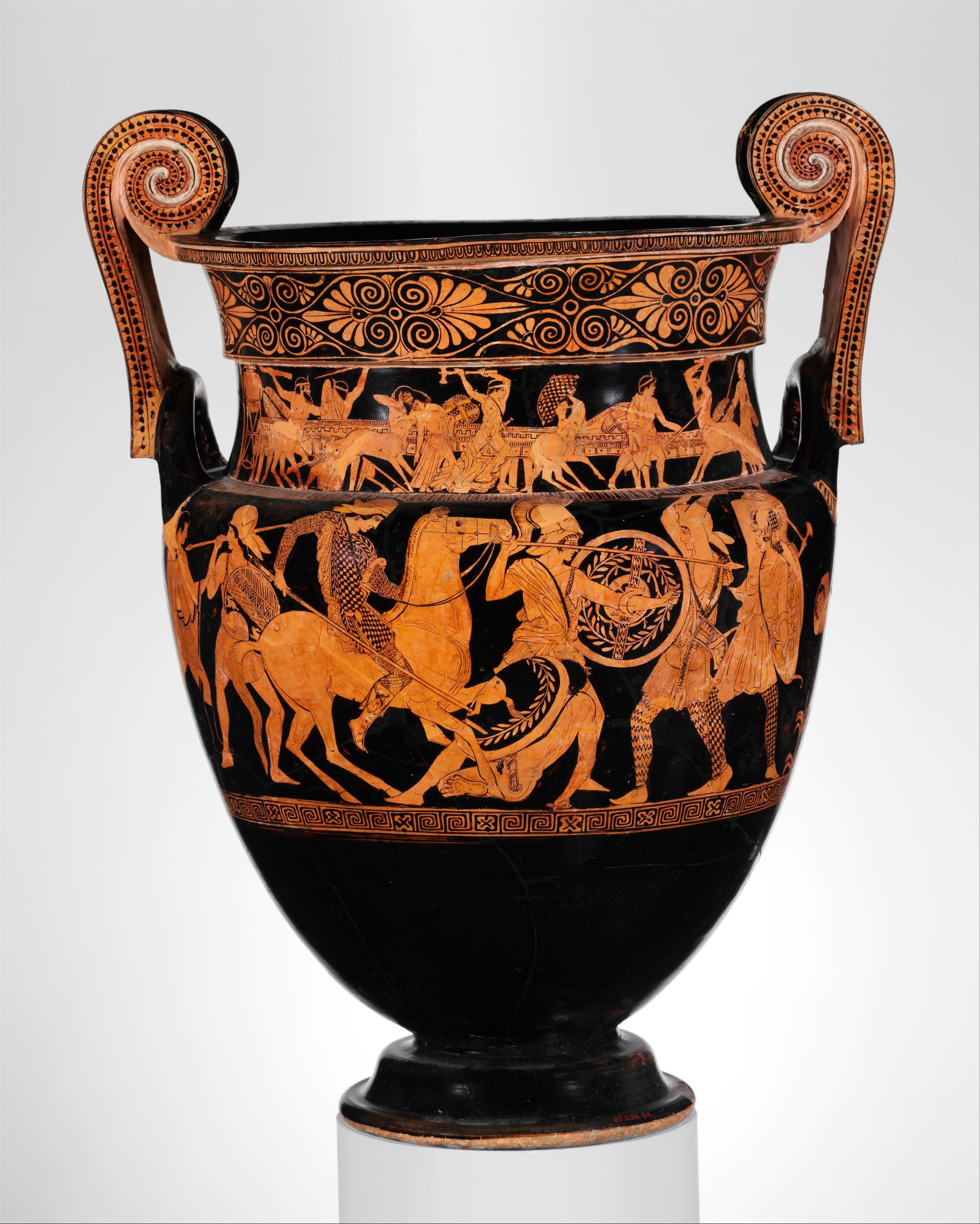 Attic red-figure volute-krater; on the neck, battle of centaurs and Lapiths, and on the body, Amazonomachy. Attributed to the Painter of the Woolly Satyrs, ca. 450 BC. Metropolitan Museum of Art, 07.286.84.
Origins and Appearance
The genealogies of the centaurs vary in ancient texts. They were often traced to Ixion, who violated measure before the gods, and to the cloud Nephele, shaped like Hera. In that version the origin itself speaks of a wrong joining of desire, deception and punishment. Centaurs appear not as an ordinary people, but as the result of an event in which the human element escapes control.
Their homeland was most often Thessaly and Mount Pelion. This is a space close to the Greek world, but outside urban order: a place of hunting, horses, travellers, feasting and fighting. The centaur is dangerous precisely because he is close to humans. He speaks, drinks wine and enters kinship or guest relations, yet at any moment he can destroy the rules that make such relations possible.
In early art the centaur's form does not always match the familiar Classical type. The eighth-century BC bronze group shows artists searching for a way to join human and equine bodies. Later the more recognisable scheme became fixed: a human torso rises from the front of a horse's body, while the hands allow the centaur to hold a stone, branch, weapon, vessel or musical instrument.
Centauromachy
The best known collective story about centaurs is the Centauromachy, the battle of Lapiths and centaurs at the wedding of Pirithous. The centaurs arrive as guests, but wine, feasting and proximity to women lead to collapse. They try to seize the bride and other Lapith women, breaking several foundations of order at once: hospitality, marriage, bodily control and respect for the host's house.
Theseus, the friend of Pirithous, takes part in the battle. This was especially useful in Athenian tradition: the hero who defeated the Minotaur also becomes a defender of wedding, civic and bodily order. Scenes of Centauromachy on vases, metopes and reliefs are therefore not merely fights between men and monsters, but images of cosmos restraining chaos.
The Centauromachy became part of the language of Greek public art. In temple programs it could stand beside Amazonomachy, Gigantomachy and other battles in which order confronts a force threatening the community. Yet the centaur is not simply an outsider: he is too close to man. His violence shows that the collapse of measure can come not only from outside but from within the human body itself.
Chiron and the Centaur as Teacher
Chiron differs sharply from the violent centaurs of the Centauromachy. He was associated with Mount Pelion, the knowledge of herbs, healing, music, hunting and the education of heroes. His pupils included Achilles, the future hero of the Iliad, Asclepius, Jason of the Argonauts cycle and other figures. In this image equine nature does not destroy reason, but joins with long memory and knowledge of the world.
Chiron's fate is tragic. He is accidentally wounded by Heracles' poisoned arrow, dipped in the blood of the Lernaean Hydra. As an immortal, Chiron cannot simply die, so suffering becomes a separate myth about the price of immortality. Later versions tell that he gives up immortality and receives release through death. This separates him from the ordinary monster: Chiron suffers not as the hero's enemy, but as a wise teacher caught in another's disaster.
Through Chiron the centaur becomes more than a warning about wildness. He shows another possibility: natural force can be educated, and knowledge of nature can become part of heroic training. A hero must master body, weapon, music, hunting and medicine; the centaur teacher connects those skills with the world beyond the city.
Heracles, Nessos and the Dangerous Gift
Another group of myths connects centaurs with the Labours of Heracles and with the hero's own death. The centaur Pholus receives Heracles in his cave and opens a communal jar of wine; the smell draws other centaurs, a fight begins, and the hero's arrows, poisoned with the Hydra's blood, kill many opponents. The themes of feast, wine and the collapse of measure return here.
Nessos is even more important. He carries Deianeira across a river, tries to assault her and is struck by Heracles' arrow. Dying, Nessos gives Deianeira his blood as if it were a love charm. Later she soaks Heracles' garment in that blood, and the Hydra's poison returns to the hero through the centaur's blood. The centaur thus becomes not only an enemy in a single fight, but the carrier of a delayed threat: a gift that promises love and safety becomes the cause of death.
These stories show why centaurs are not merely decorative monsters. They enter myths about hospitality, marriage, violence, trust and the consequences of heroic force. Victory over a centaur may end the combat, but it does not always cancel the power of his word, blood or gift.
Monuments and Images
Centaurs appear in many kinds of monuments: small bronzes, terracottas, vase-painting, temple sculpture, coins and Roman decorative objects. The early bronze group of a man and centaur, about 750 BC, is important because the image is not yet fully canonical and may preserve a very early version of the Nessos story. The Cypriot terracotta figurine shows that the centaur was understood not only in mainland Greece but also in the eastern Mediterranean; such figurines could be connected with sanctuaries and dedications.
The krater with Centauromachy gives another scale. Here the centaur is part of a large narrative cycle: the battle of Lapiths and centaurs stands beside Amazonomachy, another myth about the confrontation between Greek order and dangerous boundary force. For a fifth-century BC viewer such scenes worked as a visual language in which body, gesture and violence explained moral and political order without long text.
The Roman coin from Singara shows the later life of the image. The centaur on the reverse no longer tells a specific Greek myth, but works as the emblem of a legion and of frontier military force. This does not erase the older mythology; rather, Roman use proves that the centaur remained a recognisable sign of speed, strength and an intermediate position between worlds.
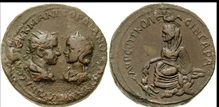 Bronze coin from Singara with portraits of Gordian III and Tranquillina; the reverse shows a centaur, emblem of Legio I Parthica. Third century AD.
Brief Chronology of the Image
- Eighth century BC: bronze groups and early small sculpture record interest in the centaur's mixed body.
- Seventh-sixth centuries BC: centaurs enter vase-painting and terracotta; the story of Nessos and Heracles develops.
- Fifth century BC: Centauromachy becomes a major subject in vase-painting and temple sculpture, connected with the language of civic order.
- Hellenistic and Roman periods: centaurs remain part of mythological art, decorative programs and the symbolism of force.
- Third century AD: the centaur on coins of Singara shows the transformation of the mythological being into a legionary emblem.
Related Topics
Literature and sources
- Homer. Iliad.
- Pindar. Pythian Odes, 3.
- Pseudo-Apollodorus. Bibliotheca.
- Ovid. Metamorphoses, IX; XII.
- Diodorus Siculus. Library of History, IV.
- LIMC. Kentauroi et Kentaurides; Cheiron; Nessos.
- Boardman J. Athenian Red Figure Vases: The Classical Period.
- Padgett J. M. The Centaur's Smile: The Human Animal in Early Greek Art.
- Metropolitan Museum of Art: 17.190.2072; 74.51.1662; 07.286.84.
Interested in Ancient Rome beyond reading? Join Legio X Fretensis or explore our reenactment directions.


