Argonauts
The Argonauts are the heroes of the Greek myth about Jason's expedition to Colchis for the Golden Fleece. Their ship Argo gathers members of many heroic lineages: Orpheus, Heracles, Castor and Polydeuces, Peleus, Telamon, Zetes and Calais, Meleager and others, with the crew list varying by version. The myth combines sea adventure, dynastic struggle for power, heroic trial, Medea's magic and Greek ideas about a distant eastern edge of the world.
Unlike the Iliad, where war is already under way, and the Odyssey, where the hero returns home, the story of the Argonauts describes the generation before the great Trojan heroes. It was therefore often understood as a prehistory of the heroic age: fathers and older contemporaries of future participants in the Trojan War still act together, and the world appears open to distant voyages, marriage alliances and dangerous encounters with the marvellous.
Origins of the Expedition
The plot begins with power in Iolcus. Pelias had seized authority by pushing aside the legitimate line of Aeson, Jason's father. When Jason came to him wearing one sandal, Pelias remembered a prophecy about the man who would become dangerous to him. Rather than kill him openly, he sent Jason for the Golden Fleece, expecting the voyage to Colchis to be fatal for the young claimant.
The Golden Fleece came from another myth. Phrixus and Helle, children of Athamas and Nephele, fled on a miraculous ram; Helle fell into the sea that became known as the Hellespont, while Phrixus reached Colchis and sacrificed the ram. The fleece remained with King Aeetes and was guarded by a dragon. Recovering it was therefore not merely the theft of a valuable object, but an intrusion into the sacred and royal memory of Colchis.
The Ship Argo and the Crew
In the myth Argo is the first great ship of the heroic age. Its builder was called Argus, and Athena was said to have assisted him; in some versions a prophetic piece of wood from the sacred oak of Dodona was fitted into the prow. Argo was therefore not simply transport but a participant in the expedition: the ship carried the heroes across unknown waters and linked human craftsmanship with divine support.
The list of Argonauts differed in Pindar, Apollonius Rhodius, Apollodorus and later authors. Constant or frequent members included Jason, Orpheus, the helmsman Tiphys, the builder Argus, Castor and Polydeuces, the Boreads Zetes and Calais, Peleus, Telamon, Idmon, Mopsus, Meleager, Ancaeus and, in some versions, Heracles. This crew turned the voyage into an assembly of almost all heroic Greece, not a private adventure of Jason alone.
An important feature of the myth is that Jason is not the strongest member of his own expedition. Heracles is stronger, Orpheus commands song, Tiphys and Ancaeus steer the ship, the seers Idmon and Mopsus understand omens, the Boreads can fly, and Polydeuces defeats Amycus. Jason is central not because he physically surpasses everyone, but because he must hold the alliance together and bring the task to completion.
The Argonauts therefore function as a collective hero. The expedition requires different skills: strength, speech, prophecy, craftsmanship, seamanship, kinship ties and the ability to negotiate. In this respect the myth reveals a Greek idea of the heroic generation as a network of lineages. Each participant carries his own fame, but during the voyage that fame is temporarily subordinated to a common goal.
The Route to Colchis
The expedition is built as a chain of stops and trials. On Lemnos the heroes meet women left without men after a bloody conflict; among the Cyzicenes an accidental night battle ends with the death of the friendly king Cyzicus; in Mysia Hylas disappears at a spring, and in several versions Heracles remains to search for him and leaves the main expedition. These episodes show that the route breaks ordinary bonds and constantly tests the crew's ability to remain together.
The Argonauts then encounter Amycus, king of the Bebryces, who forced strangers to box with him. Polydeuces defeats him, and the episode stresses not only heroic strength but the shift from savage violence to contest under rules. The blind seer Phineus then reveals the passage through the Symplegades, the clashing rocks. The Boreads drive away the Harpies who torment Phineus, and Argo passes between the rocks, opening the way into the Black Sea.
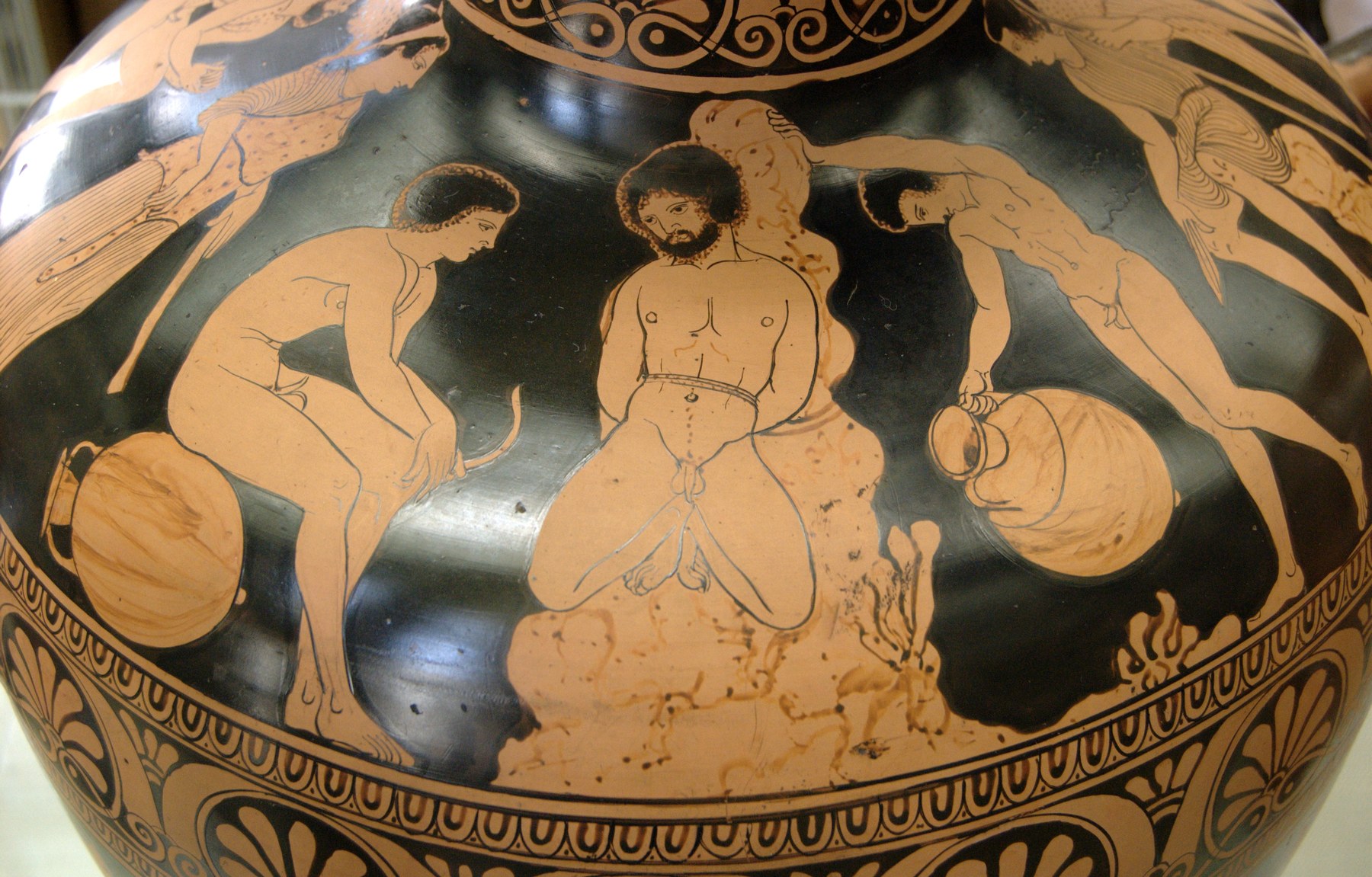 The Argonauts bind Amycus after his duel with Polydeuces. Lucanian red-figure hydria, about the 4th century BC; Cabinet des Medailles, Paris.
Colchis as an Edge of the World
In the myth Colchis lies far to the east, at the limits of the known sea. For Greeks this space was associated with wealth, the sun, foreign customs, powerful kings and dangerous magic. King Aeetes is the son of Helios, brother of Circe and father of Medea; his genealogy immediately places Colchis in a world where kingship and supernatural knowledge are almost inseparable.
The journey to Colchis can be read as a mythic exploration of the distant route to the Black Sea. It is not a report of a real expedition, but it preserves Greek interest in straits, islands, coastal peoples and trade directions. The Symplegades, Thrace, the Bebryces, Colchis and the return through different seas form a map in which geography is joined to the testing of the boundary between familiar and foreign.
Colchis and Jason's Trials
In Colchis Jason asks King Aeetes for the Golden Fleece, but receives impossible conditions. He must yoke fire-breathing bulls with bronze hooves, plough a field, sow dragon's teeth and survive the attack of warriors who grow from the earth. The trial is designed so that victory by physical strength is impossible. Jason can survive only through the help of Medea, daughter of Aeetes and priestess of Hecate.
Medea gives Jason a drug that protects him from fire and iron, and teaches him to throw a stone among the warriors born from the teeth so that they kill one another. She then helps put to sleep the dragon guarding the fleece. In ancient vase painting and later imagery this moment became one of the central scenes: hero, monster, fleece, protecting goddess and the woman without whom the feat is impossible appear together.
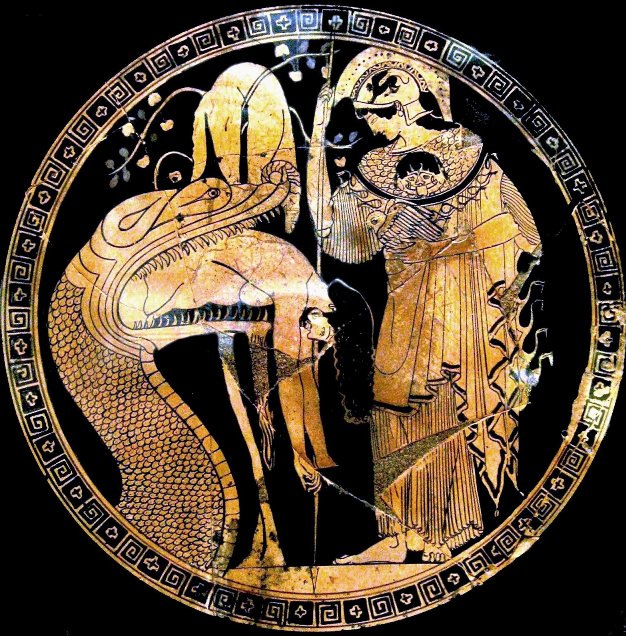 Jason, Athena and the dragon guarding the Golden Fleece. Red-figure cup by Douris, around 480-470 BC; Vatican Museums.
Medea
Medea is not a supporting figure but the main force behind the Colchian part of the myth. She defies her father, leaves her homeland, ties her fate to Jason and turns the expedition from heroic quest into a story of betrayal, marriage, exile and revenge. In different versions she chooses to help Jason under the influence of Eros, Aphrodite or Hera, but the result remains harsh: her knowledge saves the Argonauts and destroys her own house.
On the return journey Medea helps delay the pursuers. In the darkest version she is involved in the death of her brother Apsyrtus: his death cuts the bond with Colchis completely and makes return impossible. Later, in Iolcus, Medea deceives the daughters of Pelias by demonstrating the rejuvenation of a ram and persuading them to repeat the rite on their father. Revenge on Pelias is thus achieved not by Jason's sword but by Medea's magic and deception.
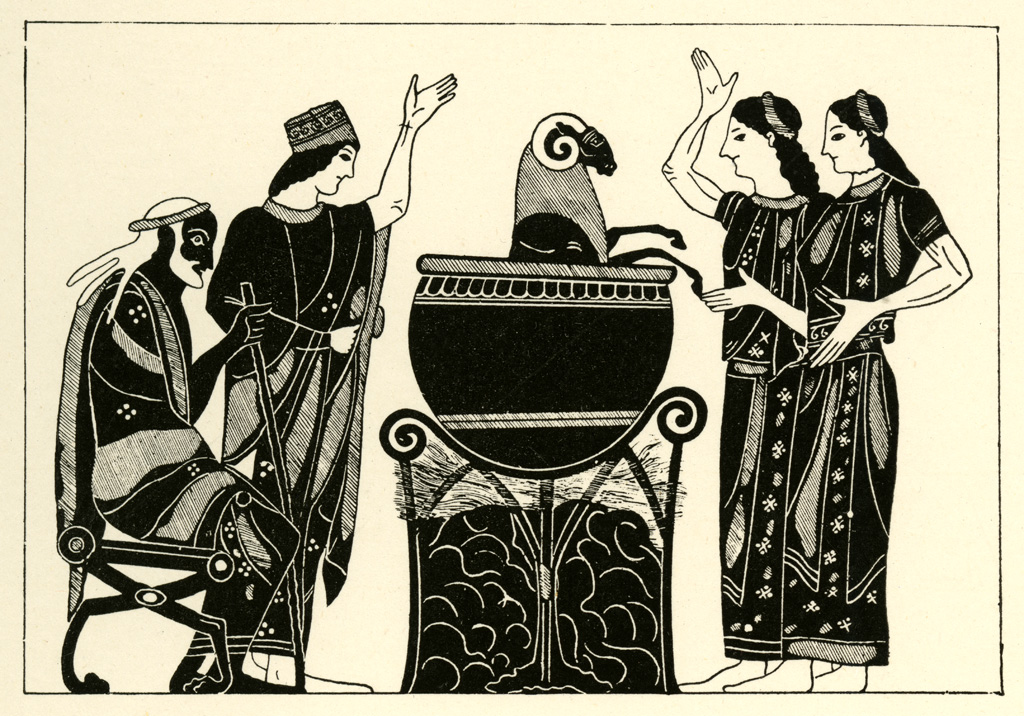 Medea rejuvenates a ram before the daughters of Pelias. An 1894 drawing after an Attic black-figure amphora in the British Museum.
Return and the Island of Talos
The return route is described differently in different traditions. The Argonauts may pass through the Danube, the Adriatic, Libya, Circe, the Phaeacians and Crete; the route reflects not geography in a modern sense but the widening of Greek mythic space. The principle matters more than the map: it is not enough to seize the fleece, it must be carried across the boundaries of foreign kingdoms, seas and ritual prohibitions.
On Crete the Argonauts meet Talos, a bronze guardian who circles the island and throws stones at foreign ships. His vulnerability lies in a vein or plug at the ankle through which his life-fluid can escape. Medea persuades or deceives Talos, and he dies. The episode became one of the most striking in ancient art: the myth brings together an artificial body, magic, technology and fear of a guardian at the border.
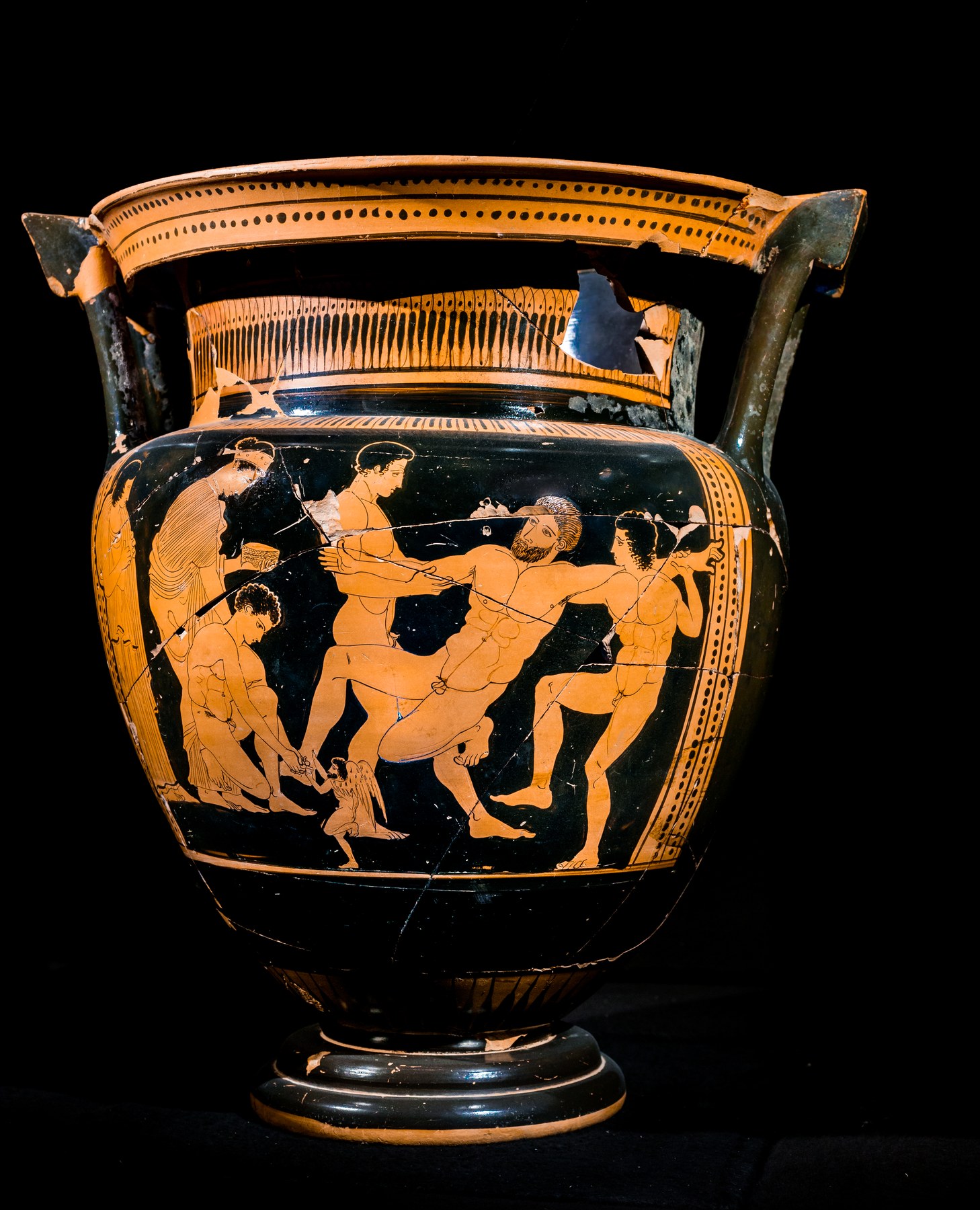 The death of Talos: Medea and the Argonauts disable the bronze guardian of Crete. Attic red-figure krater, around 450-400 BC.
Gods, Omens and Rituals
The expedition constantly depends on gods and rituals. Athena helps with the ship, Hera protects Jason and guides events against Pelias, Aphrodite and Eros intervene in Medea's fate, and Apollo is connected with prophecy and purification. The myth does not separate sea adventure from religious practice: before sailing, after disasters and after killings the heroes need sacrifice, purification and correct interpretation of signs.
Orpheus is especially important as a figure who joins the heroic world to the power of song. In different versions his music helps the rowers, overcomes the Sirens' song or orders the mood of the crew. The seers Idmon and Mopsus remind the reader that heroic courage without knowledge of divine will is dangerous. Argo's success therefore depends not only on weapons, but also on speech, song, ritual and the ability to hear warning.
Meaning of the Golden Fleece
The Golden Fleece can be read on several levels at once. Within the myth it is the sacred relic of Phrixus, a sign of Aeetes' kingship and the condition for Jason's return to Iolcus. For the heroic plot it is the object around which the crew gathers and alliances are tested. For Greek imagination it connected wealth, eastern lands, sea travel, dangerous acquisition and the idea that legitimate power could be restored only through risk.
Yet Jason's victory is incomplete. He brings the fleece to Pelias, but does not gain stable power and does not preserve a happy marriage. In later tragic tradition, especially in Euripides, the story of Jason and Medea becomes an example of heroic glory turning into family catastrophe. The myth of the Argonauts therefore does not end in simple success: the winning of the fleece opens a chain of new conflicts.
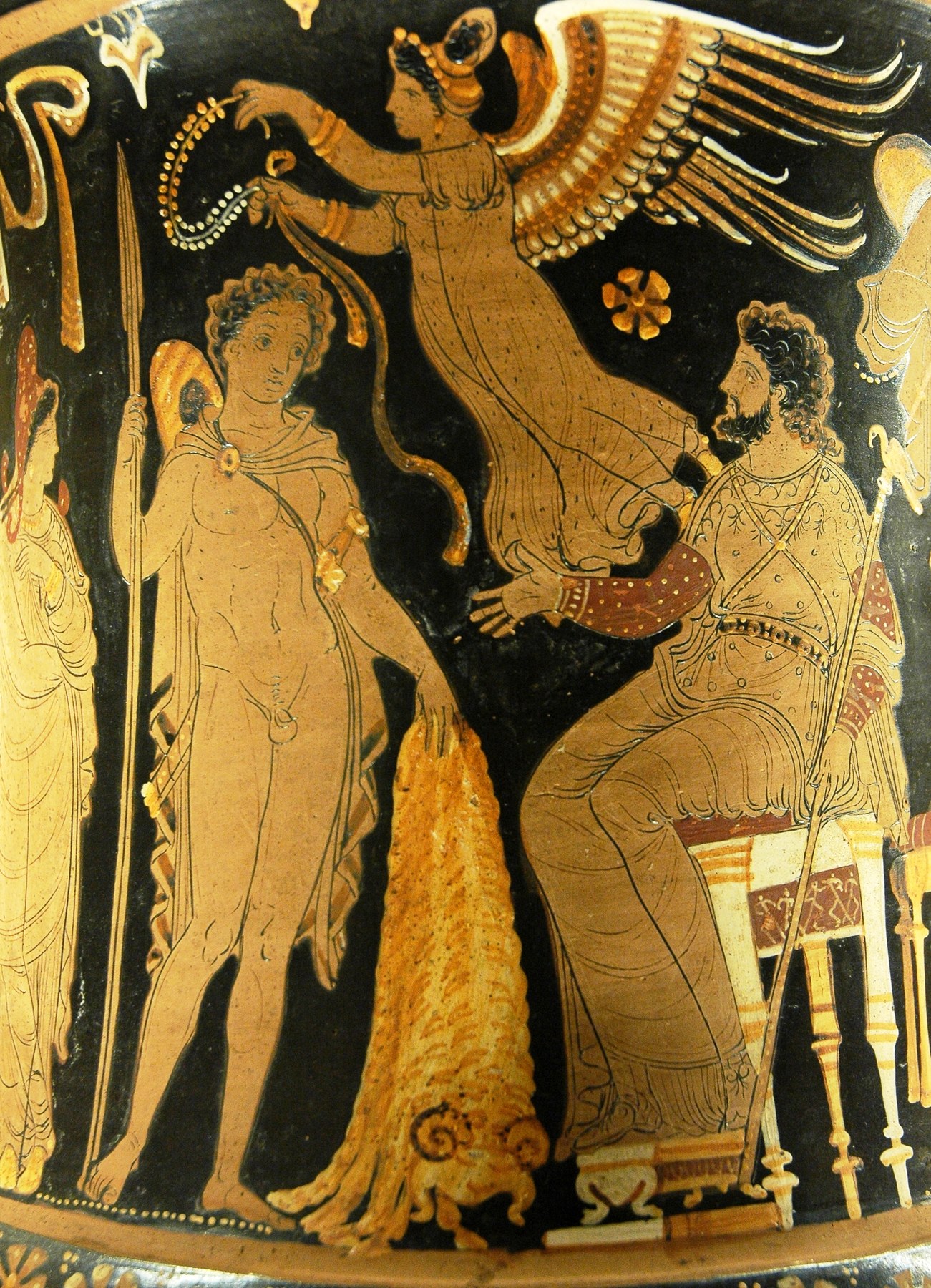 Jason brings the Golden Fleece to Pelias. Apulian red-figure calyx krater, around 340-330 BC; Louvre, K 127.
Literary Versions
The fullest ancient narrative is the Argonautica of Apollonius Rhodius, composed in the Hellenistic period. It is not early oral epic but a learned poem that knows Homer, geography, local cults and many variants of myth. Apollonius gives special depth to Medea's psychology: her fear, shame, passion, hesitation and resolve become no less important than the ship's route.
Other authors emphasized different things. Pindar in Pythian 4 connected the expedition with aristocratic memory and Cyrene. Apollodorus gave a concise mythographic account. Diodorus Siculus placed the story within a broad history of heroes. The Roman poet Valerius Flaccus rewrote the Argonautica in an imperial context, strengthening themes of power, fear and political violence.
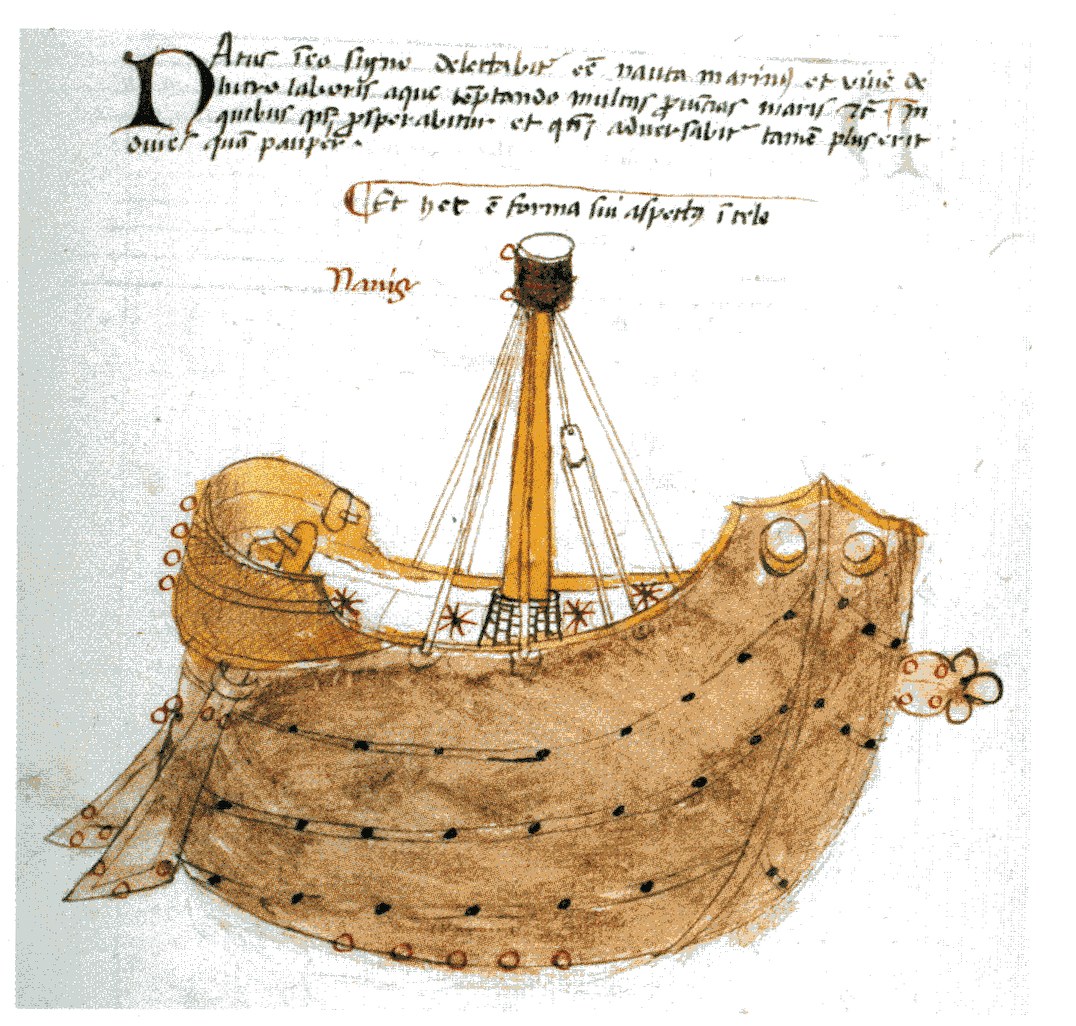 The ship Argo in a medieval manuscript tradition, 14th century; the late image shows the myth's long life beyond antiquity.
Later Fate of Jason and Medea
After the return the Argonautic success quickly becomes a problem. Jason and Medea become exiles, and their union depends on usefulness and oaths rather than peaceful social recognition. In the Corinthian version Jason tries to make a new marriage with a royal daughter in order to gain position and security. Medea reads this as betrayal, and the later tragedy destroys what began as heroic rescue.
This is why the Argonaut myth matters as more than an adventure. It shows that a feat can win an object and fame without necessarily creating a just order. Jason obtains the fleece through another person's help, but cannot preserve the relationships on which the victory depended. Medea saves the hero, but becomes a figure of terror herself. This outcome makes the myth one of the most complex stories about the price of heroic success.
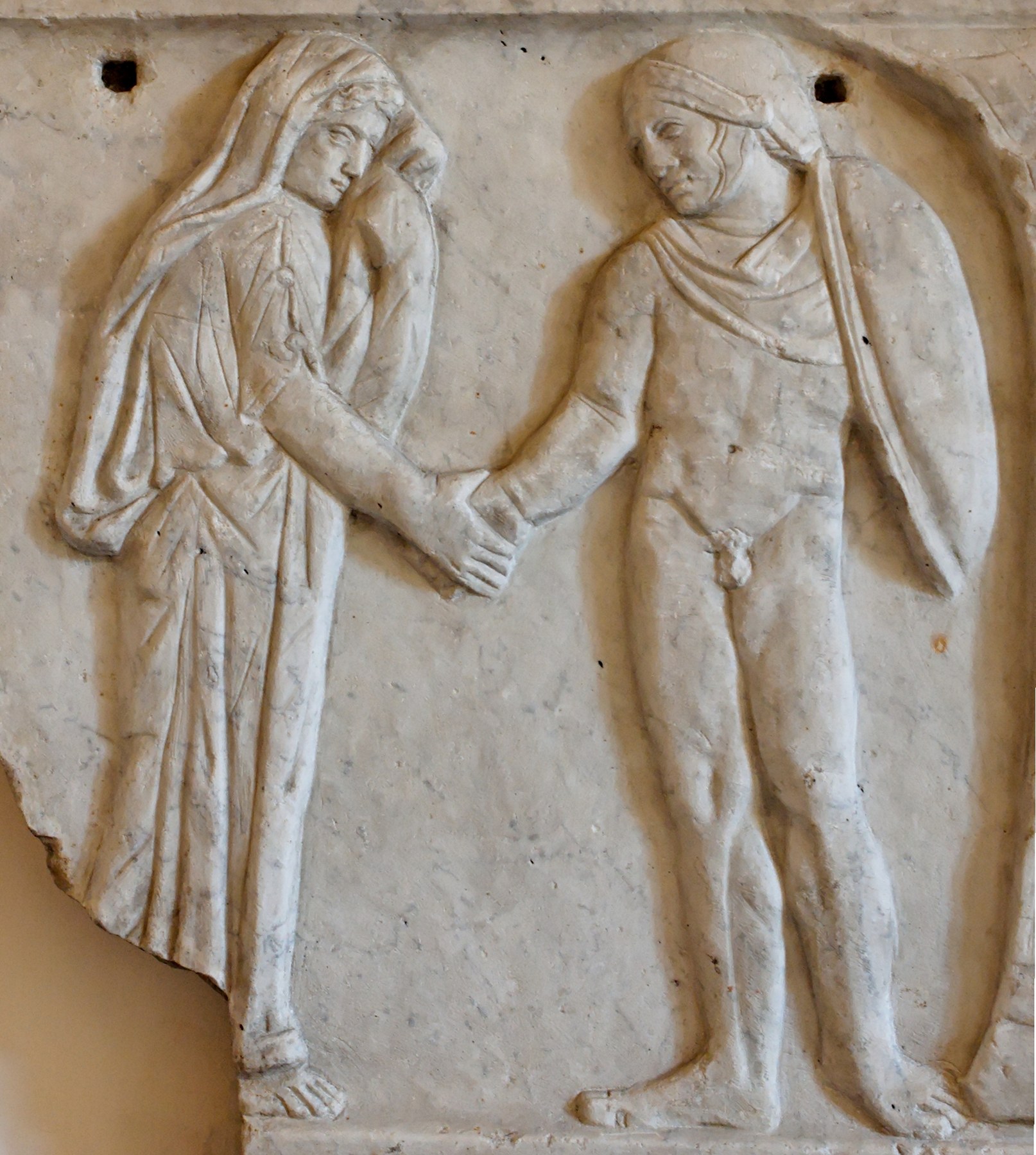 Jason and Medea on a Roman sarcophagus with the Argonaut myth; National Roman Museum, Palazzo Altemps.
Visual Tradition
Archaeological and artistic evidence shows which episodes of the myth were recognizable to viewers. Vases depicted Jason by the dragon, the return with the fleece, Amycus, Talos and scenes involving Medea. Roman sarcophagi and reliefs moved the story into funerary and family contexts, where marriage, betrayal, lineage and the dangerous power of love mattered. Medieval manuscripts preserved Argo as part of the bookish memory of antiquity.
These images are not illustrations of one fixed text. Many are earlier than Apollonius Rhodius or develop independent variants. When reading the myth it is therefore important to distinguish an Archaic vase, a Hellenistic poem, a Roman sarcophagus and a medieval manuscript: all belong to the Argonaut story, but they show different stages in the life of the plot.
Brief Chronology of the Myth
- Athamas, Nephele, Phrixus and Helle: the miraculous ram saves the children, Helle dies, and Phrixus reaches Colchis.
- The fleece remains with King Aeetes and becomes a guarded sacred object of Colchis.
- Pelias sends Jason for the fleece in order to remove a dangerous claimant to power in Iolcus.
- Argo gathers heroes from different regions of Greece; the sea expedition begins.
- The Argonauts pass Lemnos, Cyzicus, Mysia, the land of the Bebryces, Phineus and the Symplegades.
- In Colchis Jason completes Aeetes' trials with Medea's help and wins the fleece.
- The flight from Colchis leads to pursuit, the death of Apsyrtus in several versions and purification by Circe.
- On the return route the Argonauts encounter Talos on Crete and come back into the Greek world.
- In Iolcus Medea takes revenge on Pelias, but Jason's power remains unstable.
Related topics
Literature and sources
- Apollonius Rhodius. Argonautica / translated by R. C. Seaton. Loeb Classical Library. Harvard University Press.
- Pindar. Pythian 4.
- Apollodorus. Library. Book I.
- Diodorus Siculus. Library of History. Book IV.
- Valerius Flaccus. Argonautica.
- Hunter R. L. The Argonautica of Apollonius: Literary Studies. Cambridge University Press, 1993.
- Clauss J. J. The Best of the Argonauts: The Redefinition of the Epic Hero in Book 1 of Apollonius' Argonautica. University of California Press, 1993.
- Gantz T. Early Greek Myth: A Guide to Literary and Artistic Sources. Johns Hopkins University Press, 1993.
Interested in Ancient Rome beyond reading? Join Legio X Fretensis or explore our reenactment directions.


