Theseus
Theseus is the central hero of Athenian mythic memory: slayer of the Minotaur, purifier of the roads to Athens, participant in wars and adventures, and the figure credited with uniting Attica. His image joins personal feat and political myth. Unlike a wandering hero whose deeds remain far from the city, Theseus almost always brings the feat back to Athens: road, monster, marriage, kingship and civic order become parts of one biography.
Athenians often contrasted and compared Theseus with Heracles. The Labours of Heracles show a hero of immense strength and labour, while Theseus in the Athenian version more often appears as a hero of the road, measure and civic order. He destroys brigands who distort the rules of hospitality and contest, defeats monsters and then becomes a figure through whom Athens explained its own antiquity.
In this sense Theseus was useful for a city that wanted to see itself not only as military power but as a bearer of law. His early deeds are directed against those who make the road impassable, and the Cretan feat frees Athens from humiliating tribute. Even when the myth speaks of a king, a later Athenian reader could see behind him the image of a civic community ordering the space around itself.
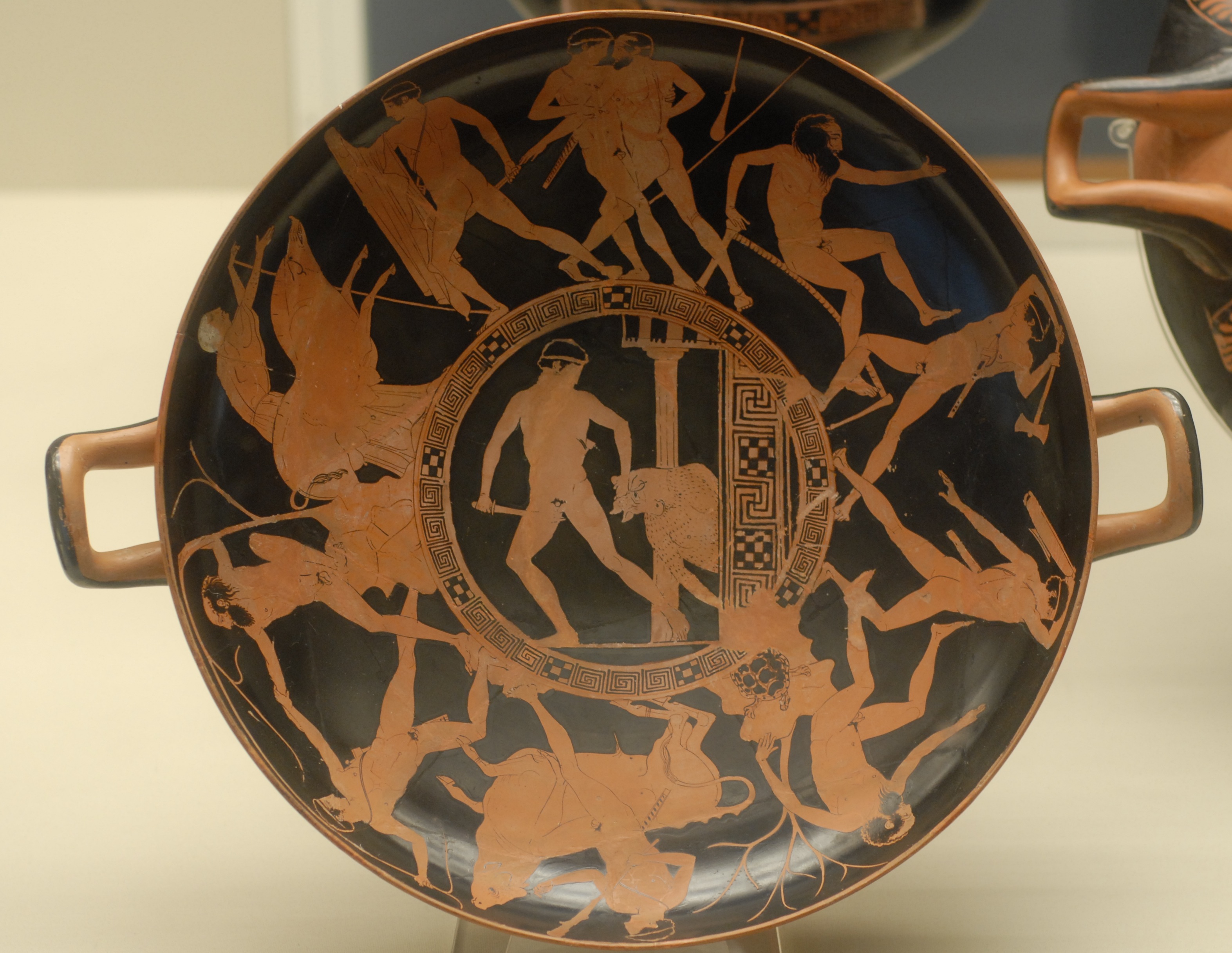 The deeds of Theseus on an Attic red-figure kylix, around 440-430 BC; British Museum, E 84.
Birth and Double Descent
Theseus was the son of Aethra, daughter of Pittheus, king of Troezen. His father was named as the Athenian king Aegeus, but a version involving Poseidon also existed. Such double descent suits a hero standing between a human royal line and divine force. Aegeus, lacking an heir, received a difficult oracle and came to Troezen, where Pittheus arranged his union with Aethra.
Before leaving, Aegeus hid a sword and sandals under a stone. If the son grew strong enough to lift the stone, he was to take these tokens and come to Athens. The motif matters not only as a test of strength. Sword and sandals confirm kinship, and the journey to Athens turns the hidden child into a recognized heir.
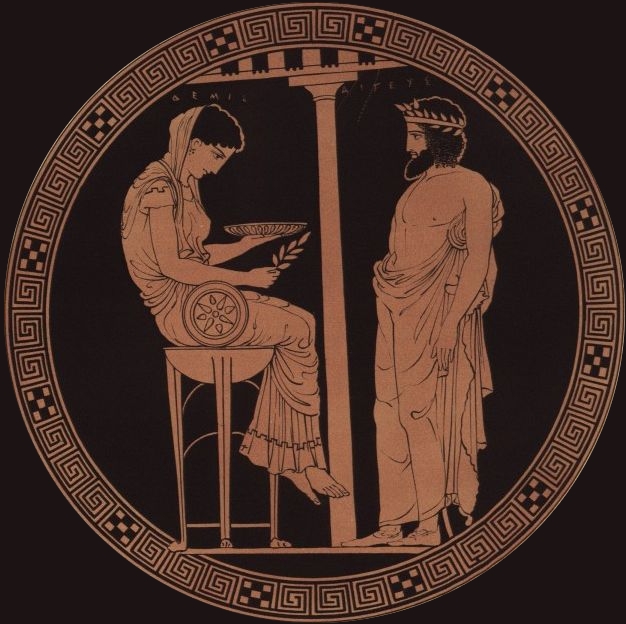 Themis gives an oracle to Aegeus. Attic red-figure kylix, around 440-430 BC; Antikensammlung, Berlin.
Versions and Sources of the Myth
The myth of Theseus survives in several layers. It combines older heroic tales, Athenian political memory, tragic stories about the hero's family and later literary treatments. Plutarch, in his Life of Theseus, already compared tradition with history and tried to separate the plausible from the marvellous. Apollodorus gives a mythographic sequence of episodes, Pausanias preserves local Attic traditions, and vase painting shows scenes recognizable before later retellings.
Details therefore vary: who exactly was the mother of the Minotaur, how Ariadne helped Theseus, why he left her on Naxos, which Amazon became the mother of Hippolytus, and how the hero himself died. The important point is not to smooth all variants into one account, but to show the stable structure: a youth of hidden origin travels to Athens, defeats the Cretan monster, becomes king and then experiences the breakdown of his own heroic fortune.
The Road to Athens
Theseus could sail to Athens by sea, but he chooses the land route through the Isthmus and the Saronic road. This decision turns the heir's arrival into a sequence of feats. On the road he kills Periphetes, who beat travellers with a club; Sinis, who tied victims to bent pines; the Crommyonian Sow, which threatened the region; Sciron, who threw travellers from a cliff; Cercyon, who forced strangers to wrestle; and Procrustes, who fitted guests' bodies to his bed.
These opponents matter because each violates a norm. They turn road, contest, hospitality or strength into instruments of arbitrary violence. Theseus often defeats them by the same method they used against others. The road to Athens thus becomes a purification of space: the future king proves his right to the city not by genealogy alone, but by the ability to make the road safe.
Procrustes is especially expressive. His bed became an image of violently forcing a person into a predetermined measure. In the myth this is not an abstract moral but a concrete act on the road: a traveller who comes as a guest becomes material for another man's cruelty. Theseus destroys that "measure" by its own method, restoring reciprocity and safety to the road.
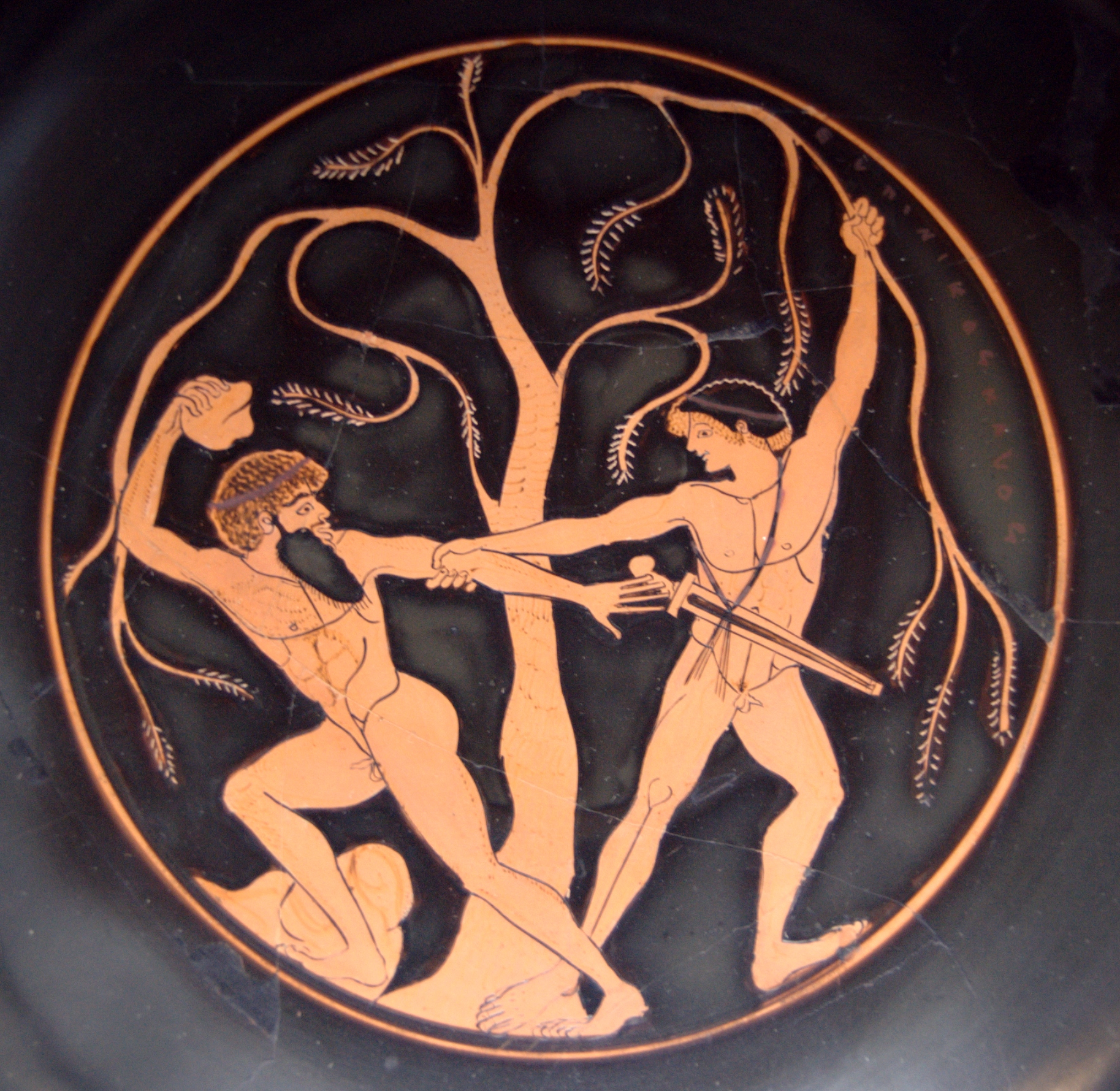 Theseus kills Sinis. Attic red-figure cup, around 490 BC; Staatliche Antikensammlungen, Munich.
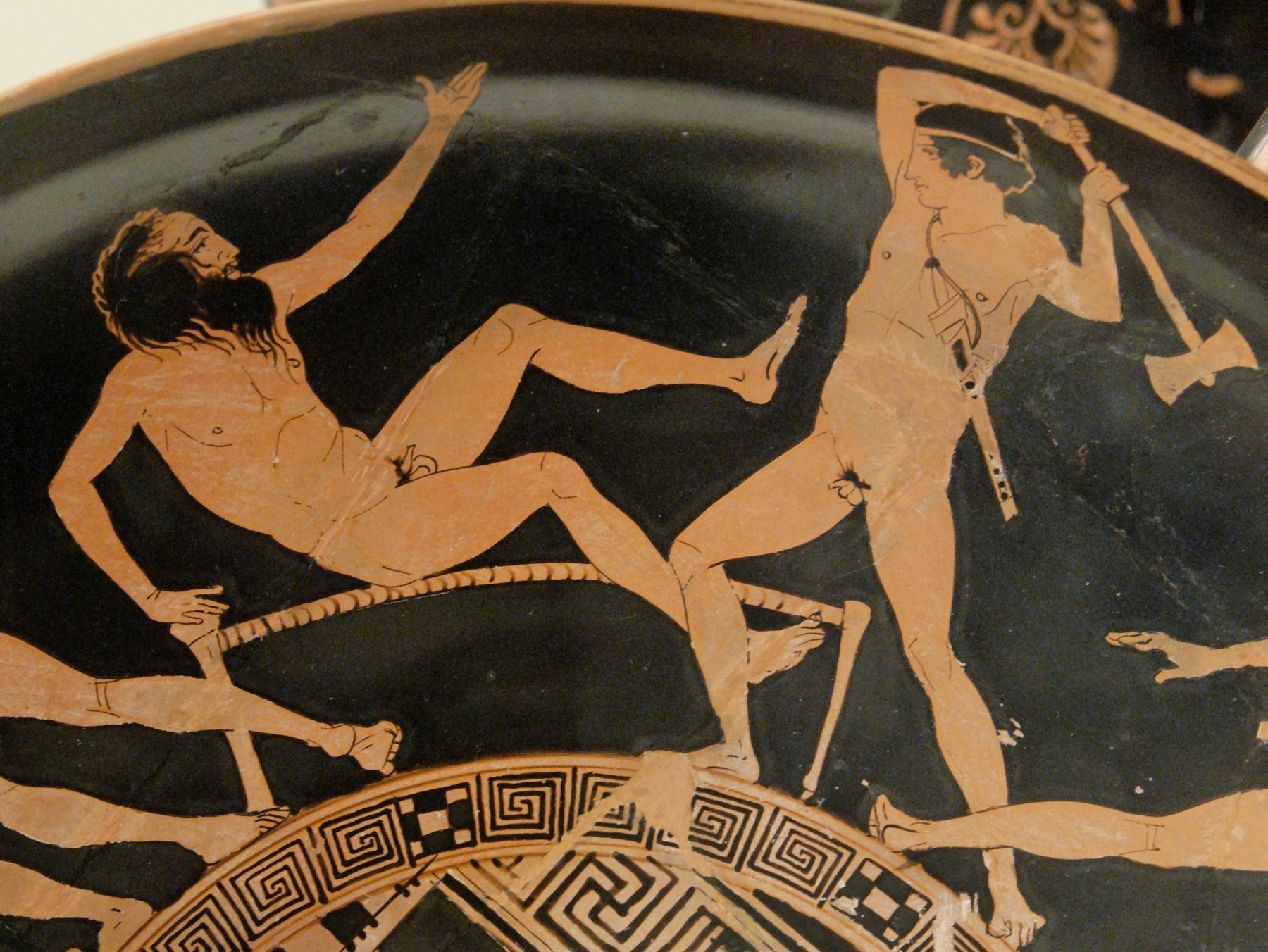 Theseus and Procrustes. Detail of a kylix with the deeds of Theseus, around 440-430 BC; British Museum, E 84.
Recognition in Athens
In Athens Theseus does not immediately arrive before Aegeus as an acknowledged son. The king lives with Medea, who recognizes the danger to her plans and tries to destroy the youth. In one version she persuades Aegeus to send Theseus against the Marathonian Bull; in another she proposes to poison him at a feast. Recognition comes through the sword and sandals: Aegeus sees the tokens left under the stone and acknowledges the heir.
The Marathonian Bull connects Theseus with the Cretan cycle even before the Minotaur. The bull threatens Attica, and victory over it shows that the hero can already act as protector of the land. At the same time the story with Medea reminds us that the palace is no safer than the road: danger can come not only from a brigand or monster but from succession struggles inside the household.
Crete, Ariadne and the Minotaur
The most famous feat of Theseus is connected with Crete. Athens had to send young men and women to King Minos as tribute after the death of his son Androgeos. The victims were placed in the Labyrinth, where the Minotaur lived, a being with a human body and a bull's head. Theseus voluntarily joins the next group in order to end Athens' dependence on Crete and destroy the monster.
Ariadne, daughter of Minos, helps Theseus. In the familiar version she gives him a thread, allowing the hero to leave the Labyrinth after killing the Minotaur. This episode makes Theseus' victory resemble Ancient Greek myths of impossible feats: the hero wins not only through strength but through the help of a woman who knows the structure of foreign space. Ariadne is not an ornament to the plot but the condition of escape.
The Labyrinth matters as a space in which ordinary heroic strength is almost useless. Killing the Minotaur is not enough: the hero must still find the way out. Ariadne's thread therefore has the same weight as sword or club in other myths. It turns the feat from a single blow into a task of memory and orientation. Theseus leaves the Cretan space because he accepts the help of someone who knows its rules.
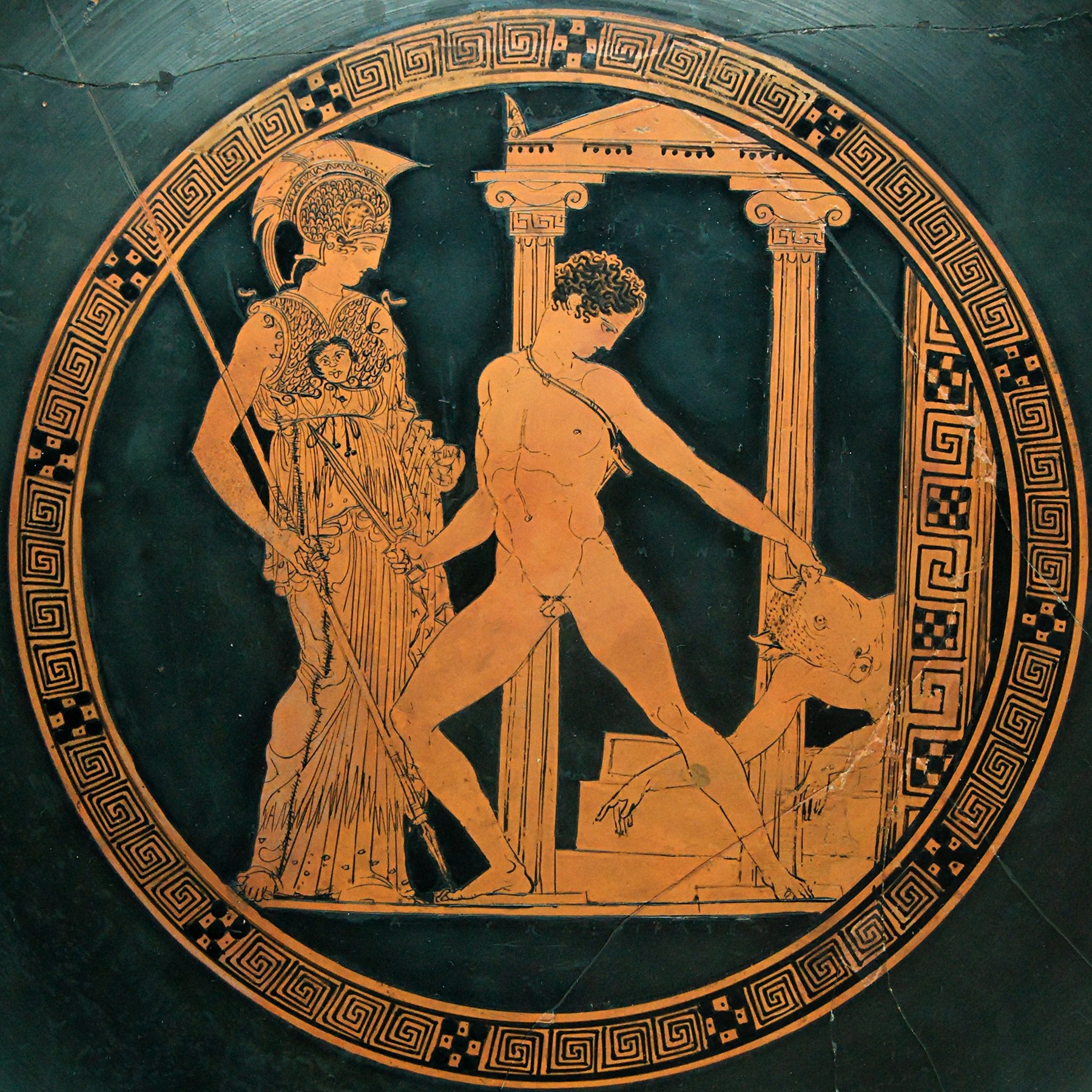 Theseus, Athena and the Minotaur. Attic red-figure kylix by Aison, around 430-420 BC; National Archaeological Museum, Athens.
Return and the Death of Aegeus
After the victory Theseus leaves Crete with Ariadne, but abandons her on Naxos. Reasons differed: forgetfulness, divine command, the arrival of Dionysus or the hero's deliberate rejection. The ship then sails toward Athens. Aegeus had ordered the black sail to be replaced with a white one if his son returned alive, but Theseus forgets to do so. Seeing the black sail, Aegeus throws himself into the sea that receives his name.
This ending makes the Cretan victory ambivalent. Athens is freed from tribute and the Minotaur is dead, but the king dies, and Theseus receives power through an error involving memory and a sign. The myth does not allow the hero to be seen only as a flawless saviour: even successful action can have a tragic price when the connection between promise and visible confirmation is broken.
Meaning of the Cretan Feat
The victory over the Minotaur matters not only as the killing of a monster. From an Athenian perspective it is liberation from external dependence, the ending of human tribute and the destruction of a space in which young men and women disappear without judgement or memory. Labyrinth, Minotaur and Minos' power form a system of fear; Theseus breaks it from within and brings the Athenian children home.
The Cretan myth could therefore become political with ease. It explained why Athens was no longer a subordinate city, while also showing that freedom required not only strength but memory of the price of victory. The mistake with the sail sharpens this meaning: the city is freed, but liberation does not restore the dead father or erase the hero's responsibility.
King of Athens and Synoecism
In Athenian political memory Theseus was not only the slayer of the Minotaur but a unifying king. He was credited with synoecism, the unification of the communities of Attica around Athens. This motif was especially important for the Classical city: through Theseus Athenians could imagine their political unity as an ancient heroic act, not only as the result of later reforms.
Theseus was also credited with founding festivals, reorganising civic order and a connection with Athenian democracy, although such stories clearly reflect later interests. Historically they show not actual Bronze Age reforms but the way Athens used the hero to explain its own institutions. Theseus became a useful figure between royal past and civic present.
In Classical Athens the image of Theseus was especially useful after the Greco-Persian Wars and during the growth of Athenian power. The hero allowed Athenians to speak about a united Attica, sea power, victory over external dependence and the city's claim to leadership. Yet the myth remained flexible: Theseus could be described as king, founder of festivals, protector of ordinary people or a hero whose mistakes led to family disasters.
Later Deeds and Tragic Stories
The myth of Theseus does not end after the Cretan feat. He takes part in wars against the Amazons; in different versions Antiope or Hippolyta becomes his wife or captive and the mother of Hippolytus. The story of Phaedra and Hippolytus turns the hero's house into a place of tragedy: false accusation, a father's curse and the son's death show how Theseus' authority over the family becomes destructive.
The friendship with Pirithous brings Theseus into Thessalian and underworld cycles. He helps the Lapiths in the battle against the Centaurs at Pirithous' wedding, then takes part in the abduction of Helen and the attempt to bring Persephone from the underworld. These later adventures show a shift from useful civic hero to dangerous hero of excessive desire. In the end Theseus loses stability, power and his earlier measure.
The tragic stories about Theseus matter because they do not cancel the early hero but complicate him. The man who cleansed the road of others' cruelty can himself act beyond measure: abandon Ariadne, curse Hippolytus, take part in abductions, descend to the underworld for an impossible marriage. Athenian memory preserved not only the useful founder but also the danger of heroic force without self-restraint.
Death and Return of the Hero
The later fate of Theseus is connected with exile and Scyros. King Lycomedes, fearing the hero or wishing to please his enemies, pushes Theseus from a cliff. Thus the hero who cleansed roads and defeated monsters dies not in open battle but through betrayal. Athenian memory later brought him back to the city: after the Greco-Persian Wars Athenians told that they found and transferred Theseus' remains to Athens.
This return was not merely a story about the hero's bones. It turned Theseus into a protector of the polis and a participant in Athenian identity. A hero connected with the royal past could be absorbed into civic religion and the political memory of Classical Athens. His myth therefore lived in several forms at once: adventure, family tragedy, explanation of Attic unity and cultic symbol of the city.
Visual Tradition
Ancient vase painting shows especially well how Athens shaped the image of Theseus. In the 6th-5th centuries BC artists readily depicted his road deeds and the fight with the Minotaur. On kylikes and amphorae individual scenes could form an almost programmatic cycle: Sinis, Sciron, Procrustes, the Marathonian Bull, the Minotaur. For viewers this was not a random set of adventures but the image of a hero cleansing the world of wrongful violence.
Images with Ariadne, Athena and Nike add another meaning to the feat. Theseus does not win alone: beside him stand the woman who provided the way out of the Labyrinth, the protecting goddess and the sign of victory. This is where visual evidence differs from a short retelling. Vase painting preserves participants, gestures and objects without which the feat would be incomplete.
Visual sources also show how the importance of individual episodes changed. On some vessels nearly all attention falls on the Minotaur, on others on the road opponents. This choice is not accidental: for an Athenian viewer Theseus was not only the slayer of one monster but the hero of a systematic cleansing of the world. Cyclical images of his deeds are therefore especially valuable: they allow us to see the hero's programme as a whole.
Brief Chronology of the Myth
- Aegeus receives an oracle and comes to Troezen, to Pittheus.
- Aethra gives birth to Theseus; Aegeus' sword and sandals are hidden under a stone.
- The grown Theseus lifts the stone and travels to Athens by land.
- On the road he defeats Periphetes, Sinis, the Crommyonian Sow, Sciron, Cercyon and Procrustes.
- In Athens Aegeus recognizes his son by the sword and sandals; Medea leaves the city.
- Theseus defeats the Marathonian Bull.
- Theseus sails to Crete with the Athenian tribute.
- Ariadne helps him enter the Labyrinth and leave it after killing the Minotaur.
- On the return Theseus forgets to change the sail; Aegeus dies.
- Theseus becomes king of Athens and in later tradition unites Attica.
- Later myths connect him with the Amazons, Hippolytus, Pirithous, Centaurs and the descent to the underworld.
- After his death on Scyros the hero returns to Athenian memory as a protector of the city.
Related topics
- Minotaur
- Centaurs
- Athens
- Ancient Greece
- Greek Mythology
- Greek Gods
- Labours of Heracles
- Argonauts
- Perseus
Literature and sources
- Plutarch. Theseus.
- Apollodorus. Library. Book III and Epitome.
- Pausanias. Description of Greece. Books I-II.
- Ovid. Metamorphoses. Books VII-VIII.
- Bacchylides. Ode 17.
- Walker H. J. Theseus and Athens. Oxford University Press, 1995.
- Calame C. Thesée et l'imaginaire athénien. Payot, 1990.
- Gantz T. Early Greek Myth: A Guide to Literary and Artistic Sources. Johns Hopkins University Press, 1993.


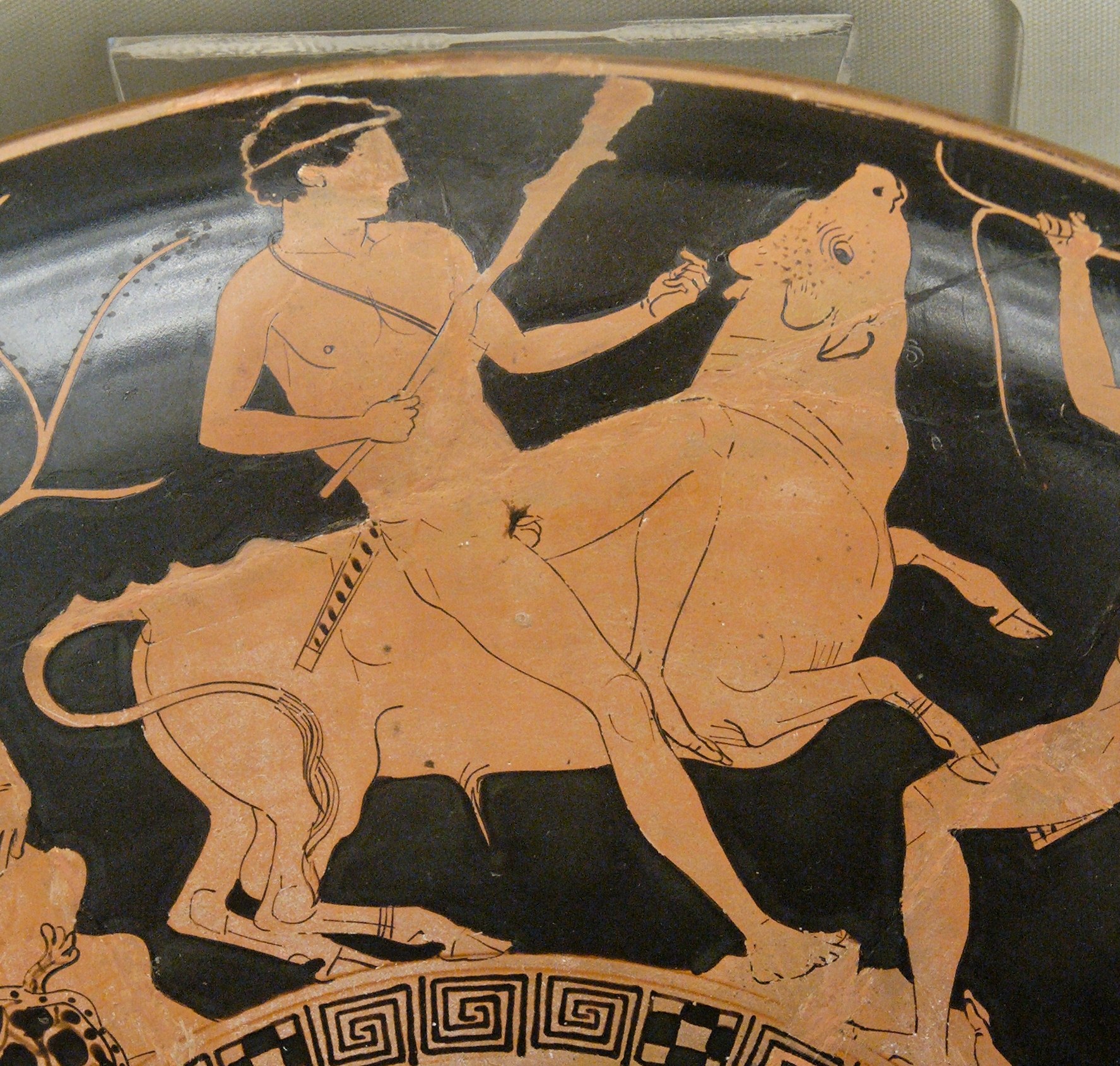 Theseus and the Marathonian Bull. Detail of a kylix with the deeds of Theseus, around 440-430 BC; British Museum, E 84.
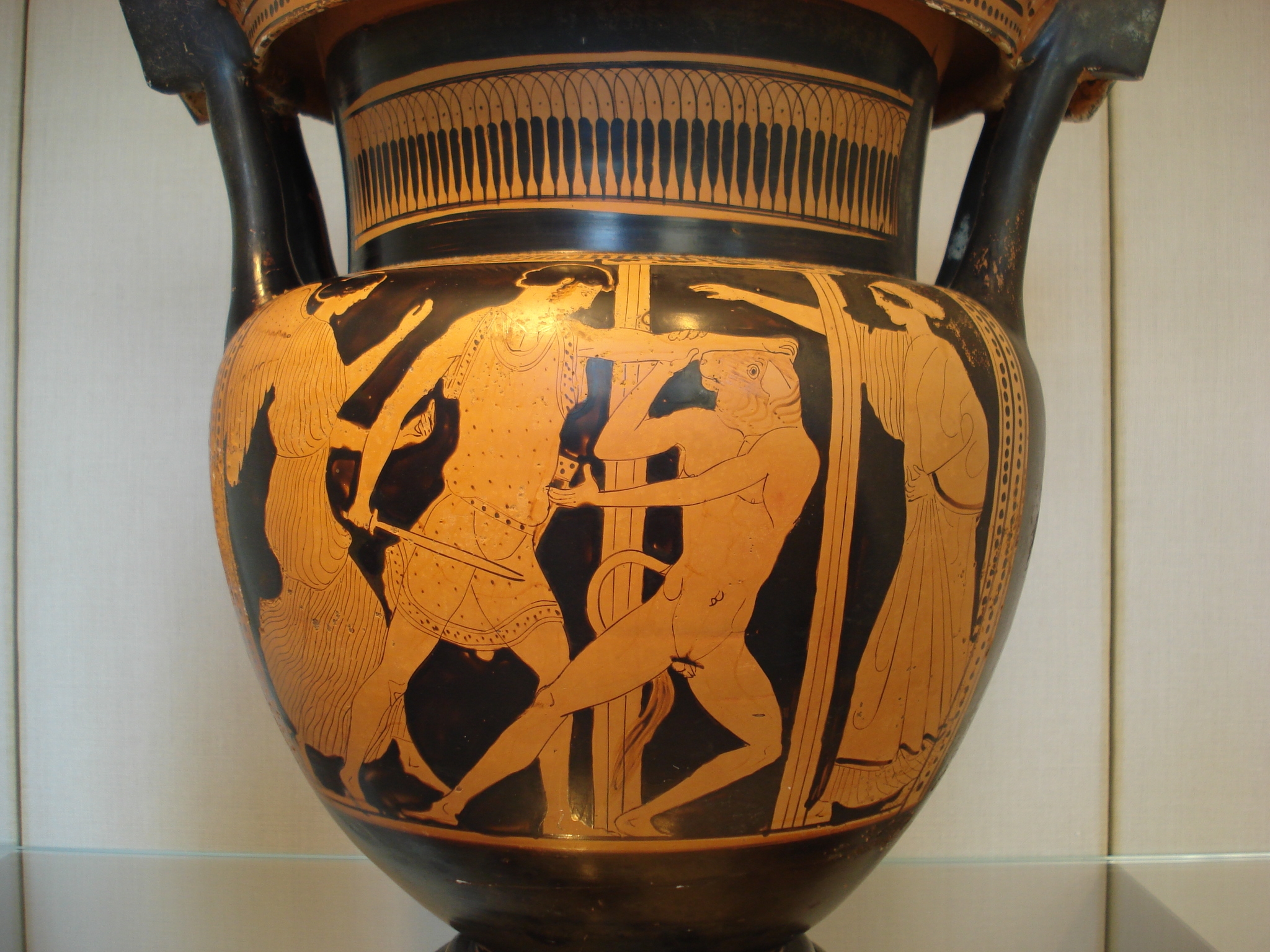 Theseus fights the Minotaur; Ariadne, Athena and Nike stand nearby. Attic red-figure krater, around 460 BC; Metropolitan Museum of Art.
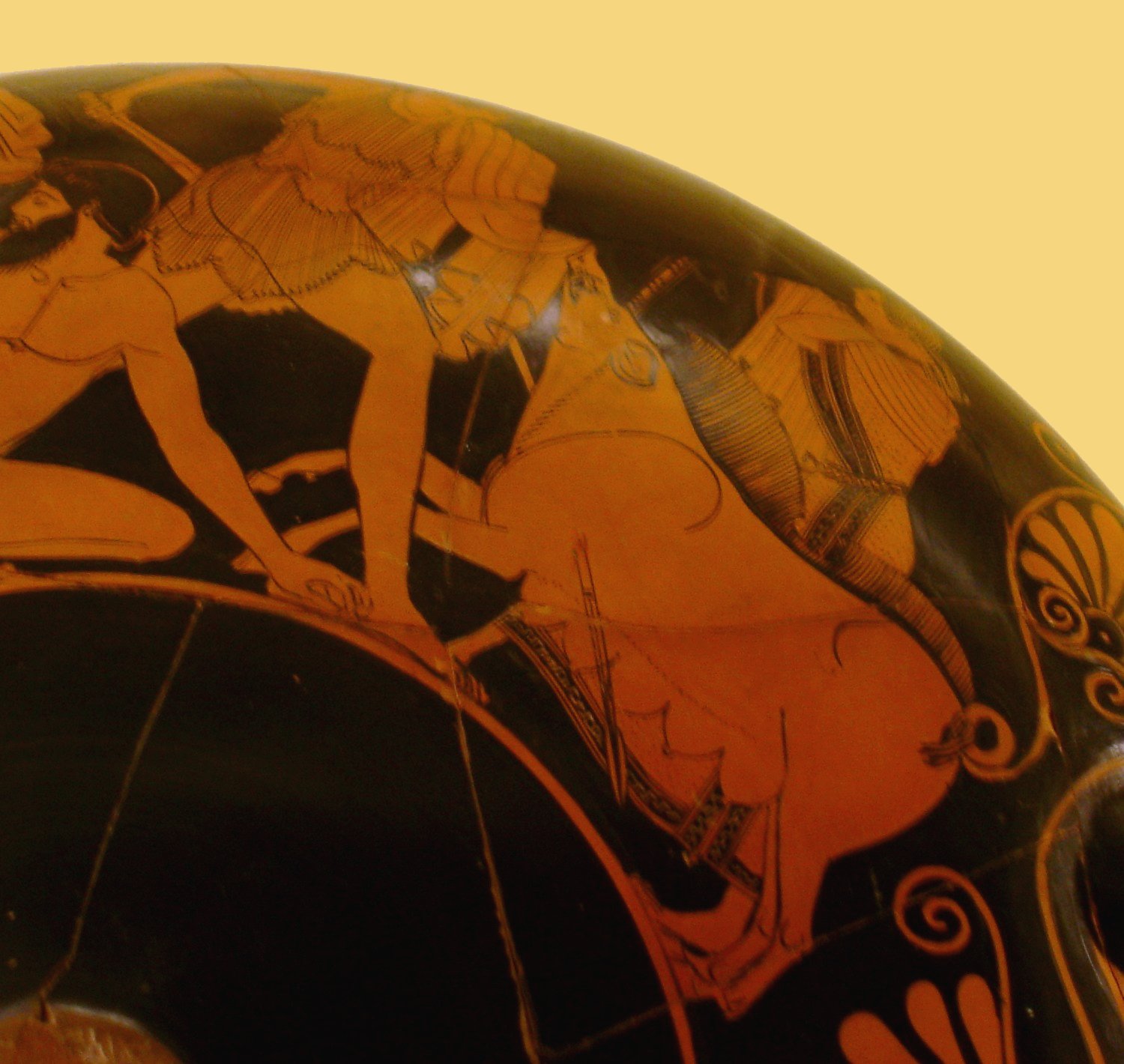 Theseus and the Crommyonian Sow. Attic red-figure kylix, around 440-430 BC; British Museum, E 48.
Interested in Ancient Rome beyond reading? Join Legio X Fretensis or explore our reenactment directions.


