Perseus
Perseus is a hero of the Argive cycle of Greek mythology, the son of Danae and Zeus, the slayer of Medusa Gorgon and the rescuer of Andromeda. His myth joins a prophecy about a king's death, miraculous birth, a journey for an impossible prize, divine aid and the foundation of new heroic lineages. In later tradition Perseus is connected with Argos, Tiryns, Mycenae and the genealogy of Heracles.
Perseus' story differs from myths about heroes who win chiefly through strength. He survives through signs, advice, cunning and the correct use of gifted objects: the reflective shield, sickle, kibisis pouch, cap of invisibility and winged sandals. Perseus therefore often appears as a hero of precise action: he does not fight Medusa on equal terms, but finds a way to defeat a being who cannot be looked at directly.
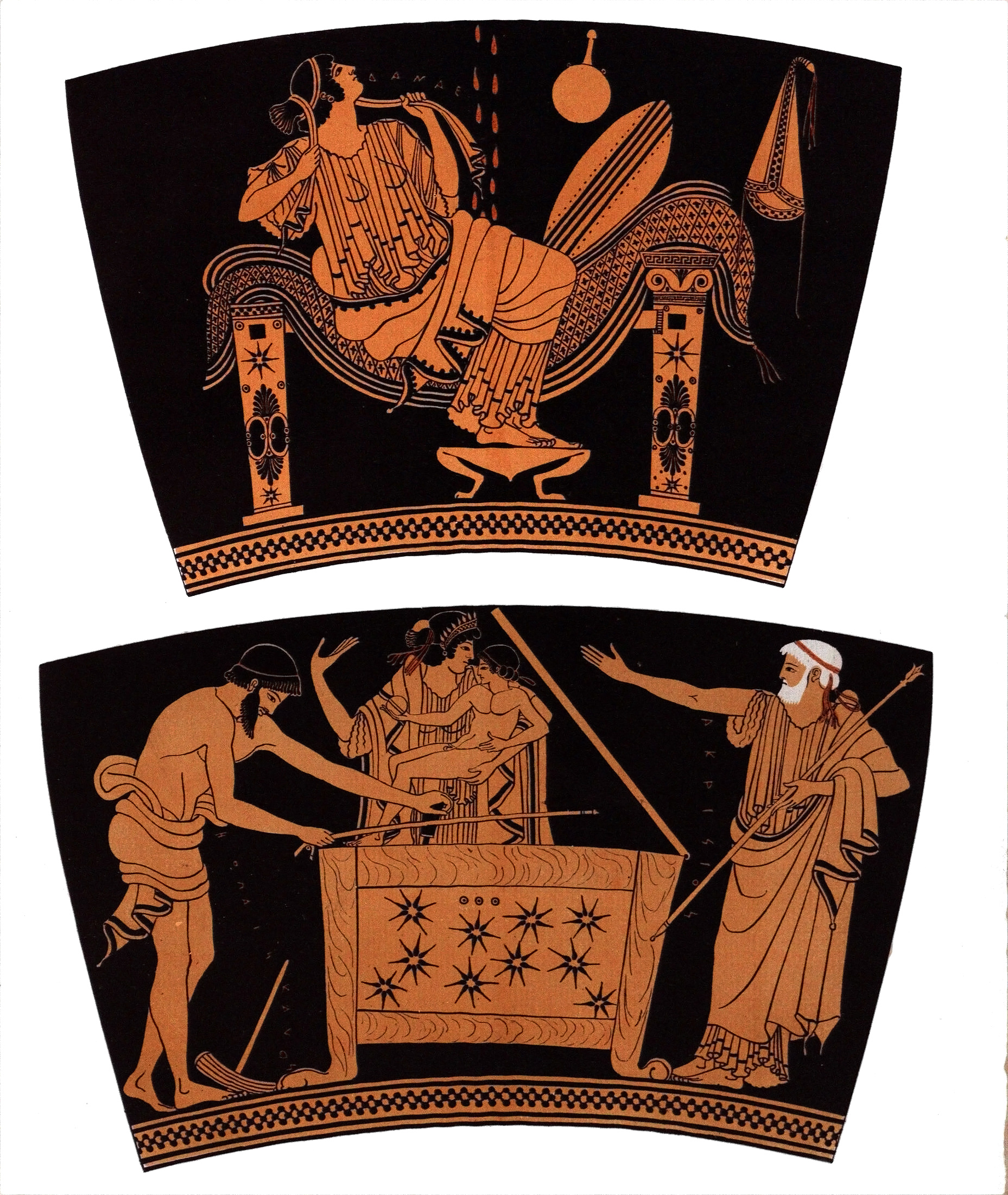 Danae and the infant Perseus in the myth of confinement and the chest. Drawing after an Attic red-figure calyx krater by the Triptolemos Painter, first half of the 5th century BC; Hermitage, inv. 637.
Danae, Acrisius and the Prophecy
The myth begins with Acrisius, king of Argos. An oracle told him that he would die at the hands of his grandson, so Acrisius shut his daughter Danae in an underground or bronze chamber to prevent her from bearing a child. Zeus came to her as a shower of gold, and Danae gave birth to Perseus. The king did not dare kill his daughter and the infant directly: he ordered them shut in a wooden chest and cast into the sea.
The chest drifted to the island of Seriphos. There Danae and Perseus were rescued by Dictys, brother of King Polydectes. This episode is crucial for the rest of the story: Perseus grows up not in the royal house of Argos but on an island, as a vulnerable outsider. His heroic biography begins not with power, but with exile, danger at sea and dependence on hospitality.
Versions and Sources of the Story
The myth of Perseus did not survive in a single canonical form. Hesiod, Pindar, tragic tradition, Apollodorus, Pausanias and Ovid preserve different emphases: in some accounts the Argive genealogy matters most, in others the wondrous objects, Andromeda, or the terrible power of Medusa's head. Details therefore vary: who gave Perseus the weapons, where he met the nymphs, how the sea monster died and where the prophecy about Acrisius was fulfilled.
Visual evidence also does not always repeat the literary narrative. An Archaic vase might emphasize the killing of Medusa itself, a Classical pyxis the approach to the Graeae, and a Roman fresco the rescue of Andromeda. All these witnesses matter for understanding the hero: they show not artists' mistakes, but which scenes were intelligible to viewers and which meanings of the myth became central in different periods.
Seriphos and Polydectes' Demand
When Perseus grew up, Polydectes wanted to marry Danae and remove her son. He therefore created a situation in which the young man had to promise an impossible gift: the head of Medusa. In some versions Polydectes pretends to be collecting presents for another wedding, and Perseus, having neither horse nor wealth, promises to bring whatever object the king demands.
The feat of Perseus thus begins as a trap. Polydectes does not send him after glory, but expects him to die. Perseus must accept the task in order to preserve honour and protect his mother, yet he does not know where the Gorgons live or how Medusa can be approached. At this point the myth stresses the hero's dependence on divine helpers and correct knowledge.
Divine Helpers and Magical Objects
Perseus is helped by Athena and Hermes, and sometimes by the nymphs as well. Hermes gives him the sickle or curved sword with which Medusa's head can be cut off; Athena gives a polished shield, allowing him to see the reflection rather than the Gorgon's direct gaze. From the nymphs Perseus receives winged sandals, the kibisis pouch for the head and the cap of Hades, which makes the wearer invisible.
To find the nymphs, Perseus approaches the Graeae, old women who share one eye and one tooth among them. He intercepts the eye and forces them to reveal the way. The episode shows that the feat is built not only on weapons: the hero must obtain information, cross the boundary between the ordinary world and the distant realm of monsters, and compel the keepers of a secret to speak.
Medusa and the Gorgons
The Gorgons Stheno, Euryale and Medusa live at the far edge of the earth. In most versions only Medusa is mortal, so only her head can be taken. Her gaze turns living beings to stone; in later stories she receives snake hair and a monstrous form after a conflict involving Poseidon and Athena's temple. Early art often shows Medusa not as a beautiful woman but as a terrifying being with grimace, tusks and a running pose.
Perseus approaches the sleeping Gorgons, looks into the shield's reflection and cuts off Medusa's head. From her blood are born Pegasus and Chrysaor, linking the monster's death with the emergence of new mythic figures. After the killing the immortal sisters pursue the hero, but the cap of invisibility and winged sandals allow him to escape. Death, birth, terror and rescue are thus joined in a single episode.
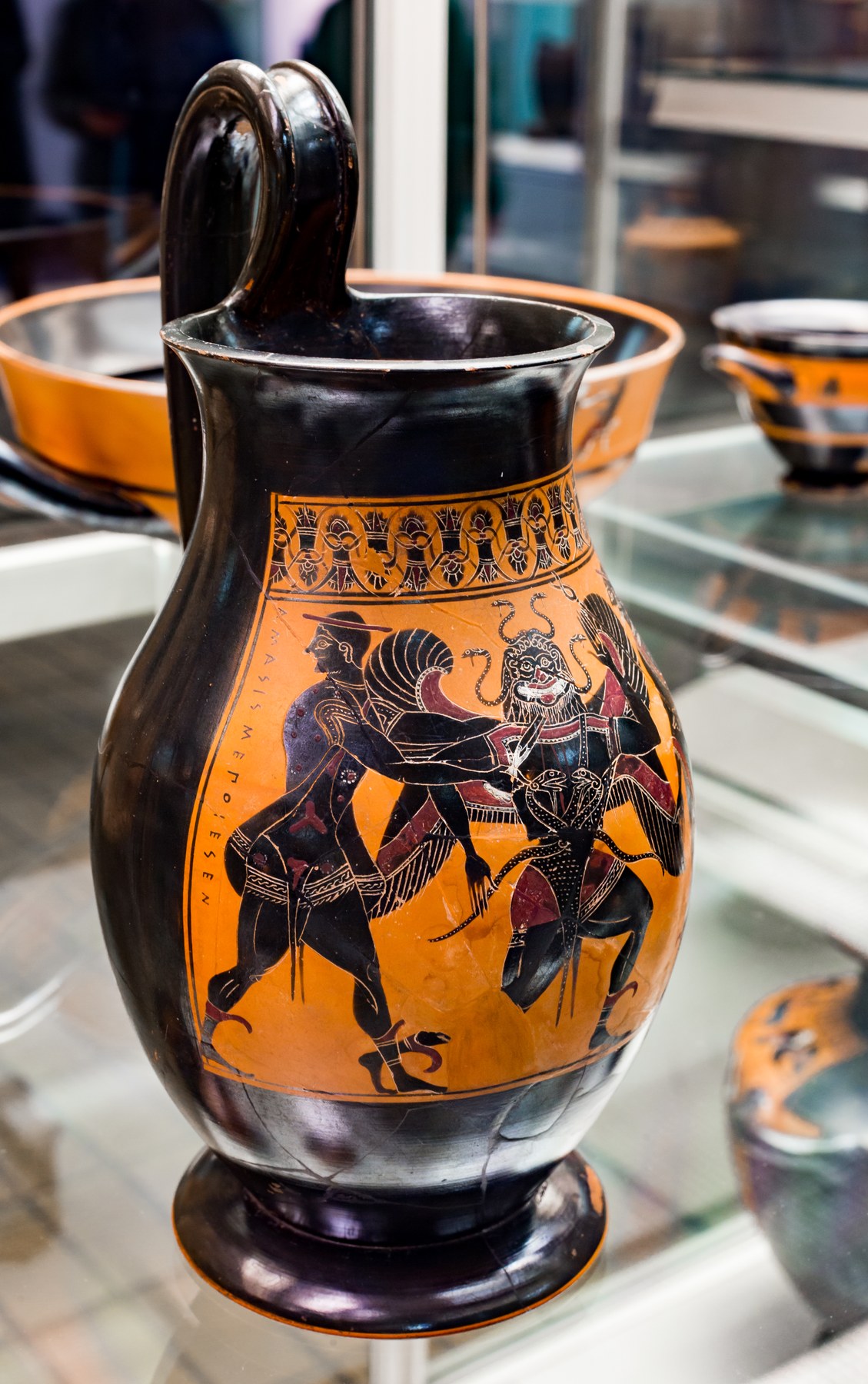 Perseus kills Medusa; Hermes stands nearby. Attic black-figure olpe by the Amasis Painter, around 550-530 BC; British Museum.
Medusa's Head as a Weapon
After the victory Medusa's head remains dangerous. Perseus places it in the kibisis and uses it only in extreme cases: he turns Atlas, the sea monster or enemies threatening him and Andromeda, and later Polydectes and his supporters on Seriphos, into stone. The object won in the quest becomes a weapon, but one that cannot be kept exposed or displayed without restraint.
In the end Perseus gives the head to Athena, who places it on the aegis. The hero's private feat becomes part of a divine sign. In Greek art the gorgoneion often had a protective function: the terrifying face repelled evil and decorated shields, pediments, vessels and architectural elements. The myth of Perseus explains why Medusa's image could both frighten and protect.
This transfer from prize to divine attribute reveals one of the myth's central themes. Perseus does not keep the head forever or build personal power upon it. He uses it for protection, punishment and rescue, and then returns its force to the goddess. The story therefore does not end with uncontrolled possession of monstrous power: the dangerous object receives a place in an order greater than the hero himself.
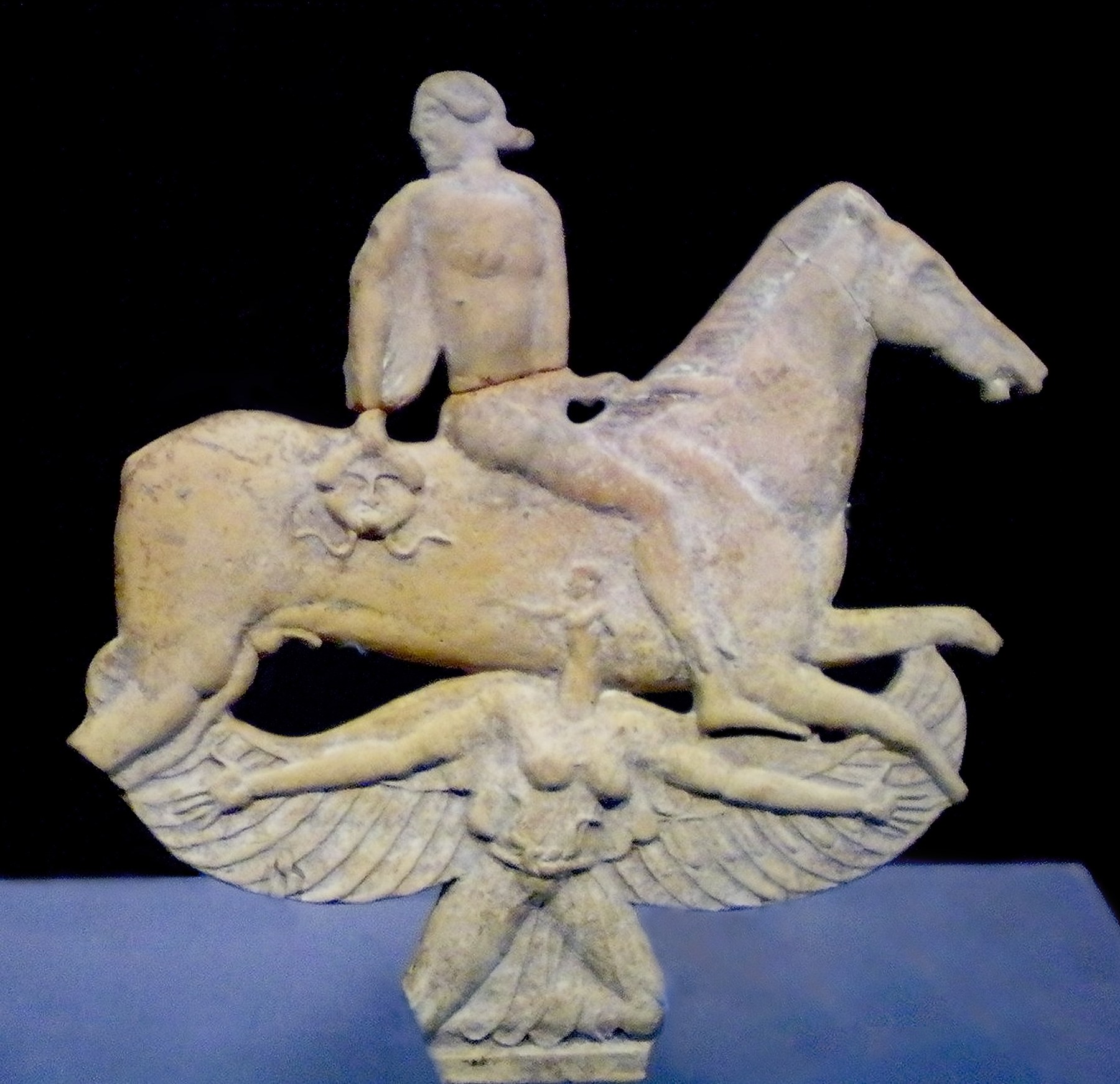 Perseus with the severed head of Medusa. Terracotta relief from Melos, ca. 490-470 BC; British Museum.
Andromeda and the Sea Monster
On his return Perseus sees Andromeda, daughter of the Ethiopian king Cepheus and Cassiopeia. Cassiopeia boasted of her daughter's beauty and offended the Nereids; Poseidon sent a sea monster and disaster against the land. An oracle demanded that Andromeda be given to the monster, and she was chained to a rock by the sea. Perseus agrees to save her on condition of marriage and fights the monster.
The rescue of Andromeda became one of the most popular scenes in ancient art, especially in Roman wall painting. In Pompeii it was shown in houses as both a dramatic and decorative subject: the hero with winged sandals, the freed young woman, the dead monster, Medusa's head and the future marriage. For the viewer it was not only a feat but a story of passage from danger to alliance.
In this episode Andromeda is not merely a rescued princess. Through her the myth connects Perseus with a new royal house and with descendants later placed within broad heroic genealogies. Her danger is caused by her mother's offence and by the community's decision to sacrifice the girl for the safety of the land. The rescue of Andromeda can therefore be read as the cancellation of an unjust payment imposed on an innocent person.
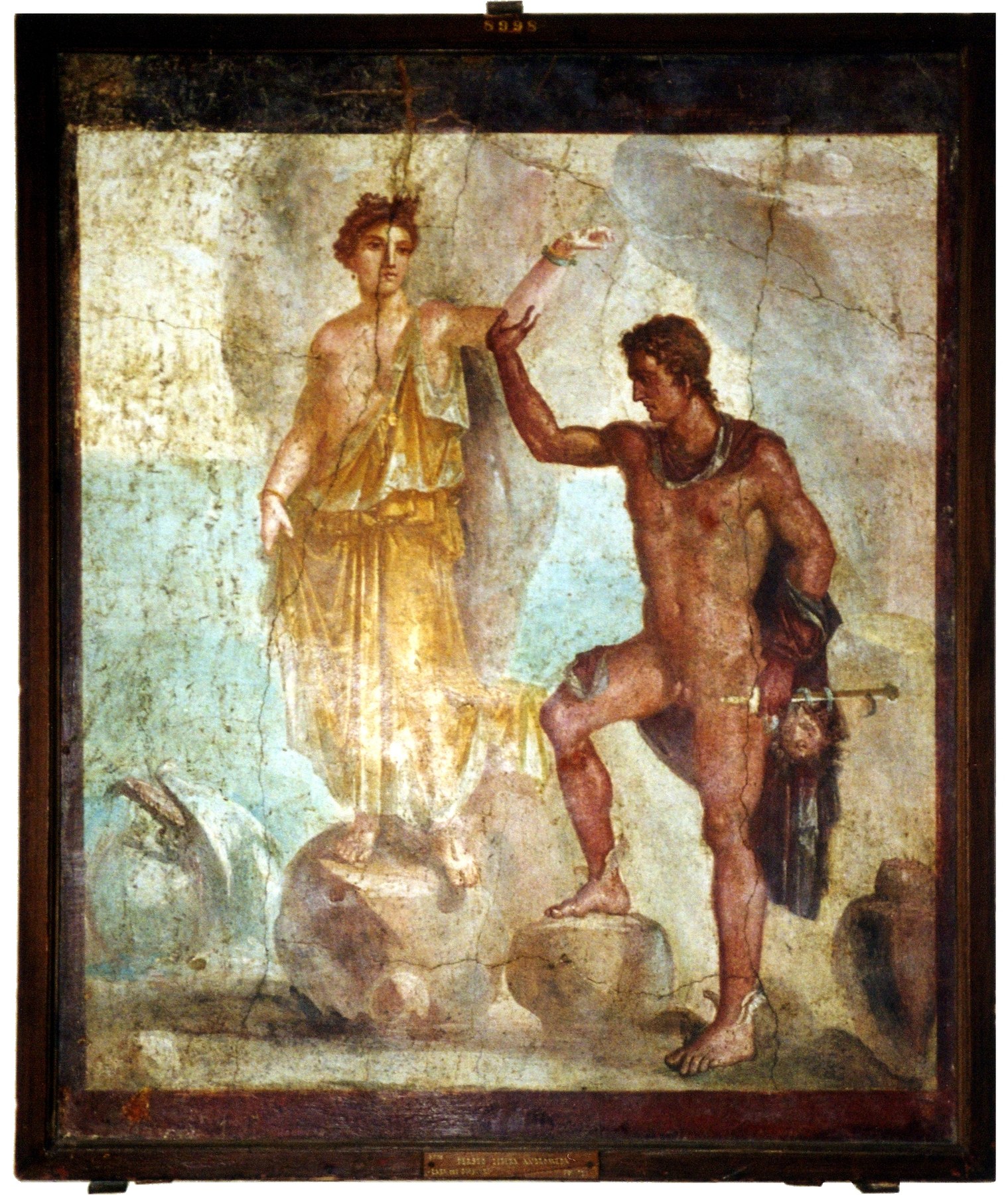 Perseus frees Andromeda after defeating the sea monster. Fresco from the House of the Dioscuri in Pompeii, 1st century AD; National Archaeological Museum, Naples.
Phineus, Seriphos and the Return to Argos
After rescuing Andromeda, Perseus confronts Phineus, Andromeda's former betrothed, who tries to break the marriage. In Ovid's version the conflict becomes a large scene of violence: Perseus fights his opponents and then uses Medusa's head, turning enemies into stone. The central motif of the myth returns: the hero's victory depends not only on the sword but on the terrible object he carries.
On Seriphos Perseus finds Danae and Dictys in danger: Polydectes continues to pursue his mother. The hero shows Medusa's head to the king and his supporters and frees the island from the tyrant. Power passes to Dictys, who had saved Danae and the infant. Perseus then returns the magical objects to their owners and gives the head to Athena, closing the cycle of the task.
Acrisius, Mycenae and Descendants
The prophecy about Acrisius nevertheless comes true. The king avoids Perseus, but during athletic games the hero accidentally strikes him with a discus. In different versions this happens at Larissa or during games arranged by a local ruler. Perseus does not kill his grandfather out of revenge, yet fate proves stronger than human attempts to avoid it. The myth thus returns to its beginning: Danae's confinement and the chest at sea did not cancel the prediction.
After Acrisius' death Perseus does not wish to rule Argos, now connected with his grandfather's blood, and exchanges territories with Megapenthes. He was linked with Tiryns and the foundation of Mycenae, and his descendants were called Perseids. Through Electryon and Alcmene this line leads to Heracles, so Perseus occupies an important place in heroic genealogy: he performs his own feats and opens the way to a future generation.
The connection with Mycenae is especially important for later Greek memory. Perseus could explain the origin of one of the main centres of the Bronze Age, and his descendants linked local royal history with pan-Hellenic myths. In this perspective the hero becomes not only the slayer of the Gorgon but also a figure of legitimation: through him city, lineage and sanctuaries receive antiquity and a place on the common map of the heroic past.
The Hero's Image
Perseus is a hero of boundaries. He moves between Argos and Seriphos, humans and monsters, life and petrification, sea exile and royal genealogy. Unlike the Labours of Heracles, where strength and labour often dominate, Perseus' feats depend on a combination of divine gift, precise knowledge and the ability not to look directly at danger.
His myth also shows the double nature of wondrous objects. The shield, sandals and cap save the hero, but Medusa's head remains dangerous even after victory. Perseus must not only win power, but keep it under control. That is why his story lends itself so well to visual art: one gesture, one glance or one object can change the fate of the characters.
Local Memory and Cult
Perseus mattered not only as a literary character. Pausanias connects him with Argive and Mycenaean local tradition, with tombs, sanctuaries and stories about the origins of cities. Such notices cannot be read as a direct biography of the hero, but they show how the myth lived in specific places. For the inhabitants of the Argolid, Perseus was part of the explanation of their own antiquity, kinship and political status.
In the Greek world heroes could have local forms of veneration distinct from the cult of the Olympian gods. They were connected with tombs, family lines, territorial protection and memory of the past. Perseus fits this type of memory well: his story explains the movement of power, the foundation of cities, the danger of prophecy and the connection between human lineage and divine origin.
Visual Tradition
Ancient images of Perseus appear already in Archaic vase painting. Artists were drawn to recognizable moments: Danae with the infant, Perseus among the Graeae, the killing of Medusa, the flight from the Gorgons, the rescue of Andromeda and the display of the head. Vase painting often communicates the story through clear attributes: sickle, winged sandals, kibisis, shield, Gorgon's head and the figures of Athena or Hermes.
In the Roman house Perseus often appeared through the story of Andromeda. Pompeian frescoes show not only the fight but also the moment after the rescue, when Medusa's dangerous head is seen through reflection. The detail is subtle: even after defeating the monster, the hero cannot handle its power as an ordinary object. The images preserve the tension between beauty, rescue and threat.
Different types of objects emphasize different sides of Perseus. Black-figure vase painting makes the action clear and almost emblematic: hero, Gorgon, divine helper and weapon. Classical red-figure pottery more often turns to preparation and the encounter with the Graeae. Terracotta reliefs fix the victorious gesture with Medusa's head. Roman frescoes shift the focus toward Andromeda, the emotion of rescue and a striking image for domestic interiors.
Brief Chronology of the Myth
- Acrisius receives a prophecy that he will die at the hands of his grandson and confines Danae.
- Zeus comes to Danae as a shower of gold; Perseus is born.
- Danae and the infant Perseus are cast into the sea in a chest and saved on Seriphos by Dictys.
- Polydectes demands Medusa's head from Perseus, expecting to remove him.
- Athena, Hermes and the nymphs help the hero obtain weapons and magical objects.
- Perseus forces the Graeae to reveal the way to the Gorgons.
- Perseus kills Medusa, escapes her sisters and takes the head as a dangerous weapon.
- On the return journey he saves Andromeda from the sea monster and marries her.
- Perseus frees Danae from Polydectes on Seriphos.
- The prophecy comes true: Perseus accidentally kills Acrisius with a discus.
- Perseus becomes linked with Tiryns, Mycenae and the genealogy of later heroes.
Related topics
Literature and sources
- Hesiod. Theogony.
- Apollodorus. Library. Book II.
- Ovid. Metamorphoses. Books IV-V.
- Pindar. Pythian 12.
- Pausanias. Description of Greece. Books II and IV.
- Gantz T. Early Greek Myth: A Guide to Literary and Artistic Sources. Johns Hopkins University Press, 1993.
- Ogden D. Perseus. Routledge, 2008.
- LIMC. Lexicon Iconographicum Mythologiae Classicae. Entries on Perseus, Medusa, Andromeda.


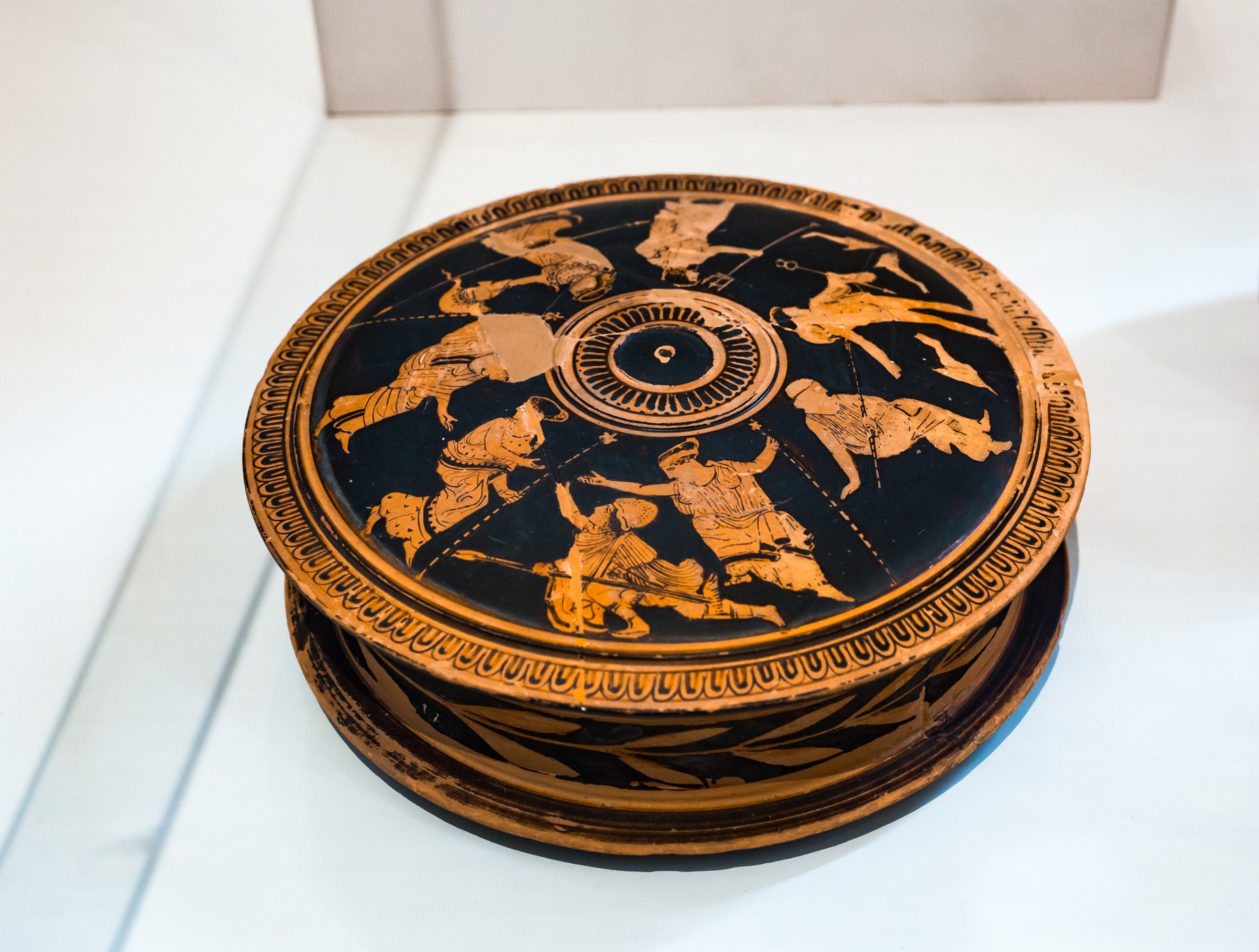 Perseus and the Graeae. Attic red-figure pyxis, 5th century BC; National Archaeological Museum, Athens.
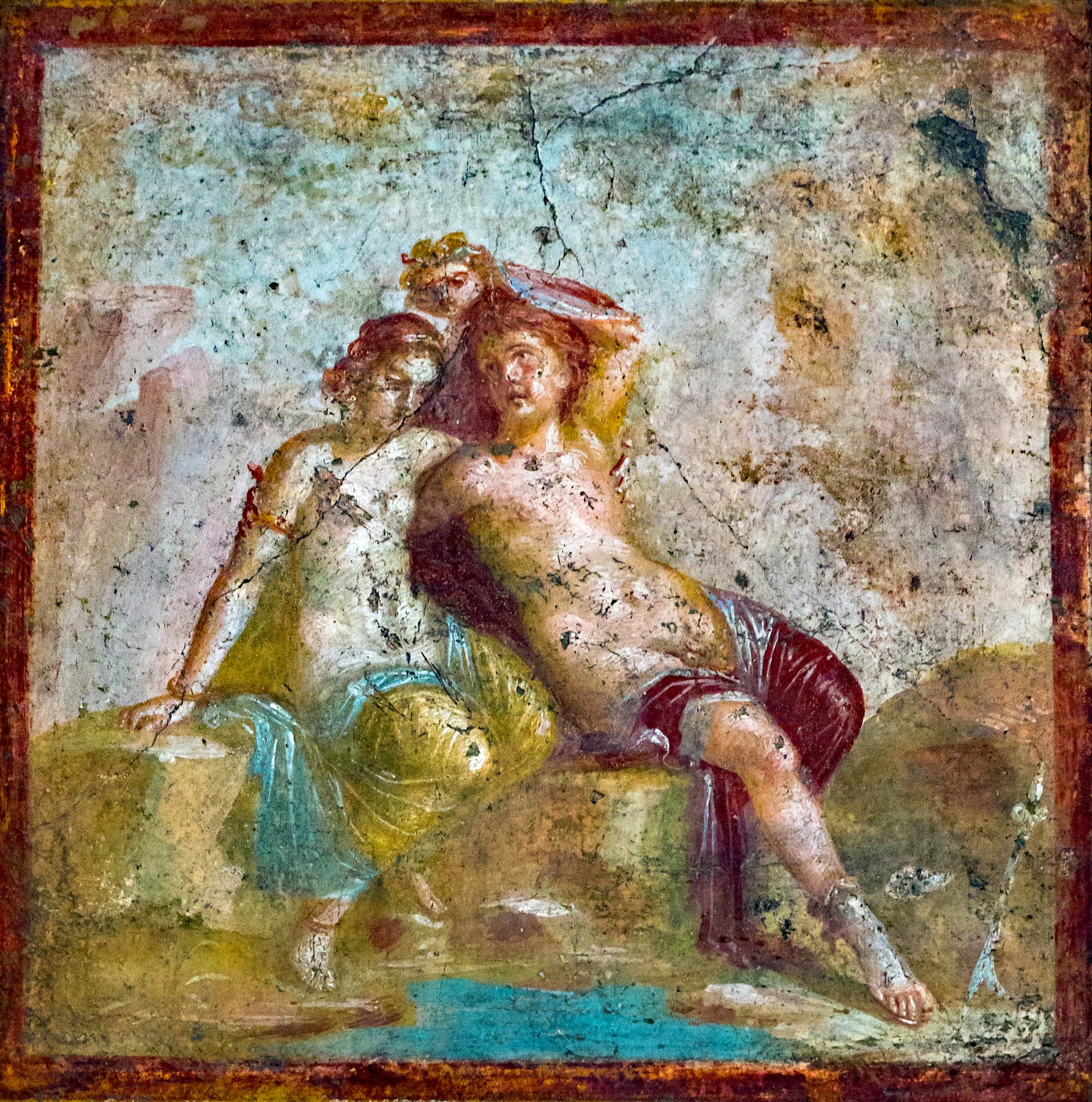 Perseus and Andromeda after the rescue; the hero shows Medusa's head through its reflection in water. Pompeian fresco, 1st century AD; National Archaeological Museum, Naples.
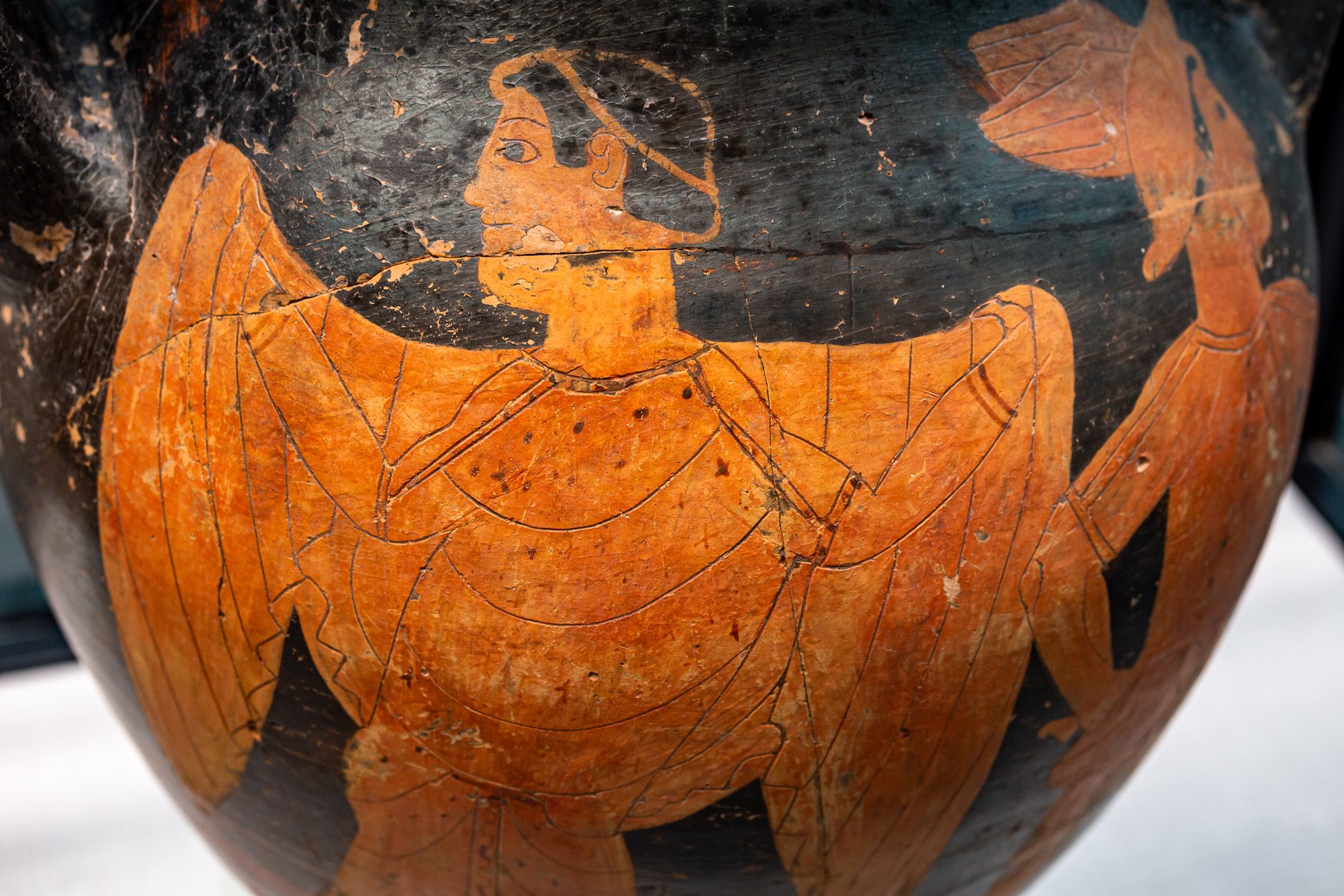 Perseus, Athena and the Gorgons on an Etruscan amphora from Vulci, around 480/470-460/450 BC; Staatliche Antikensammlungen, Munich.
Interested in Ancient Rome beyond reading? Join Legio X Fretensis or explore our reenactment directions.


