Medusa Gorgon
Medusa Gorgon is the best known of the Gorgons and the only mortal one among the three sisters in Classical tradition. In Greek mythology her gaze turned living beings to stone, and Perseus' victory over Medusa became one of the major heroic stories of Archaic and Classical Greece. Yet Medusa's importance is not limited to the killing scene: after the head is cut off, its power continues to act, passes to the hero, then to Athena and becomes an independent protective sign.
For an ancient viewer Medusa was at once a monster, a dangerous image, a weapon and an apotropaic sign. Her head appeared on shields, cuirasses, phalerae, vessels, architectural details, jewellery and luxury objects. Medusa should therefore be read on two levels: as a myth of Perseus and as the long life of the gorgoneion, a face meant to turn danger away.
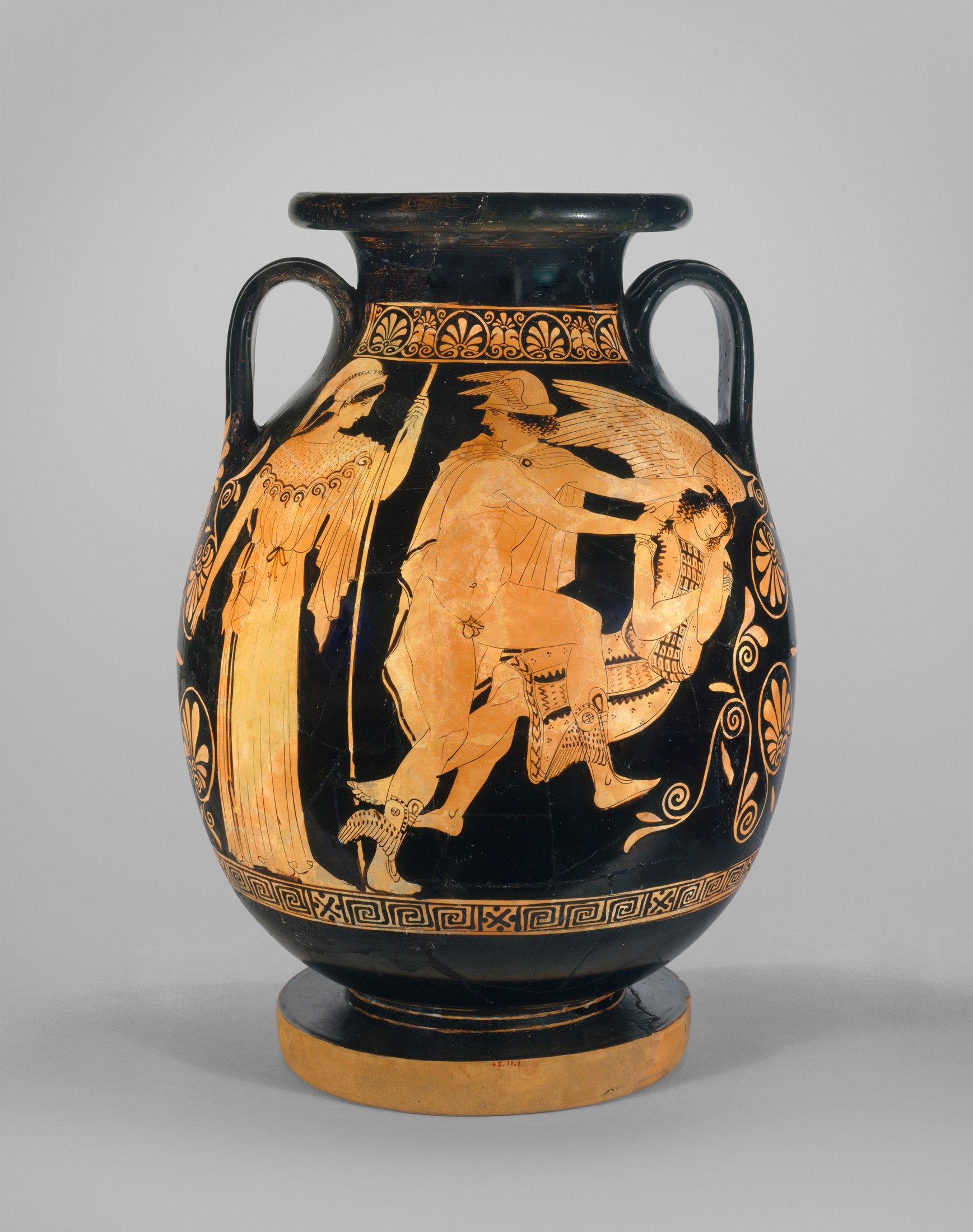 Attic red-figure pelike with Perseus and Medusa, ca. 450-440 BC. The scene shows the Classical narrative of the hero and the Gorgon. Metropolitan Museum of Art, 41.162.75.
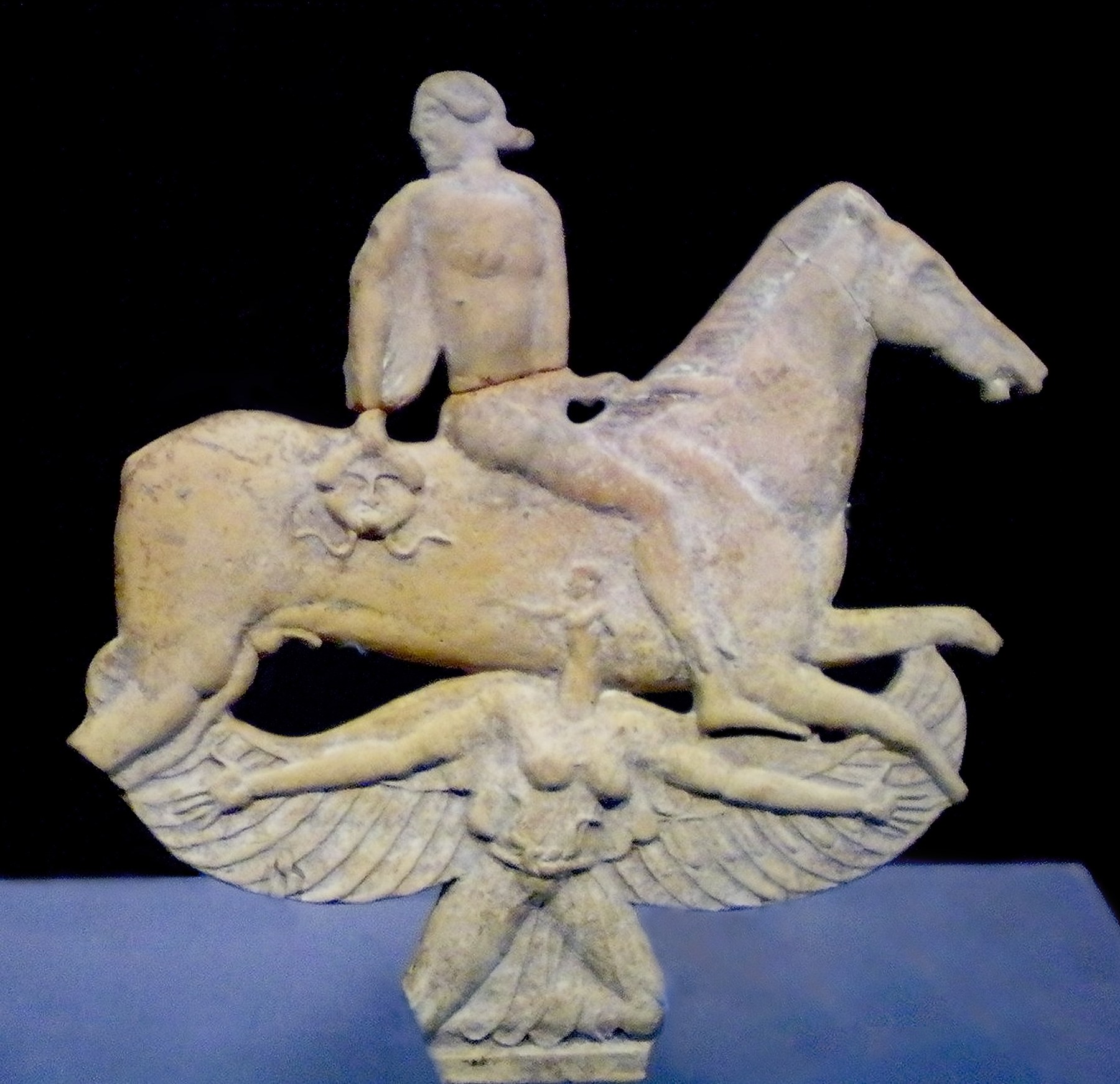 Perseus with the severed head of Medusa. Terracotta relief from Melos, ca. 490-470 BC; British Museum.
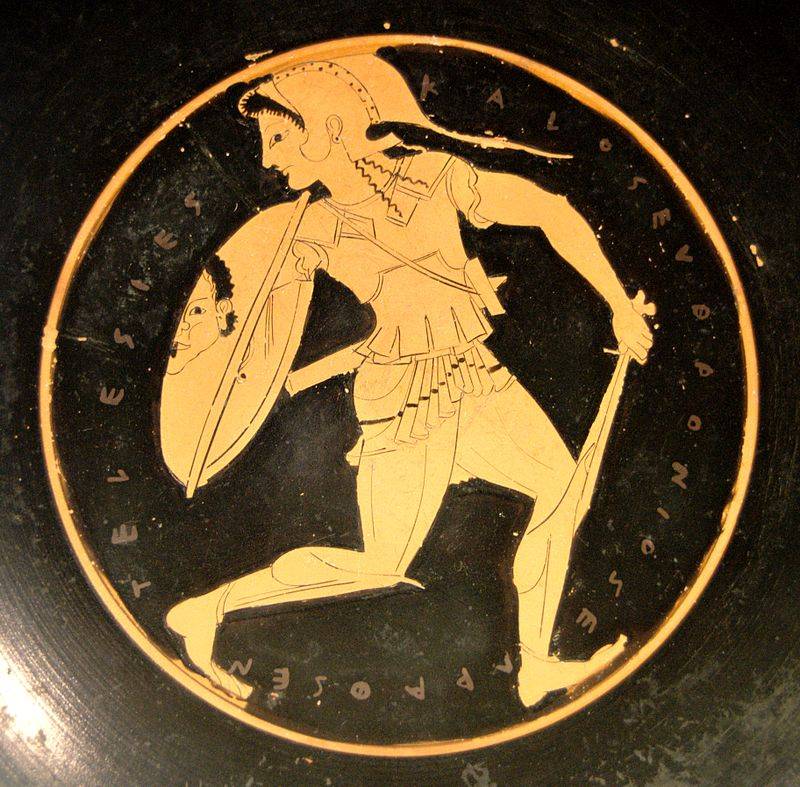 Amazon with helmet and shield bearing the head of Medusa Gorgon. Berlin Antikensammlung, ca. 510-500 BC.
The Gorgons and Medusa's Origin
In early tradition the Gorgons belong to the generation of ancient marine and boundary beings. In Hesiod they are daughters of Phorcys and Ceto, sisters of the Graiai and other beings who live at the edge of the world. Their space is not ordinary human geography but the limit of night, sea and death. That setting makes Medusa part of a world the hero can enter only with divine help and special knowledge.
Medusa's sisters, Stheno and Euryale, are immortal. Medusa is mortal, and for that reason she can become the object of a labour. This distinction matters: the hero does not defeat the entire race of Gorgons, but one figure whose death releases new stories. From Medusa's blood come Pegasus and Chrysaor; the head keeps its deadly force; the memory of the Gorgon passes into objects that no longer tell the whole myth but carry its dangerous sign.
Later ancient literature, especially Ovid, makes Medusa's story more tragic. Her snake hair is explained as the result of punishment and transformation. This version does not erase the earlier Gorgon mask, but adds another layer: Medusa becomes not only a monster at the edge of the world, but also a figure of violence, beauty, punishment and the loss of human form.
Perseus and the Dangerous Gaze
The central myth of Medusa is built around the impossibility of direct sight. Perseus cannot defeat her by an ordinary blow, because eye contact itself is deadly. The labour therefore requires not only force but precise technique. Athena and Hermes help the hero; he receives a shining shield or mirror, a sickle, winged sandals, the cap of invisibility and a bag for the head. The crucial method is to look at the reflection rather than at the Gorgon herself.
This story explains a special kind of heroism. Perseus wins not because he is physically stronger than Medusa, but because he can obey the conditions of a dangerous action. He approaches the sleeping Gorgons, avoids direct sight, cuts off the head and escapes before the immortal sisters can catch him. Images often show this moment through the hero's turned head, the presence of Athena or Hermes and the position of the sword.
After the victory Medusa's head becomes a weapon. Perseus uses it against enemies, in the rescue of Andromeda and in other episodes. Finally it comes to Athena, on the aegis or shield. The hero's prize is no longer only a trophy: it enters the divine military image and explains why the terrible Gorgon face appears on protective objects.
The Gorgoneion and Protection
The gorgoneion is the image of the Gorgon's head, usually shown frontally. Such a direct gaze is unusual in Greek art, where figures are often shown in profile or in action. Medusa looks straight at the viewer and seems to come out of the object's surface. This made her face especially useful as an apotropaic image: the dangerous gaze was turned against another danger.
On weapons and armour the gorgoneion strengthened the image of the warrior. On a shield it made defence into an active threat, on a cuirass it guarded the chest, and on a phalera it joined ornament, award and protective sign. In architecture and domestic decoration it guarded threshold, sacred space or the owner's prestige. Even when the image became more beautiful and decorative, the memory of the terrible gaze did not disappear completely.
Ancient objects show that Medusa often lived apart from the full myth. The viewer did not always need to see Perseus, the Gorgons and the killing scene. The head alone was enough: it already carried the memory of the deadly gaze and of victory over it.
 Phalera with the head of Medusa. Roman; silver, gold and bronze, AD 100-225.
 Glass phalera with the head of Medusa, mid-first century AD; Sasson Ancient Art Gallery, Jerusalem.
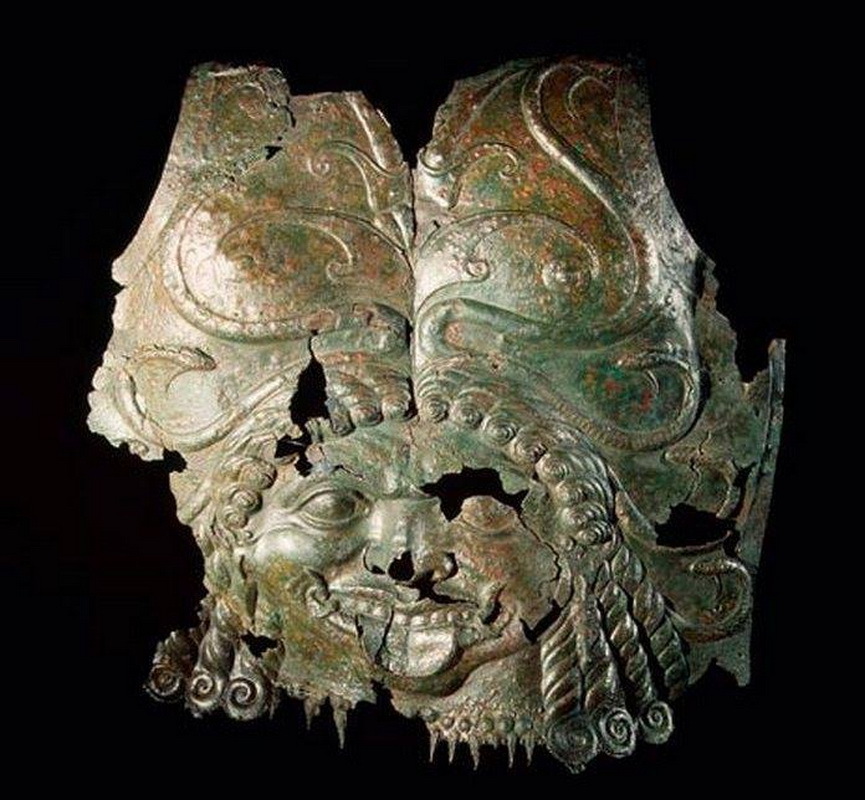 Greek bronze cuirass with a relief image of a Gorgon. Hermitage, Saint Petersburg, sixth-fifth century BC.
The Changing Image
In Archaic art the Gorgon often appears as a sharp mask of terror: round face, wide eyes, tusks, protruding tongue and sometimes beard or grimace. Such an image was easy to recognize and worked well on small objects. It did not require a long narrative: the viewer immediately saw a sign connected with fear and protection.
In the Classical period and later Medusa gradually becomes more human. The face softens, the grotesque features are reduced, and the snake hair can almost be read as tragic ornament. This does not mean that the image became safe. Rather, the danger became more complex: Medusa could be monster, victim and beautiful dead head whose force remains after death.
The Roman world used Medusa especially often as a decorative and protective motif. Her face appears on phalerae, glass medallions, mosaics, cuirasses, sarcophagi and architectural details. Roman artists did not need to retell the whole story of Perseus, but they kept the main effect: Medusa's gaze turned ornament into a sign of power.
Monuments and Images
Surviving objects show different ways in which Medusa existed in ancient culture. The pelike with Perseus and Medusa presents the narrative myth: hero, Gorgon and divine aid remain part of one scene. The terracotta relief from Melos shows another moment, after the head has been cut off, when the trophy becomes a force in its own right.
The Amazon's shield with the head of Medusa matters because the gorgoneion appears inside another mythological subject. It strengthens the martial image and shows how the Gorgon sign could move from the Perseus story into the wider language of weapons. The cuirass with a relief Gorgon makes the same point still more directly: Medusa's face is placed on the warrior's body as visible protection.
Roman phalerae and glass medallions show the later layer. Here Medusa is not necessarily tied to one episode of the myth; she works as a recognisable image of protection, status and dangerous beauty. The date, material and function of the object therefore matter as much as the label "Medusa" itself.
Brief Chronology of the Image
- Eighth-seventh centuries BC: early tradition forms the Gorgons as boundary beings at the edge of the world.
- Seventh-sixth centuries BC: the gorgoneion spreads widely through vase-painting, architecture, armour and small objects as a sharp mask of terror.
- Fifth century BC: the story of Perseus and Medusa receives developed narrative scenes in vase-painting and relief.
- Hellenistic period: Medusa increasingly receives a more human and tragic appearance.
- Roman period: the head of Medusa becomes a stable decorative and protective motif on military, domestic and funerary objects.
Related Topics
Literature and sources
- Hesiod. Theogony, 270-286.
- Pseudo-Apollodorus. Bibliotheca, II.4.
- Ovid. Metamorphoses, IV-V.
- Pausanias. Description of Greece, II.21; III.17.
- LIMC. Gorgo, Gorgones, Medousa.
- Boardman J. Athenian Black Figure Vases.
- Boardman J. Athenian Red Figure Vases: The Classical Period.
- Vernant J.-P. Mortals and Immortals: Collected Essays.
- Metropolitan Museum of Art: 41.162.75; 17.190.2072.
- British Museum: terracotta relief with Perseus and Medusa from Melos.
Interested in Ancient Rome beyond reading? Join Legio X Fretensis or explore our reenactment directions.


