Greek Gods
Greek gods were not a single dogmatic system, but a living polytheistic world formed from myths, local cults, poetry, festivals, sanctuaries and images. The same deity could be patron of a city, participant in a Panhellenic myth, force of nature, protector of a household and figure on vase painting. The Greek pantheon is therefore best understood not as a simple list of names, but as a system of kinship, power, functions and local forms of worship.
In myth the gods resemble humans in character and passions, but differ through immortality, power and the ability to act through omens, illness, harvest, sea, war, love or inspiration. In cult they were first of all recipients of ritual: people offered sacrifices, vows, figurines, vessels, weapons, first fruits and inscriptions to them. Archaeology is therefore as important as later retellings: a temple, altar, relief, coin or vase shows which deity was worshipped, where and in what role.
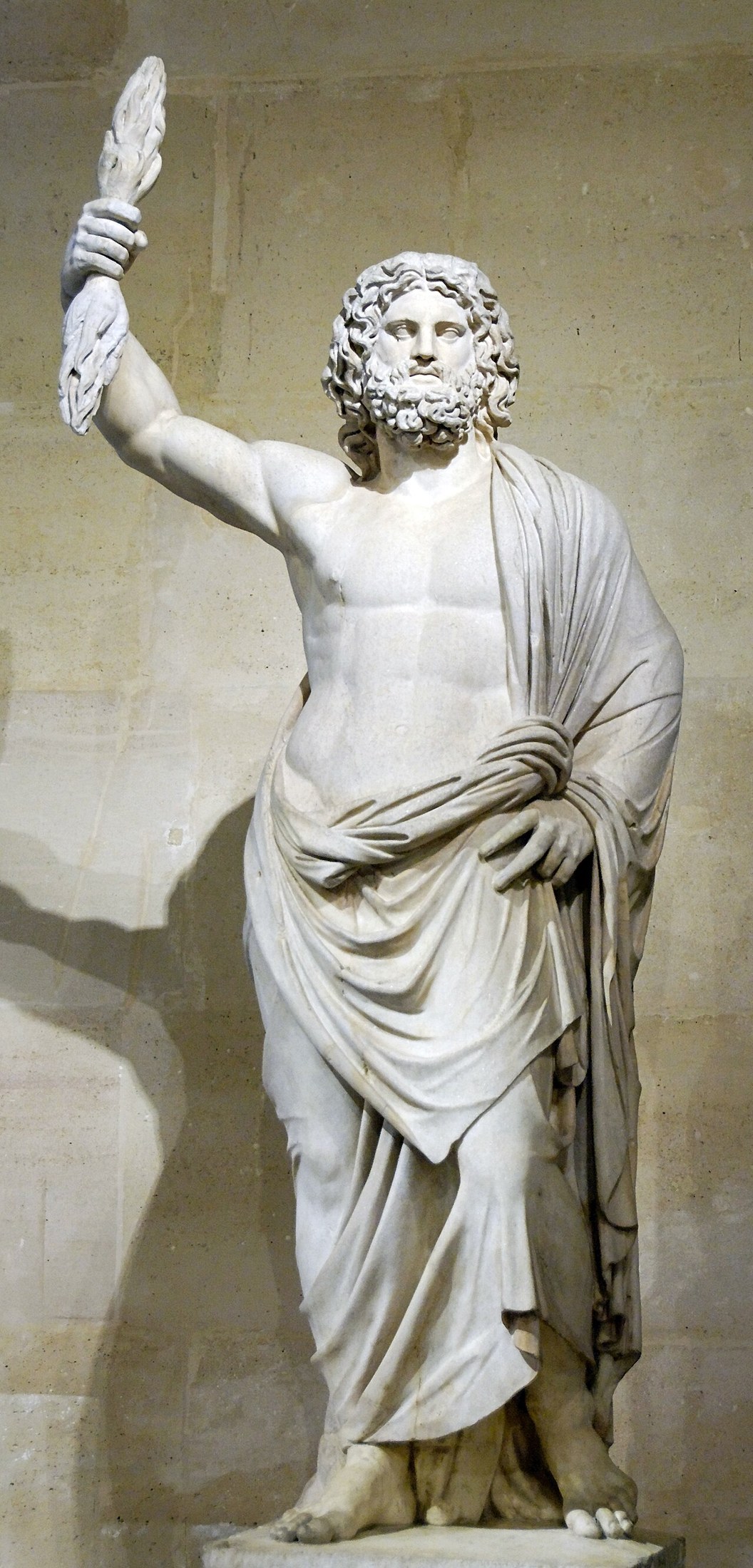 Zeus of Smyrna, marble statue around AD 250; Louvre, Ma 13.
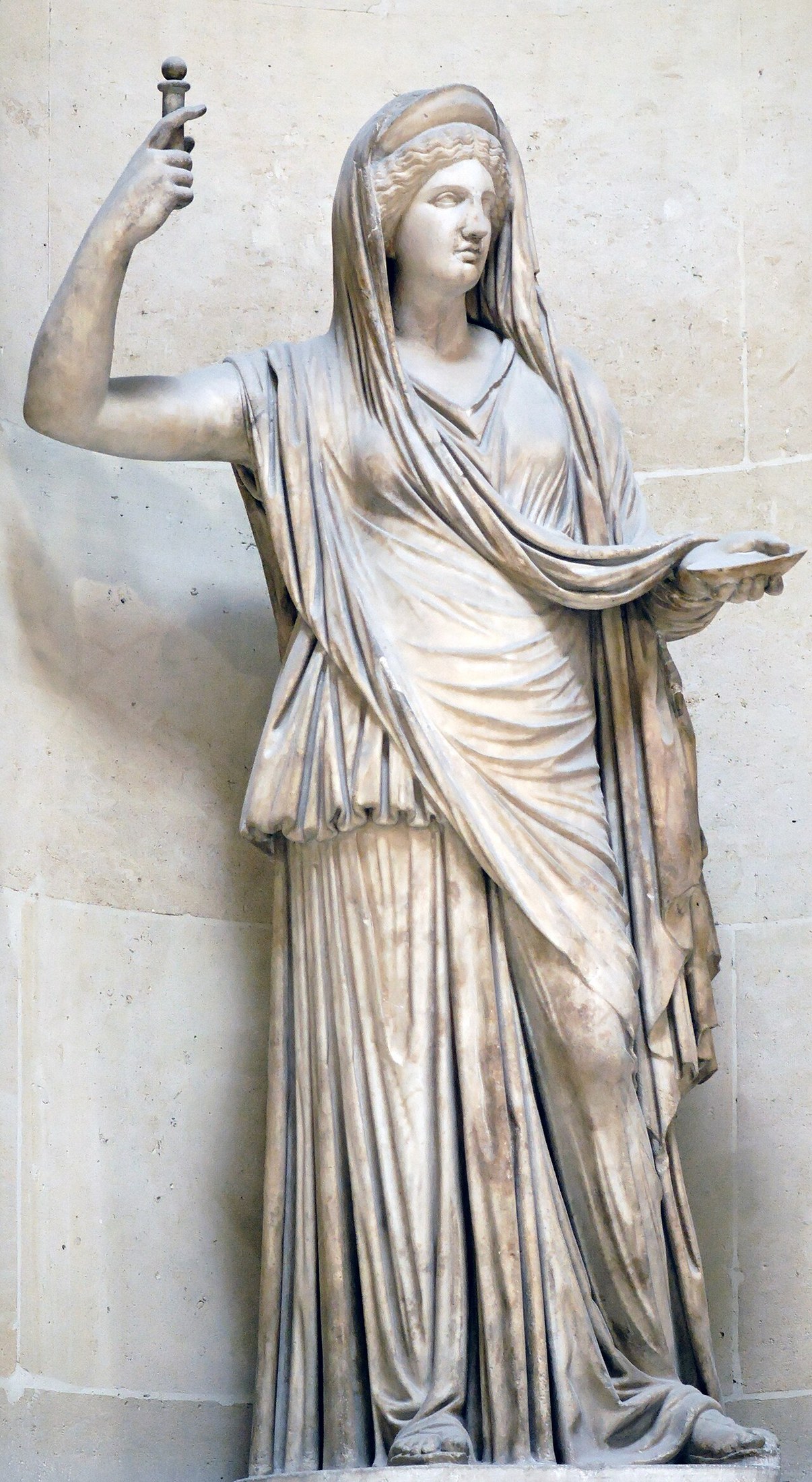 Hera Campana, Roman marble copy of a Hellenistic original, 2nd century AD; Louvre, Ma 2283.
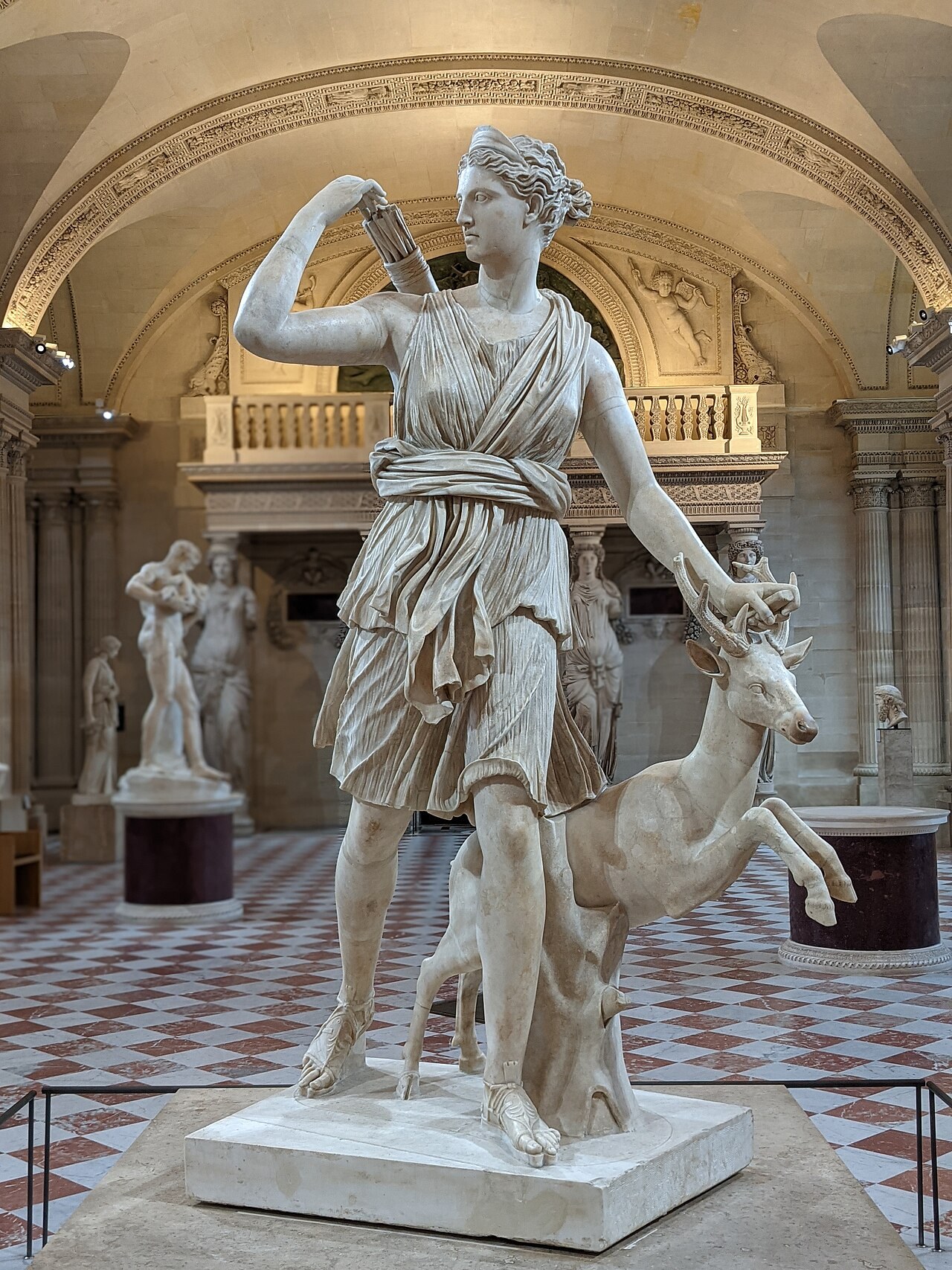 Artemis with a doe, the Diana of Versailles, Roman copy of the 1st-2nd centuries AD after a 4th-century BC Greek original; Louvre, Ma 589.
Generations and Hierarchy
Greek divine hierarchy begins with primordial powers. In Hesiod, Chaos, Gaia, Tartarus and Eros appear first; Gaia then gives birth to Uranus, the mountains and Pontus. These figures do not yet resemble the Olympian gods in the full sense: they express the structure of the world - earth, sky, depth, sea, generative force and the space from which later generations arise.
The second major generation is the Titans. Among them are Cronus and Rhea, Oceanus and Tethys, Hyperion, Iapetus, Themis and Mnemosyne. The myth of Cronus explains a change of power: he overthrows Uranus, then fears being overthrown by his own children and swallows them. Rhea saves Zeus, and after the Titanomachy the younger generation of gods gains supreme authority. This myth is not merely a family drama; it describes the transition from older cosmic powers to a more organised Olympian order.
After victory the Olympians divide the world. Zeus receives the sky and supreme authority, Poseidon the sea, and Hades the underworld. The earth remains a shared domain of gods and humans, where cities, heroes, sanctuaries and mortal families act. Olympian hierarchy is therefore not a military chain of command: Zeus stands above the others as guarantor of order, but each deity has a sphere, cultic rights and dangerous boundaries of interference.
Olympians and Their Domains
The twelve Olympians usually include Zeus, Hera, Poseidon, Demeter, Athena, Apollo, Artemis, Ares, Aphrodite, Hephaestus, Hermes and either Hestia or Dionysus. The list varied in different traditions: Hestia could give place to Dionysus, while Hades, although brother of Zeus and Poseidon, was usually not counted in the Olympian assembly because his authority belonged to the underworld.
| *=God=* | *=Main Spheres=* | *=Attributes and Cultic Emphases=* |
|---|---|---|
|
Zeus |
sky, thunder, oath, hospitality, kingship |
thunderbolt, eagle, sceptre; Olympia, Dodona, Zeus Xenios and Horkios |
|
Hera |
marriage, legitimate family, female status, queenship |
diadem, peacock, pomegranate; Argos, Samos, marriage rites |
|
Poseidon |
sea, earthquakes, horses, danger of travel |
trident, horse, dolphin; Isthmia, coastal and maritime cults |
|
Demeter |
grain, agriculture, fertility, loss and return of Persephone |
ears of grain, torch, basket; Eleusis, Thesmophoria |
|
Athena |
civic protection, craft, strategy, intelligent warfare |
helmet, aegis, spear, owl; Acropolis, Panathenaia |
|
Apollo |
prophecy, music, purification, healing, sudden death |
kithara, bow, laurel, tripod; Delphi, Delos |
|
Artemis |
hunting, wild nature, maidenhood, childbirth, youth transitions |
bow, doe, short chiton; Brauron, Ephesus |
|
Ares |
battle rage, bloodshed, destructive side of war |
helmet, spear, shield; often more mythic than central in polis cult |
|
Aphrodite |
love, desire, beauty, marriage, sea, power of attraction |
dove, mirror, apple, shell; Cyprus, Cythera, Corinth |
|
Hephaestus |
fire, forge, metalwork, complex craft |
hammer, tongs, anvil; Athens, Lemnos |
|
Hermes |
messenger, boundaries, roads, trade, cunning, guide of souls |
petasos, caduceus, winged sandals, herms |
|
Hestia |
hearth, household, stability of family and community |
hearth and fire; less anthropomorphic than other Olympians |
|
Dionysus |
wine, theatre, ecstasy, mask, crossing of ordinary order |
thyrsus, ivy, vine, kantharos, satyrs and maenads |
|
Hades |
underworld, the dead, riches of the earth |
sceptre, cap of invisibility, Cerberus; name often replaced by epithets |
|
Persephone |
queen of the underworld, spring return, passage between worlds |
torch, pomegranate, grain; Eleusinian Mysteries |
Zeus governs the sky, thunder, oaths, hospitality, kingship and general order. Hera is connected with marriage, legitimate family and female status. Poseidon rules the sea, earthquakes, horses and the danger of travel. Demeter protects grain, agricultural fertility and the cycle of Persephone's loss and return. Athena combines strategic warfare, craft, civic protection and political intelligence; in Athens her image was part of the very identity of the polis.
Apollo unites prophecy, music, purification, the bow, healing and dangerous sudden death. Artemis protects hunting, wild nature, maidenhood, transitions of youth and childbirth. Ares embodies the destructive side of battle, whereas Athena more often represents discipline and the intelligence of war. Aphrodite is connected with love, desire, beauty and marriage, but her power could be political as well as dangerous. Hephaestus is the god of fire, forge and complex craft; Hermes is messenger, guide and protector of travellers, traders, boundaries and transitions.
Hestia guards the hearth and stability of the household; Dionysus is linked with wine, theatre, ecstasy, masks, the crossing of ordinary boundaries and the return of life. These spheres overlapped. Childbirth could involve Artemis, Hera and Eileithyia; a sea voyage Poseidon, Athena and local sea gods; war Zeus, Athena, Ares, Apollo and the heroic protectors of a particular city.
 Statue of Apollo, Naples; a museum image of the god of music, prophecy, purification and arrows.
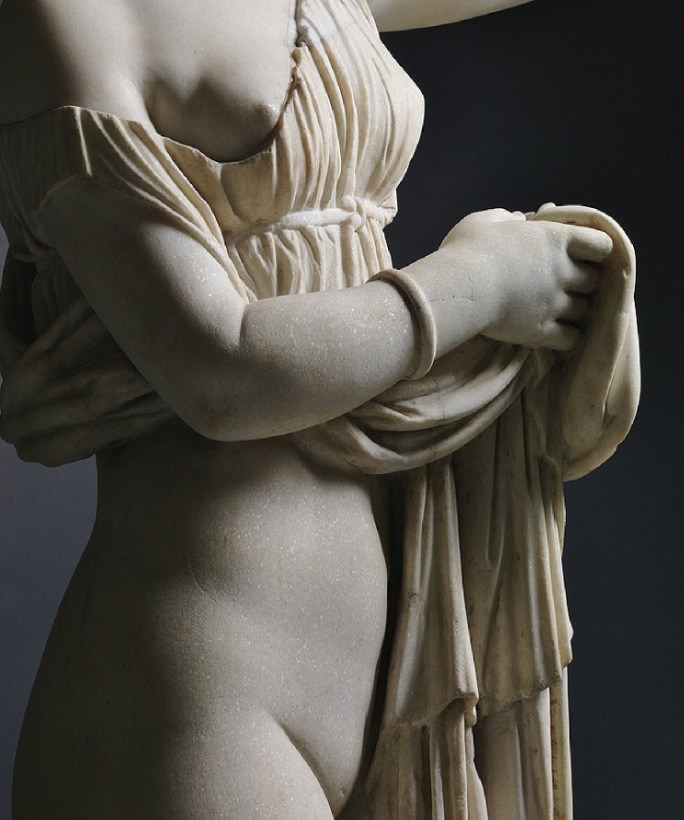 Aphrodite Kallipygos. Marble statue with later restorations; National Archaeological Museum, Naples, inv. 6020.
Chthonic Deities and Heroes
The underworld and earthly side of the pantheon is no less important than Olympus. Hades rules the dead and the riches of the earth, but in cult his name was often avoided or replaced by epithets. Persephone links the world of the dead with the cycle of vegetation: her abduction and return to Demeter explained seasonality, loss and hope for renewal. Hecate, Hermes Psychopompos, underground Zeus, the Erinyes and local earth deities show that the boundary between life, death, fertility and purification was complex.
Heroes occupied an intermediate position between humans and gods. Heracles, Theseus, Achilles, Asclepius, city founders and local ancestors received honours at tombs, sanctuaries or festivals. Heracles is especially important: he is a mortal hero who performed labours and later received immortality. His images therefore appear beside gods and help explain how Greek religion joined myth, family memory, martial glory and hopes for protection.
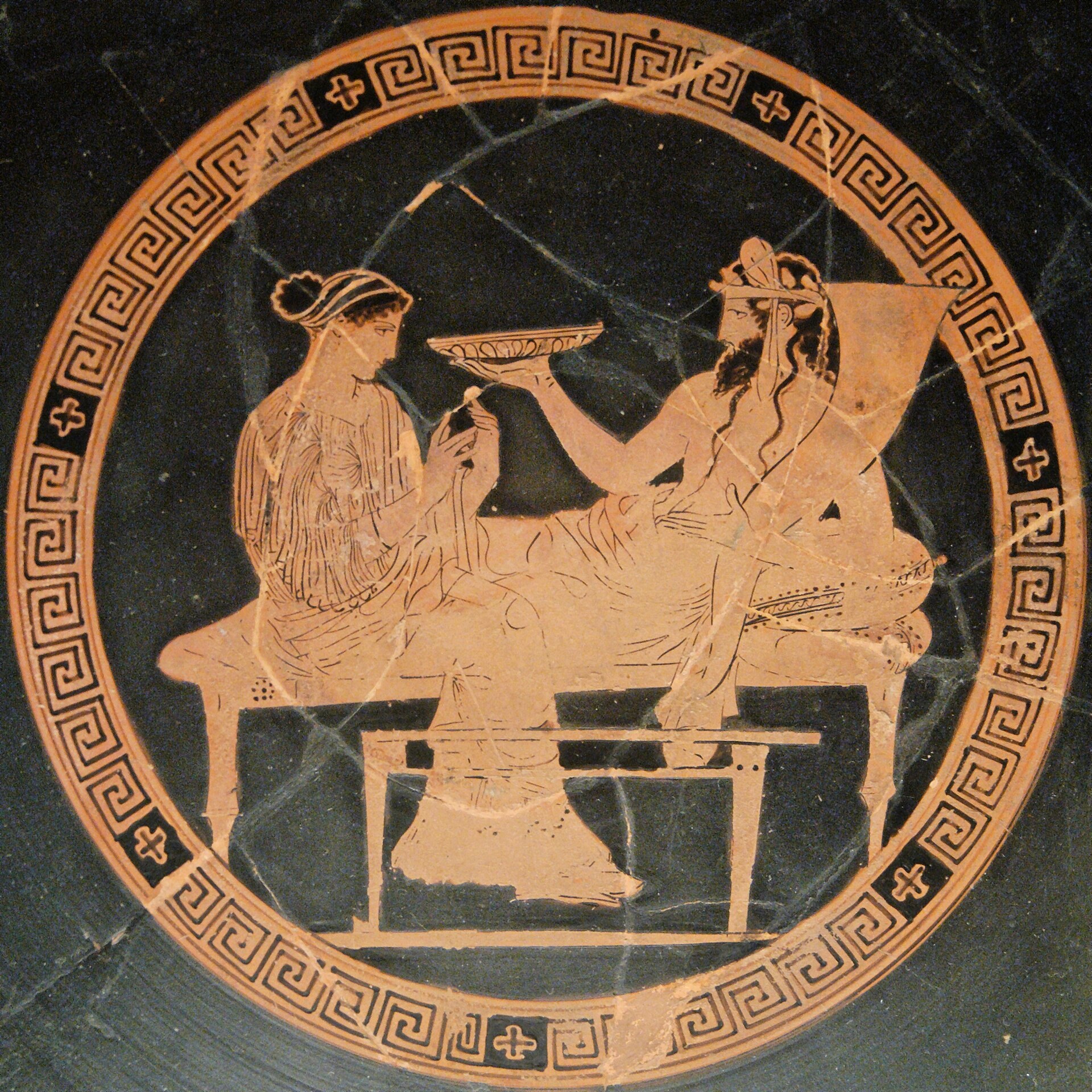 Hades and Persephone on a red-figure vase, British Museum, E 82;.
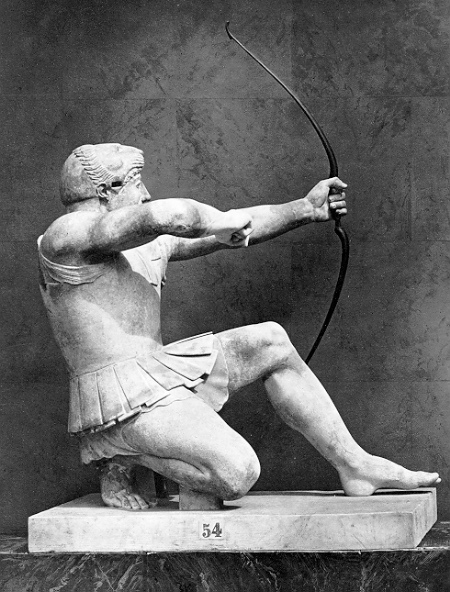 Heracles as an archer from the east pediment of the Temple of Aphaia on Aegina, 490-480 BC.
Lesser Deities and Attendants
Alongside the Olympians, the Greek religious world contained many lesser but stable powers. The Muses governed memory, song, poetry, history, dance and learned knowledge; the Charites were linked with beauty, gift and festive favour; the Moirai expressed the limits of human fate. Nike personified victory, Iris was a messenger, Hebe youth, and Eros could be both a cosmic force in early genealogies and a youthful attendant of Aphrodite in later iconography.
Nymphs, Nereids, Oceanids, satyrs, Sileni, river gods and winds show how closely the Greek pantheon was tied to landscape. A stream, cave, grove, mountain slope, shore, spring or dangerous strait could have its own divine inhabitants. Such figures rarely stand at the centre of a school list of Olympians, but they often explain a local cult, the name of a sanctuary, a scene on a vase or the dedication of an ordinary person.
Monstrous and liminal beings formed another group. Gorgons, Cyclopes, Centaurs, Sirens, Sphinxes, the Minotaur and others were not always gods, but they worked within the same mythological system. They showed the danger of the wild world, the limits of the human body, the trials of heroes and the threat of disorder. The articles on Medusa Gorgon, Cyclopes, the Minotaur and Centaurs therefore complement the topic of the gods, even though they do not describe the Olympian core of the pantheon.
Myths of Power, Marriage and City
Major myths about the gods explained the structure of the world and the rights of cults. The myth of the overthrow of Uranus, the rule of Cronus and the victory of Zeus showed why the Olympian order was legitimate. The myth of Prometheus explained sacrificial division, fire, human cunning and punishment. The story of Demeter and Persephone connected a mother's grief, agriculture, the Eleusinian Mysteries and hope for the goddesses' favour after death.
Civic myths fixed the bond between deity and territory. At Athens the contest of Athena and Poseidon explained why the city belonged to Athena: the goddess gave the olive, while Poseidon struck the ground with his trident. At Delphi Apollo defeats Python and takes possession of the oracle, turning the place into a Panhellenic centre of prophecy. Dionysus arrives as a foreign and dangerous god, but through theatre, wine and festival becomes part of polis life. Such stories were not abstract tales: they justified processions, sacrifices, sacred roads, prohibitions and a city's claim to special protection.
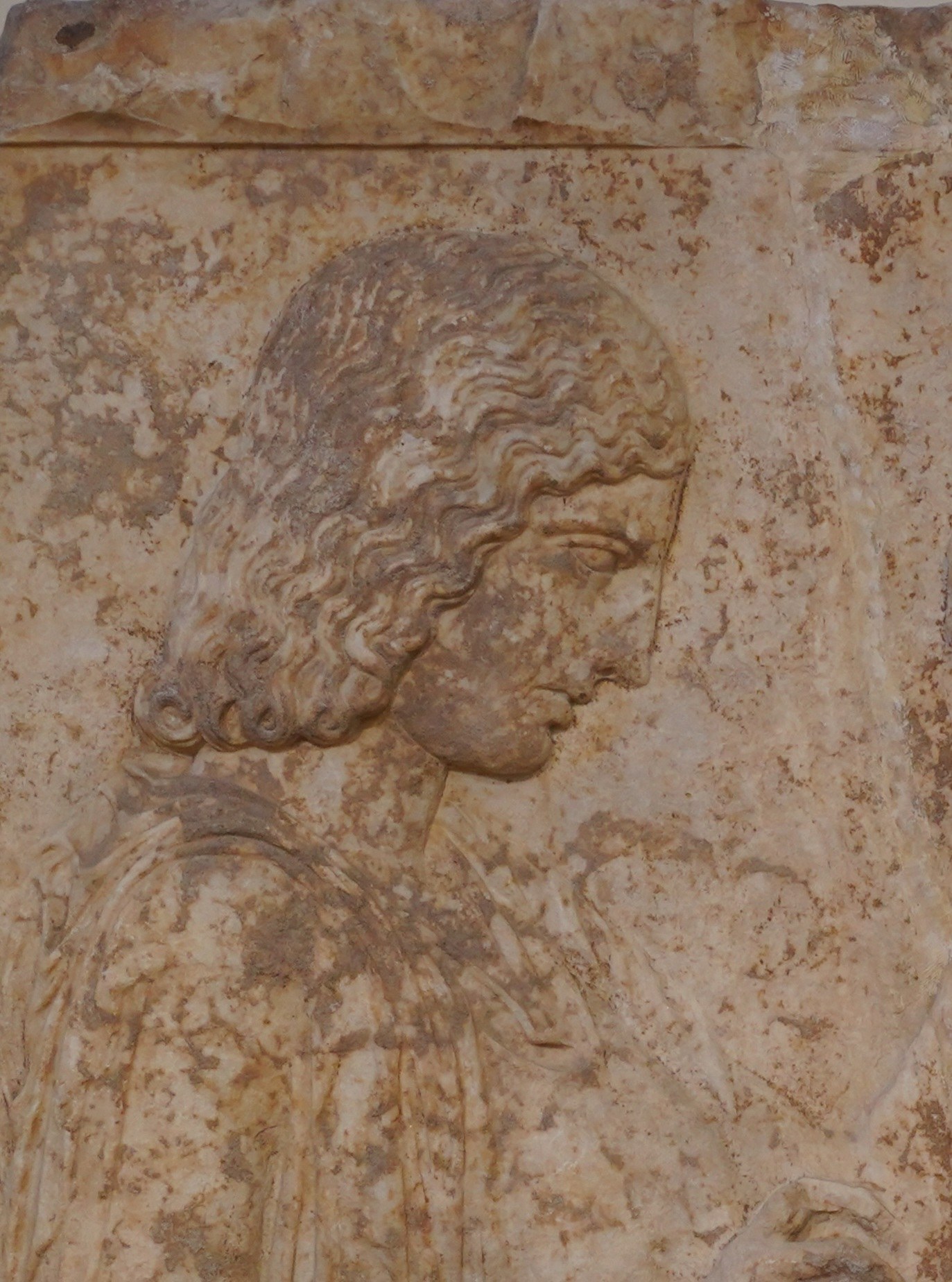 Great Eleusinian Relief: Demeter, Persephone and Triptolemos, 440-430 BC; sanctuary of Demeter and Kore at Eleusis.
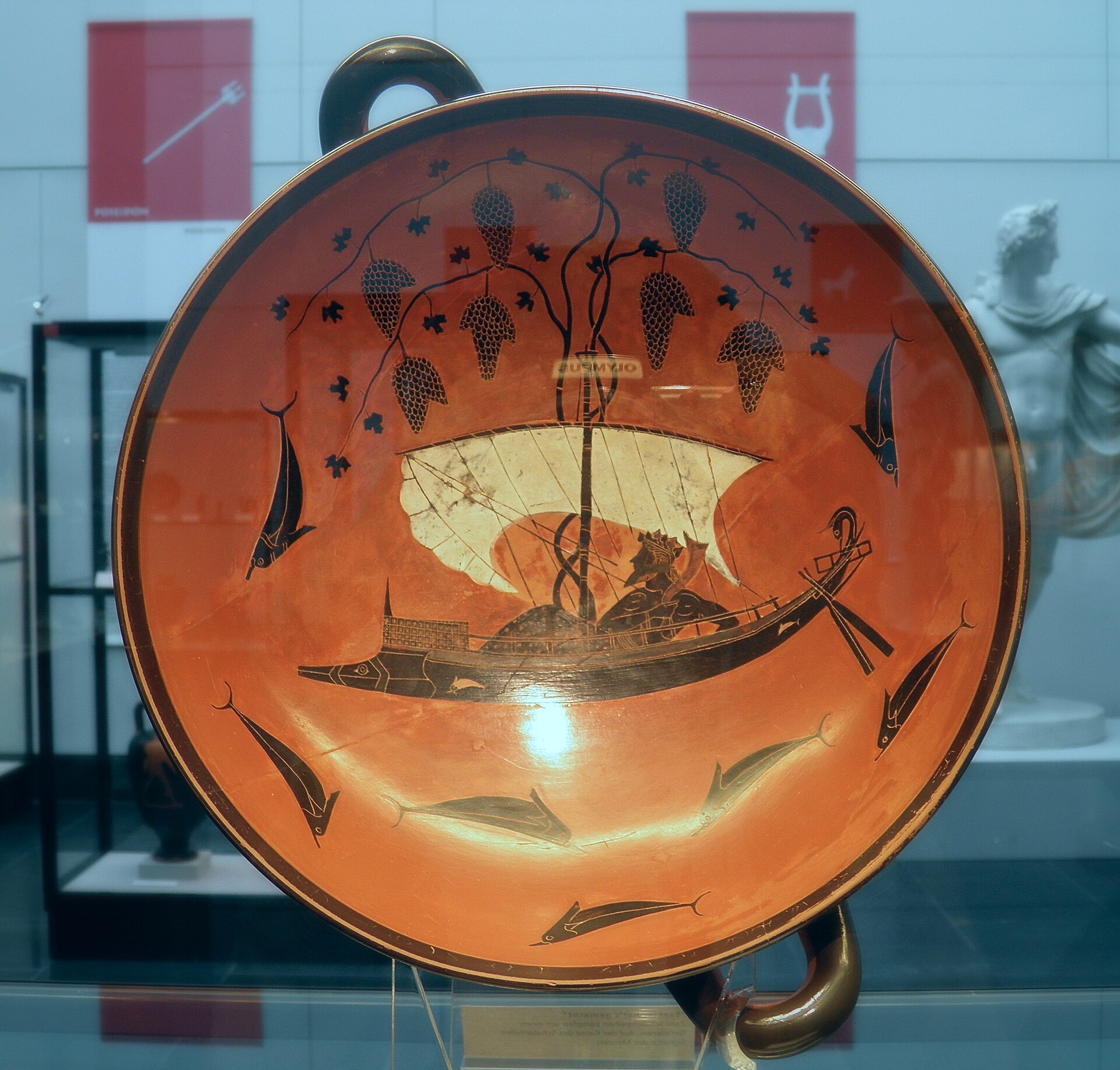 Kylix by Exekias showing Dionysus on a ship, around 530 BC; Staatliche Antikensammlungen, Munich.
Sanctuaries, Festivals and Ritual
The cult of Greek gods was tied to specific places. Olympia gathered Greeks around Zeus, the games and dedicatory gifts of victors. Delphi joined Apollo, the oracle, civic treasuries and political decisions. Eleusis was the centre of Demeter and Kore, where the Mysteries connected the agricultural cycle with hope for a better fate after death. Delos, Epidaurus, Samos, Brauron, Dodona and the Athenian Acropolis each had their own sacred landscapes, rules and monuments.
A festival made the deity visible to the community. The Panathenaia in Athens included processions, sacrifices, contests and the offering of the peplos to Athena. The Dionysia connected Dionysus with theatre and civic self-representation. The Thesmophoria was a women's festival of Demeter and Persephone, important for fertility and marriage. Apollo, Artemis, Hera, Poseidon and local heroes had their own processions, sacrificial banquets, competitions and prohibitions. Through such actions the god became not an abstract figure, but a participant in the calendar and memory of the city.
Ritual did not require personal belief in the modern sense. It was more important to address the deity correctly, name the proper epithet, offer an appropriate sacrifice and observe rules of purity. Prayer often reminded the god of earlier gifts and asked for return assistance. A vow tied a request to a future gift: if the god helped in travel, illness, war or childbirth, a person would offer a figurine, vessel, wreath, animal or inscription. This is why archaeological votive objects reveal people's actual expectations so well.
Epithets, Cults and Local Forms
A Greek deity was often recognised through an epithet. Zeus Xenios guarded hospitality, Zeus Horkios the oath, Athena Polias the city, Athena Nike victory, Apollo Pythios Delphi, and Artemis Brauronia female age transitions in Attica. An epithet was not an ornament of the name: it indicated which power of the deity was being addressed and which rite was appropriate.
Local cults could differ sharply from the literary image. Aphrodite was not only goddess of love, but also protector of seafaring, marriage, civic fortune and sometimes martial power. Artemis could appear in one place as huntress, in another as protector of girls, women in childbirth or boundaries. Apollo could be healer, destroyer, musician, prophet and purifying god. Place, date, inscription, object and function of the monument are therefore essential when describing Greek gods.
Iconography and Spheres of Responsibility
Ancient images are often identified by attributes. Zeus is marked by thunderbolt, sceptre and eagle; Poseidon by trident, horse and marine setting; Athena by helmet, aegis, spear, shield and owl; Apollo by kithara, laurel, bow and tripod; Artemis by bow, doe, short chiton and hunting pose. Hermes is recognised by the petasos, winged sandals and caduceus, Dionysus by the thyrsus, ivy, vine, kantharos, satyrs and maenads.
These signs do not replace context. The same figure with a bow may be Apollo, Artemis or a hero; a female statue without inscription may represent a goddess, mortal woman, nymph or Muse. Combinations are more reliable: findspot, inscription, accompanying figures, objects, vessel type, temple function and repetition of the image. Vase painting, reliefs and statues must therefore be read together rather than isolating a striking image from its archaeological setting.
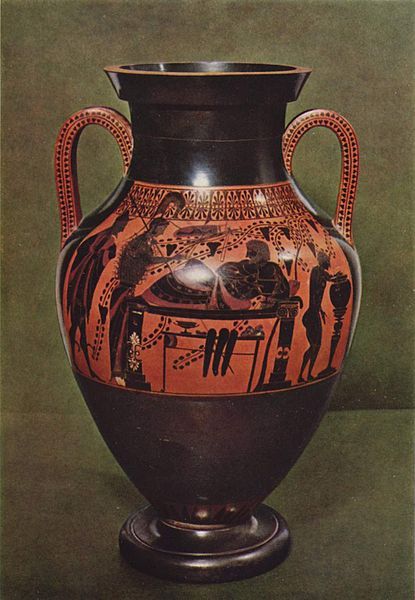 Athena beside Heracles on an Attic black-figure amphora, 520-510 BC; vase painting as evidence for myth.
 Apollo painted inside a kylix from Delphi; Delphi Archaeological Museum, Greece.
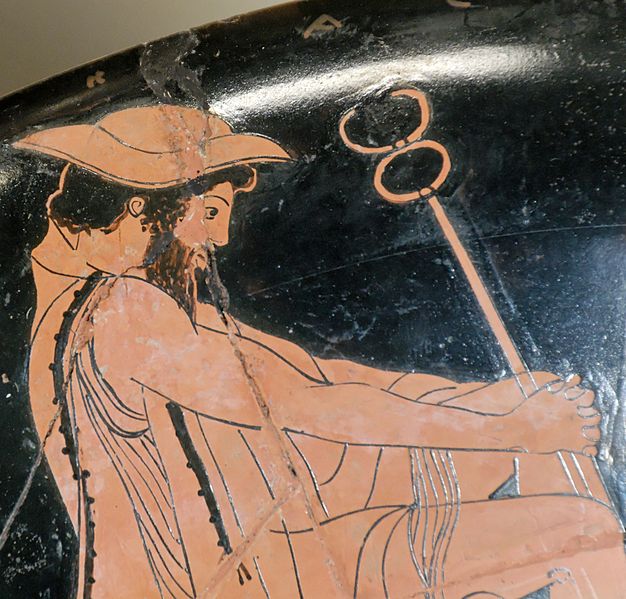 Hermes wearing a petasos and carrying a caduceus on an Attic vase from the Louvre, G 264, around 480-470 BC.
Archaeological Evidence
The main archaeological evidence for Greek gods consists of temples, altars, dedicatory inscriptions, cult statues, terracotta figurines, coins, reliefs and painted pottery. A temple shows not only architectural style, but also the position of a sanctuary within a city or landscape. An altar marks the place of sacrifice. An inscription on a gift gives the deity's name, the dedicator's name and sometimes the reason for the appeal. A vase may preserve a mythological scene while also being an object of banquet, burial or exchange.
Many famous sculptures of gods survive as Roman copies of Greek originals or as later museum restorations. This does not make them useless, but it requires caution: a marble statue from the Louvre, a relief from Eleusis, an Attic amphora and a household terracotta answer different questions. The first shows a stable visual type, the second a cultic scene, the third myth in vase painting, and the fourth everyday appeal to a deity. For an article on the gods, the combination of such evidence is what matters.
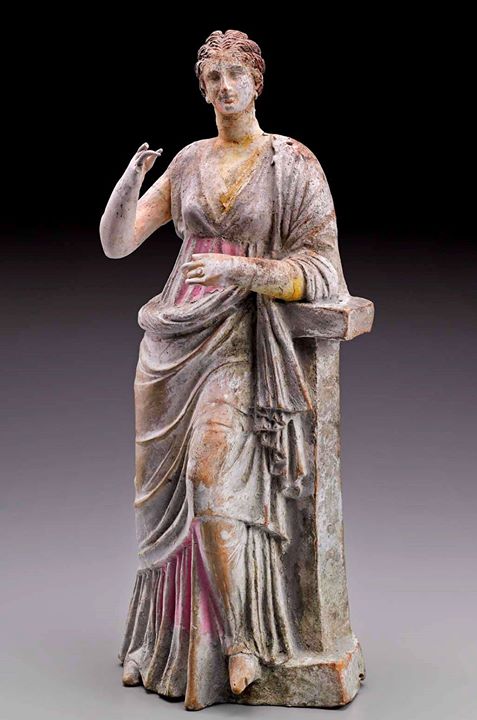 Statuette of Aphrodite or a Muse from the Tomb of the Erotes, Eretria, Euboea, 300-250 BC; Museum of Fine Arts, Boston.
Related Topics
- Religion of Ancient Greece and Ancient Rome
- Greek Mythology
- Greco-Roman Mythology
- Greek and Roman Gods
- Ancient Greece
- Homer
- Medusa Gorgon
- Cyclopes
- Minotaur
- Centaurs
Literature
- Hesiod. Theogony; Works and Days.
- Homeric Hymns.
- Homer. Iliad; Odyssey.
- Pausanias. Description of Greece.
- Burkert W. Greek Religion. Harvard University Press, 1985.
- Parker R. On Greek Religion. Cornell University Press, 2011.
- LIMC: Lexicon Iconographicum Mythologiae Classicae.


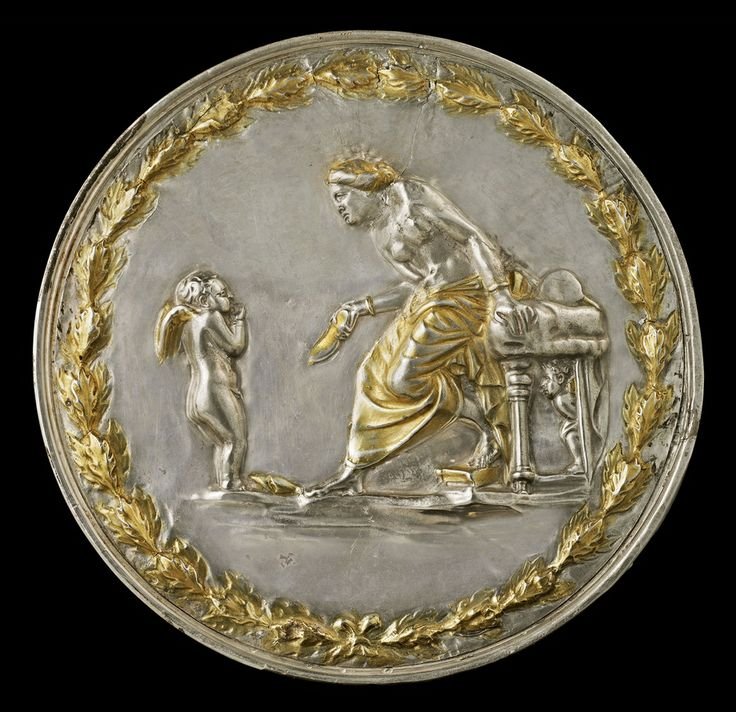 Aphrodite punishing Eros; a Hellenistic or early Roman image, 2nd-1st centuries BC.
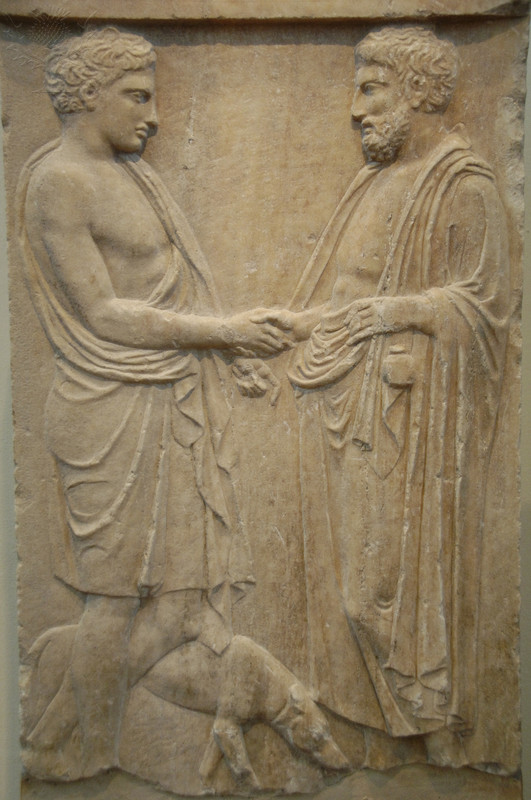 Greek marble relief found in Athens, around 400 BC; National Archaeological Museum, Athens.
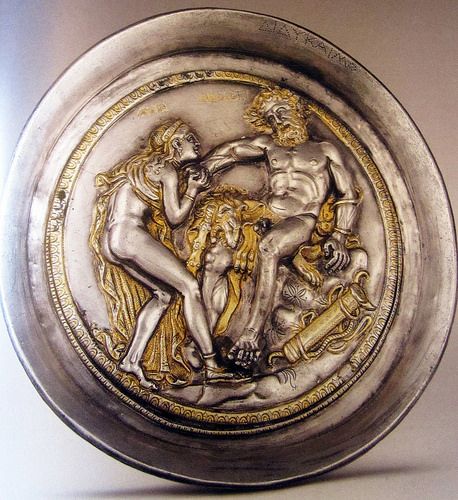 Silver dish with Heracles from the Rogozen treasure; fourth century BCE. Regional History Museum, Vratsa. A Thracian comparison, not a Roman catinum.
Interested in Ancient Rome beyond reading? Join Legio X Fretensis or explore our reenactment directions.


