Minotaur
The Minotaur is a creature with a human body and a bull's head, connected with Crete, King Minos, the Labyrinth and the deed of Theseus. In myth he is born inside the royal house, but cannot be incorporated into human order. He is hidden in the Labyrinth, and Athens is forced to send young men and women to their death. The Minotaur is therefore not simply a monster, but a sign of disturbed power, hidden shame and violence requiring regular sacrifice.
The image joins several themes: the bull as sacred and royal animal, the Labyrinth as a space of lost direction, youth trial and liberation of a city from humiliating dependence. For ancient viewers the scene of Theseus and the Minotaur was a recognizable moment of measure overcoming monstrous force, but behind that victory stood Ariadne, Minos, Pasiphae and the memory of Crete.
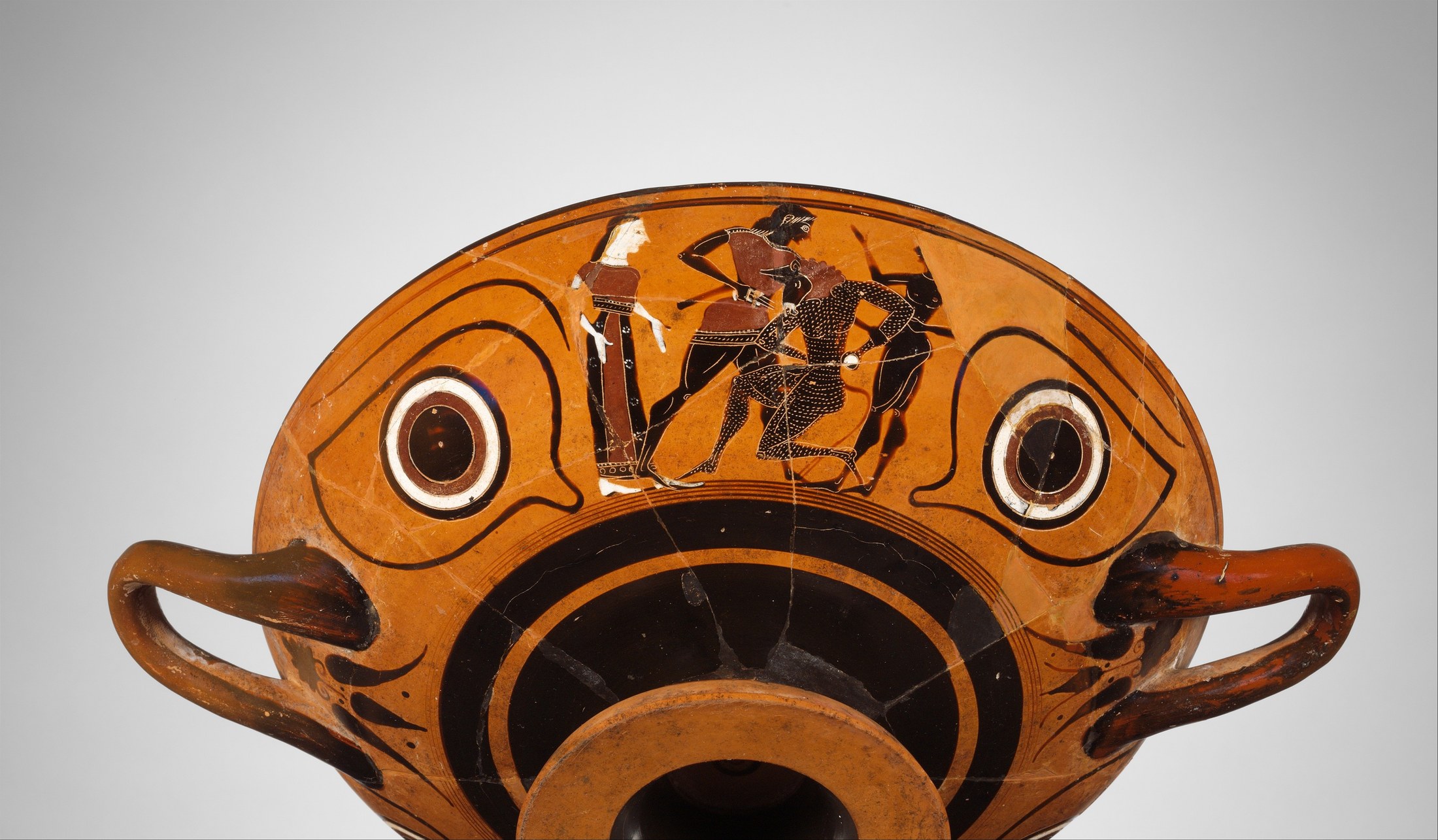 Attic eye-cup with Theseus and the Minotaur, ca. 530 BC. Metropolitan Museum of Art, 06.1021.161.
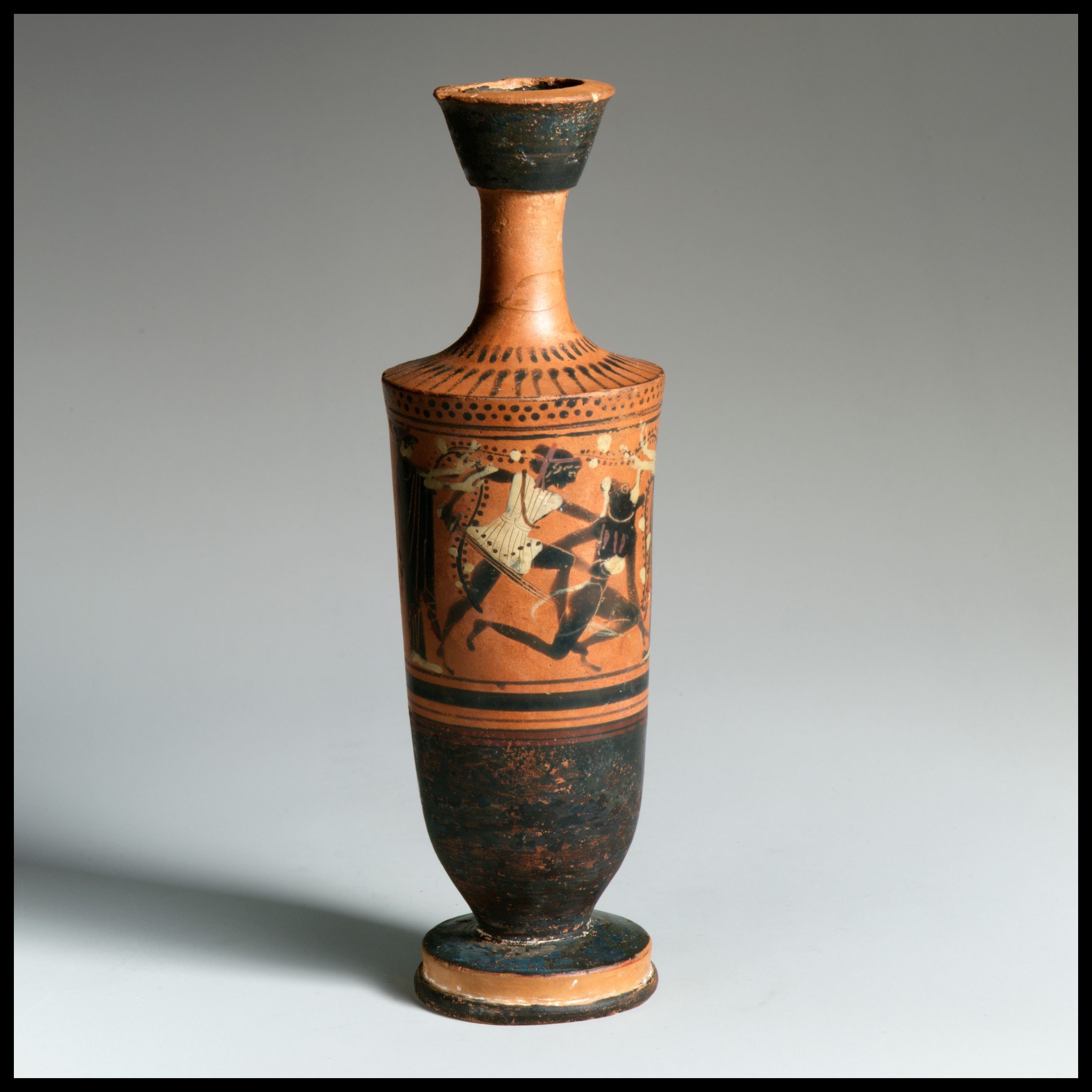 Attic lekythos with Theseus and the Minotaur, ca. 500 BC. Metropolitan Museum of Art, 06.1021.165.
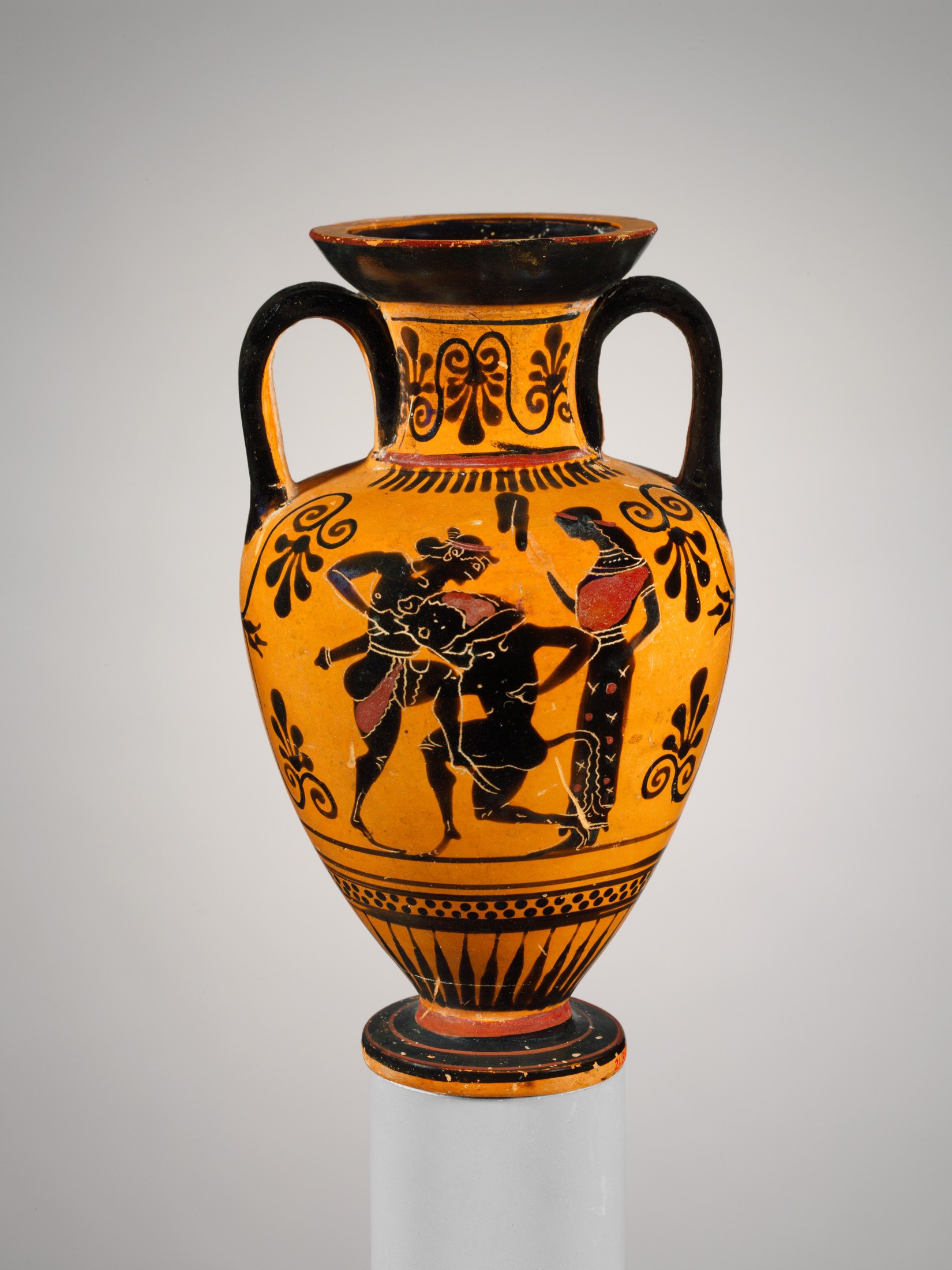 Attic neck-amphora with a Minotaur scene, ca. 500 BC. Metropolitan Museum of Art, 06.1021.170.
Birth of the Monster and the Power of Minos
The myth begins not with Theseus but with a failure of royal power. Minos receives a beautiful bull from Poseidon, but does not sacrifice it as he should. As punishment Pasiphae falls in love with the bull, and the child of that union, Asterios, later called the Minotaur, becomes the living trace of a broken promise. The monster is therefore connected not only with body but with politics: he is born from the king's wrong relation to the gods.
Daedalus builds the Labyrinth in order to hide the creature. This solution does not remove the problem, but places it inside palace space. In the myth the Labyrinth acts as an architecture of secrecy: it conceals the origin of violence and makes escape impossible for victims. The Minotaur does not go out to conquer cities; people are brought to him. This is his special terror: he is part of an established order, not simply an external enemy.
The Athenian tribute explains why Theseus' deed has political meaning. Young men and women are sent not by chance, but as a sign of Athens' subordination to Crete. Victory over the Minotaur breaks this dependence and turns the hero into a liberator. In later memory the deed is tied to Athenian identity: Theseus defeats not only a beast, but a humiliating agreement.
Theseus, Ariadne and the Way Out
Theseus does not win alone. Ariadne gives him a thread or ball of thread that allows him to find the way back. This motif makes the myth not only a story of strength but a story of remembering the path. Inside the Labyrinth one can kill the monster, but without the thread the victor himself becomes a prisoner. Ariadne is therefore not a secondary helper, but the key to the meaning of the deed.
Art most often chooses the moment of combat: Theseus grips the Minotaur by horn, hair or arm and strikes. Such a scene is clear and compact. But the literary myth is wider: before the fight come the monster's origin and the tribute; after it, flight from Crete, abandonment of Ariadne and the hero's later fate. The Minotaur dies, but the myth does not end with his death; it opens a chain of consequences.
The Minotaur's fate is almost always reduced to death at Theseus' hands. He does not receive a second existence like Medusa through the gorgoneion, and does not become the hero of a separate later biography. His meaning survives through place and plot: Labyrinth, Athens, Crete, Ariadne and the image of a young man entering a place from which no one can return.
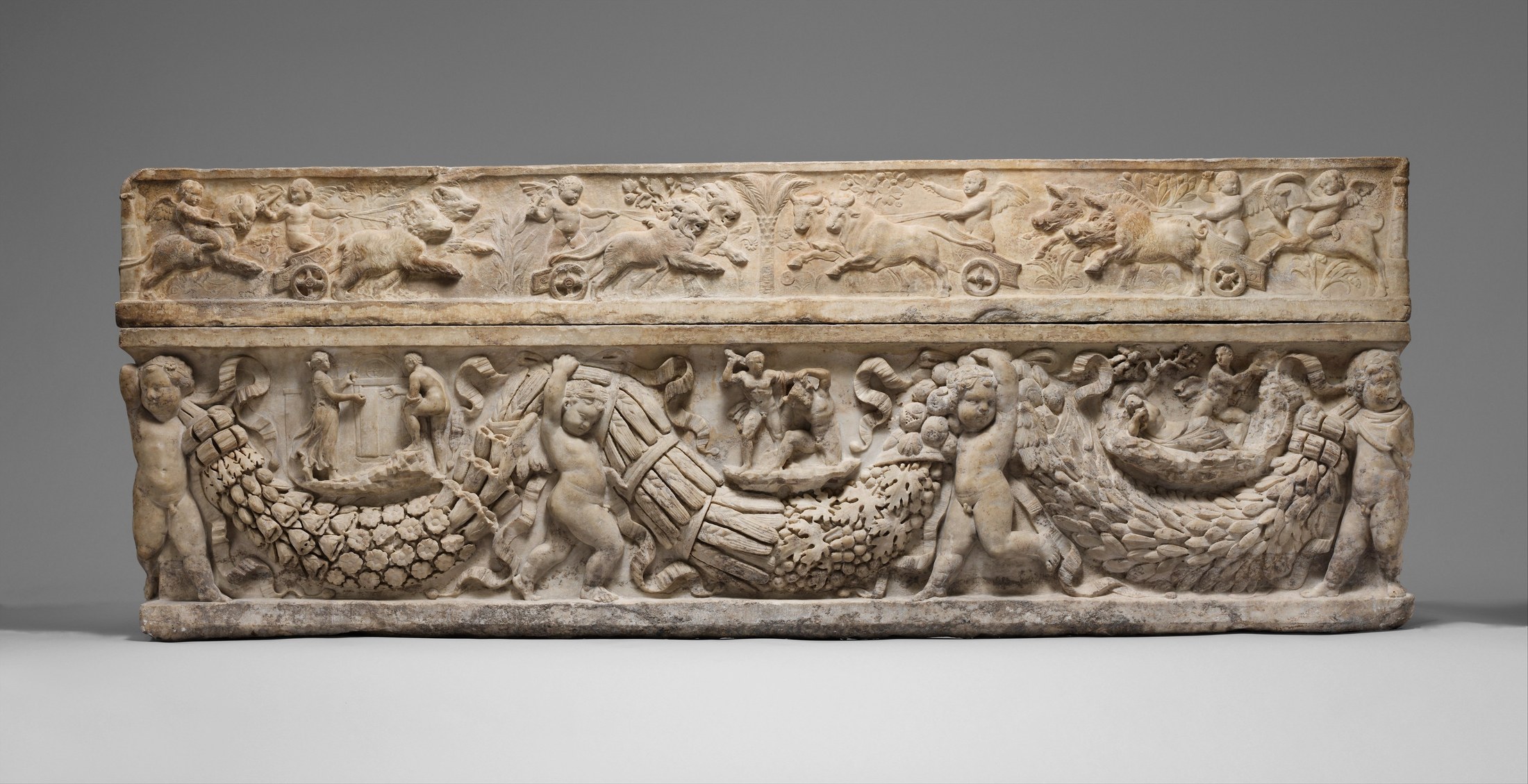 Roman marble sarcophagus with the myth of Theseus and Ariadne, ca. AD 130-150. Metropolitan Museum of Art, 09.221.7.
Symbolism and Meaning
The Minotaur joins man and bull, but not as a harmonious power. Unlike the centaur, whose mixture can signify both wildness and natural knowledge, the Minotaur is almost always placed in an enclosed space and linked with secrecy. His bull's head recalls strength and the sacrificial animal, while the human body marks a broken boundary inside Minos' own house.
The Labyrinth makes the monster a political symbol. It shows power that does not solve its own crime, but builds architecture to conceal it. The Athenian tribute turns Crete's hidden shame into public violence against another city. Theseus' victory could therefore be read as restoration of measure: secrecy is exposed, the path is found, the sacrifices cease.
For an ancient person the myth could also speak about the transition of youth. Young people are sent into the Labyrinth, and Theseus' return makes him an adult hero and future king. The death of the Minotaur becomes a trial of the ability to enter a dark space, meet bodily fear and come back.
Cretan Memory and the Athenian View
The myth of the Minotaur is connected with Crete, but it survives in a form strongly coloured by Greek and especially Athenian tradition. Crete appears as a wealthy, ancient and powerful island, while Athens is the city that must free itself from humiliating tribute. The monster's story therefore both explains a past dependence and asserts Athens' right to its own heroic memory.
The bull had special importance in Cretan culture, and later Greeks could connect the myth with visible traces of the ancient island: palaces, rituals, bull images and complex spaces. But direct identification of the Minotaur with a specific Minoan rite is dangerous. Myth is not an archaeological report; it reworks memory of Crete into the language of hero, tribute and victory.
For an ancient viewer the Minotaur was useful because he could be recognized immediately. Bull's head, human body and fight with Theseus turned a complex political story into a clear image. Yet behind the simple picture stands a large question: how a city frees itself from fear built into another power.
Monuments and Images
The Minotaur is well represented in vase-painting. A kylix, lekythos and amphora show that the Theseus story was already popular in the Archaic period. The scene usually focuses on combat: it is easily readable even on a small vessel. The Roman sarcophagus with the myth of Theseus and Ariadne shows that later tradition was interested not only in the killing of the monster but also in the consequences of the Cretan story.
Two levels must be distinguished when studying the images. One is the concrete fight between Theseus and the Minotaur. The other is the whole Cretan myth with Minos, Pasiphae, Daedalus and Ariadne. An archaeological object often fixes only one episode, but the ancient viewer could keep the whole chain in mind.
Related Topics
- Medusa Gorgon
- Cyclopes
- Centaurs
- Sirens
- Scylla and Charybdis
- Cerberus
- Lernaean Hydra
- Greco-Roman Mythology
Literature and sources
- Homer, Odyssey / Iliad
- Perseus Digital Library.
- Hesiod, Theogony
- Perseus Digital Library.
- Pseudo-Apollodorus, Library
- Perseus Digital Library.
- Ovid, Metamorphoses
- Perseus Digital Library.
- Metropolitan Museum of Art: object 248177
- Metropolitan Museum of Art: object 255178
- Metropolitan Museum of Art: object 251112
- Metropolitan Museum of Art: object 245585
Interested in Ancient Rome beyond reading? Join Legio X Fretensis or explore our reenactment directions.


