Cerberus
Cerberus is the hound of Hades and one of the principal guardians of the underworld in Greek mythology. His role is not to hunt the living, but to guard a boundary: he prevents the dead from leaving Hades' realm and keeps the uninitiated from entering freely into the place where human order ends.
In ancient tradition Cerberus is usually many-headed, most often three-headed, though early and later authors vary the number. His body may also include serpents, a snake tail or snakes rising from his mane and back. Cerberus therefore combines the familiar image of a watchdog with chthonic traits belonging to beings associated with earth, death and underworld powers.
Origin and Kinship
In the standard genealogy Cerberus is born from Echidna and Typhon, like several other monsters of Greek myth. His kin included the Lernaean Hydra, the Chimera, Orthus and other beings encountered by heroes at the edges of the inhabited world. This ancestry places Cerberus among monsters overcome by heroes, but his function is different: he does not ravage the land, but preserves the order of the underworld.
His connection with Hades makes Cerberus not simply a monster, but part of a divine order. Unlike the Hydra or the Nemean Lion, he does not necessarily have to be destroyed. In the central myth of Heracles the hero must bring Cerberus to the surface and then return him. This stresses that the guardian of death can be overcome for a time, but the boundary between the living and the dead remains.
Guardian of the Underworld
Cerberus stands at the entrance to Hades and controls movement across the final boundary. For the dead he is dangerous because he prevents return to the world of the living; for the living he is dangerous because entry into the realm of the dead already violates the natural order. In this sense Cerberus is less an ordinary animal than a living lock or threshold.
In myths about journeys to the underworld, he can be passed only under special conditions. Orpheus calms him with music, the Sibyl in the Aeneid gives him a drugged cake, and Heracles overpowers him by strength and by divine permission. These versions show three different ways of confronting the boundary of death: song, ritual gift and heroic compulsion.
The Twelfth Labour of Heracles
The best-known story involving Cerberus belongs to the last of the Labours of Heracles. Eurystheus orders Heracles to bring the hound of Hades up to earth. Before the descent Heracles is initiated into the Eleusinian Mysteries, which makes the journey not only a feat of strength but a passage across a religious boundary. In the underworld he encounters Theseus, Pirithous, the shades of the dead and Hades himself.
In most versions Heracles receives permission to bring Cerberus out on the condition that he uses no weapons. He wrestles the hound with his hands, subdues him and brings him to Eurystheus. The terrified king hides or orders the monster returned at once. The labour thus closes the cycle of trials: the hero reaches the limit of the world, touches death and returns without destroying the order of Hades.
Visual and Archaeological Sources
Images of Cerberus are especially important because texts describe his body in different ways: the monster may have two, three or more heads, a snake mane, a snake tail, or an ordinary canine body with separate chthonic features. In archaic and classical Greek vase-painting he is usually shown with Heracles, Hermes, Athena or Hades; the scene most often shows capture and removal from the underworld, not the killing of the hound. This separates Cerberus from monsters that the hero must destroy.
Objects from different periods emphasise different points. Attic vessels show a stable scheme for the twelfth labour: Heracles holds the hound on a lead or brings him toward the exit, while the gods mark an authorised passage across the boundary of Hades. Cameos and engraved stones often compress the story into a gesture of mastery over the guardian. The date, material and collection context therefore help distinguish an early Greek version of the myth from a Roman adaptation or a later artistic tradition.
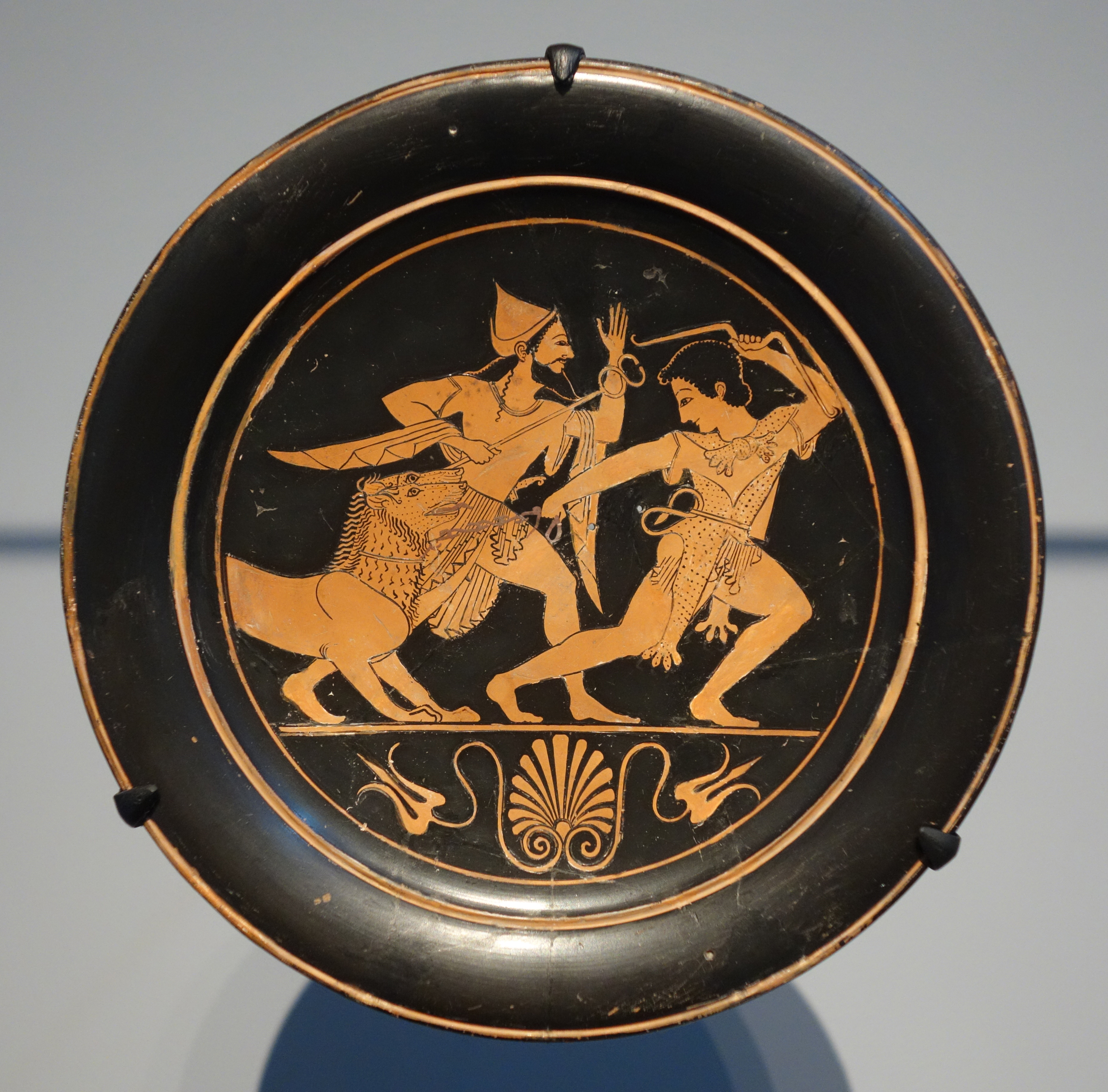 Attic red-figure plate: Heracles leading Cerberus, accompanied by Hermes. Attributed to Paseas, last quarter of the 6th century BC. Museum of Fine Arts, Boston, 01.8025.
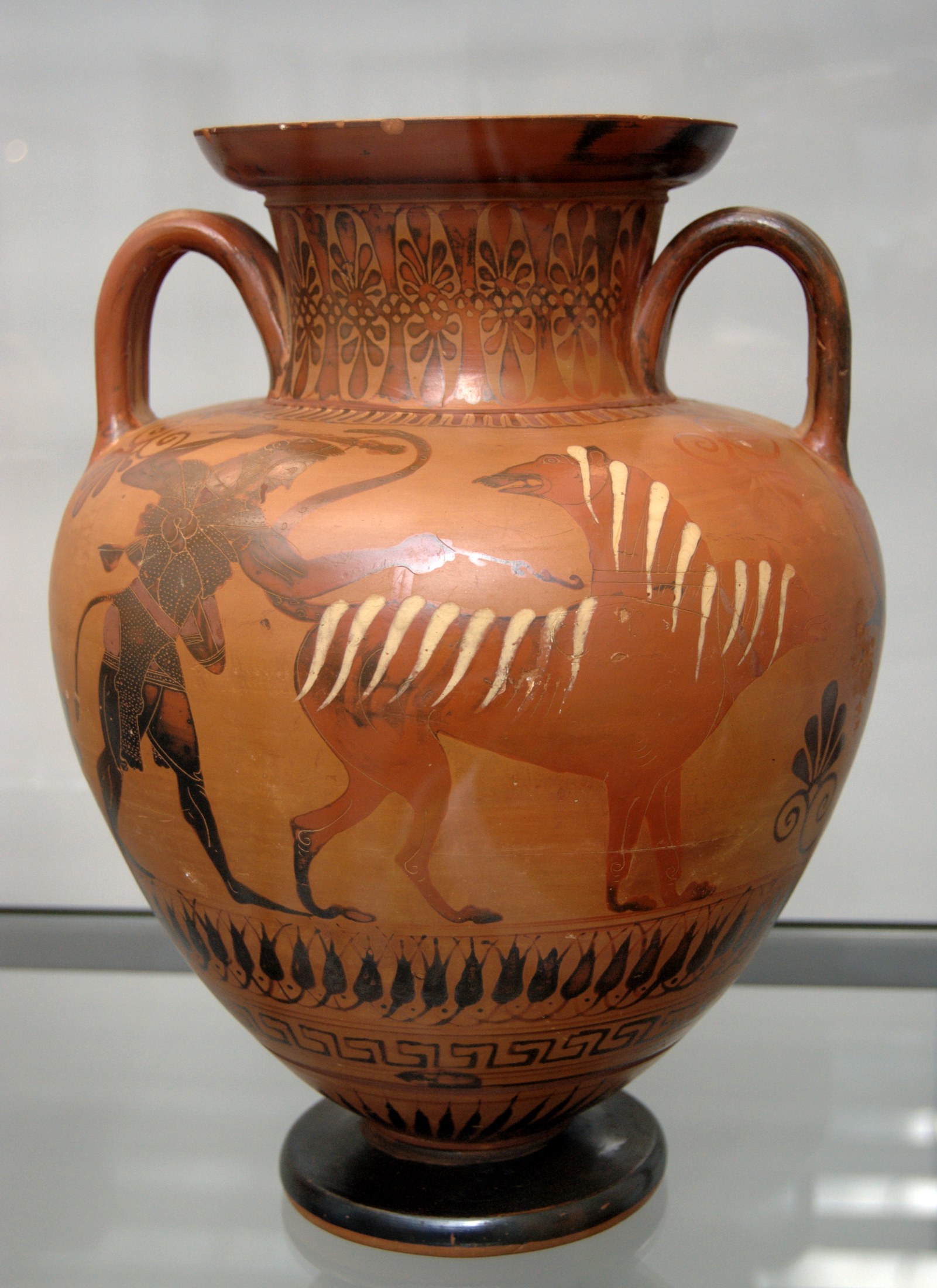 Attic amphora with Herakles and Cerberus, Staatliche Antikensammlungen, Munich.
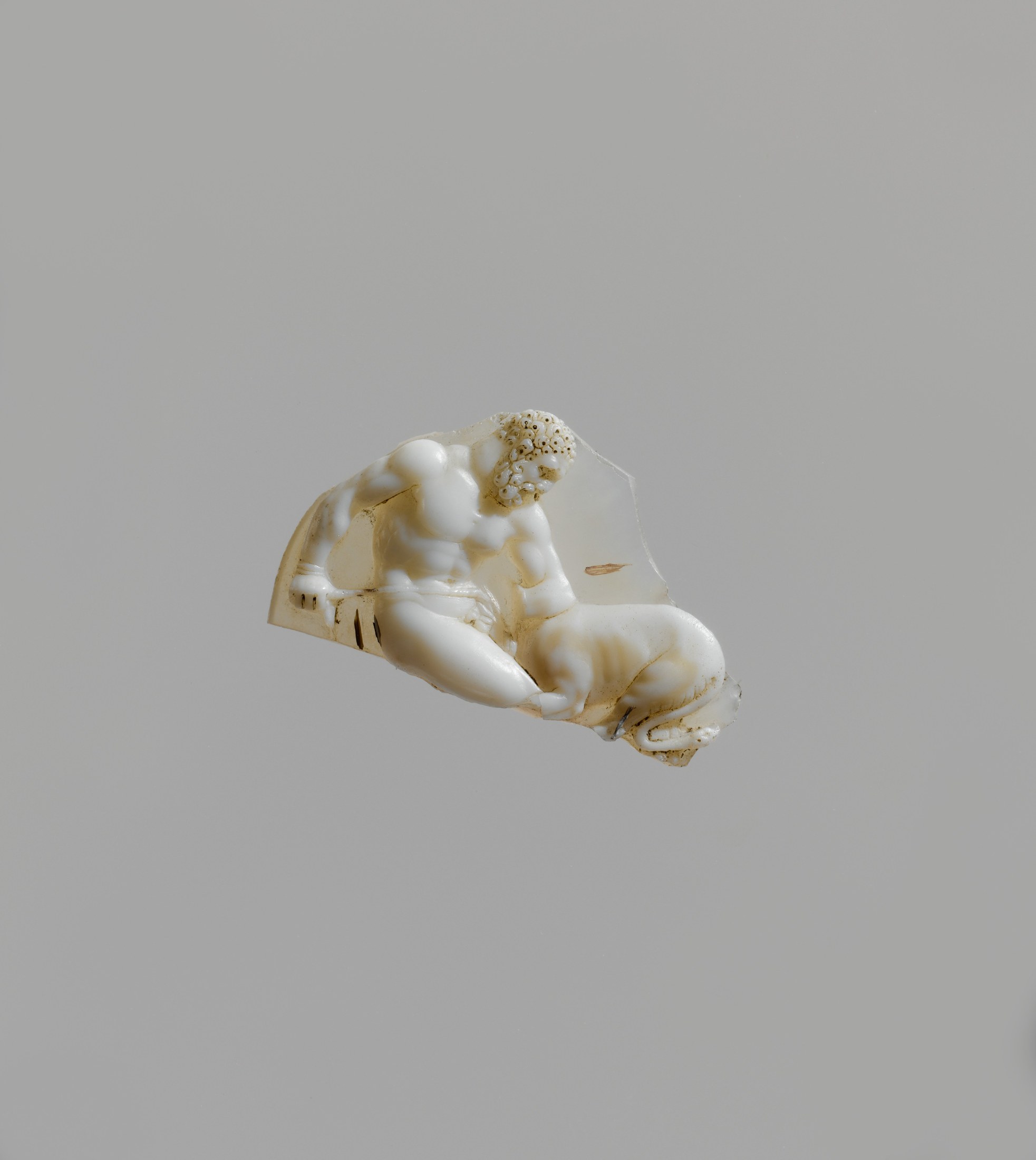 Sardonyx cameo fragment: Hercules tying up Cerberus, first century BC-first century AD. Metropolitan Museum of Art, 81.6.100.
Iconography and Meaning
The main stable feature of Cerberus is multiplicity. Several heads let him look in different directions and make him an ideal guardian. Serpentine elements connect him with the earth and chthonic power. In some images he resembles an ordinary dog, but beside heroes and gods it becomes clear that the viewer is not seeing an animal, but an embodied boundary.
Cerberus' meaning rests on a paradox. He is terrifying, but necessary; hostile to the living, but loyal to the order of Hades. He cannot be reduced to an 'evil monster': he guards the world of the dead as city guards protect a gate. Heracles' victory over Cerberus therefore does not abolish death, but displays the hero's exceptional right to cross for a time a limit closed to ordinary humans.
Related topics
Literature and sources
Hesiod. Theogony, 306-312.
Apollodorus. Bibliotheca, II.5.12.
Diodorus Siculus. Bibliotheca Historica, IV.25-26.
Virgil. Aeneid, VI.417-425.
Ovid. Metamorphoses, VII.408-419.
Pausanias. Description of Greece, III.25.5; IX.34.5.
Lexicon Iconographicum Mythologiae Classicae (LIMC), Kerberos.
Beazley Archive Pottery Database: scenes of Heracles and Cerberus in Greek vase painting.
Metropolitan Museum of Art: archaeological and museum parallels for images of Cerberus on cameo and painted pottery. - Caskey L. D., Beazley J. D. Attic Vase Paintings in the Museum of Fine Arts, Boston. Oxford, 1931, no. 1. - Beazley Archive, no. 201524; Museum of Fine Arts, Boston, 01.8025.
Interested in Ancient Rome beyond reading? Join Legio X Fretensis or explore our reenactment directions.


