Board Games in Antiquity
Board games in antiquity were not a marginal pastime, but a stable part of urban, domestic and military culture. They are known from scratches on stone slabs, portable boards, bone and glass counters, dice, knucklebones, inscriptions and images of players. This material shows leisure differently from spectacles such as chariot racing: a game could be played in a house, tavern, bath building, barracks, forum, or on the steps of a public monument.
The rules have survived unevenly. Some games are known only by name and image; for others we have the board shape, sets of counters and scattered phrases in ancient authors. It is therefore important to separate secure evidence: what the objects clearly show, which games are named in texts, which rules can be described with caution, and where a modern scheme remains only an approximation of ancient play.
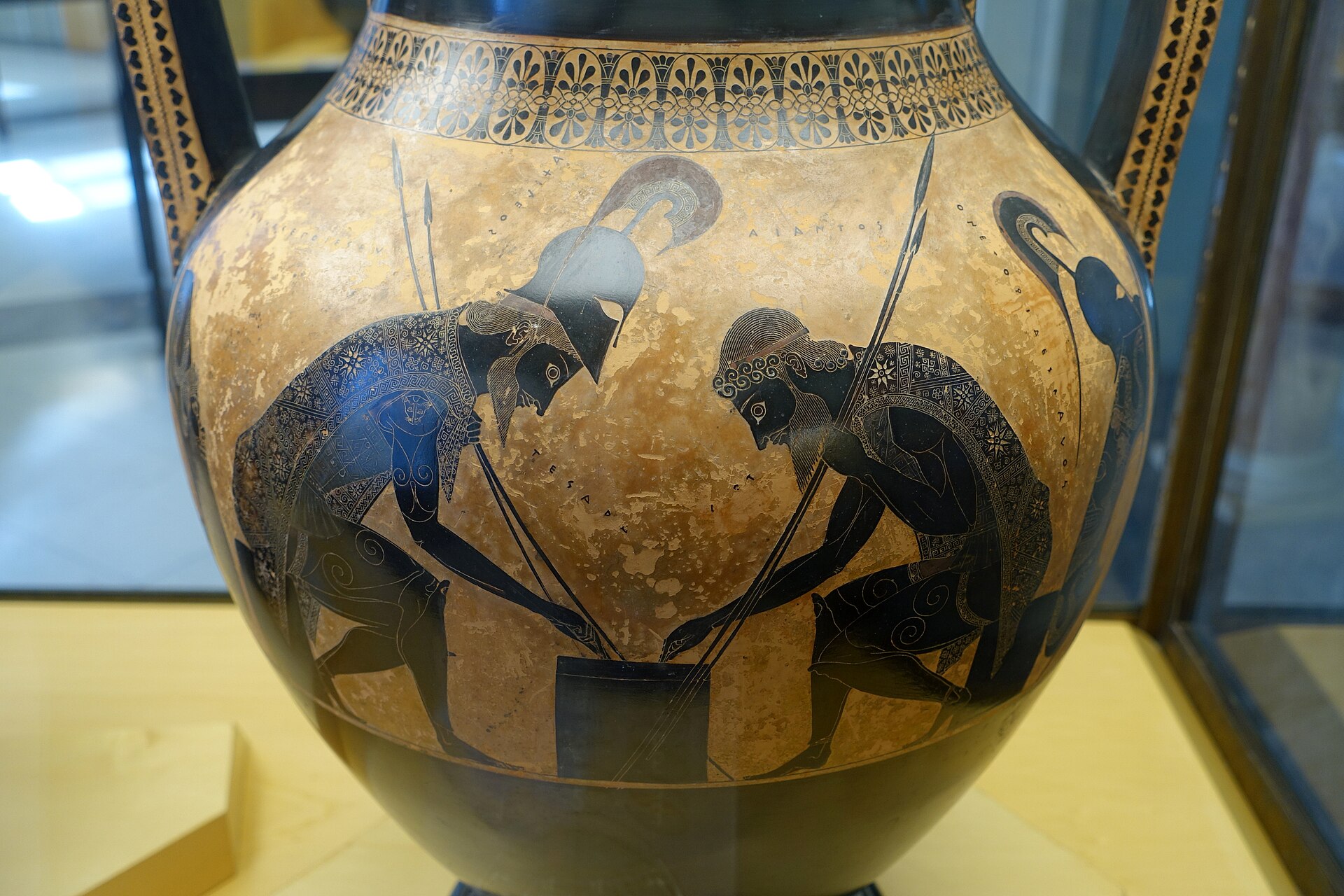 Achilles and Ajax playing a game. Detail of an Attic black-figure amphora by Exekias, 540-530 BC, Museo Gregoriano Etrusco, Vatican Museums.
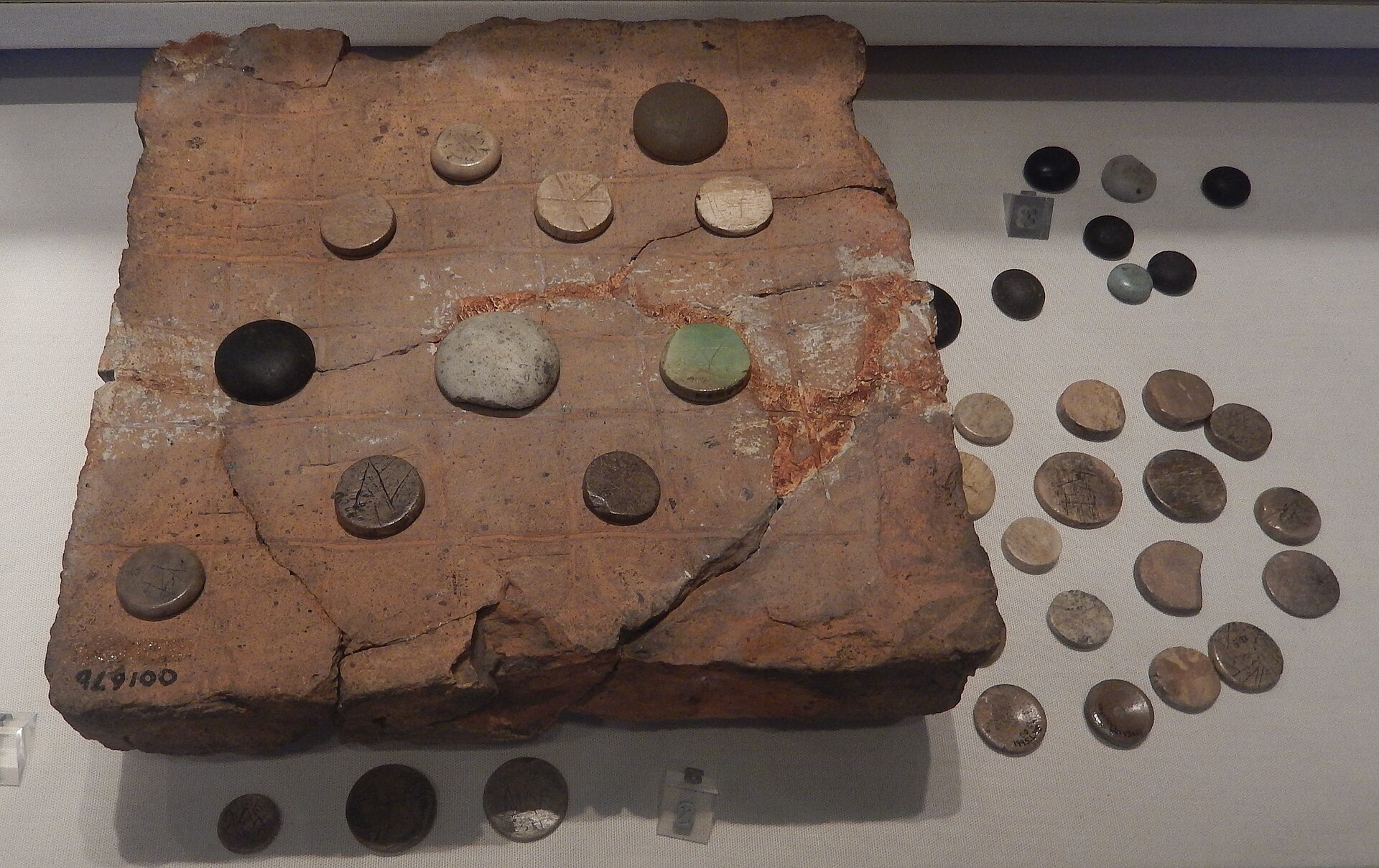 Floor tile incised as a game board with bone counters from Calleva Atrebatum, Silchester. Reading Museum.
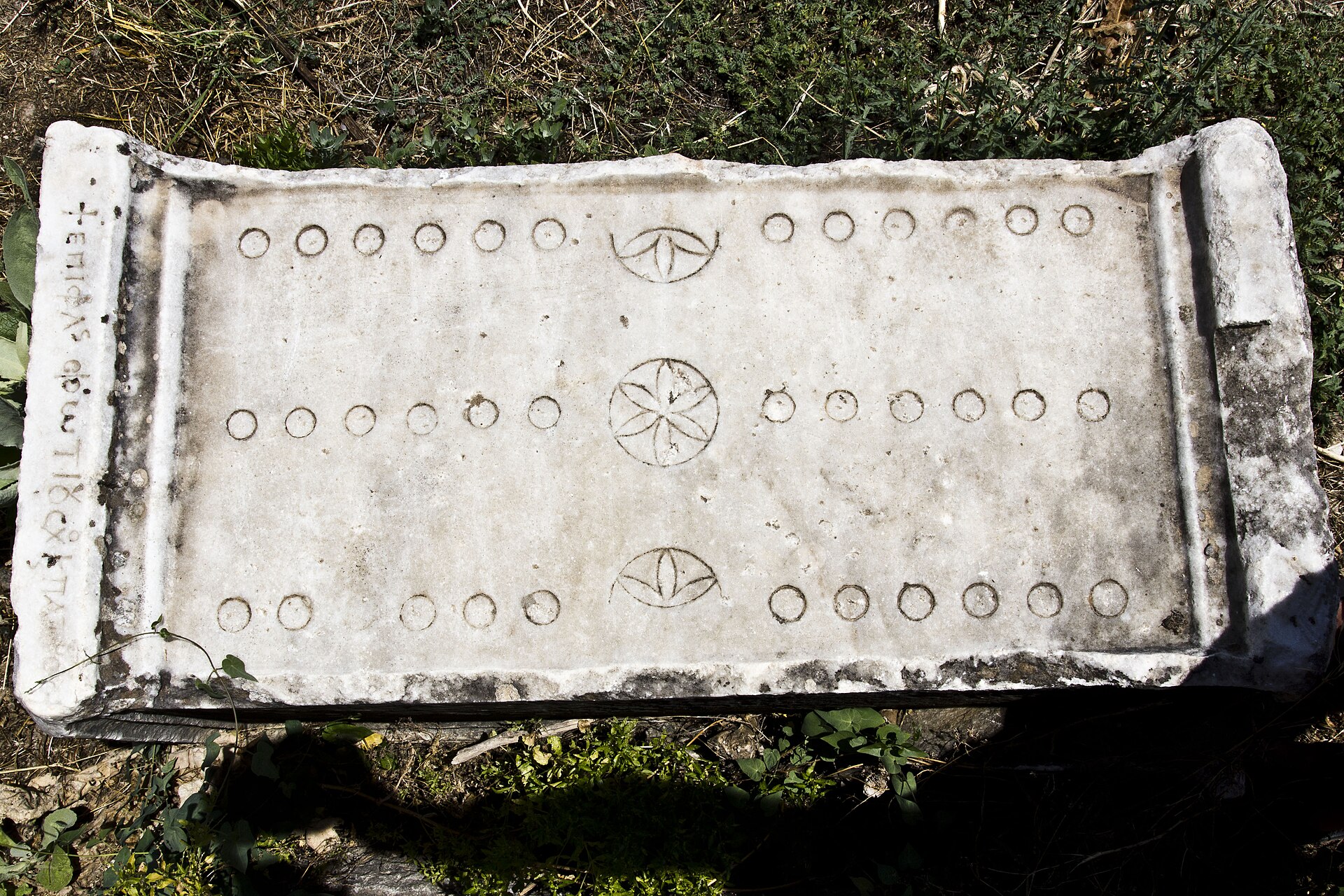 Roman board for duodecim scripta near the agora at Aphrodisias. Second century AD.
Greek and Eastern Traditions
In ancient Greece games with counters were often named through words connected with small stones: pessoi, petteia, polis. Their exact rules are not preserved in a single ancient manual, but the general picture is clear: players moved counters along lines or squares, tried to gain position, enclose the opponent or remove enemy pieces from play. In vase painting the scene of Achilles and Ajax at play became one of the most famous images: the heroes sit over a board or gaming objects during a pause in war, and the game itself becomes a sign of calculation, tension and a contest of minds.
Greek practice did not arise in isolation. Board games existed in Egypt and the Near East long before Classical Greece: senet, mehen, the Royal Game of Ur and other systems show that people of the eastern Mediterranean had long connected boards, counters, throws and movement along a track. These games should not be automatically identified with Greek and Roman ones, but they form an important background: the ancient Mediterranean inherited an established culture of counted moves, strategic competition and gaming objects.
Roman Games and Rules
In ancient Rome board games are especially visible archaeologically: boards are scratched into stone, counters occur in houses and military settlements, while dice and knucklebones appear in urban layers, graves and museum collections. Some games were strategic, some depended on throws, and many combined calculation with chance.
Ludus latrunculorum is usually translated as the game of "little soldiers" or "brigands". It was a contest between two sides on a gridded board. Later descriptions and the boards themselves suggest movement across a grid and capture by enclosing or trapping an enemy piece between two friendly ones. Board sizes varied, so there was no single tournament version for the whole empire. Its main feature was not a race along a track, but positional play with capture.
Ludus duodecim scriptorum, the "game of twelve lines", belonged to race games with counters and dice. The board was usually divided into three rows of twelve squares or letters, sometimes arranged as short phrases. Players threw dice and advanced counters along a route; success depended both on the throw and on the choice of move. The later tabula stands closer to a backgammon-like type: counters move along a track, meet, block points and are borne off after completing the course.
Terni lapilli was a simple three-in-a-row game. Boards with nine points or lines are known in Roman contexts; each player had three counters and tried to form a line. Such boards were easy to scratch onto stone, so they fit public spaces well: the game needed no expensive set and could begin with a few pebbles or potsherds.
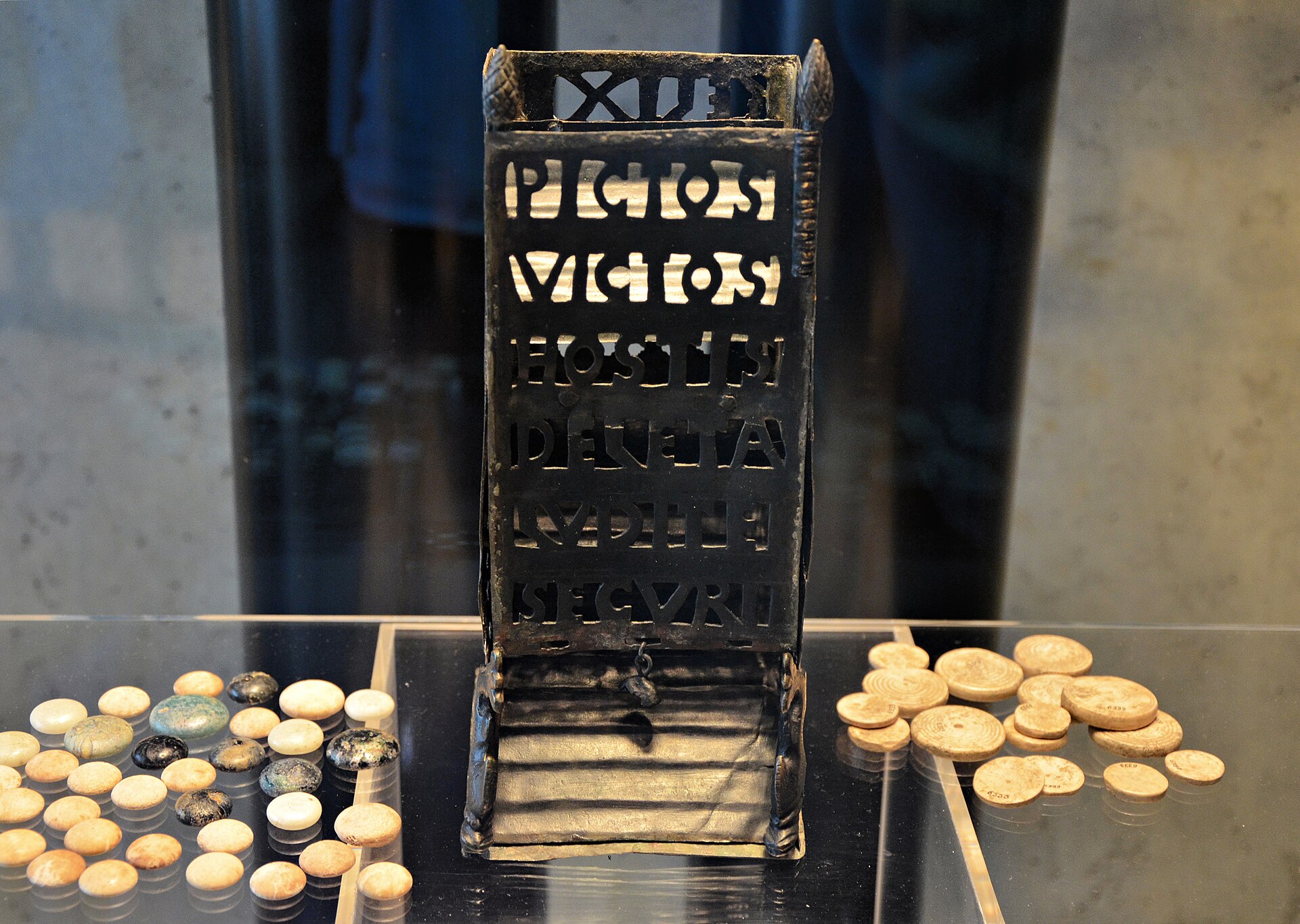 Roman dice tower from Vettweiss-Froitzheim with an inscription referring to victory over the Picts. Fourth century AD, LVR-LandesMuseum Bonn.
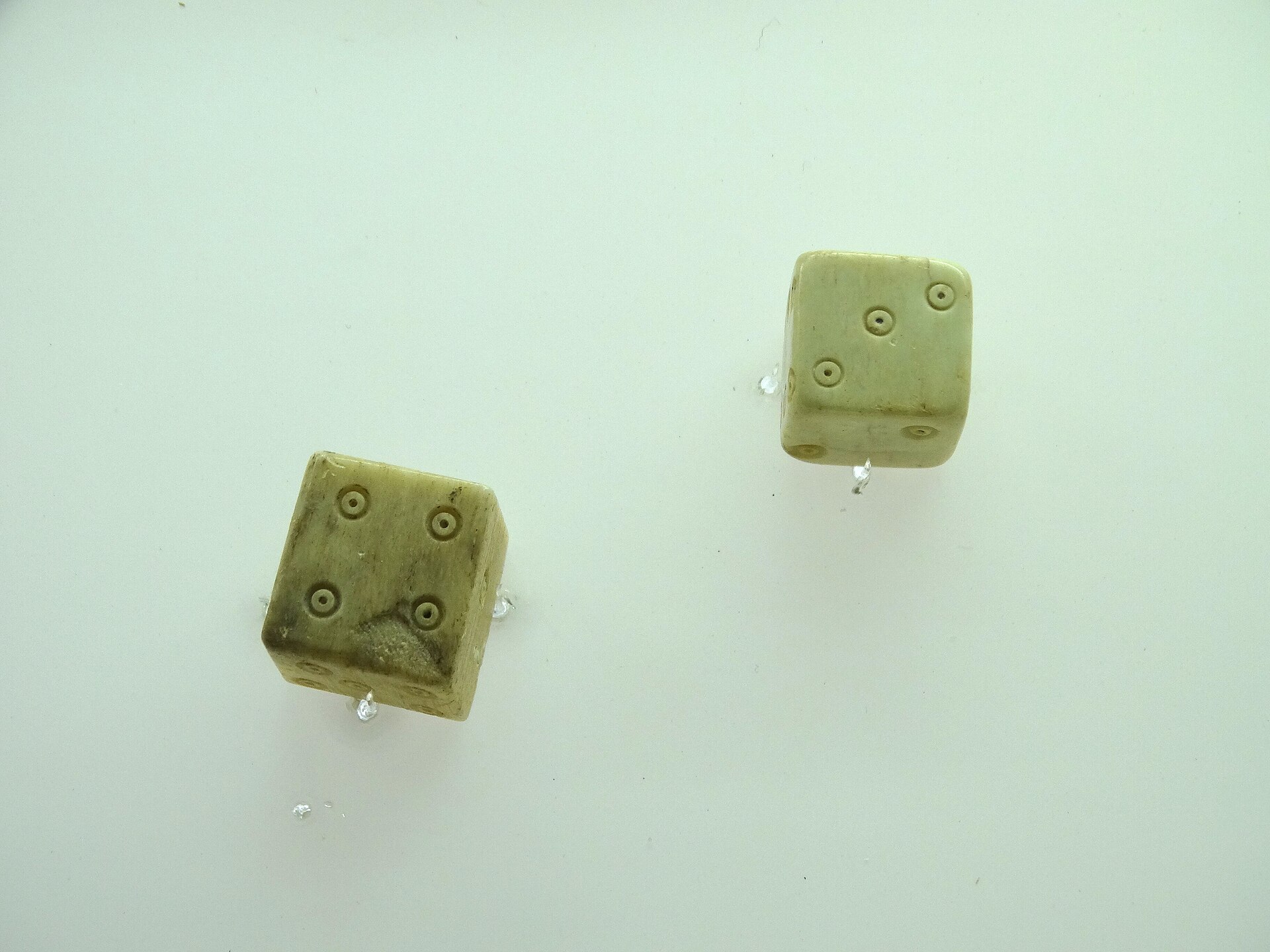 Dice used for gaming and gambling, Cartagena, Spain. First-second centuries AD, Museo del Teatro Romano de Cartagena.
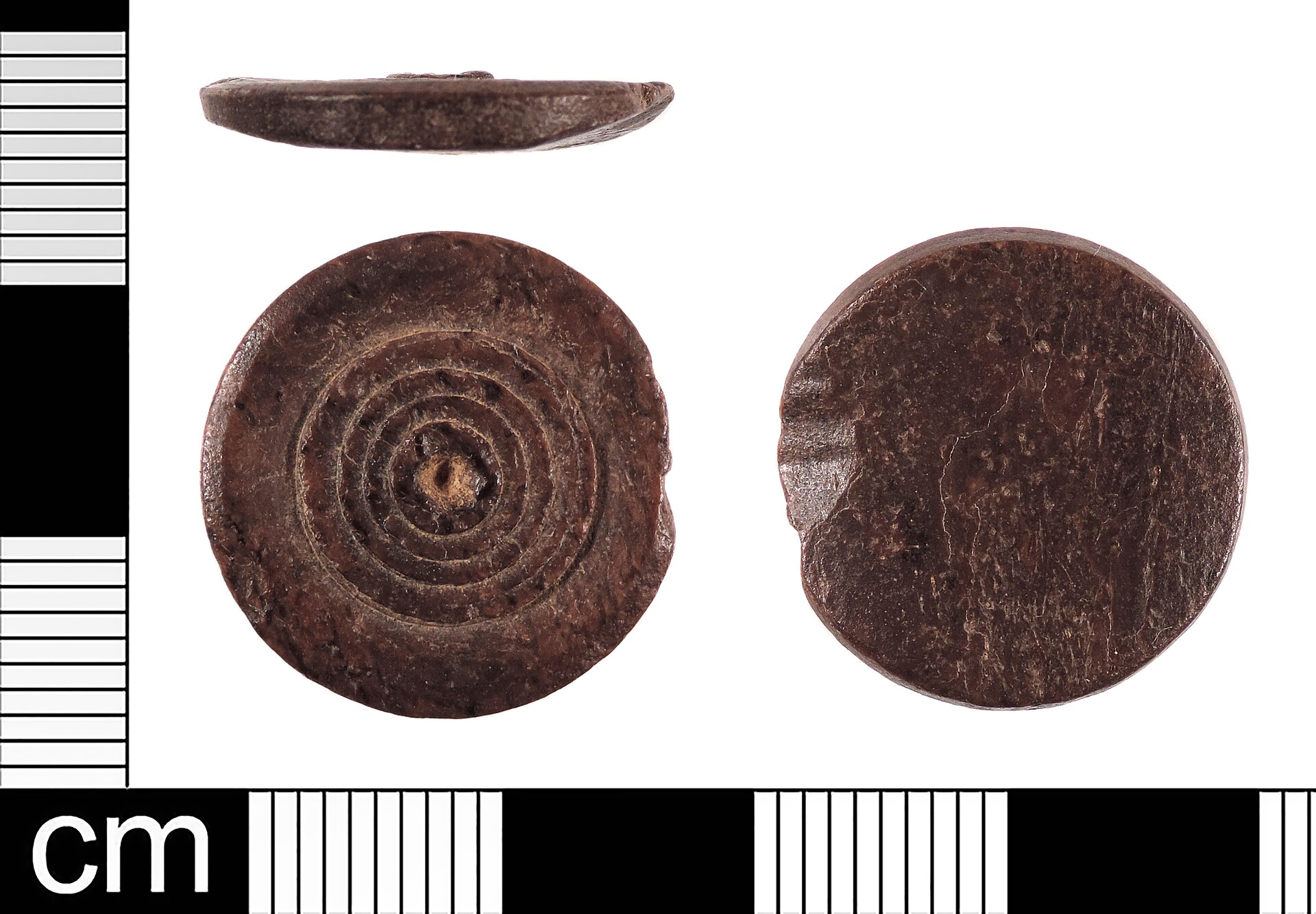 Roman bone gaming counter, AD 50-410, recorded by the Portable Antiquities Scheme.
Dice, Counters and Gaming Equipment
Roman dice were most often cubic, with pips from one to six. They were made of bone, horn, bronze, stone, glass or ceramic; unusual forms also existed, including elongated polyhedral dice. Knucklebones, or tali, were used as throwing pieces before ordinary cubes became widespread: four sides had different shapes and values, so a throw produced a special combination of results rather than an even set of faces.
Counters were called calculi, "little stones". They could be simple pebbles, glass discs, bone tokens, ceramic fragments or deliberately made discs. In an expensive set the material and finish mattered, but most games did not require luxury: the board, the number of counters and the agreed rules were more important.
Dice towers, known as turricula or pyrgus, show that ancient players understood the problem of a manipulated throw. Dice were dropped into the tower, bounced across internal steps and rolled out at the bottom, making the result harder to control by hand. The Vettweiss-Froitzheim find is especially famous because its inscription links gaming with the military language of the late Roman world: once the enemy is defeated, players may "play safely".
Players, Places and Social Attitudes
Board games were available to different social groups. In the house they could belong to evening leisure; in the baths they filled time between washing and conversation; in a tavern they could lead to wagers; in barracks they were a familiar form of soldiers' rest. In streets and public buildings games left literal marks on stone: boards were scratched into slabs, steps, benches and porticoes.
Romans distinguished between play as leisure and play as dangerous gambling. Laws and moral texts condemned monetary stakes, especially when they led to debt, cheating or public scandal. Yet gambling could not be eliminated: dice were too simple, wagers too convenient, and festivals such as the Saturnalia temporarily loosened ordinary restrictions. The attitude to games was therefore double: moderate play could be leisure and exercise, while gambling for money was a vice, but in practice the two often overlapped.
For children games with counters and numbers could train counting, turn-taking and simple calculation. For adults strategy games supplied a language of rivalry and control, while dice games supplied a language of luck, fate and risk. The ancient board was therefore more than a toy: time, money, habits, status and ideas of fairness met around it.
Material Evidence and Chronology
The main sources for ancient board games are not late retellings of rules, but the objects and their findspots. Boards from Aphrodisias, Ephesus, Rome, Pompeii, Silchester and other places show the form of the playing field and the environment of play. Dice, counters and knucklebones provide material, dimensions and wear. Vase painting and reliefs show the posture of players and the social setting. Inscriptions on boards sometimes add a joke, a name, a short phrase or the order of spaces.
- 3rd-2nd millennia BC
- complex board games with counters and movement along a route already exist in Egypt and Mesopotamia.
- 6th-5th centuries BC
- Greek vase painting shows heroes and ordinary people at play; games with pessoi and petteia become part of literate urban culture.
- 1st century BC-1st century AD
- Roman authors mention latrunculi, dice, counters and gambling; game boards appear in public spaces.
- 1st-3rd centuries AD
- the richest archaeological evidence comes from Roman cities, military settlements, baths and houses; duodecim scripta, tabula, terni lapilli and dice games are widely attested.
- 4th century AD
- late Roman gaming culture preserves older forms and develops objects such as dice towers; military and domestic settings continue to use games as ordinary leisure.
An ancient game is therefore best studied through a group of objects rather than a name alone: board, counters, throwing pieces, findspot and textual testimony. Together they make it possible to distinguish a strategic game from a race game, a household set from a casual street board, and ordinary leisure from gambling for stakes.
Related Topics
Literature and sources
- Austin R. G. Greek Board-Games. Antiquity, 1940.
- Austin R. G. Roman Board Games I-II. Greece & Rome, 1934-1935.
- Bell R. C. Board and Table Games from Many Civilizations. Oxford University Press, 1960.
- Finkel I. L. Ancient Board Games in Perspective. British Museum Press, 2007.
- Fittà M. Games and Gamblers in the Ancient World. J. Paul Getty Museum, 1997.
- Purcell N. Literate Games: Roman Urban Society and the Game Board. Past & Present, 1995.
- Schädler U. Latrunculi: A Forgotten Roman Game of Strategy Reconstructed. Board Game Studies, 1994.
- Crummy N. The Roman Small Finds from Excavations in Colchester 1971-1979. Colchester Archaeological Trust, 1983.
Interested in Ancient Rome beyond reading? Join Legio X Fretensis or explore our reenactment directions.


