Chariot Racing
Chariot racing was one of the most popular and dangerous spectacles of the ancient world. It joined speed, horse-breeding, the skill of the driver, team organization, betting, political symbolism and a strong culture of supporters. For Greeks chariot contests belonged to great festivals and Panhellenic games; for Romans and late antiquity they became a daily language of mass spectacle, urban rivalry and imperial generosity.
The architecture of the circus created the frame: starting gates, central barrier, turning posts and seats guided movement and the spectator's view. But the race itself was made by people and animals: team owner, charioteer, grooms, trainers, horses, supporters, betters, organizers of games and the authority paying for the festival. Chariot racing was therefore a sporting and social action, not only one use of a large hippodrome.
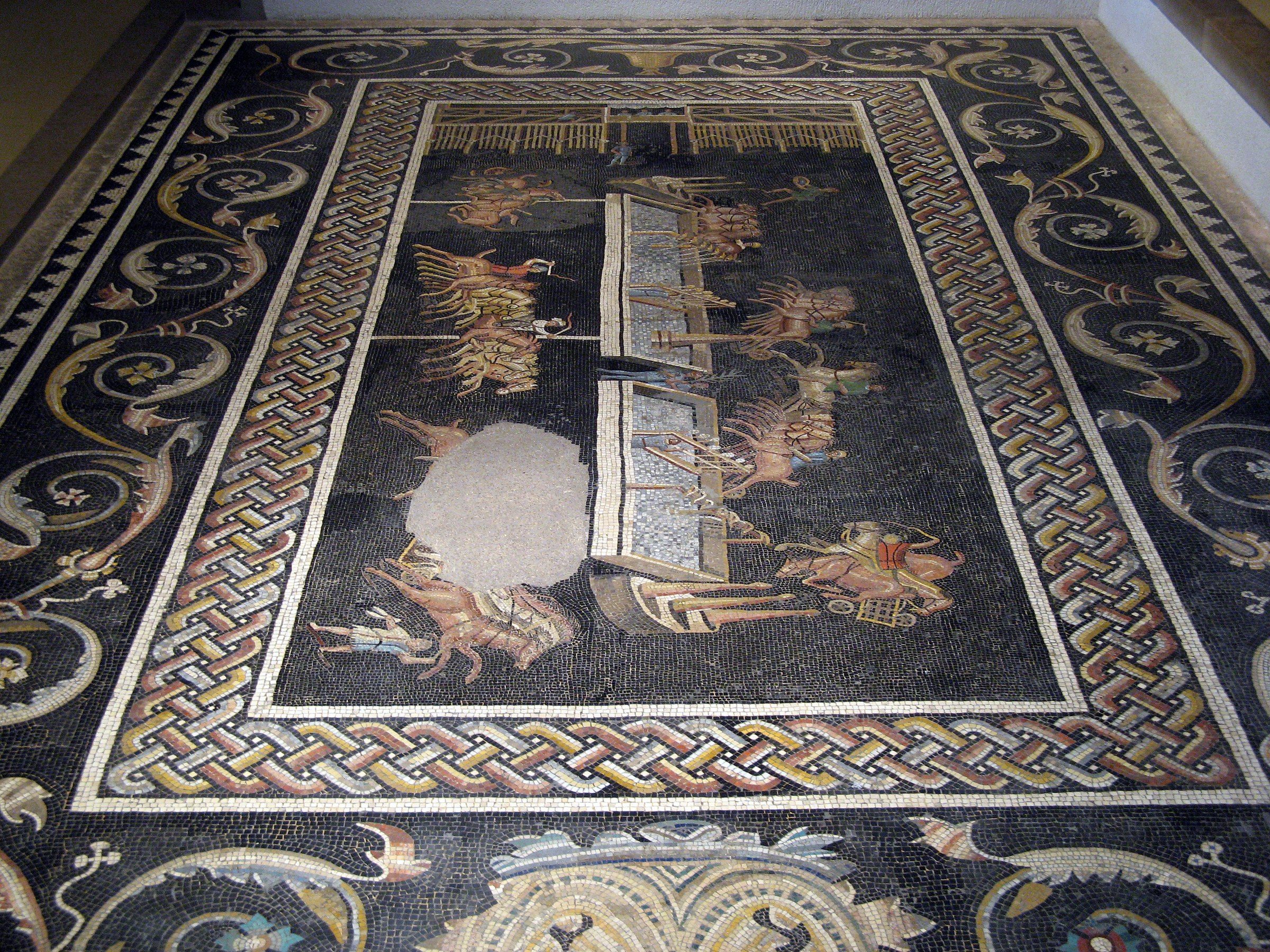 Mosaic with a chariot race in a Roman circus, found in Lyon. Second century AD; Lugdunum Musée et Théâtres, inv. 2000.0.1209.
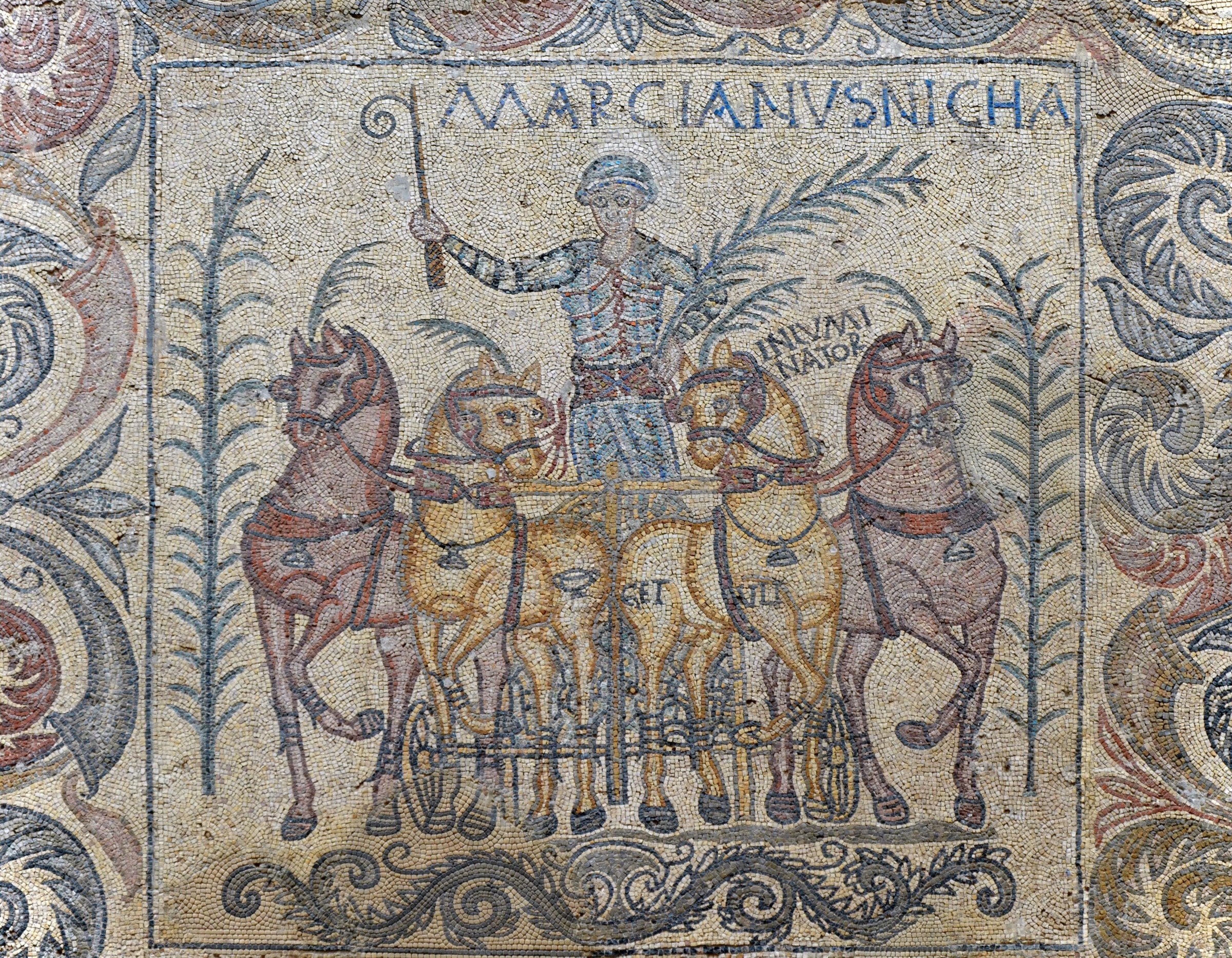 Mosaic of the victorious charioteer Marcianus driving a quadriga. Fourth century AD; National Museum of Roman Art, Mérida.
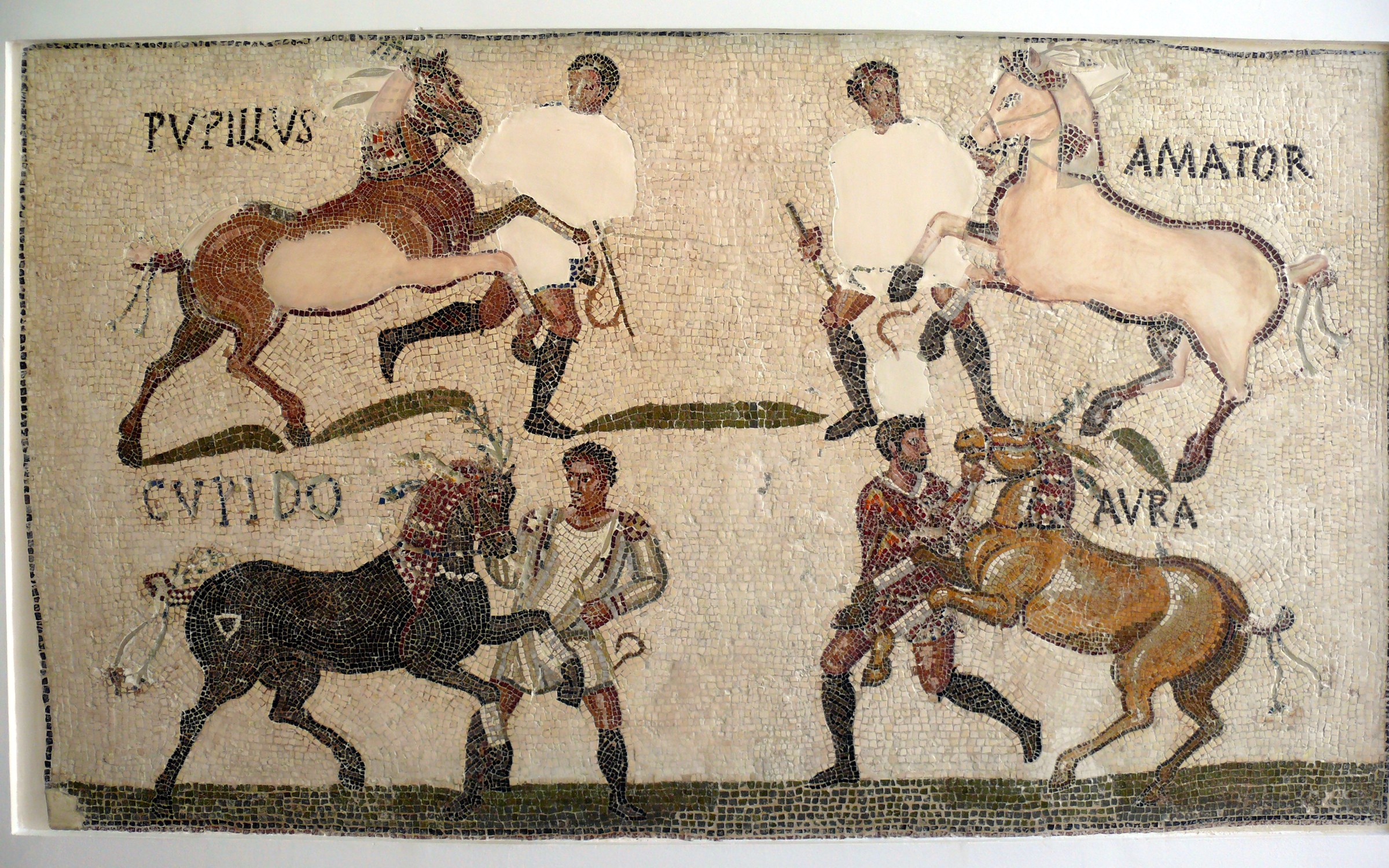 Mosaic with circus horses from Sousse: names and individual images of horses show the importance of stables and public favourites. Roman North Africa.
Greek Contests
In the Greek tradition chariot races belonged to the world of aristocratic prestige. At Olympia, Delphi, Isthmia and Nemea victory in the tethrippon, the four-horse chariot race, glorified not only the driver but above all the owner of the team. A wealthy man could enter horses, pay for training and receive the fame of victory even if he did not hold the reins himself. Victory odes by Pindar and Bacchylides show that the success of a chariot was understood as honour for family, city and patron.
Alongside four-horse races there were pair-chariot contests, events for young horses and regional variants. The Greek chariot in a sporting context was not a battle vehicle, although it used an old prestigious form of carriage. On vases and monuments the race is often connected with myth, heroic past and funerary memory: the chariot was a sign of status long before it became a mass Roman spectacle.
The Charioteer of Delphi shows this side of the theme well. The bronze statue formed part of a dedication connected with victory in a chariot contest and shows not a crash or a crowd, but a composed winner holding the reins. The Greek emphasis differs from the late Roman circus: honour of victory, gift to the god, memory of the contest and prestige of the family that paid for the team all matter.
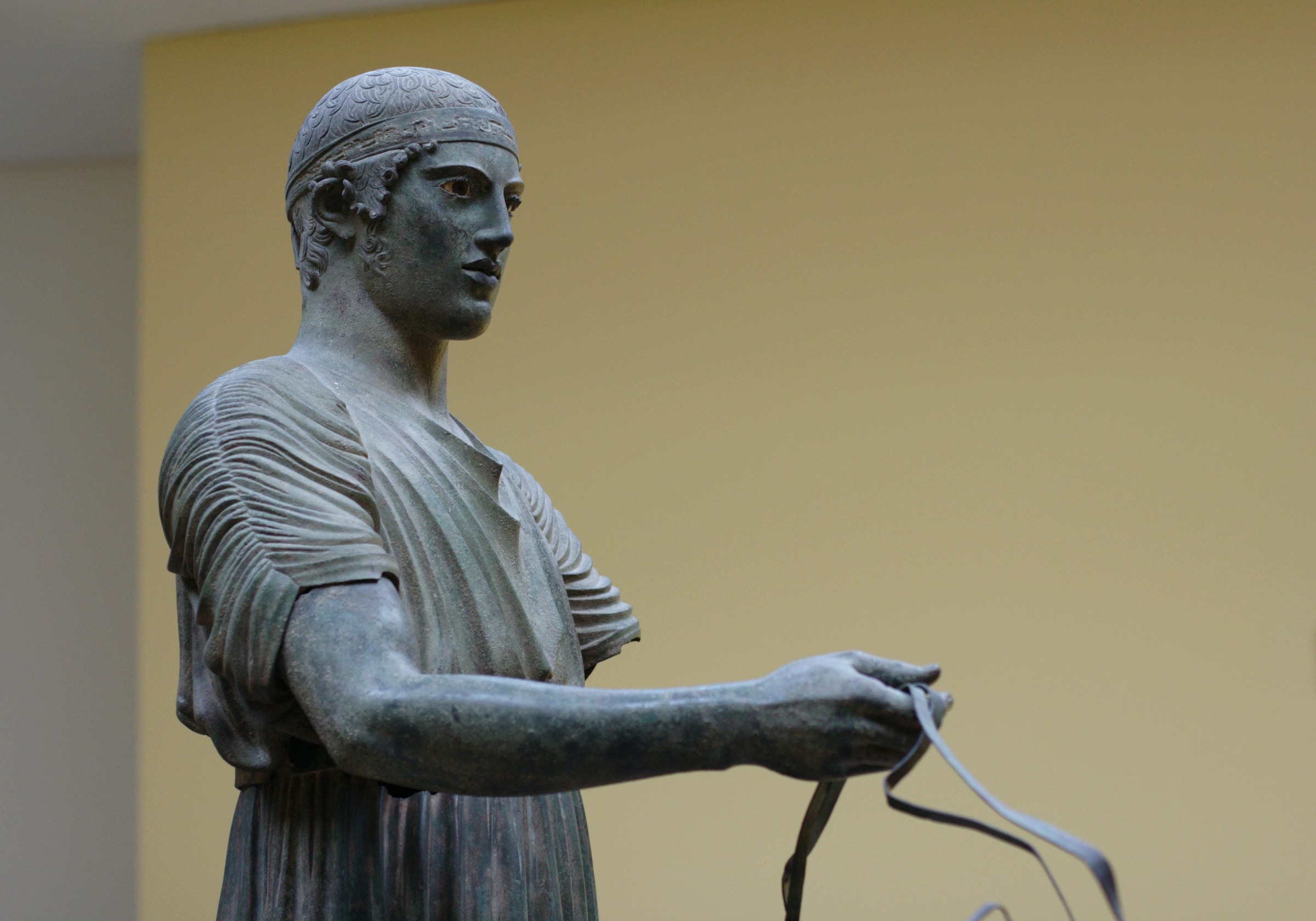 Charioteer of Delphi: bronze statue of a winner in a chariot event, c. 470 BC; Archaeological Museum of Delphi.
The Roman Race
In Rome a race consisted of separate heats, missus. Chariots left the starting gates, accelerated down the straight, turned around the metae and usually completed seven laps. Lap counters in the form of eggs or dolphins marked progress, but for the spectator the crucial point was the position of the teams: who had taken the inside line, who held pace, who risked the turn and who was preparing a final sprint.
The main struggle did not happen equally across the arena, but in several narrow moments. The start decided who gained the best position; the first turn could immediately break the order; the inside line saved distance but increased the danger of collision. The charioteer controlled not only horses but space: he could close an opponent, force him wide, endure pressure from outside or risk a turn taken too close.
Roman spectators knew the difference between good tactics and recklessness. A fast horse mattered, but victory depended on the combination of team, starting position, courage, calculation and the ability to avoid naufragium, the wreck of a chariot. A single race could therefore be read by the crowd as a dramatic story: start, struggle for the line, crash, pursuit, change of leader and victory lap.
Charioteers and Teams
The driver was called auriga or agitator. In Rome many famous racers were slaves or freedmen, but their position cannot be reduced to low status. A successful charioteer could become wealthy, recognizable and loved by the crowd. Inscriptions record victories, age, faction, sometimes the number of starts and prize money. The most famous example is Gaius Appuleius Diocles, a second-century AD driver known for enormous winnings and a long career.
Driving required a special technique. Reins were often wrapped around the body to give stronger control over the team, and a knife was needed in case of a fall and tangled straps. The charioteer had to feel each horse, know which one held the inside line, which kept speed on the straight, which was nervous near the crowd and which could make a final sprint. A race was therefore not simply "fast driving", but work with living and dangerous power.
Horses had fame of their own. Mosaics and inscriptions preserve names of circus horses: Amator, Cupido, Aura, Polydus and others. They could be represented separately, as athletes rather than anonymous pulling force. The success of a team depended on stable, breeding, training, care, fodder, pairing of horses and the experience of people who worked with the animals before they entered the arena.
Factions, Money and the Crowd
Roman races were organized around factiones, colour teams. The red, white, blue and green factions are usually named; in late antiquity the blues and greens became especially influential. A faction was not only a colour of clothing. It brought together owners, drivers, stables, technical personnel, supporters and financial interests. The spectator gained a lasting attachment: he supported not only an individual racer but a colour.
Money was a visible part of the spectacle. The organizer of games paid for the programme, teams received funds, winners gained prizes and gifts, and spectators made wagers. Betting could be informal and everyday, but the culture of prediction, discussion of chances, memory of earlier victories and argument over favourites made the races resemble modern mass sport. A supporter came not only to watch, but to participate with voice, emotion, calculation and group identity.
The political importance of factions grew especially in the late Roman and Byzantine world. Support for a colour could intersect with urban conflicts, attitudes to power, local identity and crowd violence. Even in the early empire, however, races were a convenient place where the people saw the emperor, responded to generosity, expressed requests and discussed power through the language of spectacle.
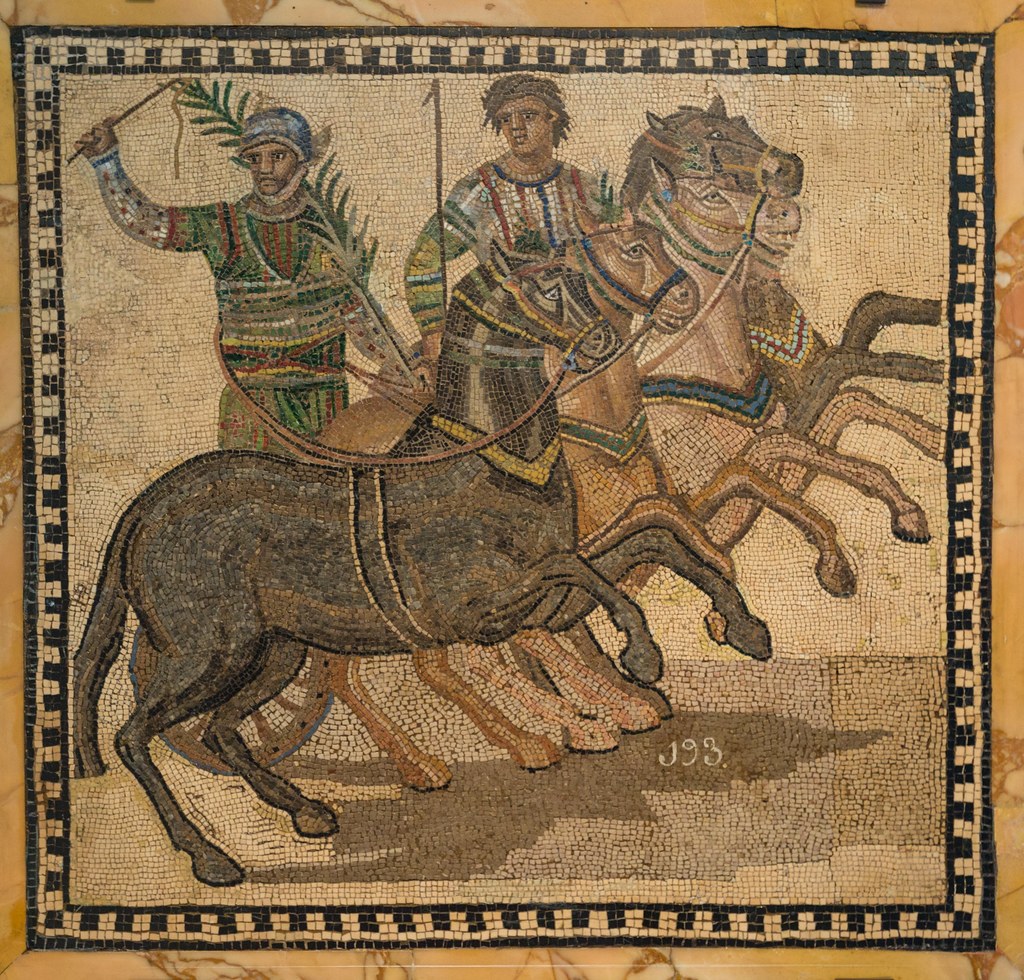 Winner of a Roman chariot race with a palm branch. Roman mosaic; National Archaeological Museum of Spain.
Danger and Memory of Victory
Danger was not a side effect but part of the spectacle's force. The chariot was light, the speed high, the turn sharp and several teams ran beside one another. In a fall the driver could be struck by his own wheels, by hooves or by rival chariots. Tangled reins turned a fall into a deadly trap, so the knife in hand or at the belt was not decoration but a tool of survival.
The crowd saw in this not only cruelty but proof of skill. A charioteer who endured danger, kept control and won after a risky race became a hero of the circus. His name could be shouted, written, represented in mosaics, mentioned in inscriptions and compared with other favourites. The death of a young racer or horse also became part of memory: the circus created not only winners, but legends of lost glory.
In this the races differed from gladiatorial combats. Gladiatorial games were built around human duel and decisions of life and death; chariot racing was built around speed, team, turn, factional identity and the possibility of a crash. Both spectacles were dangerous and massive, but they created different expectations in the spectator.
Late Antiquity
In late antiquity chariot racing retained importance even where other forms of spectacle changed or declined. In Constantinople the hippodrome became one of the capital's main spaces: the emperor appeared before the people, factions displayed strength, and the urban crowd could move from sporting passion to political action. Races continued to bind festival, power, money and civic identity.
The Roman tradition did not vanish at once after the crises of the third to fifth centuries. Circuses and hippodromes functioned in various cities, although their scale and regularity depended on finance, authority and the condition of urban life. The gradual contraction of racing was not caused by one factor, but by changes in city budgets, political centres, elite tastes, religious environment and infrastructure. In the Eastern Roman Empire the tradition survived longer than in many western regions.
Related Topics
- Hippodrome and Circus Maximus in Rome
- Chariots in Ancient Rome
- Chariots in Antiquity
- Gladiatorial Games
Literature and sources
- Humphrey J. H. Roman Circuses: Arenas for Chariot Racing.
- Futrell A. The Roman Games.
- Kyle D. G. Sport and Spectacle in the Ancient World.
- Bell S., Willekes C. The Horse in the Ancient World.
- Cameron A. Circus Factions: Blues and Greens at Rome and Byzantium.
- Harris H. A. Sport in Greece and Rome.
- Golden M. Sport in the Ancient World from A to Z.
- Suetonius. De vita Caesarum.
- Cassius Dio. Historia Romana.
- Procopius. History of the Wars.
Interested in Ancient Rome beyond reading? Join Legio X Fretensis or explore our reenactment directions.


