Chariots in Ancient Rome
In Ancient Rome the chariot was not an ordinary means of transport and did not become the main weapon of the legions. Its importance lay in three spheres: races in the circus, ceremonial processions and the image of power. A Roman chariot must therefore be distinguished from Egyptian or Hittite war vehicles of the Bronze Age, and also from everyday carts, wagons and road carriages.
Romans used several words and types. Currus could refer to a chariot as a ceremonial or racing vehicle; biga to a two-horse team; quadriga to a four-horse team, especially important for racing and triumph. Rarer arrangements with three, six or more animals also existed, but they were striking exceptions rather than the norm. Roman chariots are studied through their construction, function, depictions and archaeological remains.
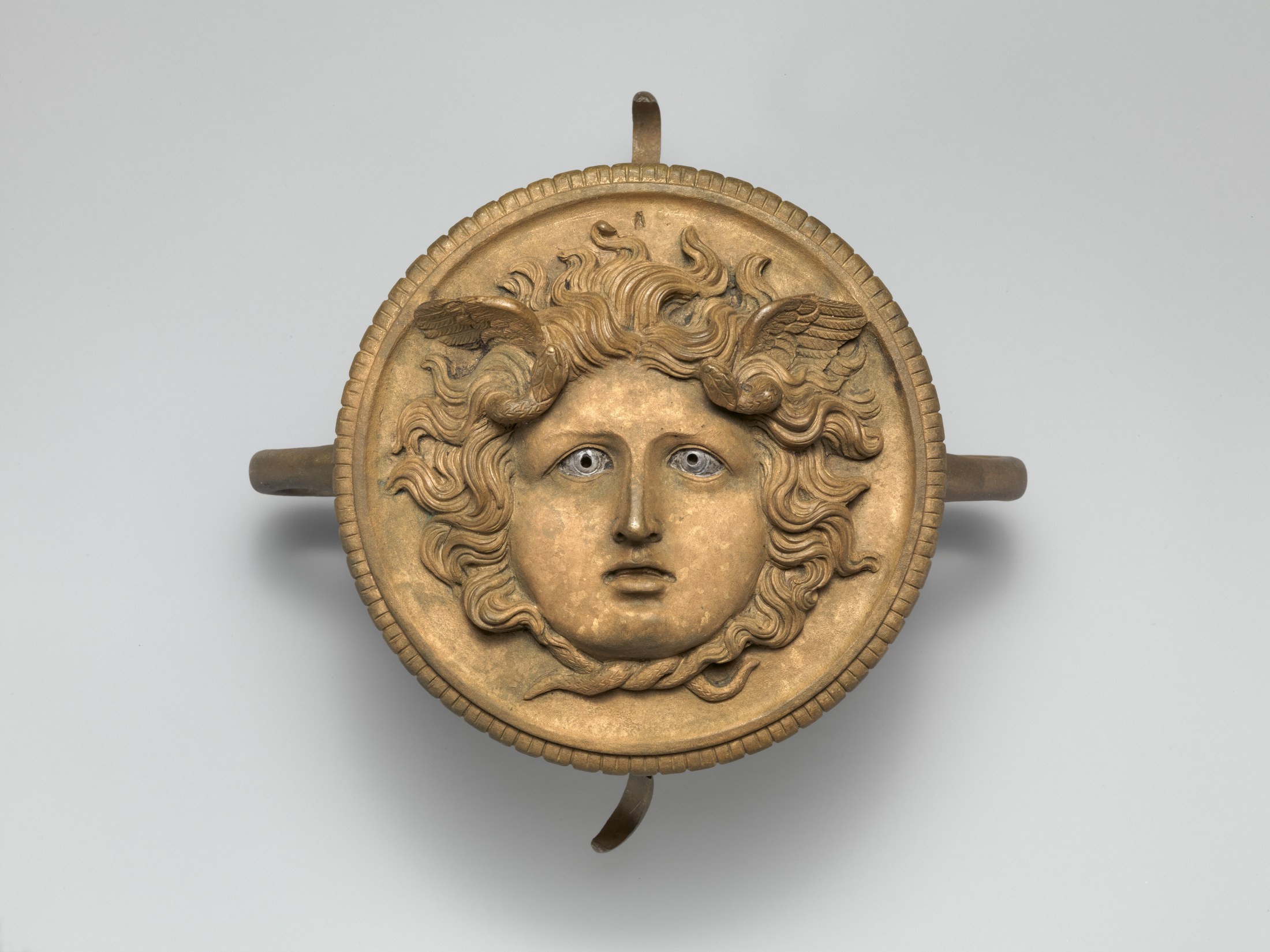 Bronze ornament from a Roman chariot pole, first-second century AD; probably from a ceremonial currus triumphalis rather than a light racing chariot. Metropolitan Museum of Art, 18.75.
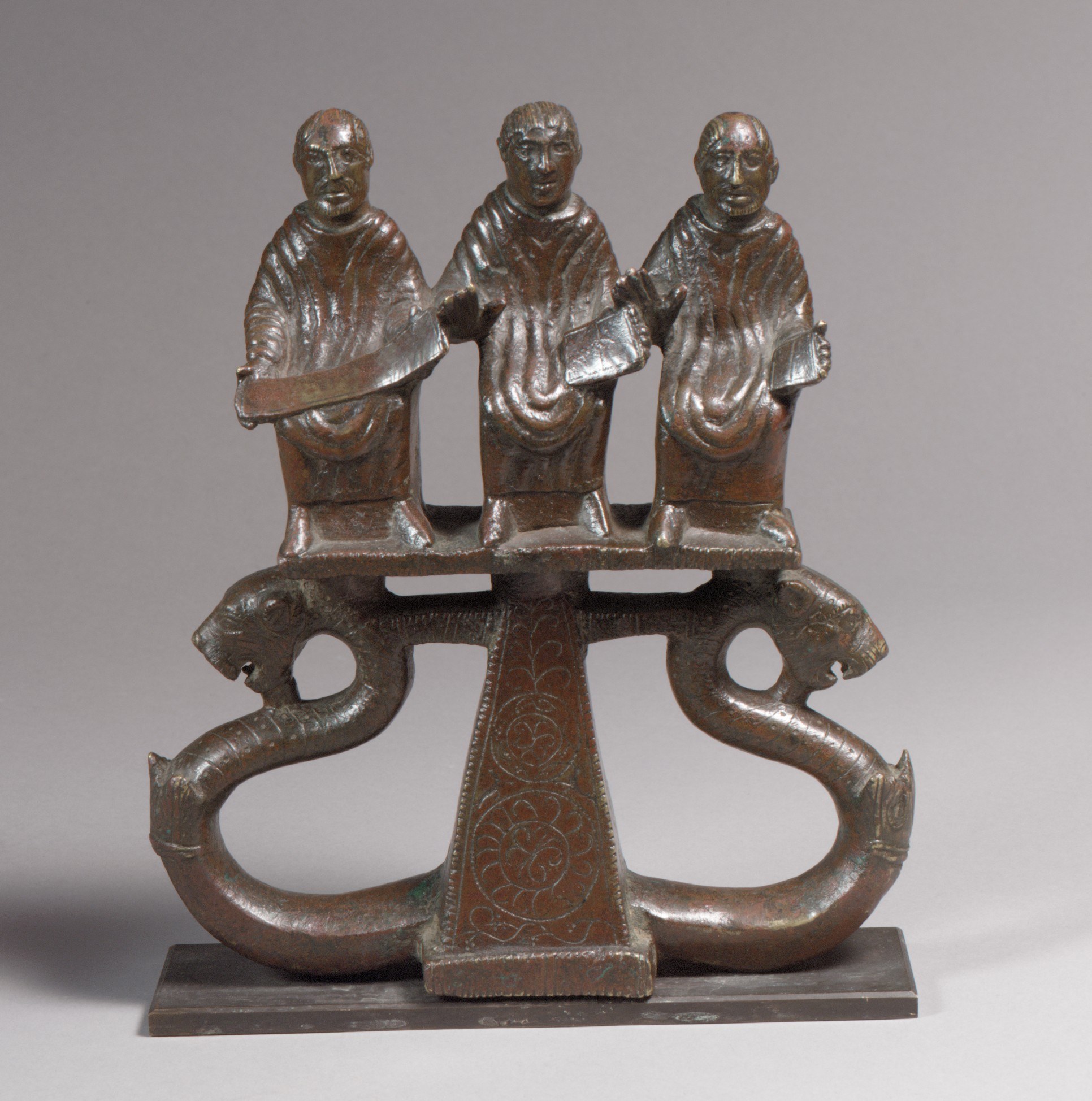 Chariot mount with three figures, Late Roman or Byzantine, AD 300-500; the piece may have decorated the chariot of a distinguished person in Gaul. Metropolitan Museum of Art, 47.100.42.
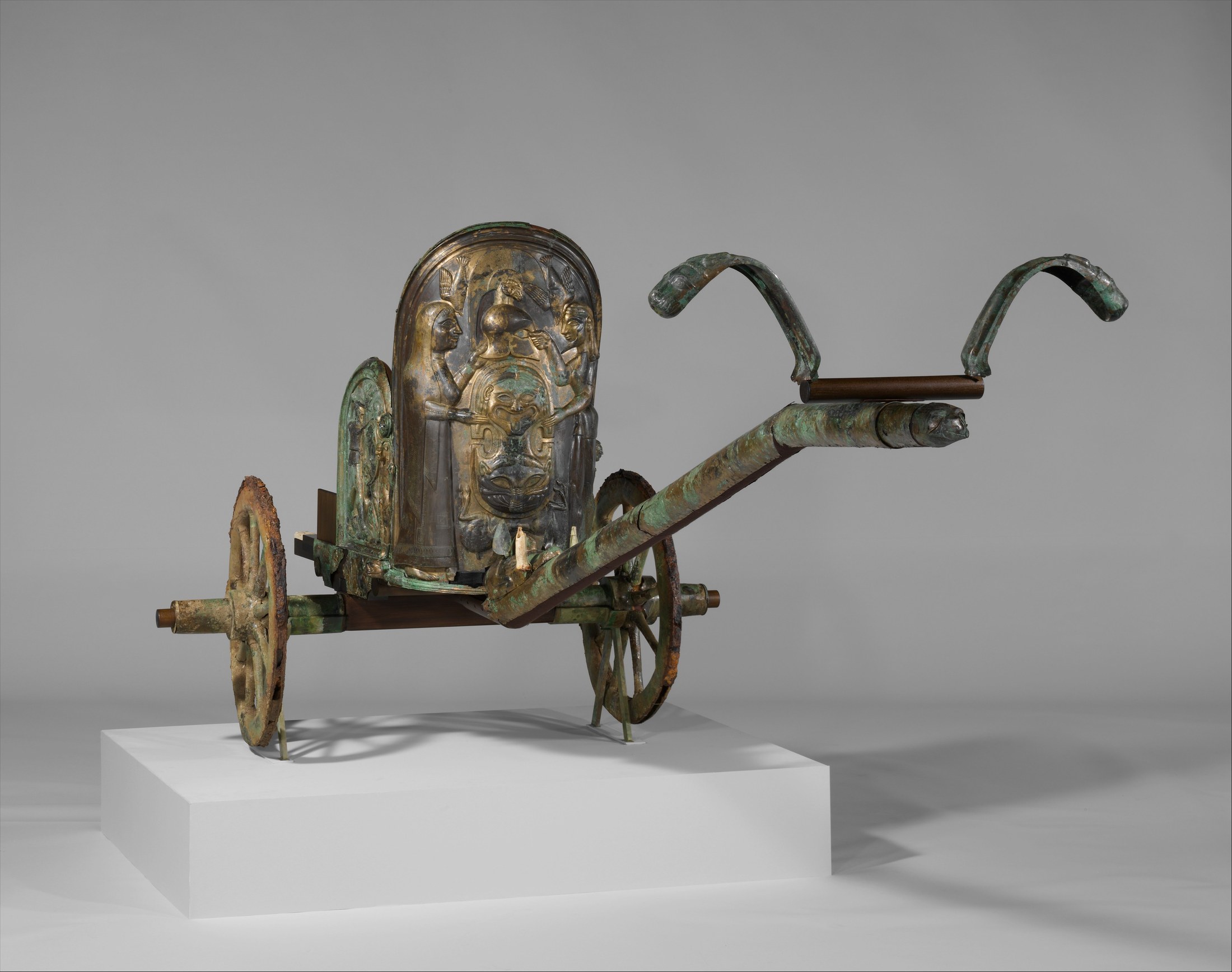 Etruscan bronze chariot from Monteleone, second quarter of the sixth century BC; an important Italic example of a parade chariot before Roman rule. Metropolitan Museum of Art, 03.23.1.
Italic and Etruscan Background
The Roman chariot tradition did not arise in a vacuum. On the Italian peninsula before Roman dominance there were already parade and burial chariots, especially in Etruscan contexts. They were not the main weapon of the battlefield, but showed the owner's status, accompanied ceremonial outings and entered tombs with other prestigious objects.
The Etruscan chariot from Monteleone matters precisely as an Italic predecessor. It belongs to the sixth century BC and shows a luxurious parade vehicle with bronze reliefs, iron tyres and a wooden structure of which not all parts survive. It is not a Roman chariot in the narrow sense, but without such monuments it is difficult to understand the visual and social form Rome inherited from Italy: the chariot as a sign of high status, procession and the right to be seen.
When Rome became stronger than the Etruscan cities, the idea of ceremonial riding did not disappear. It entered the Roman triumph, cult processions and images of victory. The Roman chariot therefore inherited an earlier Italic prestige form, but received a new state framework.
The Racing Chariot
The racing chariot was light and built for speed. Its body was small, open at the back so that the driver could stand and control the team, while weight remained minimal. Unlike a heavy wagon, it was not meant for cargo. Unlike a parade chariot, it did not need rich bronze sheathing if that decoration hindered speed.
The main racing form was the quadriga, the four-horse team. It demanded from the driver not only strength but precise coordination: four horses had to accelerate together, hold the line, avoid breaking formation at the turn and respond to neighbouring chariots. The biga was simpler and lighter, but the quadriga became the image of the great circus race and a symbol of victory.
The technical side of racing explains why Roman chariots are poorly compared with Bronze Age war chariots. In the circus the vehicle worked in the predictable space of the arena, on a prepared track and along a repeated course. Its task was not to carry an archer across the battlefield, but to give the driver maximum speed and control at the turns.
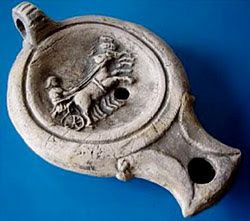 Roman oil lamp with chariot. 1-2 century AD
Construction and Details
A Roman chariot consisted of a body, axle, pair of wheels, pole, yoke, harness and system of reins. In a light racing vehicle the body had to be strong enough to withstand jolts and turns, but light enough not to slow the horses. Wood, leather, woven elements, straps and precise wheelwright work were therefore essential. Metal was used where strength or decorative effect was needed, but excess weight was the enemy of speed.
The wheels were the most vulnerable element. A wheel that was too heavy reduced acceleration, while one that was too weak broke at the turn. Tyre, central boss, spokes and axle had to work together. In a collision with a rival or a sharp turn around a meta, the wheel took the first load. Images of crashes therefore often show a broken chariot as the collapse of a whole system, not merely as a human fall.
Harness was no less important. The driver controlled not one animal, but a pair or a team of four, with each horse in its own place. Reins, yoke and pole connected the animals' power to the light platform. If straps tangled, the advantage of speed became a mortal danger. The driver's knife in images was therefore not decorative, but a tool of survival.
A parade chariot could follow a different logic. Heavy bronze mounts, gilding, reliefs, divine figures and protective symbols were acceptable. Such a vehicle moved more slowly, but created an impression of wealth and sacred order. An archaeological detail must therefore always be related to function: racing, triumphal, cult or burial chariots had different requirements.
Triumphal and Cult Chariot
Another Roman chariot was not a racing vehicle but a ceremonial one. The currus triumphalis, the triumphator's chariot, belonged to the language of victory. A commander entered the city in special dress, alongside the army, captives, spoils and images of conquered lands. The vehicle in this case was a stage of power: it raised a man above the crowd and placed him within a ritual in which victory appeared as both divine favour and Rome's achievement.
A cult or processional chariot could carry statues of gods, sacred objects or participants in a festival procession. In this context strength, brightness and symbolism mattered more than speed. The bronze chariot-pole ornament with the head of Medusa in the Metropolitan Museum fits this sphere: such a heavy metal element is unlikely to have belonged to a light racing vehicle, but suits a ceremonial chariot well.
The quadriga became a stable image of victory. It appeared on arches, coins and monuments, and was linked with the sun, triumph and imperial glory. Here the chariot is almost no longer transport but a sign: four horses, forward motion, a god or victor appearing before the spectator as a figure of power.
Chariots on Coins, Reliefs and Small Objects
In Roman visual culture the chariot often appears where victory, motion or divine protection had to be shown quickly. On coins a quadriga could carry a deity, Victory or a triumphator. The small size of the coin forced the artist to use an intelligible sign: four horses and a standing figure immediately suggested success, power and ceremonial movement.
Reliefs and sarcophagi could use the chariot differently. It became part of a procession, mythological episode or circus scene. In one case the real technique of racing matters, in another allegory, in a third the status memory of the deceased. The same object type does not always mean the same thing: a quadriga on a coin and a quadriga on a circus mosaic answer different questions.
Small objects, such as lamps, cups and mounts, show how widely the image of the chariot circulated beyond the arena itself. A person could see a quadriga not only in the Circus Maximus, but on a household object, in a workshop, on a vessel or in a burial assemblage. This makes the chariot part of everyday visual experience, even if the vehicle itself was not everyday transport.
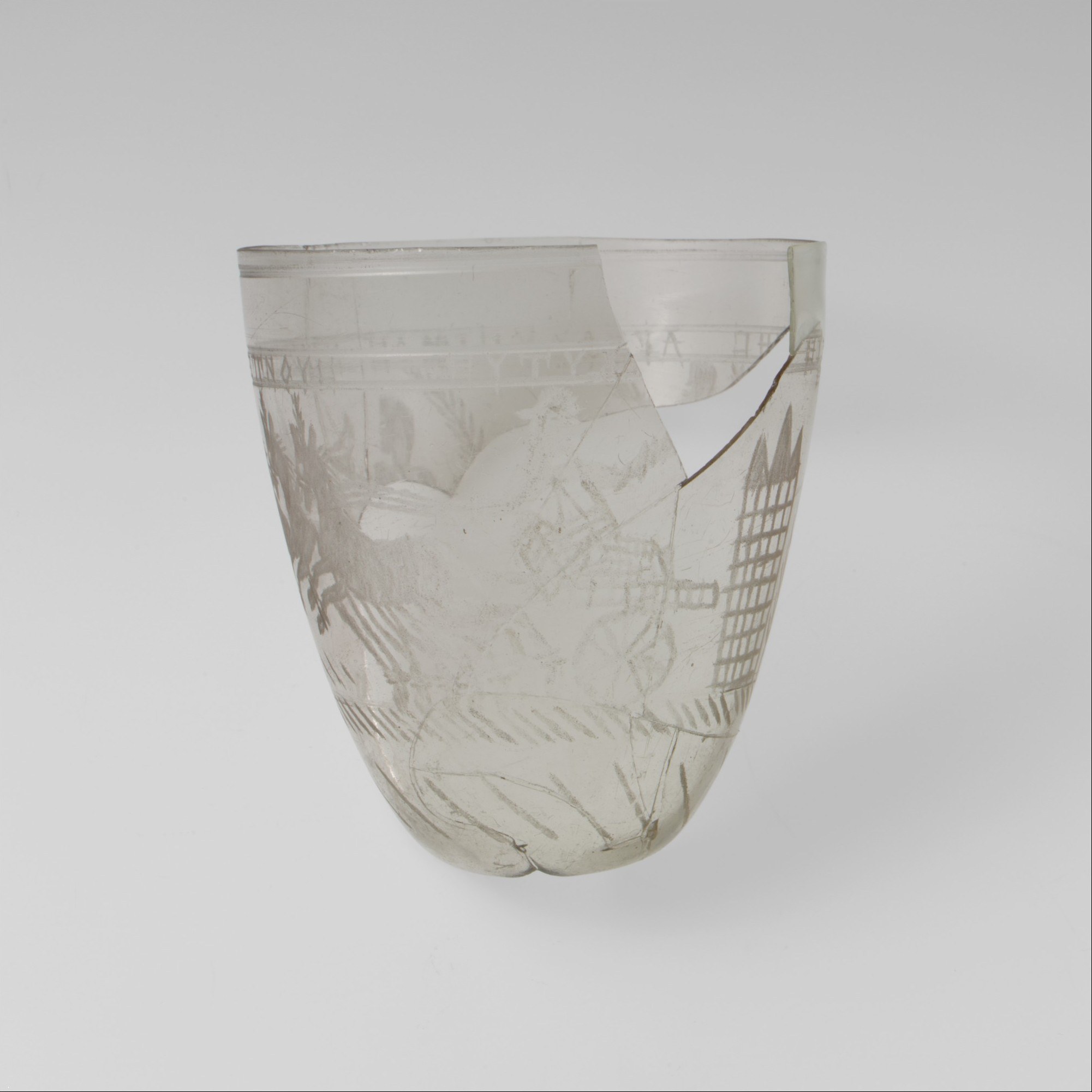 Glass beaker with a victorious charioteer, Eastern Mediterranean, fourth century AD. The figure with a palm branch shows how circus victory entered expensive objects of the Late Roman period. Metropolitan Museum of Art, 81.10.245.
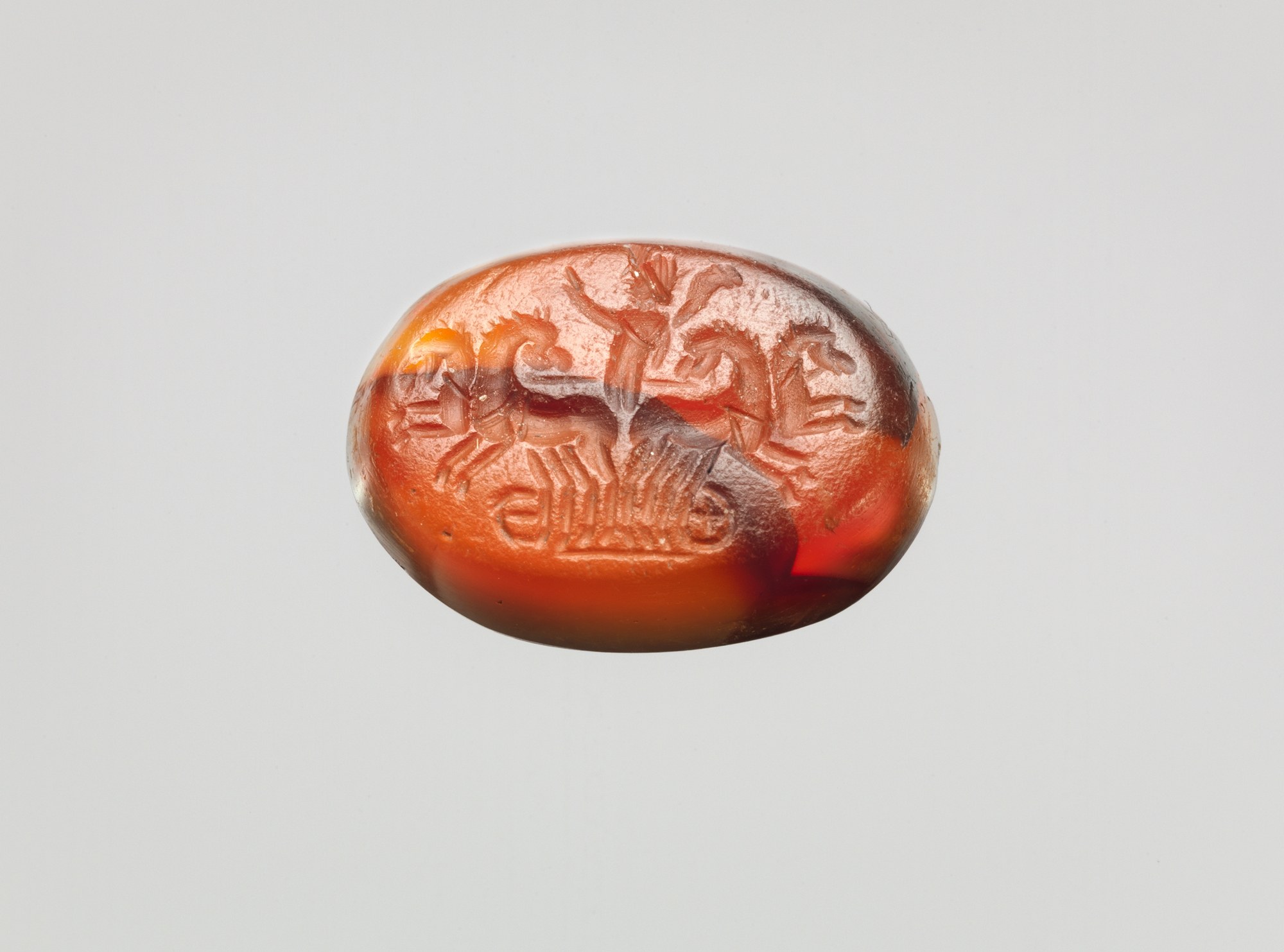 Carnelian intaglio with Sol in a quadriga, Roman Imperial, second century BC-second century AD. The small object presents the chariot as a sign of divine motion and victory. Metropolitan Museum of Art, 81.6.127.
Why It Was Not Everyday Transport
Roman everyday life knew many wheeled vehicles: carts for loads, wagons for rural work, road carriages, covered carriages, litters and riding. The chariot occupied a special place among them. It would have been inconvenient for carrying a family, goods or baggage, poorly suited to bad roads and dependent on expensive horses.
In the city wheeled traffic was regulated, and narrow streets and dense buildings would have made a fast chariot dangerous. Outside the arena its advantages sharply declined. Scenes with chariots in Roman art therefore almost always require a question: is this a race, a triumph, a myth, a cult procession, an image of the Sun or an allegory of victory? The answer changes the meaning.
For this reason an article on Roman chariots should not replace one on Roman roads or carts. The chariot was expensive, visible and symbolically charged. Its value lay in speed before spectators and in its ability to represent power, not in economic usefulness.
Visual and Archaeological Evidence
Actual wooden parts of Roman chariots rarely survive. Wood, leather, straps and textiles usually disappear, and metal was often removed and melted down. Chariot construction is therefore reconstructed from different kinds of evidence: bronze fittings, pole ornaments, mounts, lamps with circus scenes, mosaics, coins, reliefs, inscriptions and comparative Italic finds.
This variety matters. A lamp with a quadriga shows a popular image of racing, but not the exact dimensions of the vehicle. A bronze pole ornament points to a ceremonial chariot, not a light racing one. A Late Roman mount from Gaul shows that decorated chariots could still exist in the social culture of the later empire. The Etruscan chariot from Monteleone helps us see the older Italic tradition of parade vehicles, but it should not be transferred automatically to every Roman race.
Reliable reconstruction emerges only by comparing such sources. If an image is on a coin, it may be a political sign; if on a circus mosaic, part of a narrative of racing; if in a tomb, a marker of the owner's status. Caption, date and context are therefore as important as the picture itself.
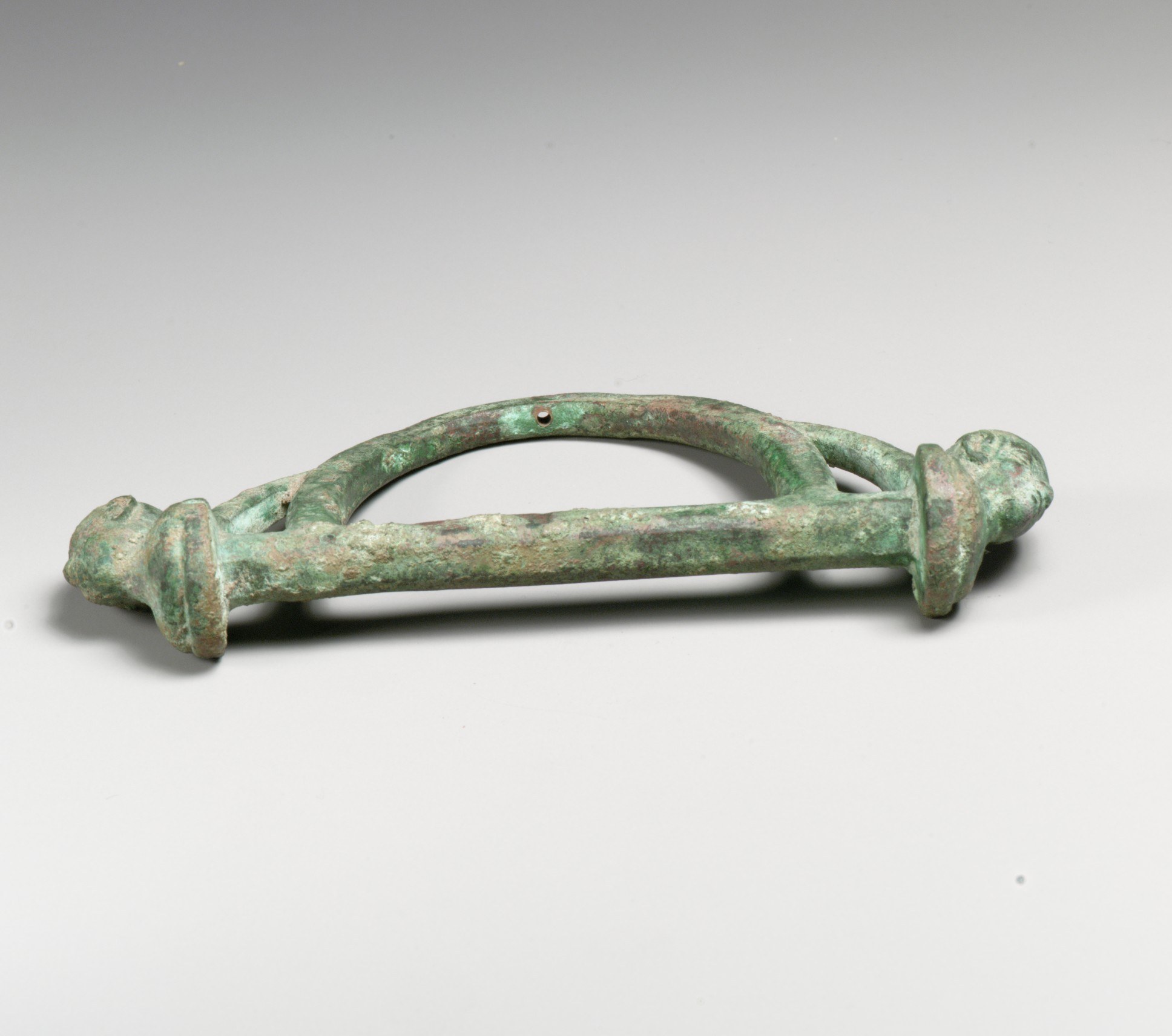 Bronze fitting, possibly from a cart or chariot, Roman Imperial, second-third century AD. Finds of this kind are important for studying fittings and decorative elements that rarely survive with the wooden structure. Metropolitan Museum of Art, 96.9.391.
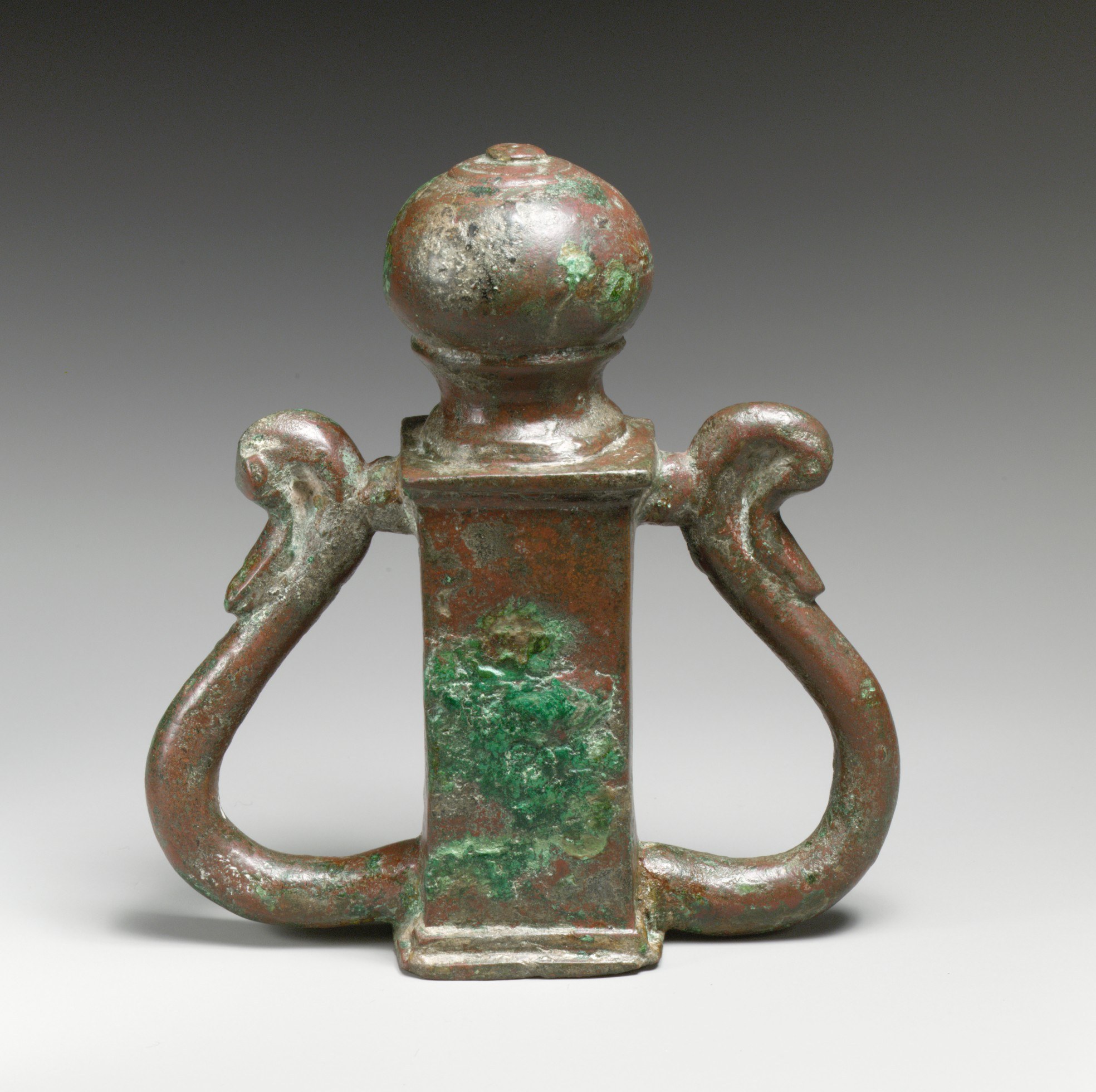 Two bronze chariot attachments with duck-head finials, Late Roman, third-fourth century AD. The object shows the decorative side of Late Roman chariot equipment. Metropolitan Museum of Art, 96.9.404a, b.
Related Topics
Literature and sources
- Humphrey J. H. Roman Circuses: Arenas for Chariot Racing. London, 1986.
- Toynbee J. M. C. Animals in Roman Life and Art. London, 1973.
- Beard M. The Roman Triumph. Cambridge, MA, 2007.
- Futrell A. The Roman Games: A Sourcebook. Oxford, 2006.
- Metropolitan Museum of Art: Bronze ornament from a chariot pole, 18.75, Public Domain.
- Metropolitan Museum of Art: Chariot Mount with Three Figures, 47.100.42, Public Domain.
- Metropolitan Museum of Art: Bronze chariot inlaid with ivory, 03.23.1, Public Domain.
- Metropolitan Museum of Art: Glass beaker with victorious charioteer, 81.10.245, Public Domain.
- Metropolitan Museum of Art: Carnelian intaglio with Sol in a quadriga, 81.6.127, Public Domain.
- Metropolitan Museum of Art: Bronze fitting, possible from a cart or chariot, 96.9.391, Public Domain.
- Metropolitan Museum of Art: Two bronze chariot attachments with ducks' head finials, 96.9.404a, b, Public Domain.
Interested in Ancient Rome beyond reading? Join Legio X Fretensis or explore our reenactment directions.


