Chariots in Antiquity
A chariot is a light wheeled vehicle with an open platform, usually drawn by a pair of horses and designed for speed, manoeuvre and prestigious display. In the ancient world it was not the same kind of vehicle in every period. Early Mesopotamian vehicles were heavier and closer to war or ceremonial carts; Late Bronze Age chariots became lighter, used spoked wheels and formed an elite military complex; in the Greco-Roman world contests, triumphal display and public spectacle came to the foreground.
The chariot therefore matters in several fields at once: warfare, royal ideology, craft, horse breeding, sport, urban architecture and the social career of drivers. It should not be understood as an ancient equivalent of an all-purpose carriage. For ordinary transport of goods and people, carts, pack animals, litters or riding were often more suitable; a chariot required costly horses, trained harness, level ground or roads and people able to control speed.
 Bas-relief of a Gallic chariot,Museum of Padua. 4th century BC
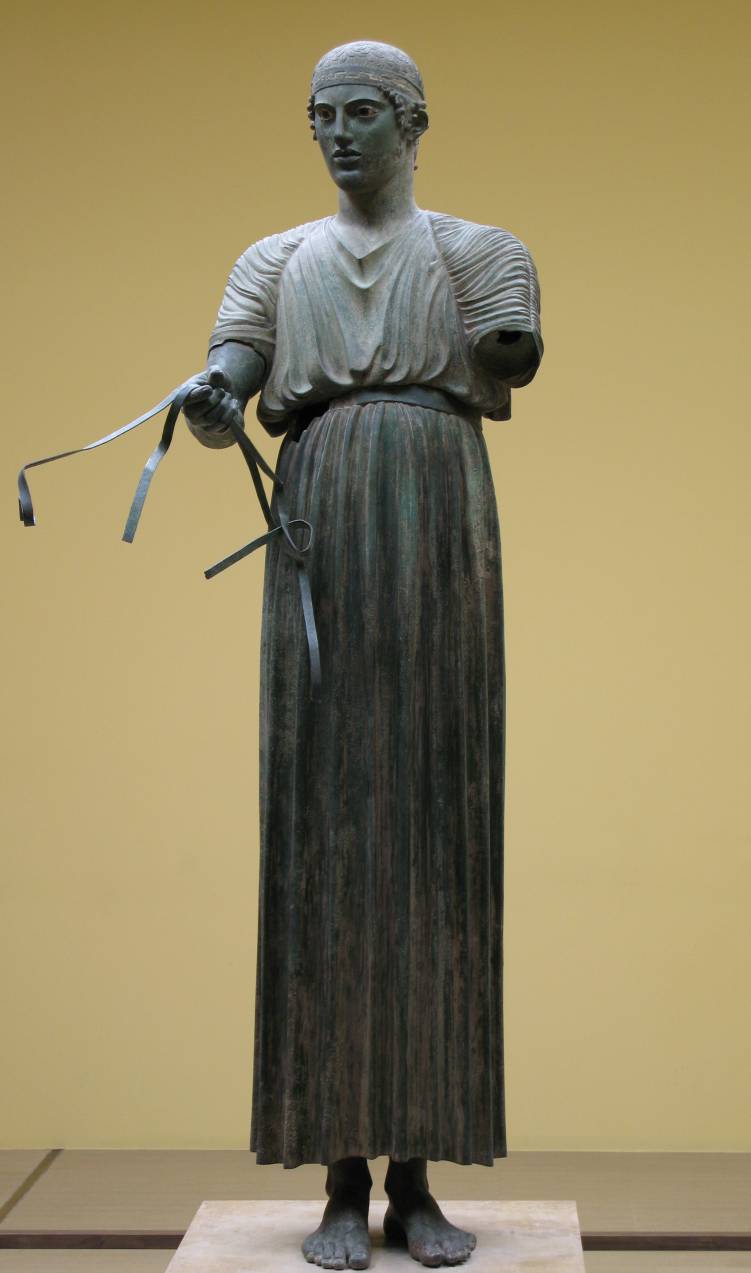 The Charioteer of Delphi, wearing a long chiton. Bronze; around 470 BCE. Archaeological Museum of Delphi.
Origins and Construction
Wheeled transport appeared before the classical chariot. In southern Mesopotamia, connected with the cities of the Sumerians, images and models of vehicles with solid wheels are known already in the fourth and third millennia BC. Such vehicles were heavy and slow, and they did not serve the same kind of battle as New Kingdom Egyptian or Hittite chariots. They show the underlying technology: wheel, axle, body, draught animal and a workshop able to make a strong frame.
The decisive change came with the horse, the light spoked wheel and more flexible harness. In the second millennium BC the chariot spread through Western Asia, Egypt and the eastern Mediterranean as expensive elite equipment. The light body was made from wood, leather and woven elements; the axle was often placed toward the rear to improve speed; the wheels were large and light. Low weight mattered more than protection: the chariot had to bring a warrior quickly to the point of attack, change position or carry him out of danger.
Archaeological finds of actual chariots are rare because wood, leather and textiles preserve poorly. Construction is therefore reconstructed from burial vehicles, reliefs, models, images of wheels, harness fittings and traces of craft. Well-preserved royal chariots from Egypt and the bronze Etruscan chariot from Monteleone show two different sides of the tradition: the working lightness of a military vehicle and the ceremonial form of a prestige object.
War Chariots
In war the chariot was not an ancient tank, but a mobile platform for an elite fighter. Its strength lay in speed, height of view, the ability to approach an enemy quickly and withdraw after shooting or throwing. The most stable form of crew included a driver and an armed warrior; in different armies a shield-bearer, spearman or runner accompanying the vehicle on foot could be added.
In Ancient Egypt chariots became especially prominent during the New Kingdom. Egyptian images show an archer on a light two-wheeled vehicle: the driver controls the horses while the warrior shoots or throws a spear. In Western Asia and among the Hittites chariots could be heavier and carry more men. In Assyria of the first millennium BC royal reliefs show chariots in hunting, siege and displays of royal power, although cavalry was already becoming more important.
Large battles reveal the limits of chariot warfare as well. On open ground chariots could envelop, harass and disrupt an enemy's order. In confined terrain, on poor ground, against disciplined infantry or without supply their value declined. The Battle of Kadesh became a famous example of a clash between chariot armies, but even there the outcome depended not on technology alone, but on scouting, reserves, infantry, the king's guard and the ability to hold formation after a surprise attack.
Drivers and Crew
The driver was the central figure of the crew. He was responsible not simply for movement, but for the survival of the pair: he held the reins, sensed the horses' pace, chose the line, turned the vehicle and gave the warrior a stable position. A driver's mistake could overturn the chariot, break the axle, tangle the harness or expose the crew to attack. Chariotry therefore required long training, not only physical courage.
The warrior on the chariot depended on the driver just as the driver depended on grooms, wheelwrights and armourers. Behind a war vehicle stood a whole service: breeding and feeding horses, repairing wheels, checking straps, storing bows, spears and quivers. In royal and palace economies chariots belonged to an administrative system, not to the accidental property of an isolated hero.
In Greco-Roman sport the driver's role changed, but it did not become simple. Professional charioteers controlled teams at high speed, fought for the inside line at turns, risked collisions and could build careers with the backing of stable owners. In Rome many drivers were slaves or freedmen, but a successful auriga could gain money, fame and patronage. Social status remained ambiguous: crowds loved winners, while elites often treated the profession as low but highly visible craft.
Transport, Hunting and Ceremony
A chariot could be used for riding out, hunting, ceremony and display of power, but that does not make it ordinary transport. For carrying grain, stone, timber or people, carts and pack animals were more practical. A chariot had little carrying capacity, depended on road quality and required an expensive pair of horses. Its advantage lay in speed and image, not in everyday utility.
In royal scenes the chariot shows power in motion. An Egyptian pharaoh strikes enemies from a chariot; an Assyrian king hunts lions; a Greek hero appears in poetry beside horses; a Roman triumphator enters the city in a ceremonial car. In all these cases the transport function is joined to a symbolic one: the vehicle carries not cargo, but status, victory and the right to be seen.
Ceremonial and burial chariots are especially important for this side of the subject. They were decorated with bronze, gold, ivory, painting or inlay; they were placed in tombs, given to rulers and displayed in processions. Such a chariot may never have been a normal fighting vehicle, but precisely this kind most often survived and entered museums.
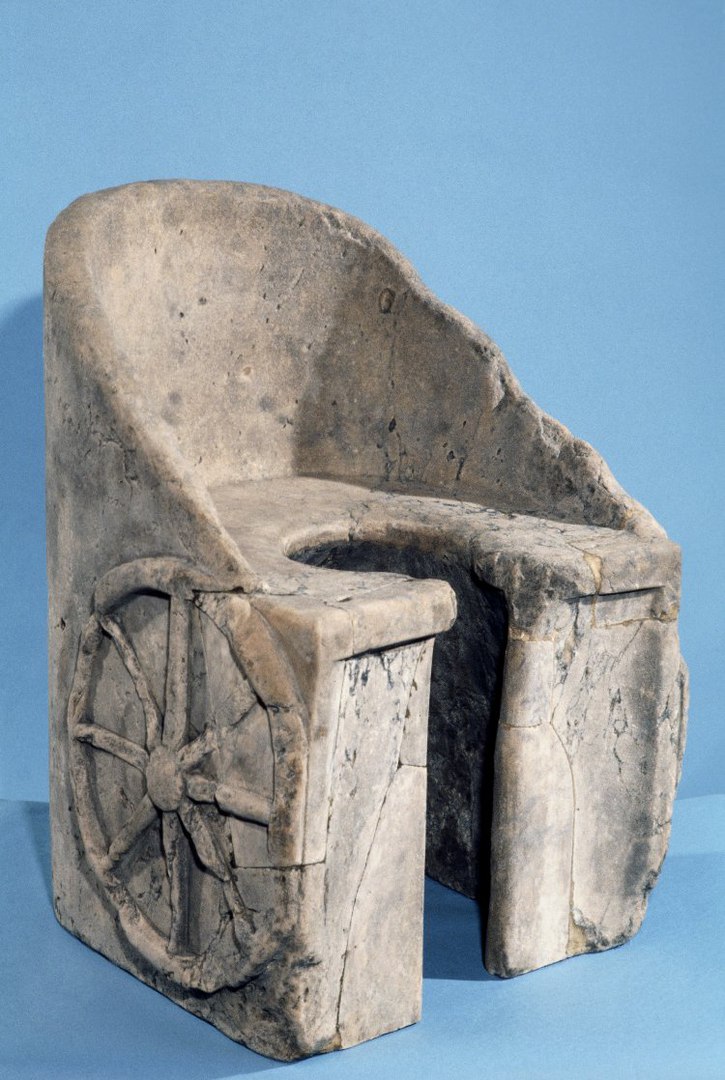 Marble chariot seats for latrina from the baths of Caracalla. The British Museum. 3rd century AD
Greece and Aristocratic Prestige
In Greek tradition the chariot linked war, myth and aristocratic competition. In Homeric epic heroes may ride to the battlefield in a chariot, but such scenes cannot be transferred directly to the classical phalanx. For historians they matter as a memory of prestigious Bronze Age military equipment and as a language of heroic status.
At the games chariot races were costly competitions. Victory glorified the owner of the horses and chariot, even if a professional driver handled the team. This distinguished chariot sport from contests in which the victor competed with his own body: behind the fame stood wealth, a stable, animal training and the ability to pay for risk. The bronze Charioteer of Delphi recalls precisely this link between skill, dedication and aristocratic success.
In art the chariot became a convenient way to show gods, heroes and ceremonial movement. On vases, reliefs and statues it may not be an everyday scene, but a sign of transition, victory, marriage, funeral or divine appearance. Images of chariots must therefore be read according to genre: a sporting scene, mythological episode and funerary procession answer different questions.
Roman Racing and the Circus
In Ancient Rome chariots did not become the basis of the army. Roman military power rested on infantry, allies, engineering and later cavalry. Yet in symbolic and spectacular culture the chariot held an enormous place. The triumphal chariot set the victor apart from the crowd, while chariot racing became one of the major mass entertainments of the city.
Roman races took place in the circus, where starting gates, the central barrier, turning posts, seating and team organization all mattered. The hippodrome and Circus Maximus show that in Rome the chariot was not simply transport, but the centre of a large urban infrastructure. It connected stables, fan factions, betting, imperial patronage and the festival calendar.
Images of Roman chariots appear on lamps, mosaics, sarcophagi, coins, silverware and wall painting. A small oil lamp with a racing chariot or a cup showing the Circus Maximus matters no less than large architectural remains: such objects show how the spectacle entered the house, banquet, memory of victory and everyday things.
 Building plan of the Circus Maximus in Rome
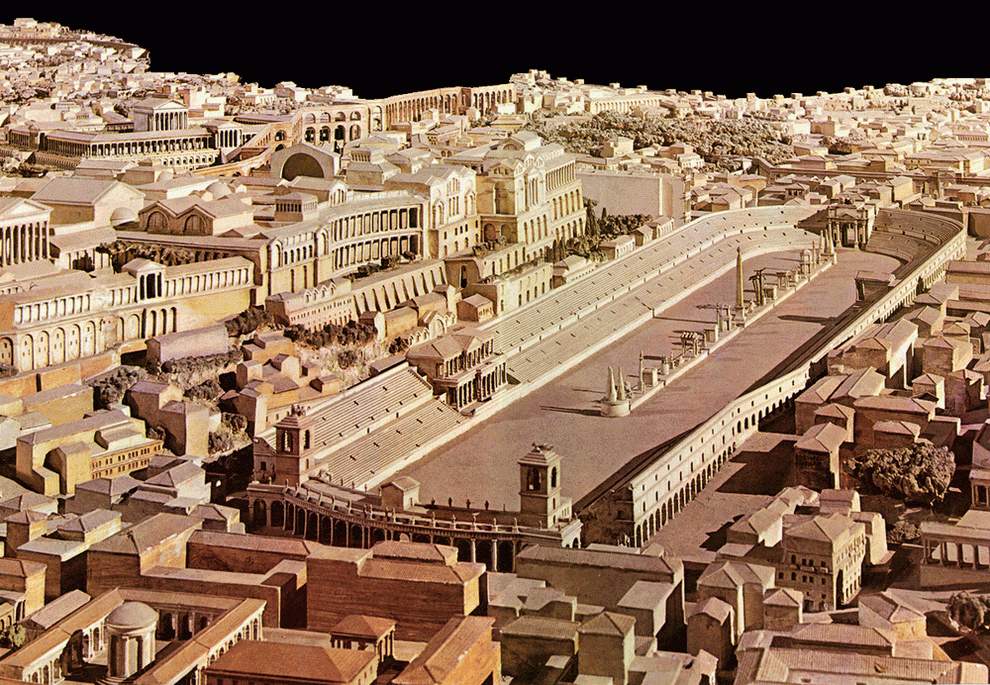 Reconstruction of the Circus Maximus in Rome
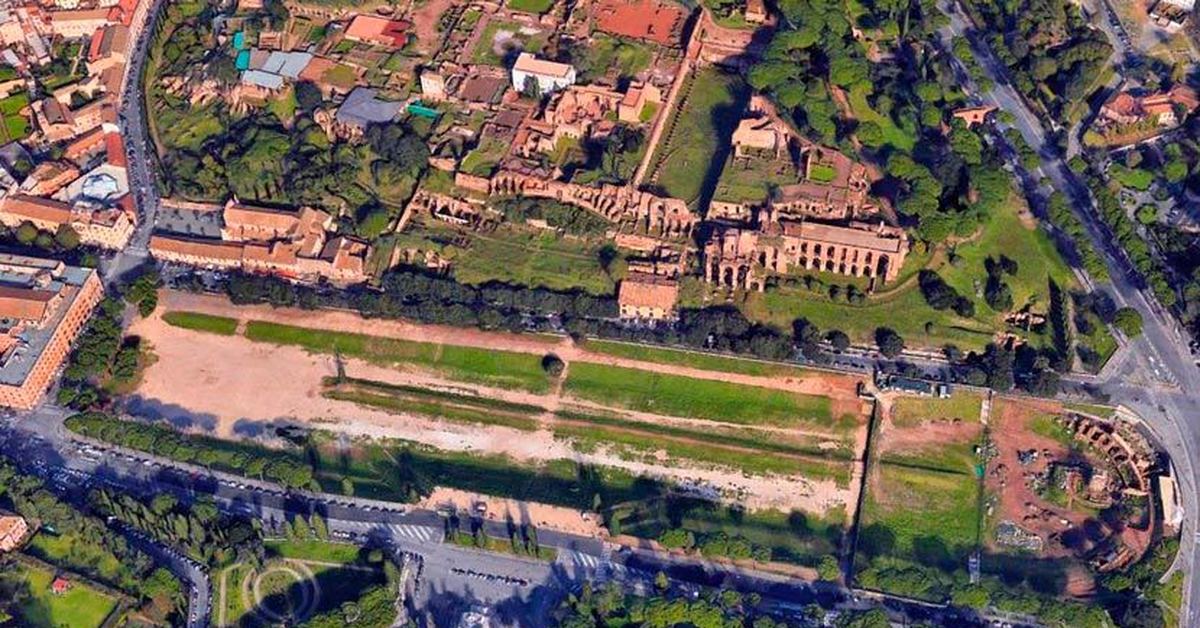 Circus Maximus in Rome. Modern look
Types of Chariots
Different names for chariots reflect not only the number of horses, but also function. A biga was drawn by two horses, a triga by three and a quadriga by four. In a military context the Latin name often matters less than the vehicle's weight, axle position, crew size, weapons and horse training. A light archer's chariot and a heavy ceremonial vehicle could look similar in an image, but serve different tasks.
War chariots aimed at manoeuvre and stability on uneven ground. Racing chariots were even lighter and more dangerous: they offered speed but little protection to the driver. Ceremonial chariots emphasized the splendour of the owner and could be richly decorated. Hunting chariots stood between these forms: mobile enough for pursuit and highly suitable for royal display.
Ordinary carts, wagons and carriages existed alongside chariots in the ancient world. They should not be confused. A cart carried goods, a war chariot carried a fighter, a racing chariot competed in a contest, and a triumphal chariot made the victor the centre of a ritual.
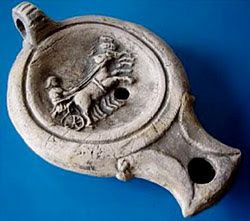 Roman oil lamp with chariot. 1-2 century AD
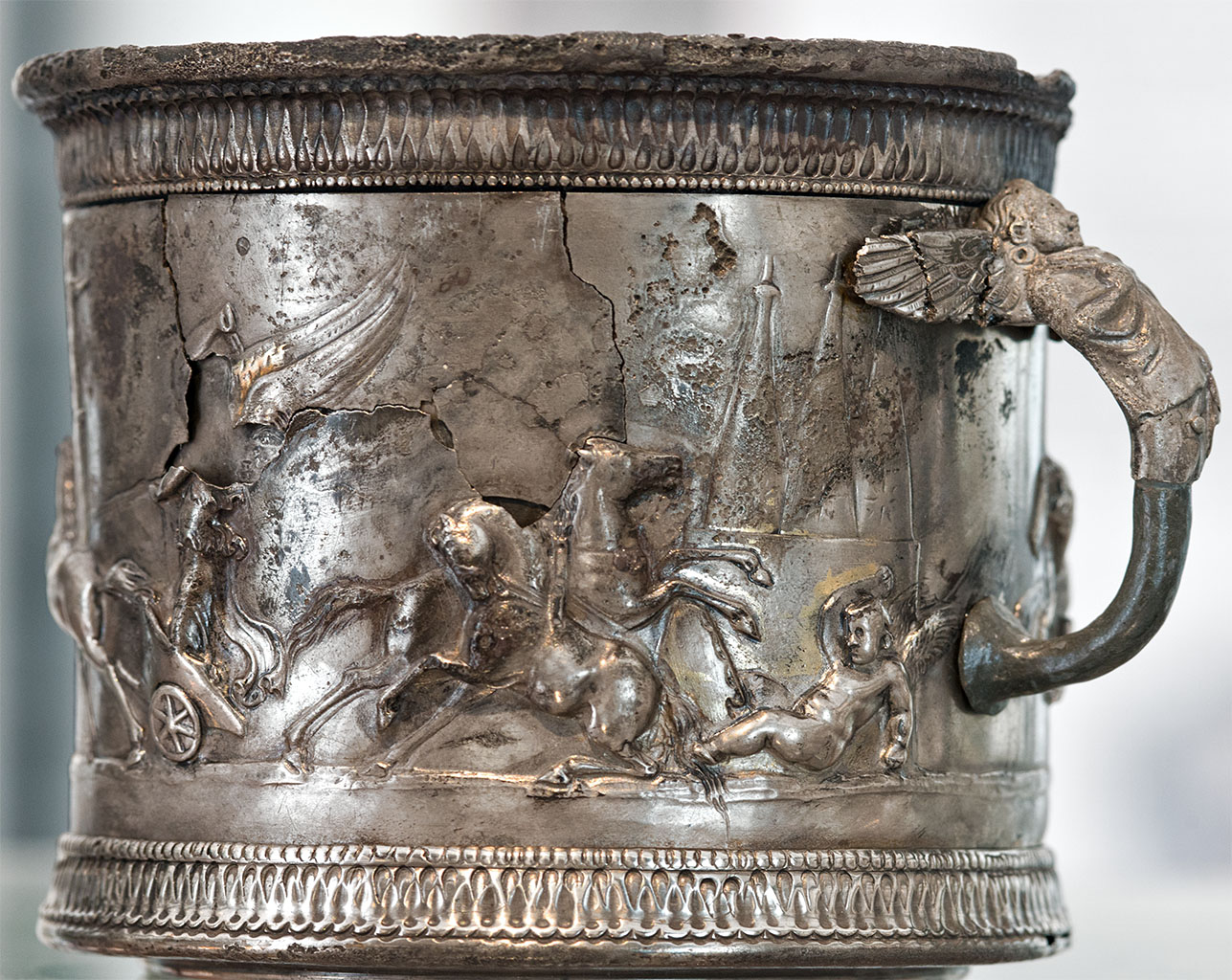 Silver bowl with the image of Circus Maximus. Pompeii. Height: 8 cm,width-9.5 cm. Weight-355 g. Inv. No. 145510. 1st century AD
Chronology
- Fourth-third millennia BC
- early wheeled vehicles and images of war carts with solid wheels appear in Mesopotamia.
- Ca. 2000-1700 BC
- horses, light spoked wheels and technology close to the classical chariot spread in Western Asia.
- Sixteenth-thirteenth centuries BC
- chariot forces become an important part of the armies of Egypt, the Hittites and states of the eastern Mediterranean.
- Ca. 1274 BC
- the Battle of Kadesh shows the scale of Late Bronze Age chariot warfare.
- Ninth-seventh centuries BC
- Assyrian reliefs show royal chariots in war and hunting, while mounted cavalry grows in importance.
- Eighth-sixth centuries BC
- in the Greek world chariot races become a prestigious part of games, and in Italy ceremonial vehicles such as the Monteleone chariot are produced.
- First century BC-fourth century AD
- in Rome the chariot is especially important in triumphs, circus racing and mass spectacular culture.
- Late Antiquity
- the military role of chariots almost disappears, but circus races and the symbolism of the quadriga continue in urban ceremonies and art.
Archaeological Evidence
Chariots are studied through different groups of sources. Actual vehicles and harness fittings show technology; reliefs and paintings show the ideology of battle, hunting or ceremony; inscriptions and athletic dedications name owners, drivers and victories; circus architecture shows how the contest was built into the city. No single type of evidence replaces the others.
Images must be read with particular care. A king in a chariot is often larger than ordinary people, enemies are arranged, and the chaos of battle becomes a clear scene of victory. A racing scene on a lamp may not report a specific race, but signal a popular spectacle. A burial or ceremonial chariot may be too expensive and decorated to count as an ordinary military vehicle.
The most useful comparisons appear when an image can be tied to an object, place and date: chariots from Egyptian tombs, Kadesh reliefs, the Charioteer of Delphi, a Gallic relief with a chariot, the Etruscan bronze chariot from Monteleone, Roman lamps and silver vessels with circus scenes. Such a series shows not a single "evolution of the chariot", but a change of functions: from war and royal hunting to sport, triumph and memory.
Related Topics
- War Chariots of Ancient Egypt
- Chariots in Ancient Rome
- Chariot Racing
- Hippodrome and Circus Maximus in Rome
- Battle of Kadesh
Literature and sources
- Littauer M. A., Crouwel J. H. Wheeled Vehicles and Ridden Animals in the Ancient Near East.
- Littauer M. A., Crouwel J. H. Chariots and Related Equipment from the Tomb of Tutankhamun.
- Drews R. The End of the Bronze Age: Changes in Warfare and the Catastrophe ca. 1200 B.C.
- Spalinger A. J. War in Ancient Egypt: The New Kingdom.
- Humphrey J. H. Roman Circuses: Arenas for Chariot Racing.
- Junkelmann M. Die Reiter Roms. Teil III: Zubehör, Reitweise, Bewaffnung.
- Metropolitan Museum of Art: Bronze chariot inlaid with ivory, 03.23.1.
Interested in Ancient Rome beyond reading? Join Legio X Fretensis or explore our reenactment directions.


