Battle of Kadesh
The Battle of Kadesh was fought around 1274 BC near the city of Kadesh on the Orontes, in the zone where Egypt and the Hittite kingdom competed for Syria-Palestine. The Egyptian army was commanded by Ramesses II, while the Hittite coalition was led by Muwatalli II. The battle is famous not because it produced a clear victor, but because it survives in an unusually detailed Egyptian version: texts, reliefs and repeated temple scenes.
Kadesh was a battle of the chariot age. Egyptians approached the city in several divisions stretched along the road from the south. Hittite chariots hid behind the city and struck when part of the Egyptian army had not yet arrived. The result remained disputed: Ramesses II presented it as a personal victory, but strategically Kadesh did not come under firm Egyptian control.
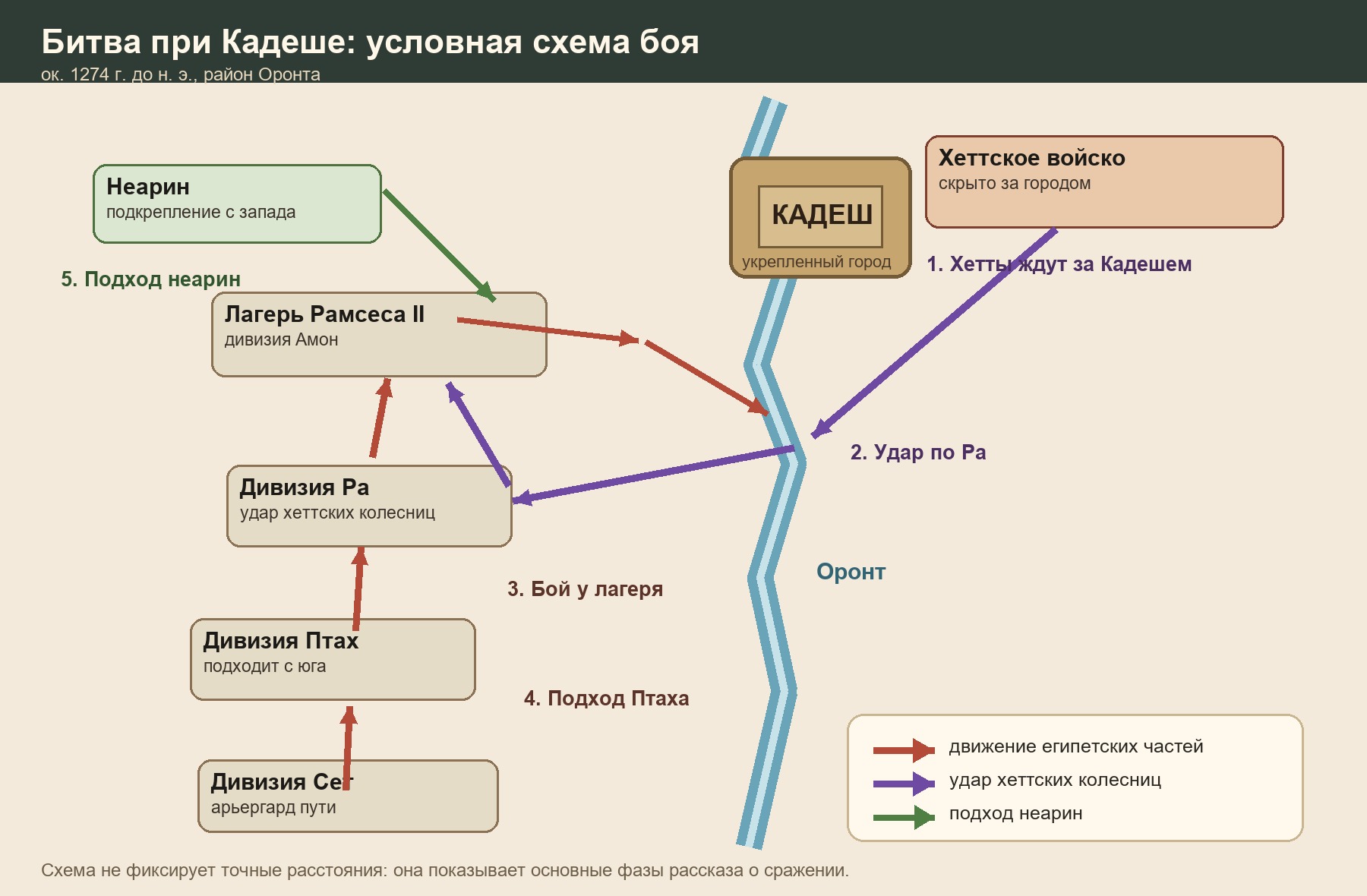 Schematic plan of the Battle of Kadesh: Egyptian divisions approached from the south, Hittite chariots struck from behind Kadesh against the Re division and Ramesses II's camp; the Nearin and Ptah division then arrived. X-Legio schematic after the Egyptian account; exact positions are debated.
Causes of the Campaign
Kadesh stood at an important junction of northern Syrian politics. Control of it meant influence over Amurru, routes to the coast and inland Syria, and prestige among dependent rulers. For Egypt, the loss of such cities meant the weakening of the power built by the campaigns of Thutmose III and his successors.
Ramesses II's father, Seti I, had already campaigned in the north and tried to restore Egyptian influence. Under Ramesses II the conflict intensified: the Hittite kingdom retained strong positions, and local rulers could shift from one great power to another. The campaign against Kadesh was therefore not an accidental raid, but part of a struggle for a system of vassal cities.
The sources show the war through Egyptian eyes. Ramesses II stressed his courage and resolve, but the account itself preserves signs of crisis: faulty intelligence, a stretched column, a surprise attack and the need to save the camp.
Battle Scheme
The schematic image shows the main phases of the battle in a simplified form. The Egyptian army marched from the south in four major divisions, associated in the Egyptian account with Amun, Re, Ptah and Seth. Ramesses II with the Amun division reached the camp before the other units had arrived.
The Hittites used deception and concealment. Two captured Shasu told the Egyptians that Muwatalli was far to the north, but it then became clear that the Hittite army was behind Kadesh. When the Re division was marching separately, Hittite chariots crossed the Orontes and struck it, then broke toward the Egyptian camp.
The turn of the battle is connected with Ramesses' counterattack, the arrival of the Nearin and the approach of the Ptah division. In the Egyptian version this becomes a story of almost solitary royal heroism. Modern reconstruction is more cautious: Kadesh was not a miraculous victory, but a hard battle in which the Egyptian army escaped destruction without achieving its strategic goal.
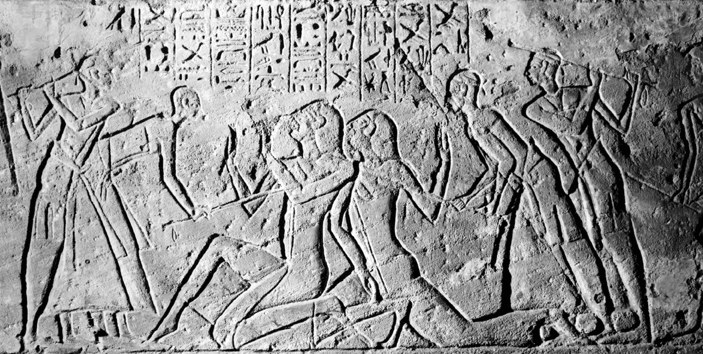 Scene of the interrogation of Shasu, connected with the false-information episode before Kadesh. Drawing after an Egyptian relief.
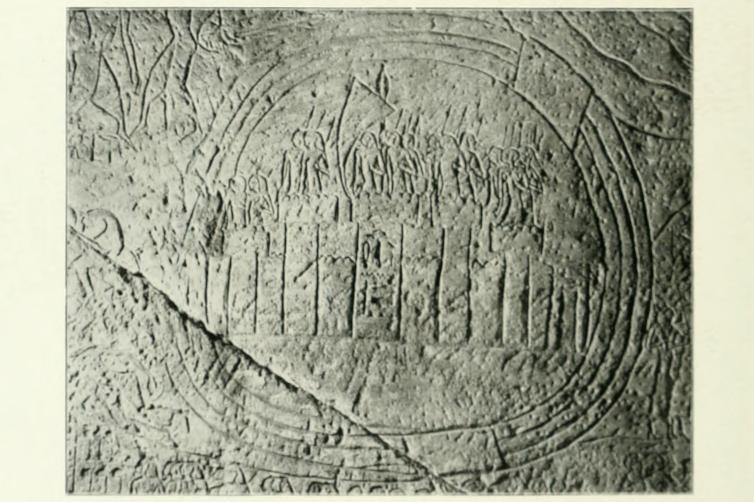 Kadesh on an Abu Simbel relief: the Orontes surrounds the fortified city and a Hittite garrison is shown inside. Drawing by J. H. Breasted, 1908.
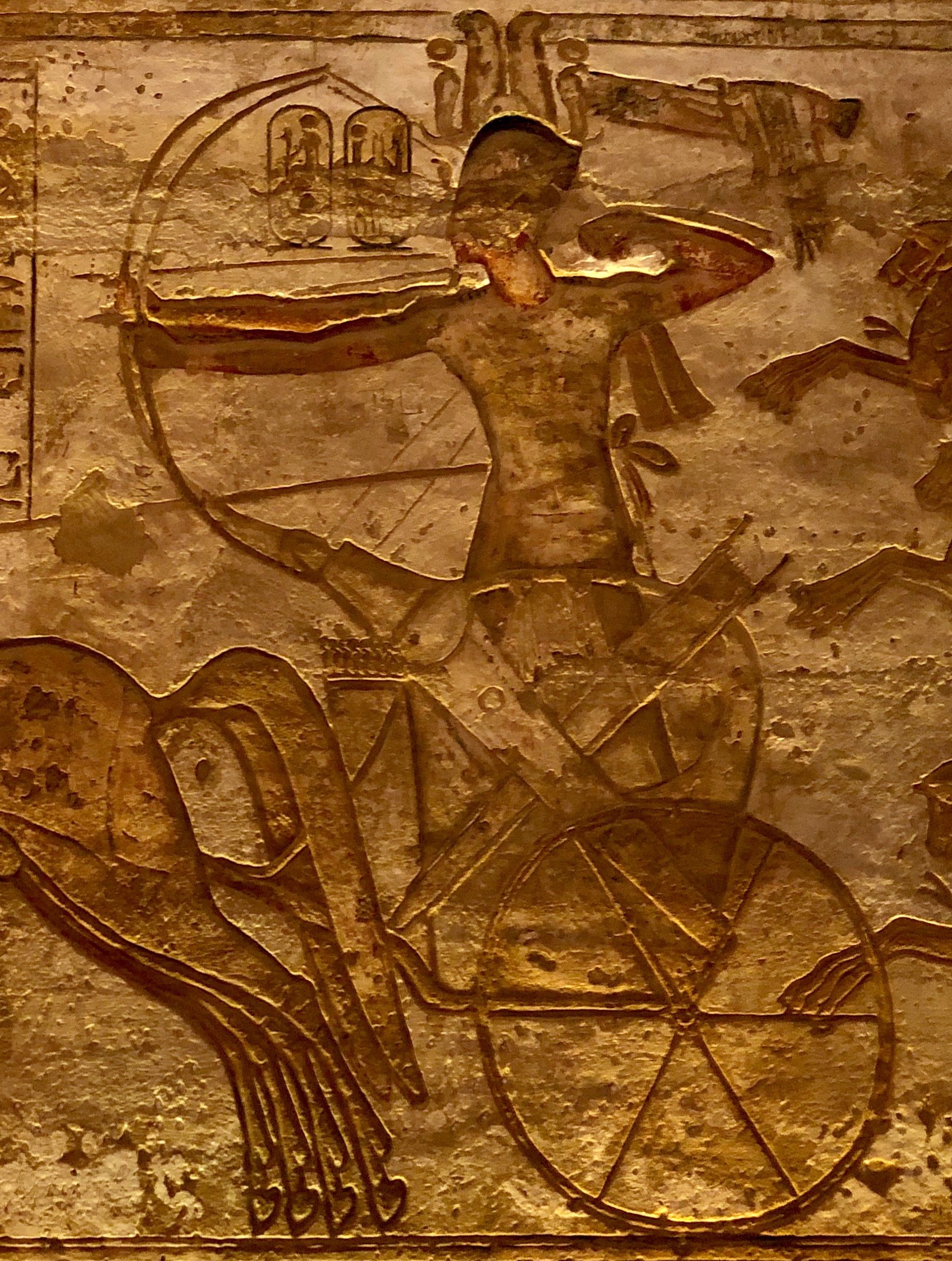 Ramesses II in a chariot in a Battle of Kadesh scene, relief of the Abu Simbel temple.
Course of the Battle
The course of the battle is known mainly from the Egyptian account, so details must be read critically. At first Ramesses II moved ahead faster than the other divisions. Captured Shasu confirmed the convenient Egyptian version that the Hittites were far away, but after the interrogation of other men it became clear that this was a trap.
The main blow fell on the Re division. Hittite chariots broke its formation and drove toward the camp where Ramesses was located. The Egyptian text describes the soldiers' confusion and the pharaoh's solitary action; the reliefs strengthen this image by showing the king as huge, swift and surrounded by enemies. In reality the camp's resistance, royal guard, arrival of the Nearin and approach of other divisions must have mattered just as much.
After the counterattack the Hittite charioteers were driven back toward the river. Yet the Egyptians did not take Kadesh and did not destroy Muwatalli's army. On the following day the sides apparently did not continue the battle on the same scale. The Egyptian army withdrew south, while the political balance in northern Syria remained more favourable to the Hittites.
Results and Significance
The tactical result of Kadesh remains debated. Egypt avoided disaster and gained material for powerful royal propaganda, but did not achieve decisive control over Kadesh. The Hittites did not destroy Ramesses II, but they held strategic positions in the region.
The long-term importance of the battle is connected with diplomacy. Years after the campaigns, Egypt and the Hittite kingdom concluded a peace treaty, one of the best-known international documents of the ancient Near East. It was not the direct result of one day at Kadesh, but it grew from the need to stabilise relations between the two powers.
For military history Kadesh matters as an example of a major clash of chariot armies, complex reconnaissance, error on the march and the use of temple art to transform a disputed result into royal triumph.
Reliefs and the Egyptian Version
Kadesh is well represented not only by texts but also by images. The interrogation of Shasu belongs to the false-intelligence episode; the relief with the city shows Kadesh as a fortified point surrounded by the Orontes; chariot scenes at Abu Simbel and Abydos show the official Egyptian version of the battle.
These monuments should not be read as neutral illustrations. They were made for the temples of Ramesses II and were meant to glorify the king. Their value lies elsewhere: they preserve details of chariots, weapons, camp, fortified city, captives and battle composition, and they show how Egyptian power turned a dangerous episode into an image of victory.
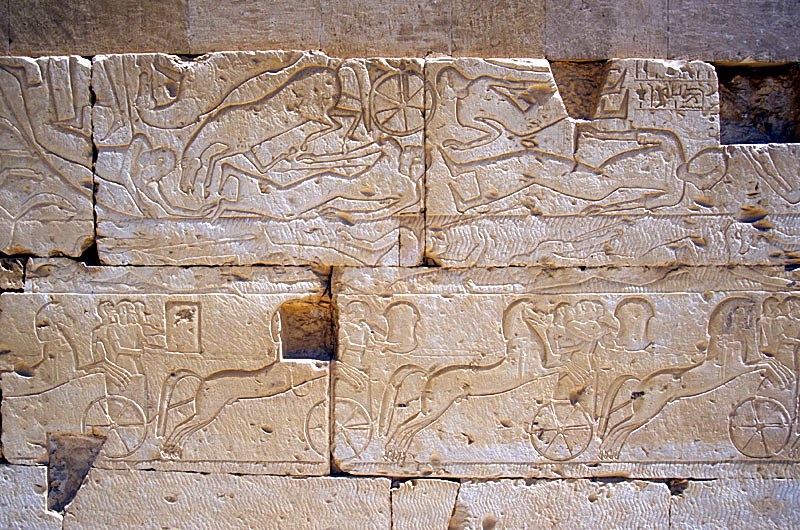 Kadesh scene on a relief of Ramesses II at Abydos: the Egyptian version of the battle was repeated in several temple complexes.
Related topics
- New Kingdom Egypt
- Army of Ancient Egypt
- Weapons of Ancient Egypt
- War chariots of Ancient Egypt
- Pharaohs of Ancient Egypt
Literature and sources
- Gardiner A. H. The Kadesh Inscriptions of Ramesses II.
- Kitchen K. A. Pharaoh Triumphant: The Life and Times of Ramesses II.
- Spalinger A. J. War in Ancient Egypt: The New Kingdom.
- Bryce T. The Kingdom of the Hittites.
- Goedicke H. The Battle of Kadesh: A Reassessment.
Interested in Ancient Rome beyond reading? Join Legio X Fretensis or explore our reenactment directions.


