Army of Ancient Egypt
The army of Ancient Egypt was not a single unchanging force, but a set of military institutions that changed with the state. Under the early kings it rested on royal retainers, local detachments and expeditionary groups. In the Old Kingdom seasonal levies, mining expeditions and southern garrisons mattered greatly. In the Middle Kingdom fortresses and permanent control over Nubia became more important, while in the New Kingdom the Egyptian army became the instrument of an external empire with infantry, archers, chariotry, fleet and mercenary units.
Egyptian warfare cannot be separated from the Nile, administration and pharaonic authority. A campaign required scribes, storehouses, boats, porters, water supply, reconnaissance and control of desert roads. Temple reliefs often present victory as the king's personal deed, but behind that ideological image stood the practical work of recruitment, training, logistics and command.
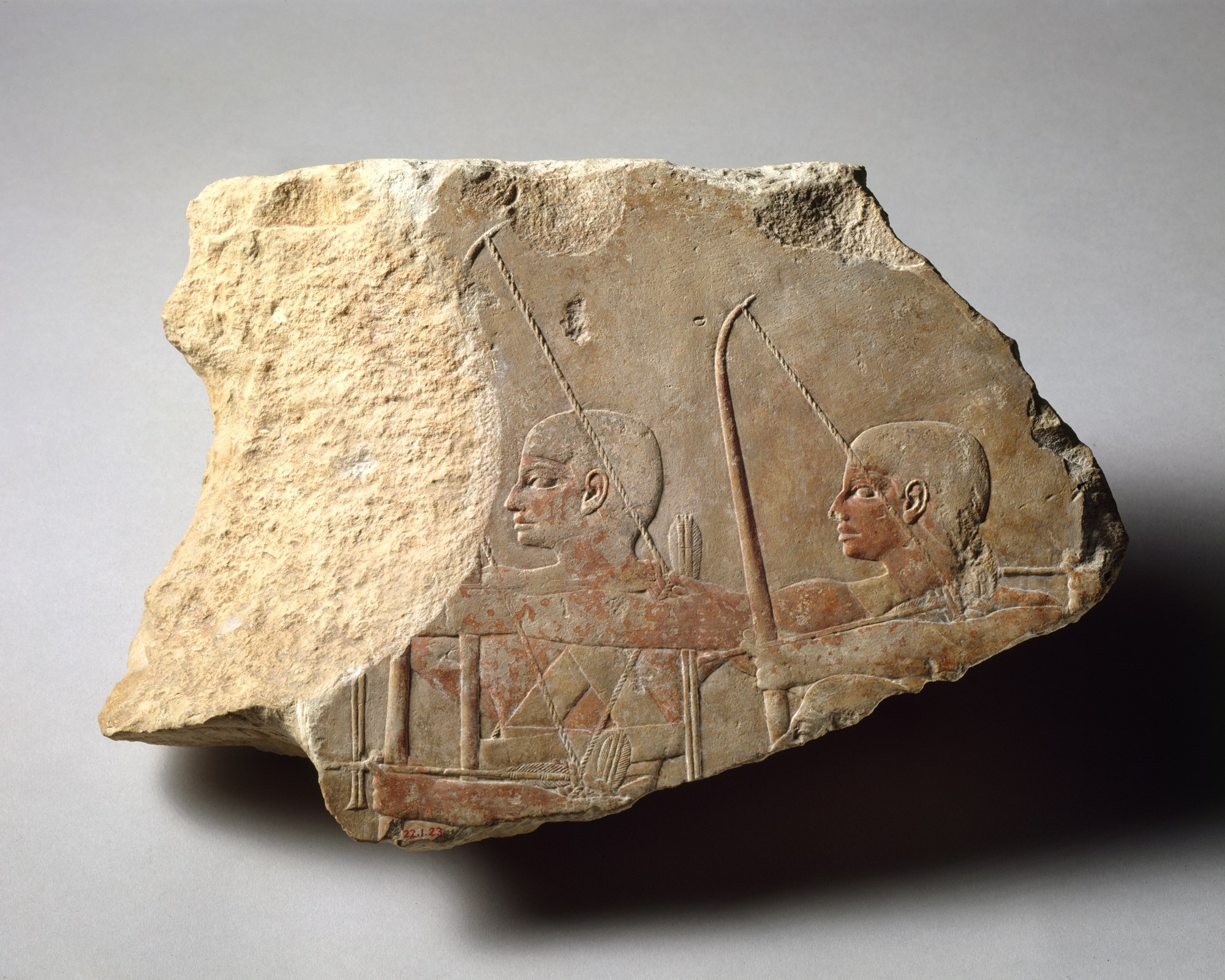 Relief with archers, probably reign of Khufu or Khafre, Dynasty 4, Old Kingdom. Metropolitan Museum of Art.
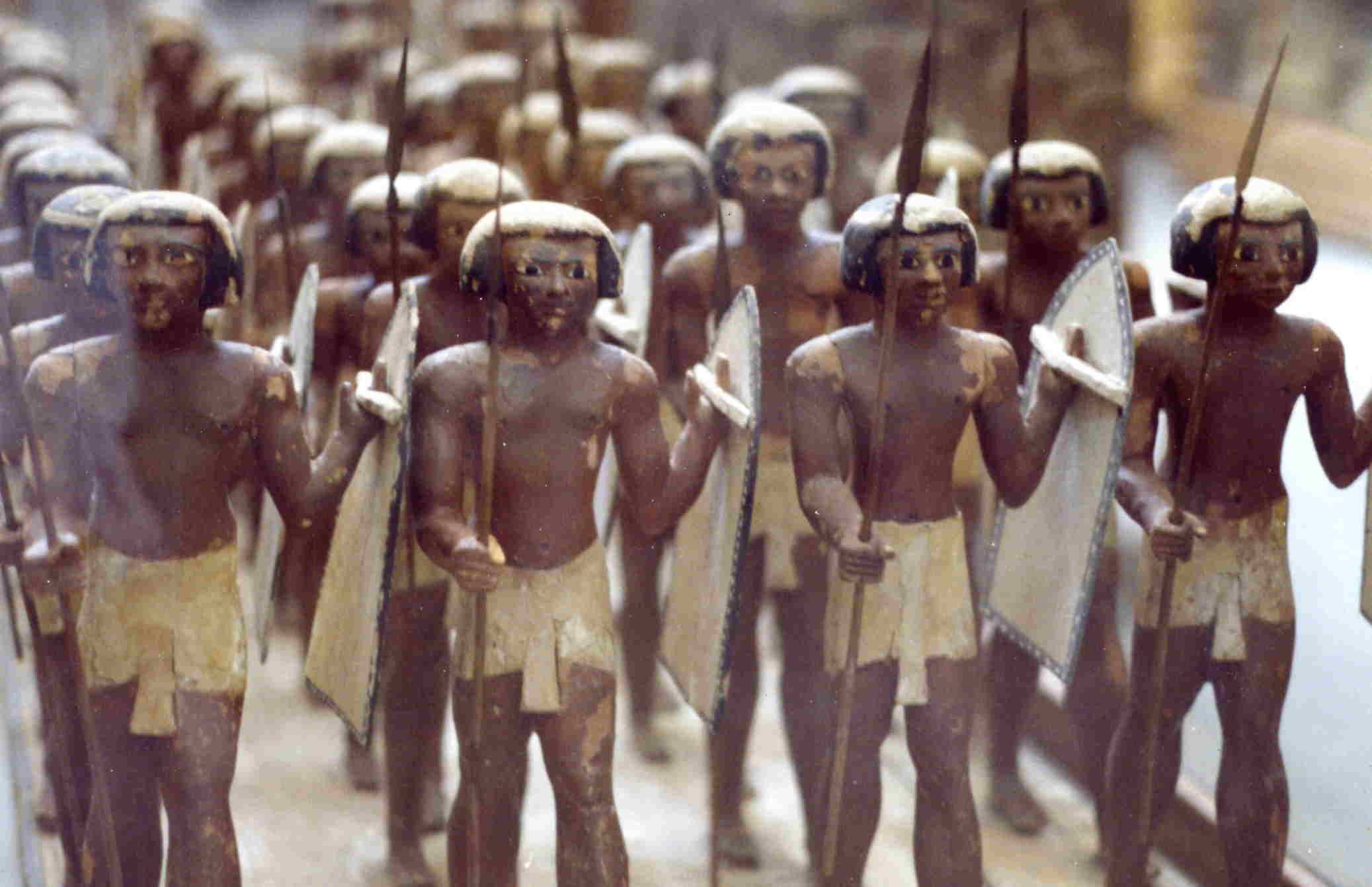 Wooden model of Egyptian spearmen from the tomb of Mesehti, Dynasty 11, Asyut.
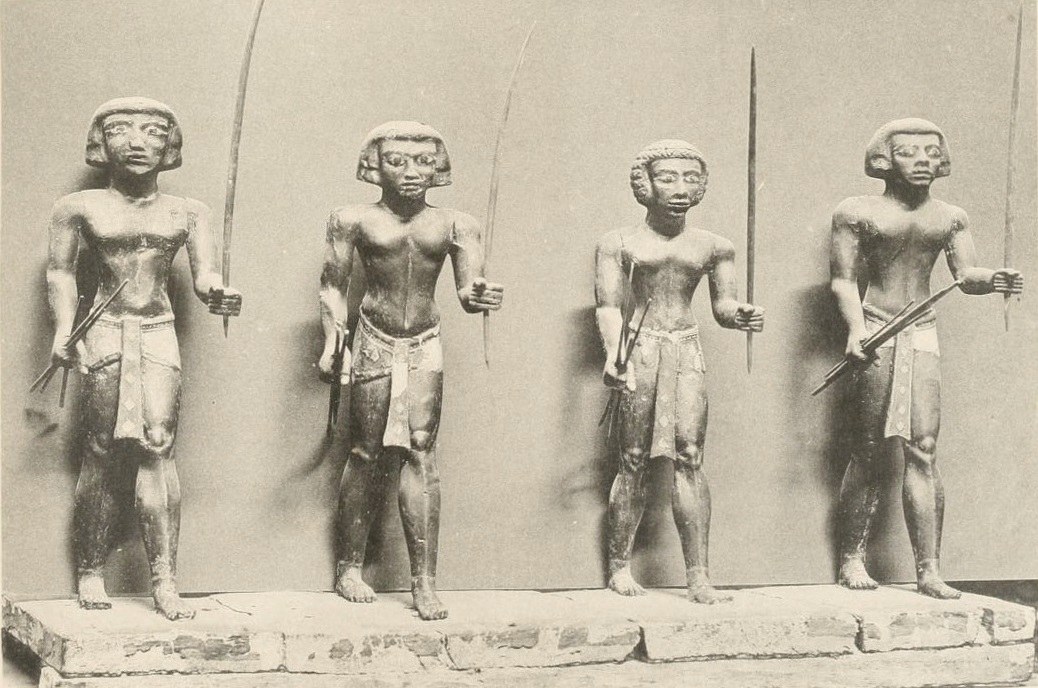 Model of Nubian archers from the tomb of Mesehti at Asyut, ca. 2000 BC. Illustration from Ludwig Borchardt's catalogue, Egyptian Museum Cairo CG 257 / JE 30969.
From Early Detachments to a Royal Army
Warfare appears already in Predynastic and Early Dynastic monuments: the king strikes the enemy, captives are shown bound, and state boundaries are expressed through violence and submission. These scenes are not simple reporting, but they show that military force was part of kingship from the beginning. In the Early Dynastic Period war strengthened the unification of Upper and Lower Egypt, control of desert routes and access to raw materials.
In the Old Kingdom Egypt campaigned for more than battle. Detachments accompanied expeditions to Sinai for turquoise and copper, to Wadi Hammamat for stone, and to Nubia for people, cattle, gold and southern goods. Troops could be assembled from local populations through nome officials, while permanent specialists - guards, archers, unit leaders and guides - formed the core around which an expeditionary force was built.
The visual evidence of this period more often shows individual archers, captives, royal guards and symbolic scenes of victory than a full battle. For early periods, therefore, reliefs must be read alongside administrative inscriptions, military titles, frontier settlements and traces of expeditions.
Middle Kingdom: Forts and Garrisons
The Middle Kingdom made the southern frontier one of the main military zones. Twelfth Dynasty kings advanced into Nubia, built fortresses near the Second Cataract and secured control over trade, gold and the movement of people. Buhen, Semna, Uronarti and other forts were not merely walls: they included storehouses, barracks, quays, administrative rooms and systems for watching the river.
Under Senwosret III Nubian policy became especially strict. Boundary stelae stressed the king's right to prevent unwanted groups from moving north and required constant vigilance from garrisons. Here the army acted as a frontier service: it guarded crossings, checked routes, escorted caravans and upheld Egyptian officials' authority.
Models of soldiers from tombs, especially the formations of spearmen and archers from Mesehti's burial at Asyut, show formation, shields, spears, bows and the collective character of the army. They are not photographs of a real battle, but they are valuable because they preserve types of soldiers and an idea of order inside a unit.
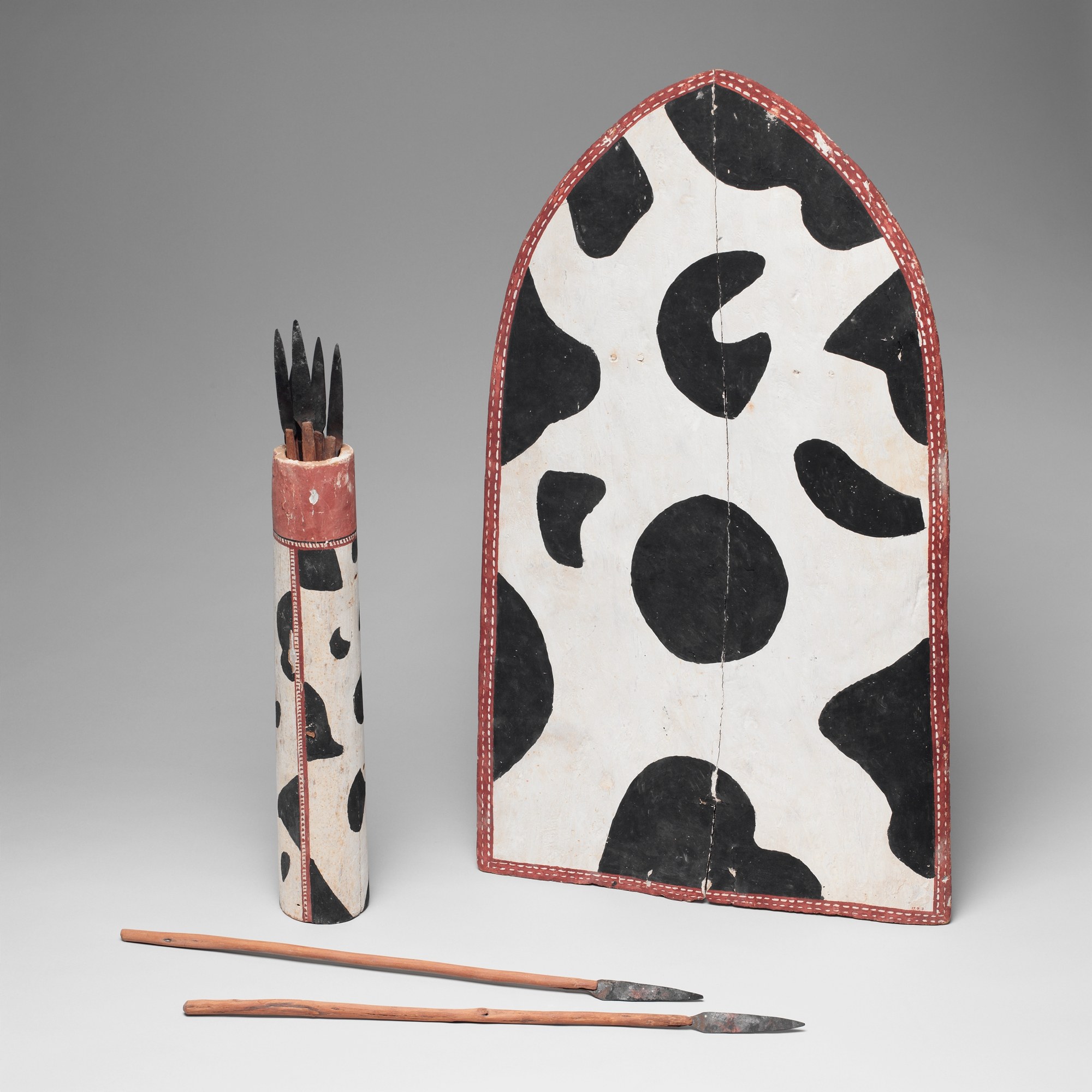 Model shield, spear case and spears, Dynasty 12, Middle Kingdom. Metropolitan Museum of Art.
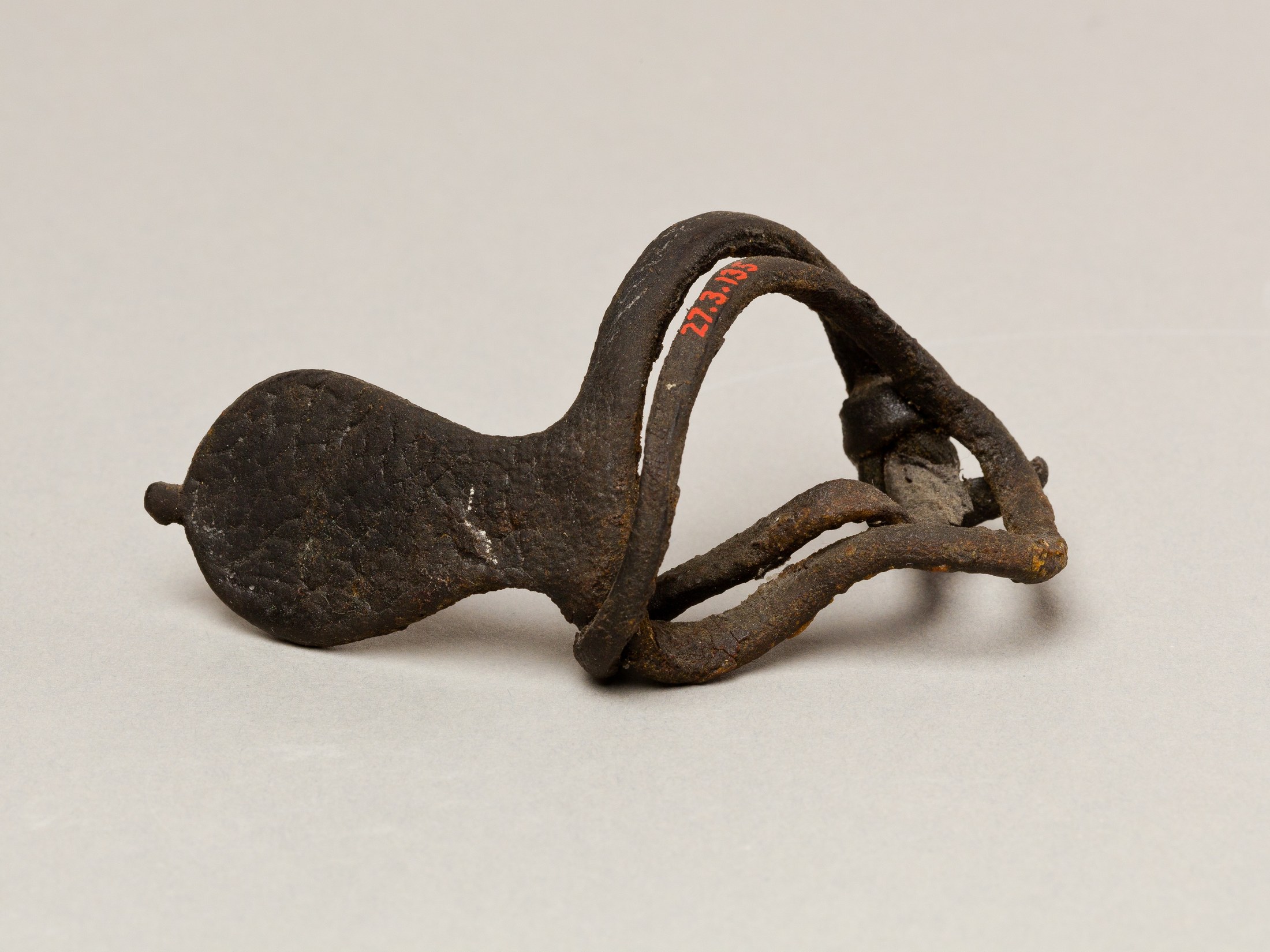 Leather archer's wrist guard, possibly reign of Senwosret I, Dynasty 12. Metropolitan Museum of Art.
 Wooden bow, Dynasty 11, Middle Kingdom. Metropolitan Museum of Art.
New Kingdom: Army of an Empire
The military system changed sharply after the Second Intermediate Period, when Egypt faced the Hyksos and western Asiatic military technologies. The horse, light chariot, composite bow and new forms of armour became part of the Egyptian military world. After the expulsion of the Hyksos, Eighteenth Dynasty kings carried the army beyond the Nile Valley and turned it into a permanent instrument of foreign policy.
At the beginning of the New Kingdom Ahmose I restored power in the north and began renewed expansion southwards. Thutmose III led a series of campaigns in Syria-Palestine; the battle of Megiddo showed the importance of reconnaissance, route choice, siege and control of booty. Hatshepsut is less often presented as a military ruler, but her temple programme shows armed men, processions and the state's ability to organise major expeditions.
Under Seti I and Ramesses II the army operated on the north-eastern frontiers against the Hittites and their allies. The Battle of Kadesh around 1274 BC became the most famous example of Egyptian military propaganda: texts and reliefs glorify the king, but they also show the danger of surprise attack, the importance of the camp, chariots and communication between army corps. Later Ramesses III used army and fleet against Libyans and groups known as the Sea Peoples; the reliefs at Medinet Habu preserve one of the most detailed visual narratives of late New Kingdom war.
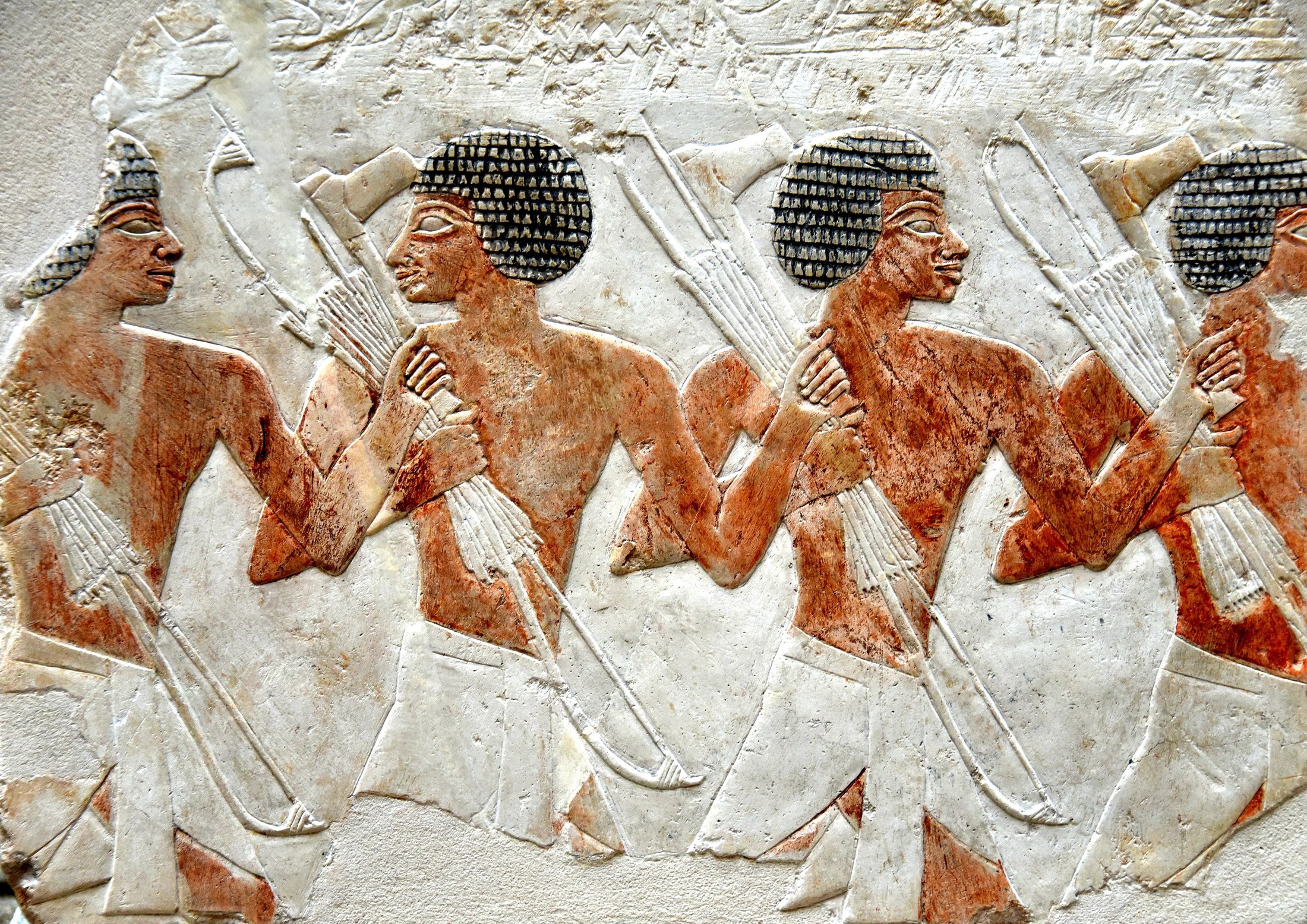 Egyptian soldiers with bows, quivers and axes on a relief from Hatshepsut's mortuary temple at Deir el-Bahri. Dynasty 18, ca. 1470 BC; Neues Museum, Berlin.
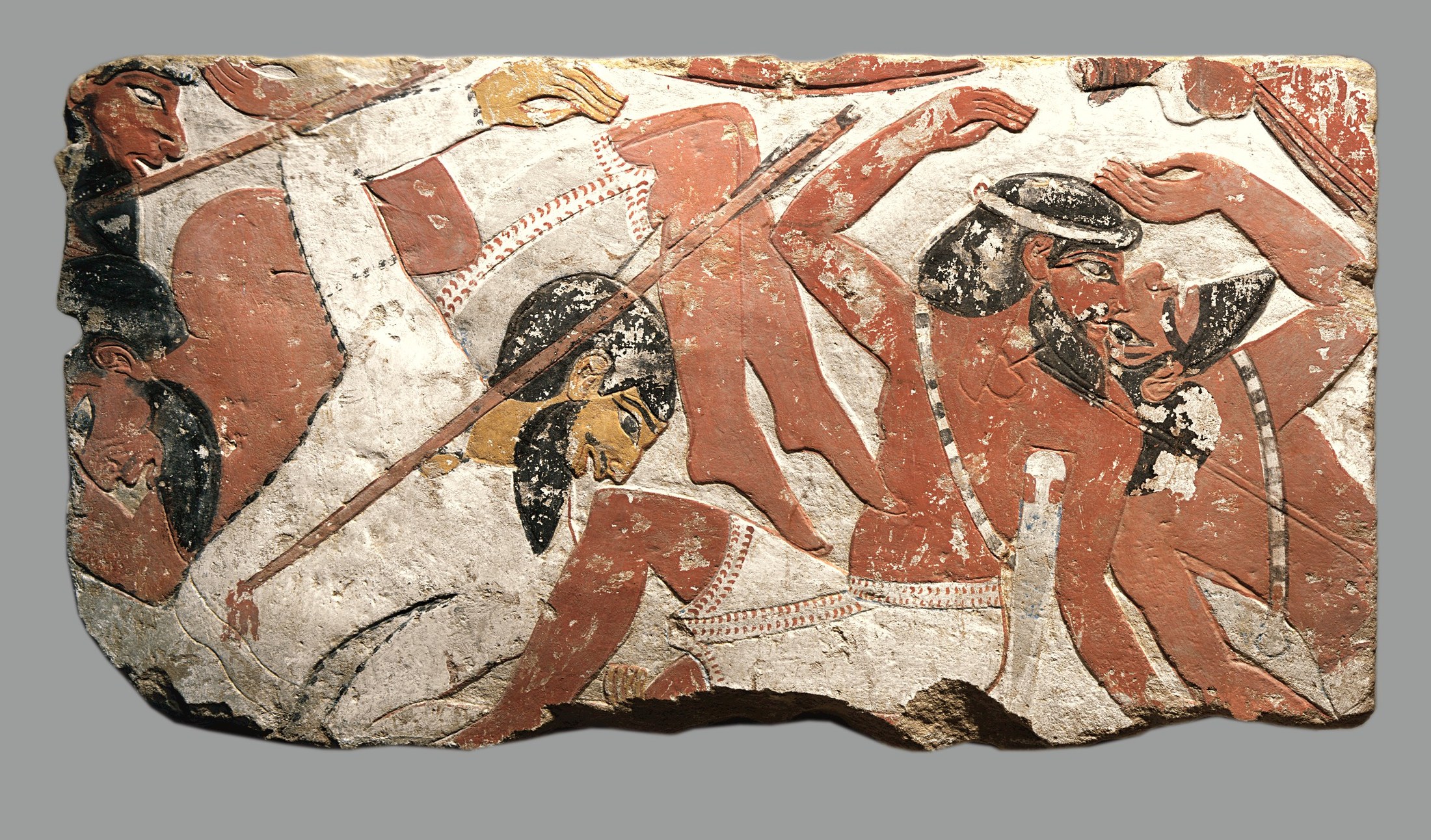 Relief block with a battle scene, probably reign of Amenhotep II, Dynasty 18. Metropolitan Museum of Art.
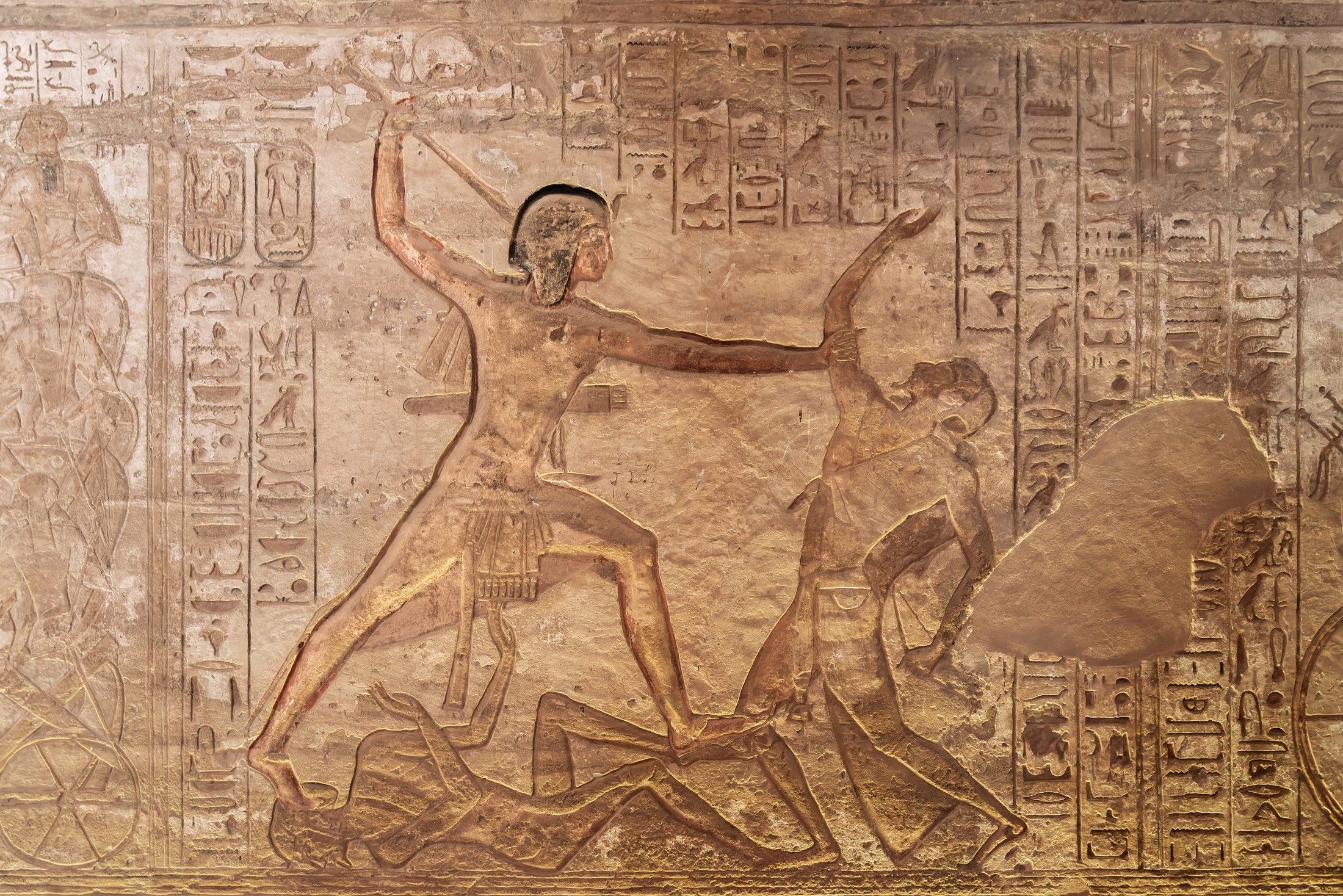 Relief at Abu Simbel showing Ramesses II in a battle scene connected with Kadesh.
Infantry, Archers and Chariots
Infantry formed the base of the army. Spearmen held formations, used shields and could defend a camp, pass or flank. Archers struck the enemy before close contact, supported sieges and were especially important in open ground. Heavy armour was usually less common in the Egyptian army than one might expect from later armies: the hot climate, speed of march and cost of equipment made light protection normal for most soldiers.
The chariot complex of the New Kingdom required separate training. A crew usually included a driver and a warrior-archer; around them worked arms-bearers, grooms, repairers and infantry support. War chariots of Ancient Egypt gave speed, visibility and prestige, but they did not replace infantry. In broken terrain, during sieges or in narrow passes, infantry detachments, engineering work and supply mattered more.
Military musicians, standards, scribes and commanders made the army manageable. Trumpets, drums and signals helped maintain order; scribes counted the issue of bread, beer, weapons and booty; officers commanded units which in the New Kingdom could be named after gods or royal residences.
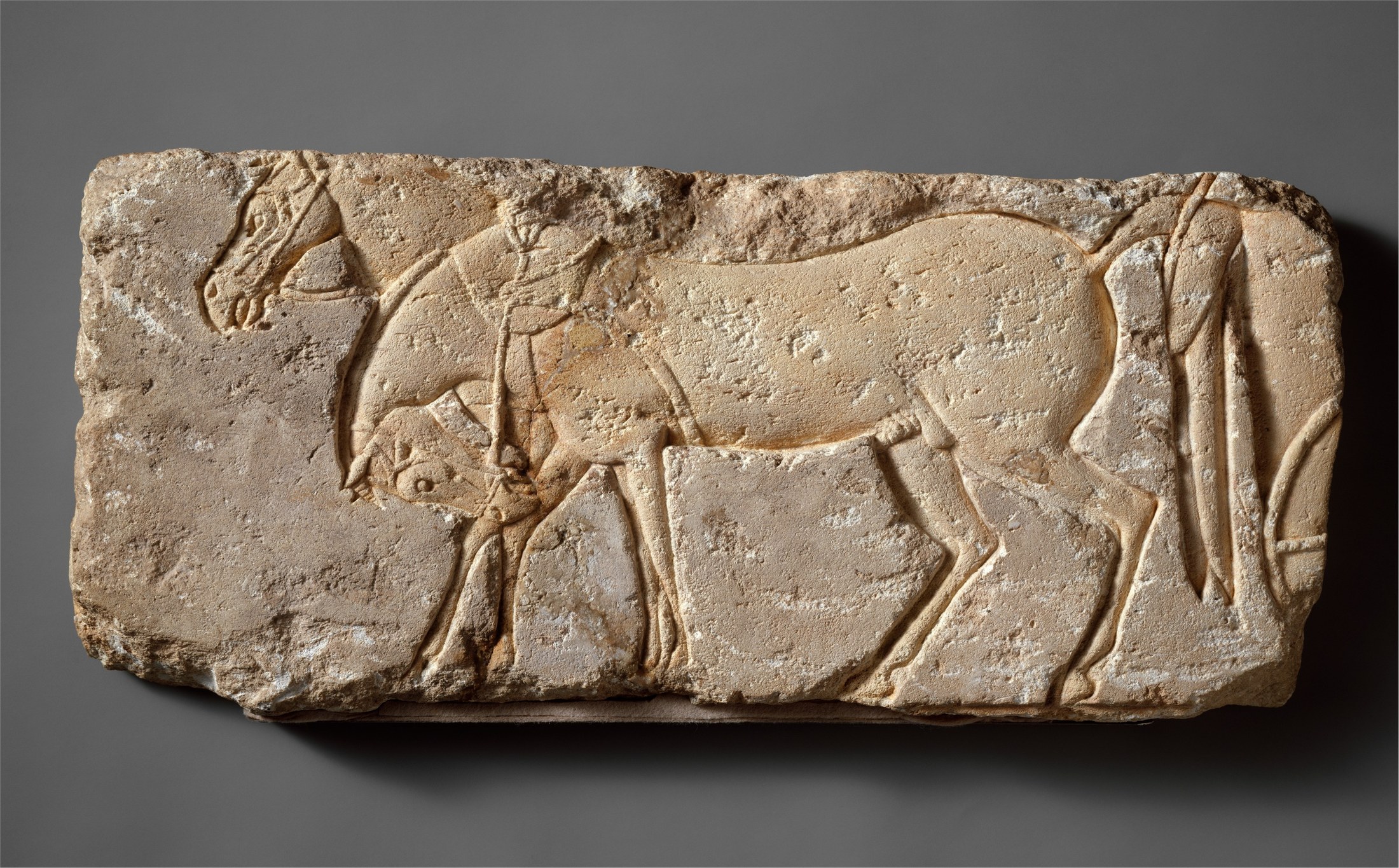 Horses harnessed to a chariot, Amarna-period relief from the reign of Akhenaten. Metropolitan Museum of Art.
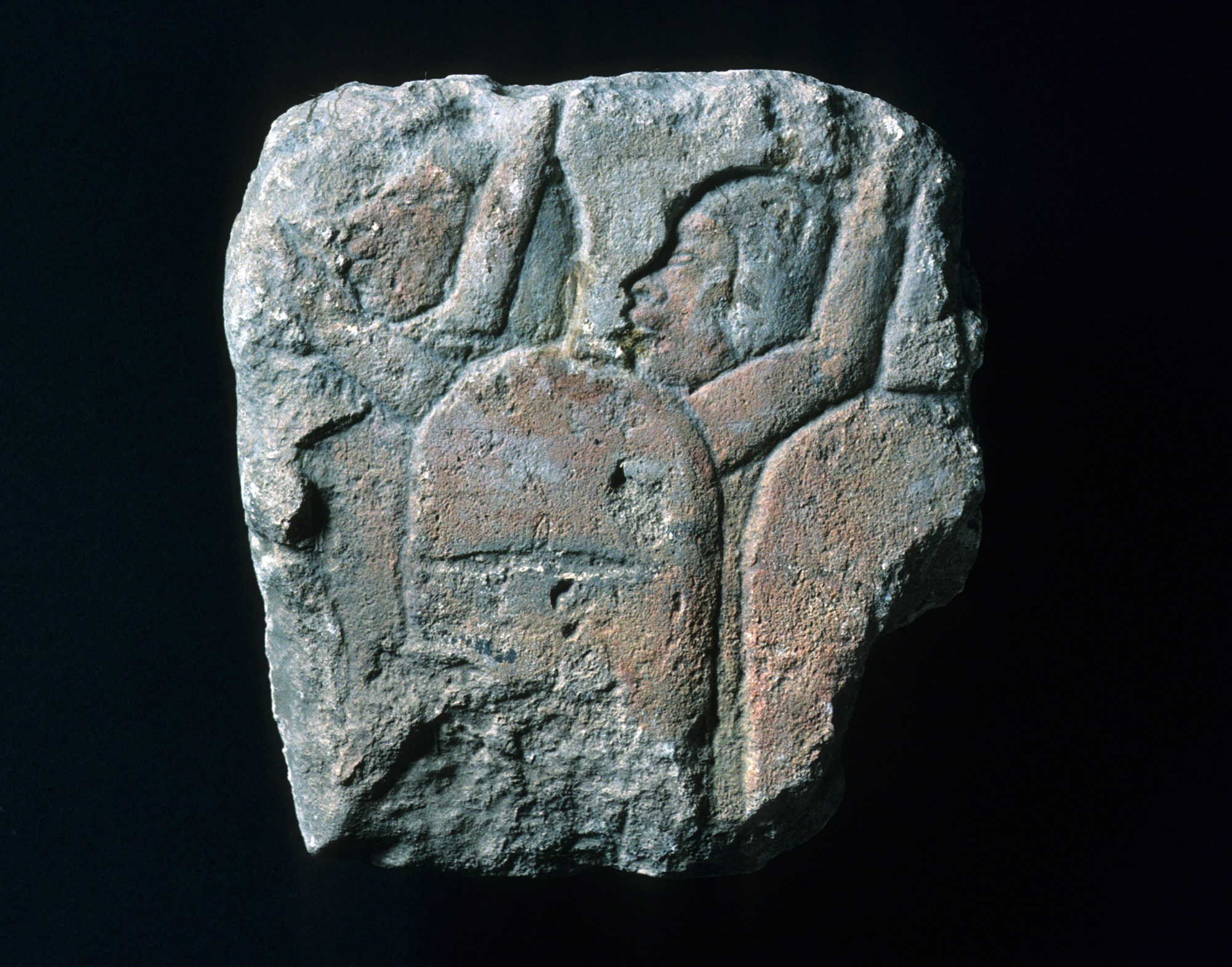 Amarna relief fragment with Nubian soldiers, Dynasty 18. Metropolitan Museum of Art.
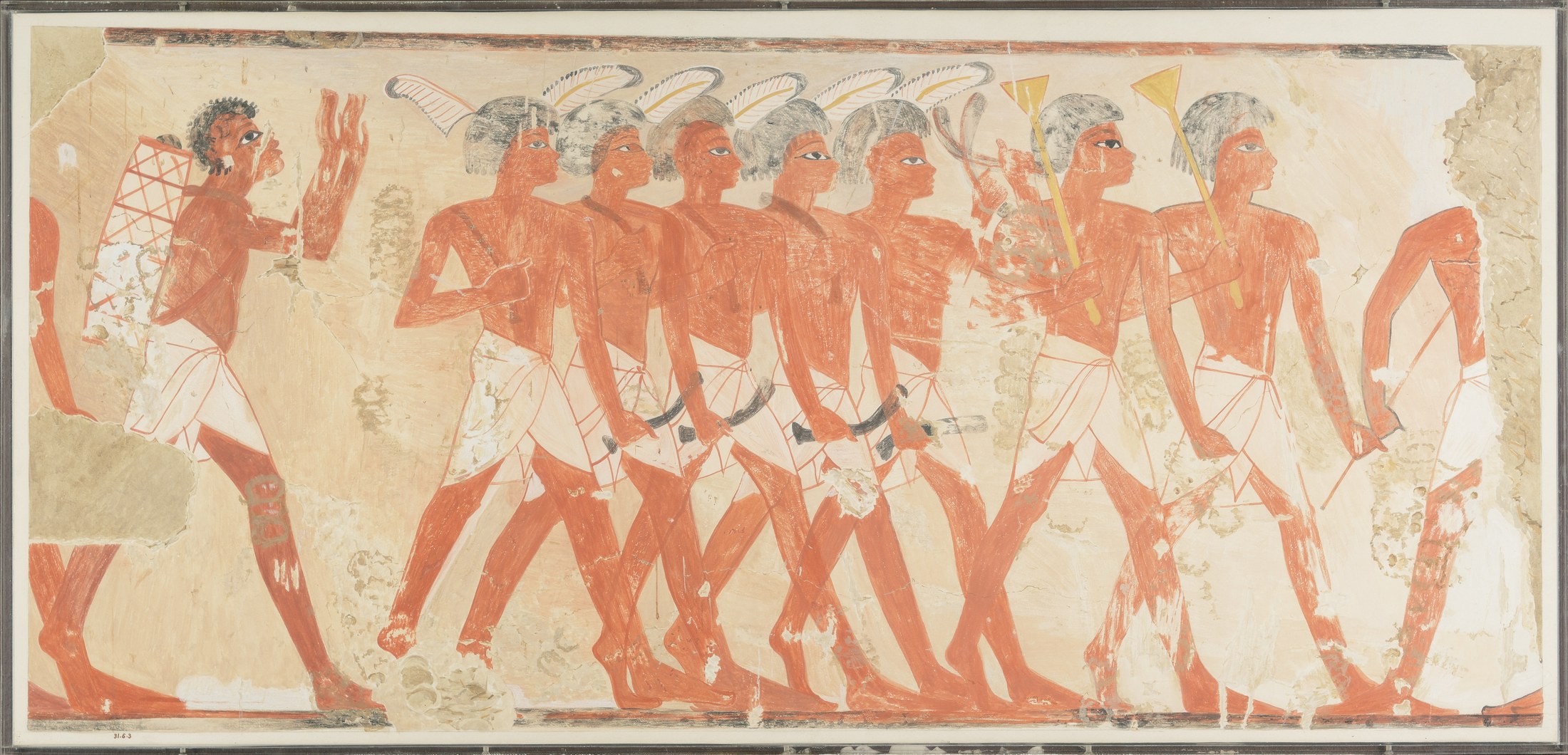 Military musicians in Nubian and Egyptian styles on a facsimile of a tomb scene from the reign of Thutmose IV. Metropolitan Museum of Art.
Recruitment, Service and Foreign Units
Recruitment depended on period and task. Inside Egypt, the state could mobilise men through local administrations and temple or royal estates. Some soldiers served seasonally, while others became professionals, especially in garrisons, chariot units and guard service. Military service offered pay in kind, a share of booty, social prestige and sometimes land or office.
Egypt made active use of foreign units. Nubian archers were valued as bowmen; Medjay could serve as scouts, police and guards in desert regions; Libyans, Sherden and other groups entered the army as mercenaries, captives or settlers. In later periods Greek and Carian mercenaries became more important, and in Hellenistic Egypt the army included Macedonian-Greek forms of organisation alongside local contingents.
Foreign soldiers were not merely a background auxiliary. They changed equipment, appearance and tactics, and sometimes became independent political actors. Reliefs with Nubians, Libyans, Syrians and Sherden are therefore as important for understanding the Egyptian army as images of Egyptian spearmen themselves.
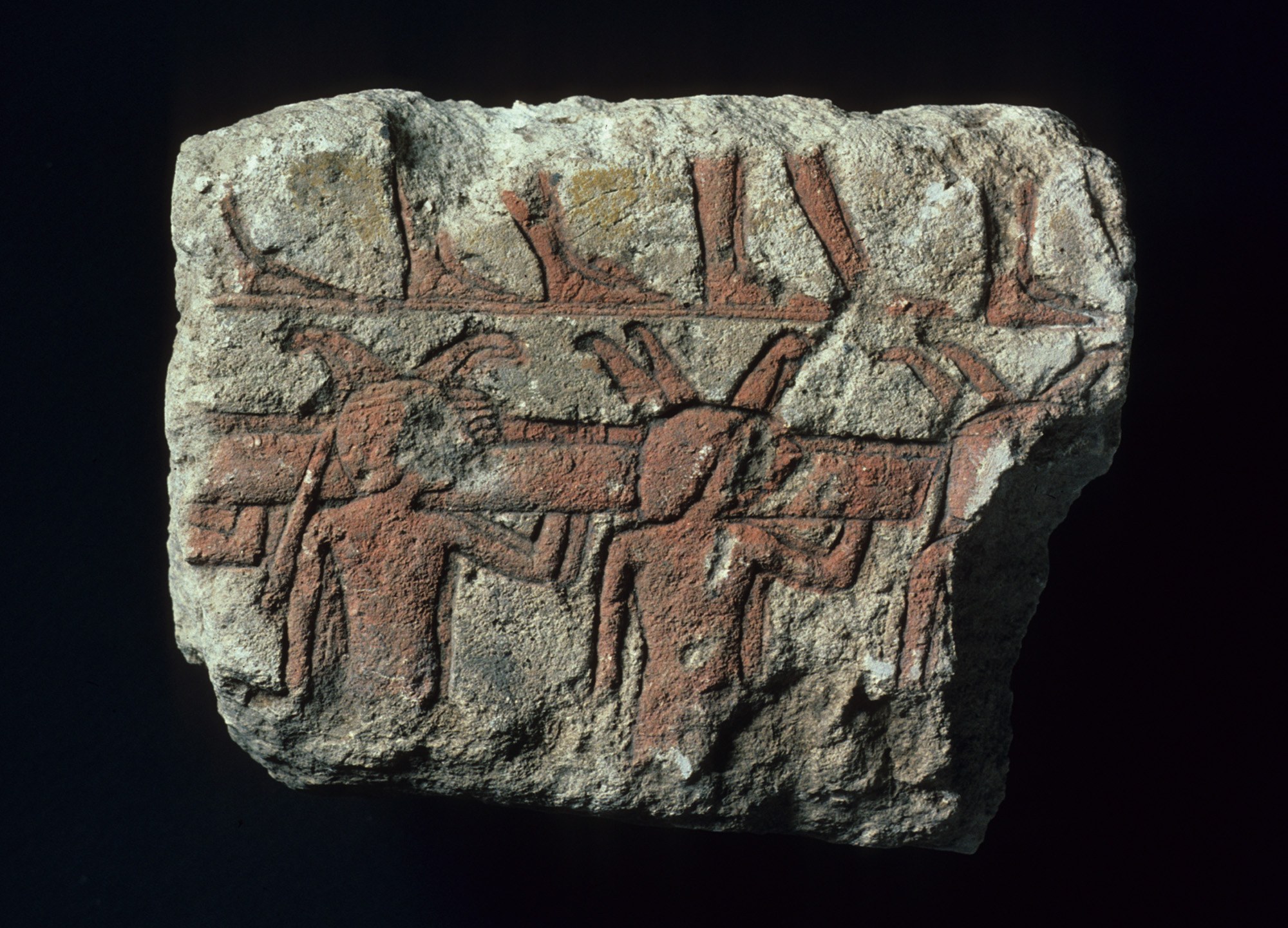 Amarna relief with foreign soldiers, Dynasty 18. Metropolitan Museum of Art.
Forts, Camp and Logistics
Egyptian campaigns were organised around the river. The Nile made it possible to move grain, weapons, men and building materials faster and more reliably than overland caravans. In the north the Delta canals and route to Sinai were crucial; in the south, cataracts, forts and quays mattered. When marching into Syria-Palestine, the army depended on the roads through northern Sinai, water, allied towns and fortified points.
The camp was a military system of its own. It had to be set up, defended, supplied and linked with reconnaissance. In the Kadesh scenes the Egyptian camp becomes part of a narrative of royal rescue, but behind the literary drama are real questions: how to distribute army corps, how to learn the enemy's movement, and how to avoid a gap between the advance force and the main army.
Sieges and assaults required ladders, rams, shields, carpenters and control of approaches. Egyptians did not always seek to destroy a town; often it was more important to secure submission, hostages, tribute, food and recognition of pharaonic authority. War therefore combined battle, diplomacy, display of force and calculation of economic result.
Monuments and Images of the Army
Images of Egyptian soldiers must be read by genre. Funerary models, such as Mesehti's detachments, show formation and equipment type, but they were made for a tomb and reflect an idea of order. Temple reliefs with the king in a chariot present official victory ideology: the pharaoh is larger than everyone else, enemies are compressed into disorder, and the outcome is already subordinated to royal superiority.
Even so, such images remain indispensable. They show shields with rounded tops, short kilts, quivers, battle axes, composite bows, chariot harness, musical signals and distinctions between Egyptian and foreign units. When a relief is read together with date, place and text, it helps separate practical warfare from ceremonial formula.
The reliefs of Medinet Habu are especially important for the late New Kingdom. They show not only the victory of Ramesses III, but also ships, infantry, chariots, captives and individual markers of opponents. Line drawings help to read crowded scenes, but they do not replace photographs of the monument: the line of a copy is already an interpretation.
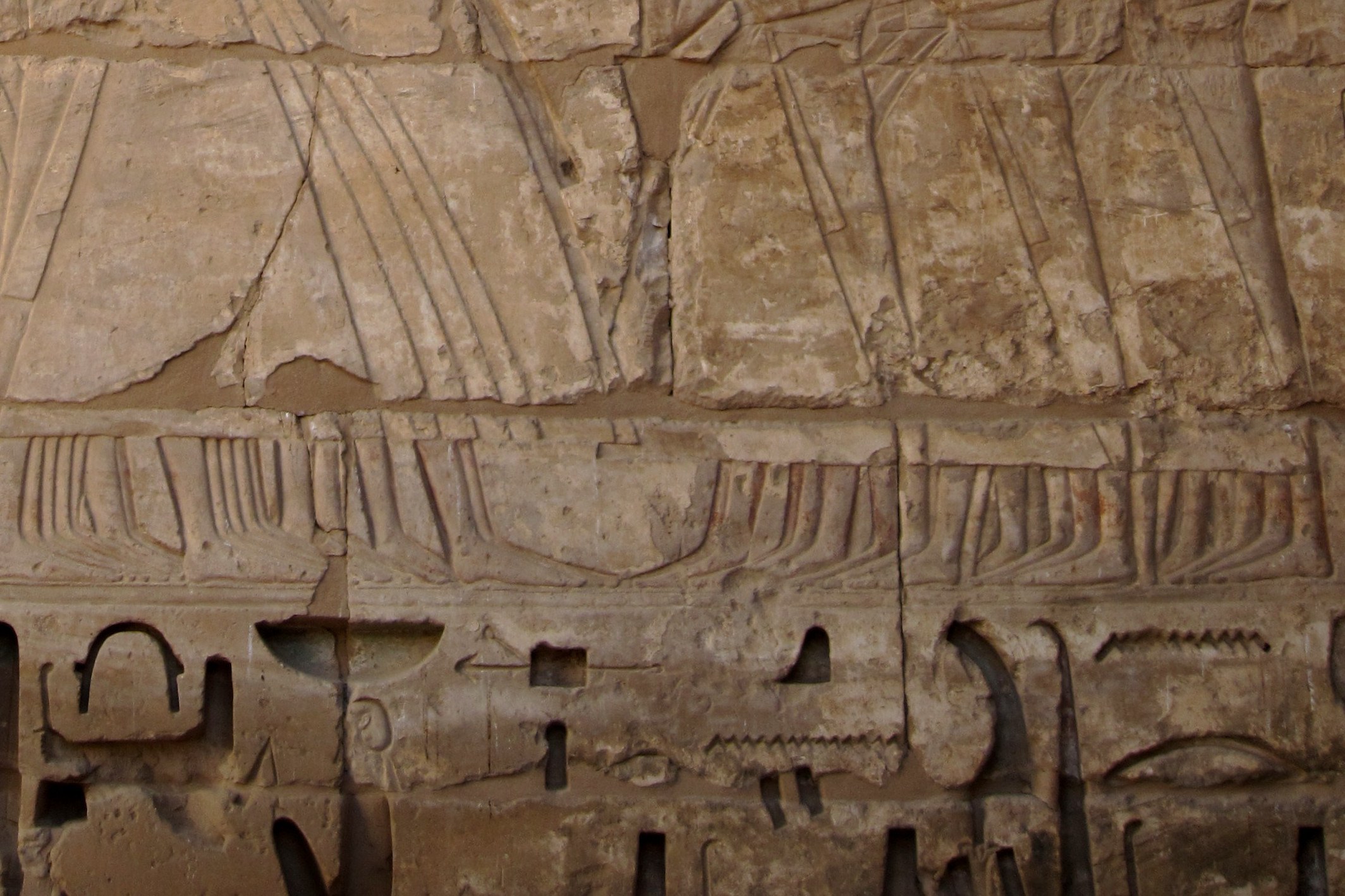 Battle relief of Ramesses III at Medinet Habu: the temple programme presents royal victory and enemy formations.
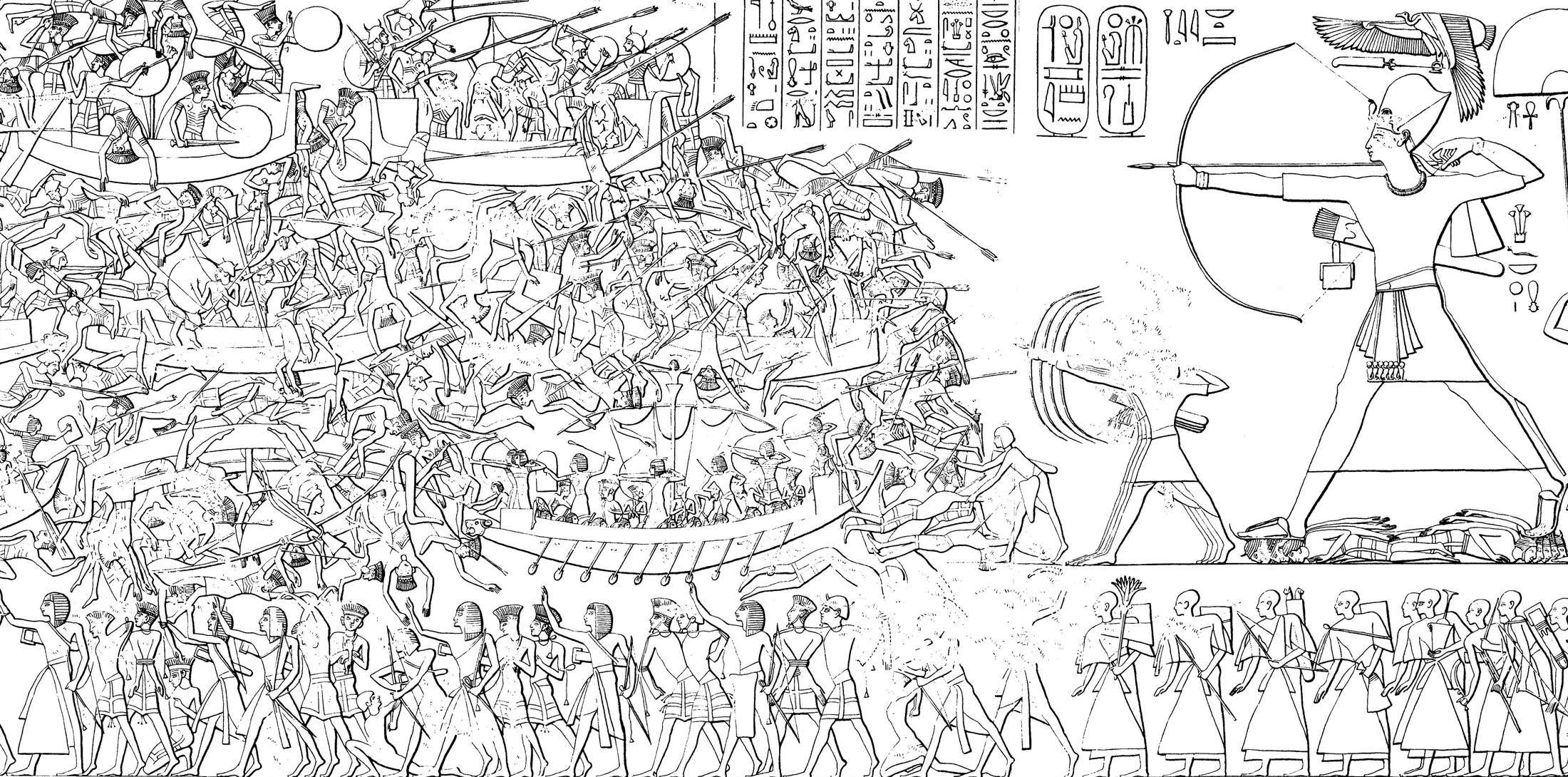 Line drawing of the Sea Peoples battle relief at Medinet Habu. Such copies help to read crowded scenes but must be compared with the monument itself.
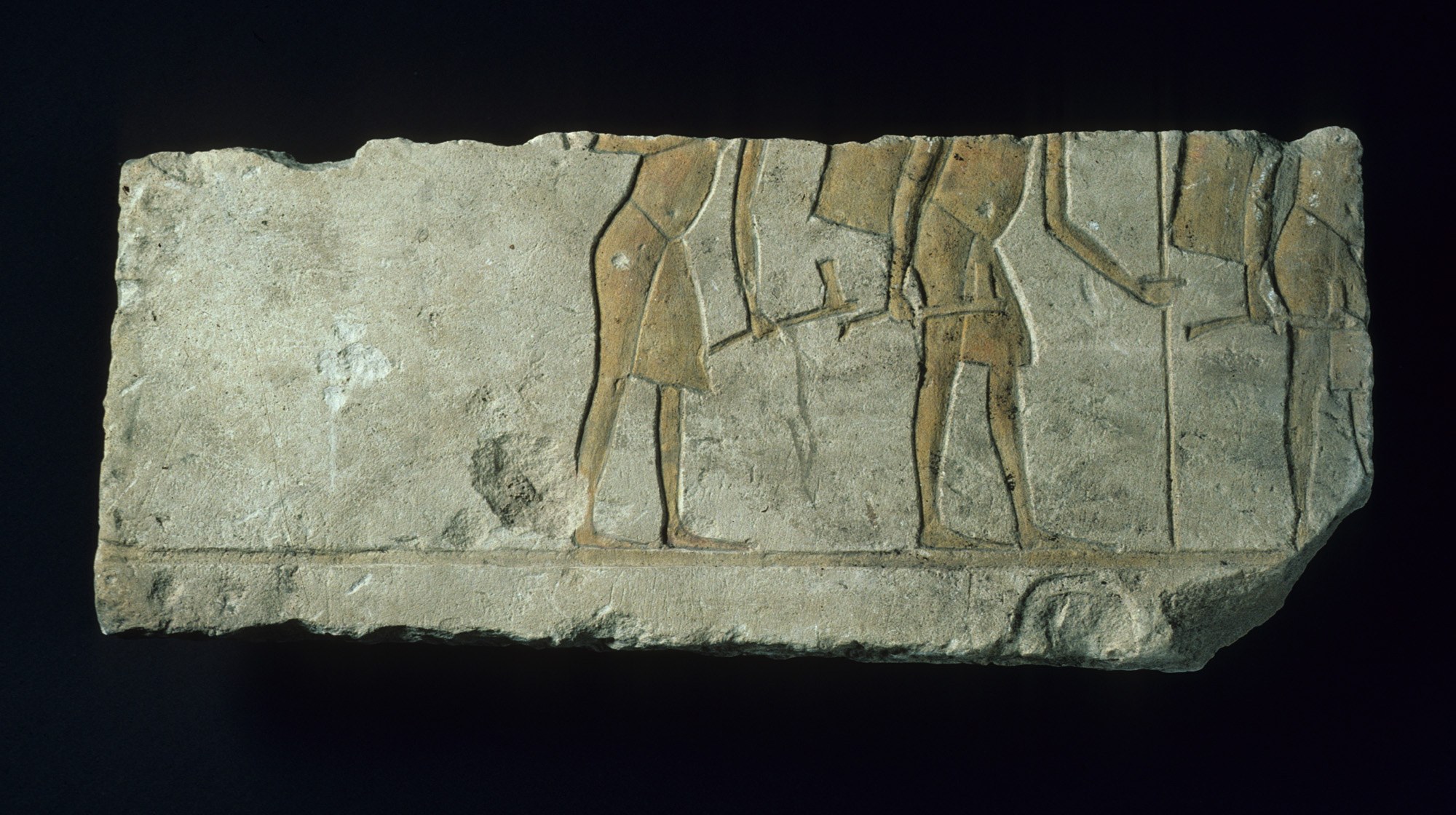 Amarna relief with three soldiers, Dynasty 18. Metropolitan Museum of Art.
Chronology
- Late fourth millennium BC
- early royal images of victory and the subjection of enemies.
- Third millennium BC
- Old Kingdom expeditions to Sinai, Nubia and desert regions; development of expeditionary detachments.
- Ca. 2000-1800 BC
- strengthening of the Middle Kingdom army, Nubian fortresses and models of soldiers from tombs.
- Ca. 1650-1550 BC
- Second Intermediate Period, conflict with the Hyksos and military reorganisation.
- Sixteenth-fifteenth centuries BC
- formation of the New Kingdom empire, campaigns of Ahmose I and Thutmose III.
- Ca. 1274 BC
- Battle of Kadesh, the largest Egyptian complex of war texts and reliefs.
- Twelfth century BC
- wars of Ramesses III against Libyans and Sea Peoples, reliefs of Medinet Habu.
- First millennium BC
- increasing role of Libyan, Nubian, Greek and Carian military contingents.
Related topics
- Warriors of Ancient Egypt
- Weapons of Ancient Egypt
- War chariots of Ancient Egypt
- Battle of Kadesh
- New Kingdom Egypt
- Ancient Egypt
Literature and sources
- Avdiev V. I. Military History of Ancient Egypt.
- Spalinger A. J. War in Ancient Egypt: The New Kingdom.
- Shaw I. Egyptian Warfare and Weapons.
- Schulman A. R. Military Rank, Title and Organization in the Egyptian New Kingdom.
- Faulkner R. O. Egyptian Military Organization.
Interested in Ancient Rome beyond reading? Join Legio X Fretensis or explore our reenactment directions.


