History of Ancient Egypt
The history of Ancient Egypt is the history of a state that grew from Nile Valley settlements and preserved durable forms of kingship, religion and economy for millennia. Egypt was not a static civilization: it experienced unification, fragmentation, foreign conquest, religious reforms and integration into larger empires.
Egyptian history is usually divided into kingdoms and intermediate periods. Kingdoms mark ages of strong centralized power, while intermediate periods mark weakened central authority, regional rivalry or foreign domination.
From unification to the Old Kingdom
At the end of the fourth millennium BC major centres of Upper and Lower Egypt grew in power. Early kings gradually created the symbolism of a dual country: two crowns, two lands and one royal authority. Narmer and the early dynasties are connected with this process.
In the Old Kingdom the state reached a high degree of centralization. Memphis became the political centre, and pharaonic power was expressed through pyramids and large funerary complexes. The age of Djoser, Sneferu, Khufu and Khafre made monumental architecture a central language of royal ideology.
Middle and New Kingdoms
After the crisis of the First Intermediate Period Egypt was reunited by rulers from Thebes. The Middle Kingdom strengthened administration, developed irrigation, advanced into Nubia and left a notable literary tradition.
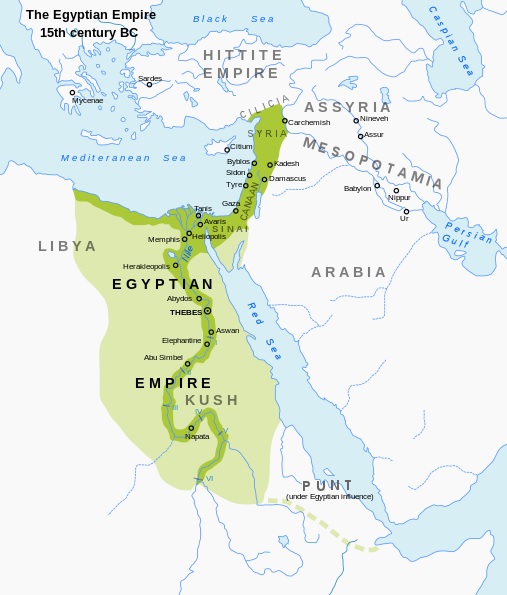
The Second Intermediate Period is connected with Hyksos rule in the Delta and the rise of Thebes in the south. The struggle against the Hyksos led to the New Kingdom, the age of Egypt's greatest external expansion. Pharaohs campaigned in Nubia, Syria and Palestine, built temples at Karnak and Luxor, and the army gained chariots and new forms of organization.
Late, Hellenistic and Roman Egypt
After the New Kingdom Egypt again experienced fragmentation and the power of regional forces. In the Late Period it faced Kushites, Assyrians and Persians, while preserving its own cultural forms.
In 332 BC Alexander the Great occupied Egypt. After his death the Ptolemaic dynasty established itself there and made Alexandria one of the centres of the Hellenistic world. In 30 BC, after the defeat of Cleopatra VII and Mark Antony, Egypt became a Roman province.
Additional sources and visual checks
Egyptian history should be checked through king lists, archaeological phases and external evidence, not only through a linear dynastic scheme. The article now stresses that political history, temple complexes and material culture did not always change at the same pace.
For source checks: - UCLA Encyclopedia of Egyptology - UCL Digital Egypt - Institut francais d'archeologie orientale
Related topics
- Ancient Egypt
- Periods of Ancient Egypt
- Pharaohs of Ancient Egypt
- Army of Ancient Egypt
- Hellenistic Egypt
Literature
- Shaw I. The Oxford History of Ancient Egypt.
- Wilkinson T. The Rise and Fall of Ancient Egypt.
- Trigger B. G. et al. Ancient Egypt: A Social History.
- Avdiev V. I. History of the Ancient East.
Interested in Ancient Rome beyond reading? Join Legio X Fretensis or explore our reenactment directions. Reenactment


